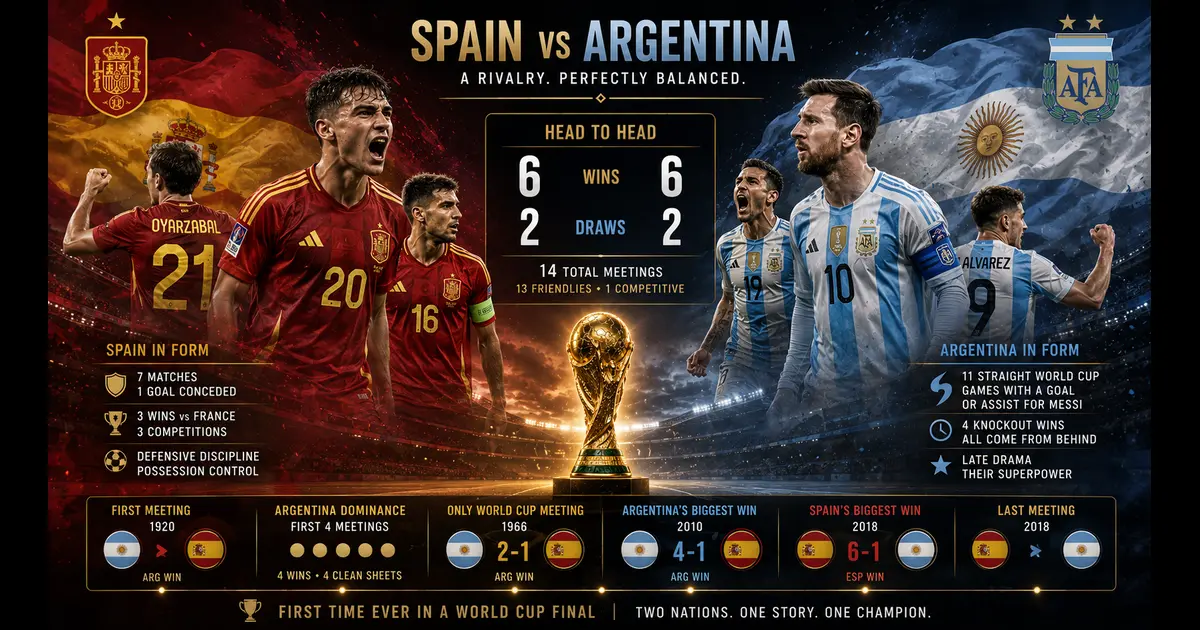
 Football rarely hands you a rivalry this perfectly balanced heading into its single biggest possible stage. Spain and Argentina have played each other 14 times across their shared history, and the ledger reads exactly even: six wins for Spain, six for Argentina, two draws, nothing separating them. On Sunday at MetLife Stadium, that dead heat finally gets broken, in the one setting neither side has any real precedent for. This is the complete Spain vs Argentina head to head record, and why history offers almost no clues about what happens next.
Fourteen Meetings, Almost No Knockout Football
The first thing worth understanding about this rivalry is what kind of matches have actually made it up. Thirteen of the fourteen previous meetings between Spain and Argentina have been friendlies, including several played in the old Copa Hispanidad exhibition tournament during the 1970s, a competition designed explicitly to celebrate the shared Spanish-speaking football culture between the two nations rather than to settle anything competitive. Only one prior meeting has carried genuine tournament stakes, and it happened a very long time ago.
That solitary competitive clash came at the 1966 World Cup in England, where Argentina beat Spain 2-1 in the group stage. Luis Artime scored twice for Argentina that day, with Spain’s Pirri grabbing a brief equalizer in between. The result meant little for either side’s tournament in the end; Spain were eliminated at the group stage, while Argentina went on to lose their own quarterfinal to hosts England, a defeat still remembered in Argentina for the controversial sending-off of captain Antonio Rattín. Neither Lionel Scaloni nor Luis de la Fuente had been born when that match was played. De la Fuente wouldn’t arrive for another five years. That’s how long ago Spain and Argentina last shared a World Cup pitch.
Early Argentine Dominance, Then a Long Wait
Look at the earliest meetings between these two nations and a clear pattern emerges: Argentina started this rivalry in complete control. The South Americans won each of their first four encounters with Spain, and remarkably, kept a clean sheet in every one of those wins. Spain didn’t manage their first victory over Argentina until 1961, a full breakthrough that took years to arrive after repeated early frustration.
That early Argentine dominance didn’t last forever, and the rivalry has swung back and forth in the decades since, producing exactly the kind of even record the two nations carry into Sunday’s final. What’s notable is how the swing has favored Spain more recently. In the 21st century specifically, Spain hold the clear edge, winning three of the last four meetings between the sides, a stretch that includes the most lopsided result either nation has ever produced against the other.
The Biggest Wins on Both Sides
Spain’s most emphatic victory in this fixture’s history came in March 2018, a startling 6-1 demolition of Argentina headlined by an Isco hat-trick. That result arrived during a turbulent period for Argentine football, sandwiched between World Cup cycles and coaching uncertainty, and it remains the largest winning margin either side has produced in this head-to-head across all 14 meetings. It’s also, notably, the most recent time these two nations have played each other at all; Sunday’s final will be their first meeting in over eight years.
Argentina’s own high-water mark came in 2010, when they beat Spain 4-1, a result that arrived just months before Spain went on to win their first-ever World Cup title later that same year. The scoreline stands as a reminder that even in a rivalry defined by even numbers, individual results have swung dramatically in both directions depending on where each nation happened to be in their respective cycles at the time.
What Both Sides Bring Into Sunday
Beyond the historical ledger, both nations arrive at this final in genuinely strong form, which only adds to the sense that Sunday’s result is close to a true coin flip. Spain have been the tournament’s most defensively watertight side, conceding just once across seven matches heading into the final, a run built on Luis de la Fuente’s patient, possession-heavy system and anchored by Rodri’s control at the base of midfield. Their semifinal win over France, a 2-0 victory built on a Mikel Oyarzabal penalty and a Pedro Porro finish, extended a streak that now sees them unbeaten in their last three meetings with France across three consecutive summers, in three different competitions.
Argentina, by contrast, have won ugly rather than won pretty for most of this tournament’s knockout stage, surviving extra-time scares against Cape Verde and Switzerland before producing another dramatic late turnaround against England in the semifinal, Enzo Fernández and Lautaro Martínez scoring in the 85th and 92nd minutes respectively after Anthony Gordon had given England the lead. Lionel Messi, at 39, didn’t score in that semifinal but set up both goals, extending a run in which he’s now scored or assisted in eleven straight World Cup matches, the longest such streak on record dating back to 1966, the exact same year Argentina and Spain last met at this tournament.
Yamal and Messi: A Head-to-Head Within the Head-to-Head
No storyline captures the stakes of this fixture quite like the individual matchup between Messi, playing in what’s widely assumed to be his final World Cup at 39, and Lamine Yamal, Spain’s 19-year-old prodigy who wasn’t even alive for that 2018 6-1 thrashing. The two attacking talismans have never faced each other in a competitive match before, and Sunday will be the first time either gets to test himself directly against the other with the World Cup itself on the line. It’s a genuinely rare kind of generational handoff moment, playing out inside a fixture that, incredibly, these two footballing nations have almost no recent history to draw on. [link to: Messi vs Yamal]
Why History Won’t Help You Predict This One
If you’re looking to the head-to-head record for a clue about Sunday’s outcome, the honest answer is that it won’t give you much. A series dominated by friendlies and exhibition matches, split dead even at 6-6-2, capped by a single World Cup meeting six decades old that neither current manager was alive to see, simply doesn’t carry predictive weight for a final of this magnitude. What both nations bring into Sunday, Spain’s defensive control and Argentina’s knack for finding a way through adversity, will matter far more than anything the record books can tell you. For the first time ever, the reigning European champions and the reigning Copa América holders will meet in a World Cup final, and whichever way it breaks, this rivalry’s next chapter will finally have real stakes attached to it.
🔹🔹 follow us on facebook 🔹🔹
About the Author