How Spain Stopped Lionel Messi and Won the FIFA World Cup Final
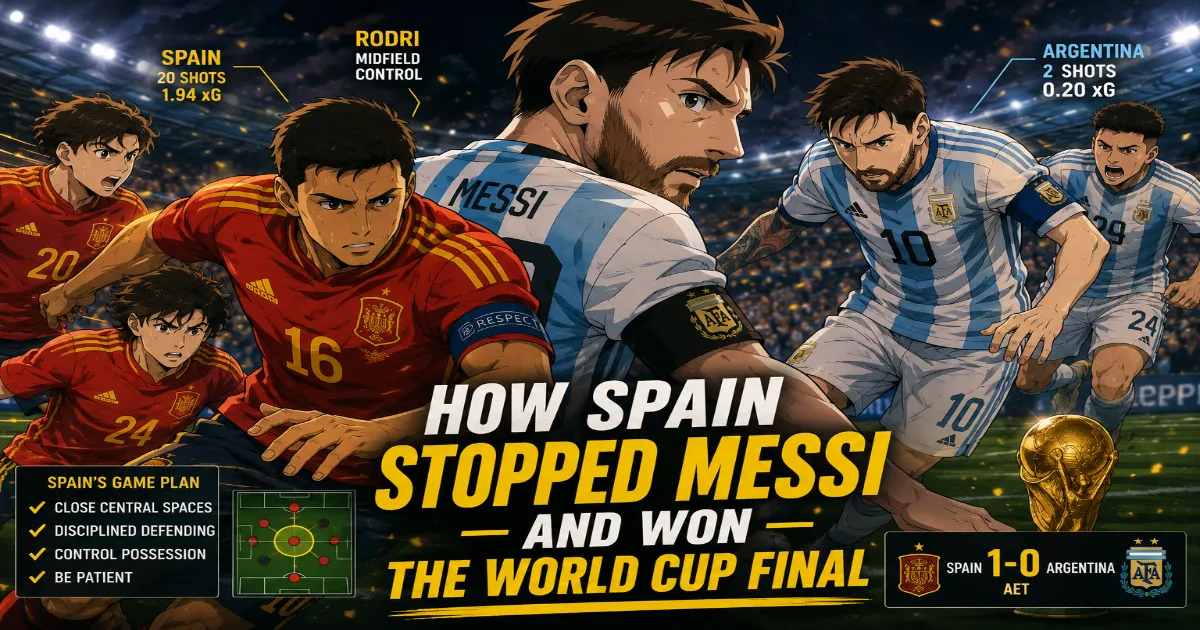 Spain’s disciplined defence, Rodri’s midfield control and a patient tactical approach helped La Roja neutralise Messi and beat Argentina 1-0 after extra time.
The question before the FIFA World Cup 2026 final was almost impossible to answer: how do you stop Lionel Messi in a World Cup final? Spain eventually found an answer, but it was not based on assigning one defender to follow him around the pitch or attempting to physically overwhelm him. Luis de la Fuente’s team understood that the best way to limit Messi was to control the spaces around him and prevent Argentina from building the attacking situations in which he is most dangerous.
Spain defeated Argentina 1-0 after extra time at New York New Jersey Stadium to win their second World Cup title. The victory came after a remarkably controlled defensive performance in which Argentina managed only two shots, compared with Spain’s 20. Spain also produced approximately 1.94 expected goals against Argentina’s 0.20, underlining just how comprehensively the champions controlled the final.
Spain Did Not Try to Eliminate Messi From the Game
The biggest mistake a team can make against Messi is treating him as an isolated problem. Spain understood that his danger comes not simply from his ability to dribble or shoot, but from the reaction his movement creates in an opposing defence.
When a defender follows Messi into midfield, space can open behind him. When a midfielder abandons his position to press Messi, another passing lane can appear. When a full-back moves inside to help, Argentina can attack the resulting space on the flank.
Spain avoided that chain reaction. Rather than allowing Messi’s movement to dictate their entire defensive structure, they maintained their shape and concentrated on taking away his preferred options. Messi could still receive possession, but Spain made it much harder for him to turn those touches into the kind of decisive attacking sequences that had defined Argentina’s tournament.
Rodri ame Spain’s First Line of Defence
At the centre of Spain’s strategy was Rodri. The Manchester City midfielder had already been one of the defining players of Spain’s campaign, operating as the single defensive pivot in Luis de la Fuente’s 4-3-3 system. Against Argentina, his positioning became even more important.
Rodri did not spend the final chasing Messi around the pitch. Instead, he protected the central zone between Spain’s midfield and defence. That was exactly the area Messi preferred to occupy when dropping deep to receive the ball.
The objective was not necessarily to prevent Messi from touching the ball. It was to prevent him from receiving it with the time and space required to immediately turn, accelerate the attack or find a runner behind the defensive line.
Rodri’s positioning helped Spain achieve that. Argentina could pass toward Messi, but the options immediately around him were often limited. The central corridor became crowded, forcing Argentina to search for alternative routes forward.
Spain Denied Messi His Favourite Central Spaces
The Messi Spain faced was very different from the explosive forward who spent much of his younger career constantly attacking space behind defensive lines. At 39, he had adapted his game, conserving energy for the moments when his influence could be decisive.
That made Spain’s positional discipline even more important.
Messi could spend long periods walking or moving at a relatively low intensity before suddenly becoming decisive. Trying to exhaust him physically was therefore not necessarily the smartest strategy. Spain instead concentrated on denying him the central pockets of space where he could receive the ball and immediately influence the match.
Whenever Messi dropped deeper, Spain’s midfield remained compact. When he moved toward the flank, the team adjusted without completely abandoning its central structure. When he looked for a position between the lines, Rodri and the defenders ensured that the space was extremely difficult to exploit.
Spain were effectively asking Argentina to beat them somewhere else.
Laporte and Cubarsí Refused to Break the Defensive Shape
Aymeric Laporte and Pau Cubarsí also played an important role in Spain’s approach. Their biggest responsibility was maintaining the defensive line without allowing Messi’s movement to pull them out of position.
This was particularly important because Messi’s greatest weapon is often the pass that comes after defenders react to him.
If one centre-back stepped forward too aggressively, Argentina could potentially exploit the space behind him. If both defenders dropped too deeply, Messi would have more time to dictate the attack.
Spain therefore maintained compact spacing and trusted Rodri to provide protection in front of them.
That patience prevented Argentina from creating the kind of gaps Messi has exploited throughout his career. Instead of constantly responding to Argentina’s movement, Spain forced the Argentine attackers to operate within a much smaller amount of usable space.
Spain’s Full-Backs Completed the Defensive Puzzle
Pedro Porro and Marc Cucurella also had an important role in preventing Messi from receiving the conditions he wanted.
Argentina needed to stretch Spain horizontally. If the full-backs were dragged too wide, the central spaces could open for Messi. If they moved too far inside, Argentina could attack from the wings.
Spain therefore had to maintain a careful balance.
The full-backs remained connected to the centre-backs while still being prepared to deal with Argentina’s wide players. That prevented Argentina from creating enough width to pull Spain apart.
The result was a compact defensive structure in which Messi rarely found the combination of space, time and supporting runners that makes him so difficult to defend.
Spain’s Possession Was Another Defensive Weapon
Spain’s defence did not begin when they lost the ball. Their possession itself became part of their defensive strategy.
Every minute Spain controlled the ball was another minute Argentina could not attack. Rather than turning the final into a chaotic exchange of chances, Spain repeatedly moved possession around the pitch and forced Argentina to defend.
Rodri was again central to that process. His ability to receive possession under pressure, recycle the ball and dictate the rhythm allowed Spain to control the tempo.
This was particularly important against Messi. Argentina needed sustained possession to give their greatest creator opportunities to influence the match. Spain consistently denied them that rhythm.
The more Spain controlled the ball, the fewer opportunities Argentina had to build attacks around Messi.
Patience Became Spain’s Greatest Weapon
There was a psychological challenge involved as well. Spain had to resist the temptation to become impatient.
Argentina had already shown during the tournament that they could remain competitive in difficult situations and produce decisive moments late in matches. Messi’s ability to conserve energy made this especially dangerous.
Spain therefore needed to remain disciplined even if the score remained level.
They did exactly that.
The 0-0 scoreline did not cause Spain to abandon their structure. They continued to build attacks patiently, moved the ball through midfield and waited for opportunities instead of forcing passes into crowded areas.
That patience eventually became one of the defining characteristics of their World Cup-winning performance.
Argentina Could Not Create the Space Messi Needed
The final statistics reveal just how successful Spain’s approach was.
Argentina finished with only two shots across the match, while Spain produced 20. The expected-goals figures were similarly decisive, with Spain generating approximately 1.94 xG compared with Argentina’s 0.20.
These numbers show that Spain’s victory was not simply the product of Argentina missing chances. Argentina struggled to create those chances in the first place.
Messi was unable to consistently establish the kind of attacking rhythm he had enjoyed during earlier stages of the tournament. His movement was still intelligent, his technical quality remained obvious, but Spain repeatedly reduced the opportunities available to him.
For a player who can transform a tiny opening into a goal or assist, those small defensive restrictions were enormously important.
Spain Did Not Panic When the Final Stayed Goalless
After 90 minutes, the final remained 0-0.
For Spain, that was not necessarily a problem.
Their entire tournament had been built around control. They had remained unbeaten across eight matches, winning seven and drawing one, while conceding just one goal throughout the competition.
That record gave them the confidence to continue playing their football.
They did not need to turn the final into a frantic contest simply because Argentina were still within one moment of winning it.
Instead, Spain continued to control possession and territory while maintaining their defensive structure.
The match entered extra time with neither side willing to make the mistake that could decide the World Cup.
Spain Finally Found the Winning Moment
The breakthrough eventually arrived in the 106th minute.
Spain scored to take a 1-0 lead, transforming the tactical situation completely.
Argentina now had to attack.
Spain, meanwhile, could focus even more heavily on protecting their advantage.
That was an ideal situation for the Spanish side. Argentina had struggled to create chances against Spain’s compact defensive structure for more than 90 minutes, and now they were being forced to take greater risks.
Spain remained disciplined during the final stages of extra time and successfully protected the lead.
The final whistle confirmed one of the biggest victories in Spanish football history.
Messi’s Final World Cup Ended in Defeat
For Messi, the final represented the end of an extraordinary World Cup career.
At 39, he had entered the tournament with expectations that this would be his final appearance at the competition. His campaign had still been remarkable, with eight goals and four assists as Argentina progressed to the final.
But the second World Cup title he wanted was ultimately denied by Spain.
The result did not erase Messi’s influence on the tournament or his extraordinary international career. Instead, it provided a fitting final challenge for a Spain side that had spent the entire competition building a team capable of controlling elite opponents.
Spain did not make Messi disappear.
They made him less influential.
At World Cup level, that can be the difference between victory and defeat.
Rodri’s Golden Ball Was the Perfect Recognition
There was something particularly appropriate about Rodri winning the Golden Ball after Spain’s triumph.
The award reflected exactly what had made Spain so effective.
Rodri was not simply a defensive midfielder sitting in front of his centre-backs. He controlled the rhythm of matches, protected the central spaces and provided the foundation for Spain’s attacking players to express themselves.
Against Argentina, those qualities became even more important.
His positioning helped prevent Messi from dominating the central areas, while his control of possession helped Spain dictate the match.
The Golden Ball therefore represented more than individual recognition. It was also recognition of the tactical philosophy that had carried Spain to the World Cup title.
How Spain Actually Stopped Lionel Messi
Spain did not discover one magical tactical trick capable of completely stopping Messi. Instead, their success came from combining several defensive principles.
Rodri protected the central corridor. Laporte and Cubarsí maintained their positions and refused to be dragged out of shape. Porro and Cucurella provided defensive width without allowing the centre to become exposed. The midfield stayed compact, while Spain’s possession prevented Argentina from building sustained attacking pressure.
Most importantly, Spain defended collectively.
Nobody was given the impossible task of following Messi everywhere. Instead, the entire team understood where he wanted to receive the ball and made those areas difficult to access.
That was the key.
The Striker Report Verdict
Spain’s victory over Argentina was not simply about stopping Lionel Messi. It was about understanding how Messi influences football matches and then removing the conditions that allow that influence to become decisive.
Rodri controlled the space in front of the defence. Spain’s centre-backs remained disciplined. The full-backs avoided being dragged too far from their positions. The midfield controlled the tempo, while Spain’s possession repeatedly forced Argentina onto the defensive.
The numbers tell the story: 20 shots for Spain, just two for Argentina, and approximately 1.94 expected goals against 0.20.
After 120 minutes, Spain had their second World Cup title.
Messi had one final World Cup match.
And Spain had answered the question that had dominated the build-up to the final.
They did not stop Lionel Messi by chasing him. They stopped him by controlling the game around him.
🔹🔹 follow us on facebook 🔹🔹
PSG v Arsenal: How Paris Won the Champions League Final on Penalties
Bangladesh Create History in Darwin, Defeat Australia by Nine Wickets in Landmark Test Victory
Cristiano Ronaldo Jr.: Club, Lifestyle, Career and Future Prospects
About the Author