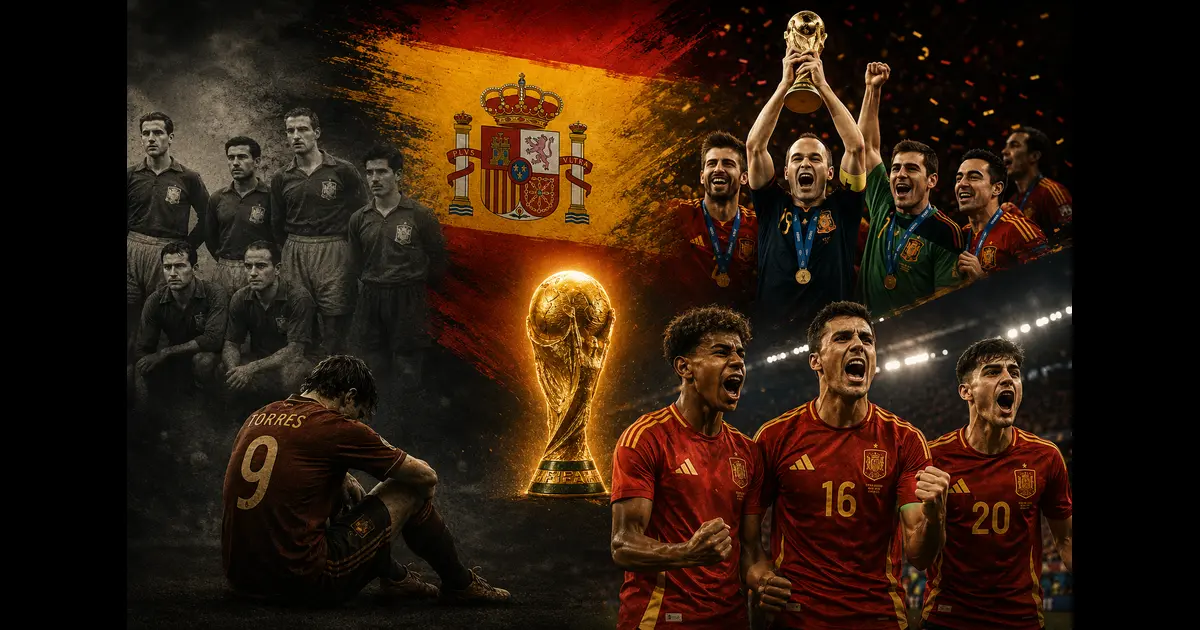
 A look back through Spain World Cup history — one triumphant golden era, decades of near-misses either side of it, and what a second star would mean now.
For most of the twentieth century, Spain’s relationship with the World Cup was defined less by success than by a stubborn, almost puzzling failure to translate obvious talent into results. A country that has produced some of the sport’s greatest club sides and individual players spent decades being labelled underachievers on the international stage, a tag that persisted right up until a golden generation finally broke through in 2010. Understanding that full arc — the long wait, the brief golden era, and the years since — is essential to understanding just how much weight Sunday’s final carries for Spanish football.
Is This Spain Team Better Than the 2010 Champions?
Every FIFA World Cup Winner Since 1930 — Complete Champions List, Stats & History
The Long Wait: Spain Before 2010
Spain entered its first World Cup in 1934 and, for the following seven decades, built a reputation as one of international football’s most persistent underachievers. Their best finish across that stretch came in 1950, a fourth-place finish in Brazil that stood as the country’s high-water mark for sixty years. Beyond that solitary highlight, the pattern was remarkably consistent: talented squads, often stacked with players who were dominating at club level, exiting tournaments earlier than their individual quality suggested they should.
The reasons offered for that gap varied by era — a lack of tactical cohesion, an inability to handle pressure in knockout football, insufficient squad depth compared to the traditional powers — but the result was the same tournament after tournament. By the mid-2000s, “Spain will underperform at the World Cup” had become almost as reliable a prediction as the tournament itself, regardless of how good the squad looked on paper heading in.
The Golden Era: 2008 to 2012
That narrative was dismantled entirely across a four-year stretch that remains one of the most dominant runs in international football history. Spain won the 2008 European Championship, then the 2010 World Cup in South Africa — their first and, until this final, only World Cup title — and followed it with a second consecutive European Championship in 2012, becoming the first nation to win three straight major international tournaments.
The 2010 triumph itself was built on a level of defensive control that bordered on suffocating: Spain won the tournament having scored just eight goals across seven matches, the fewest of any World Cup winner in the tournament’s history, relying instead on a possession-based approach under Vicente del Bosque that ground opponents down rather than overwhelmed them. It remains, statistically, one of the most conservative title-winning campaigns ever recorded, and it stood in sharp contrast to the fluid, attacking sides many now associate with peak Spanish football.
The Fallow Years: 2014 to 2022
Golden eras rarely last, and Spain’s decline from world-beaters back toward the tournament’s cautionary tales was swift. The 2014 World Cup defence ended in a group-stage exit, a stunning collapse for the reigning champions that included a 5-1 defeat to the Netherlands in their opening match. The years that followed brought further heartbreak in the exact fashion Spain had specialized in before 2010: penalty shootout defeats to hosts Russia in the 2018 round of 16, and to Morocco in the 2022 round of 16, both matches in which Spain dominated possession — over 75% in both games, with a combined 36 shots — yet could manage only a single goal across 240 minutes of football.
That statistic, more than any other, captures what had gone wrong. Spain’s technical identity hadn’t disappeared, but their ability to convert overwhelming territorial control into actual goals against well-organized, deep-defending opponents had. Breaking down teams that sat back and absorbed pressure had become a genuine, repeated problem, and it cost them in exactly the moments that mattered most.
The Rebuild: De la Fuente’s Evolution
Luis de la Fuente took over after the Morocco exit in 2022 and has been explicit that the goal was evolution rather than a wholesale rebuild — keeping the technical control that has always defined Spanish football, while adding far more directness and verticality to actually punish opponents once they’d been pinned back. That approach delivered the 2024 European Championship title, Spain’s fourth major trophy and first since 2012, won playing a style widely credited as faster and more direct than the possession-only football of the previous decade.
The current World Cup campaign has been the clearest evidence yet that the shift is durable rather than a one-tournament peak. Spain’s run to Sunday’s final has included a 37-match unbeaten streak — matching an all-time record previously held by Italy — and eight consecutive knockout wins across major tournaments, a run that spans this World Cup and the Euro 2024 triumph before it. Aside from a single goal conceded against Belgium in the quarterfinal, Spain’s defence has barely been troubled across five knockout matches at this tournament, addressing directly the exact weakness — an inability to close games out against determined opposition — that defined their exits in 2018 and 2022.
What a Second Title Would Mean
A win on Sunday would give Spain their second World Cup, level with nations like Uruguay and France on two titles, and would cement the current generation — built around Rodri, Pedri, and the teenage phenomenon Lamine Yamal — as a genuine second golden era for Spanish football, distinct from and arguably more tactically complete than the 2008-2012 vintage. It would also be a fitting bookend to the specific weakness that had haunted Spain for over a decade: a team once defined by control without penetration finally proving it can do both, on the biggest stage available, against an Argentina side built on entirely different strengths.
For a football nation that spent most of the twentieth century being asked why so much individual talent kept producing so little at World Cups, and then spent the decade after 2012 hearing the same question in a slightly different form, Sunday offers the clearest possible answer available: a second star, earned by a team that solved the exact problem that used to define its history.
🔹🔹 follow us on facebook 🔹🔹
About the Author