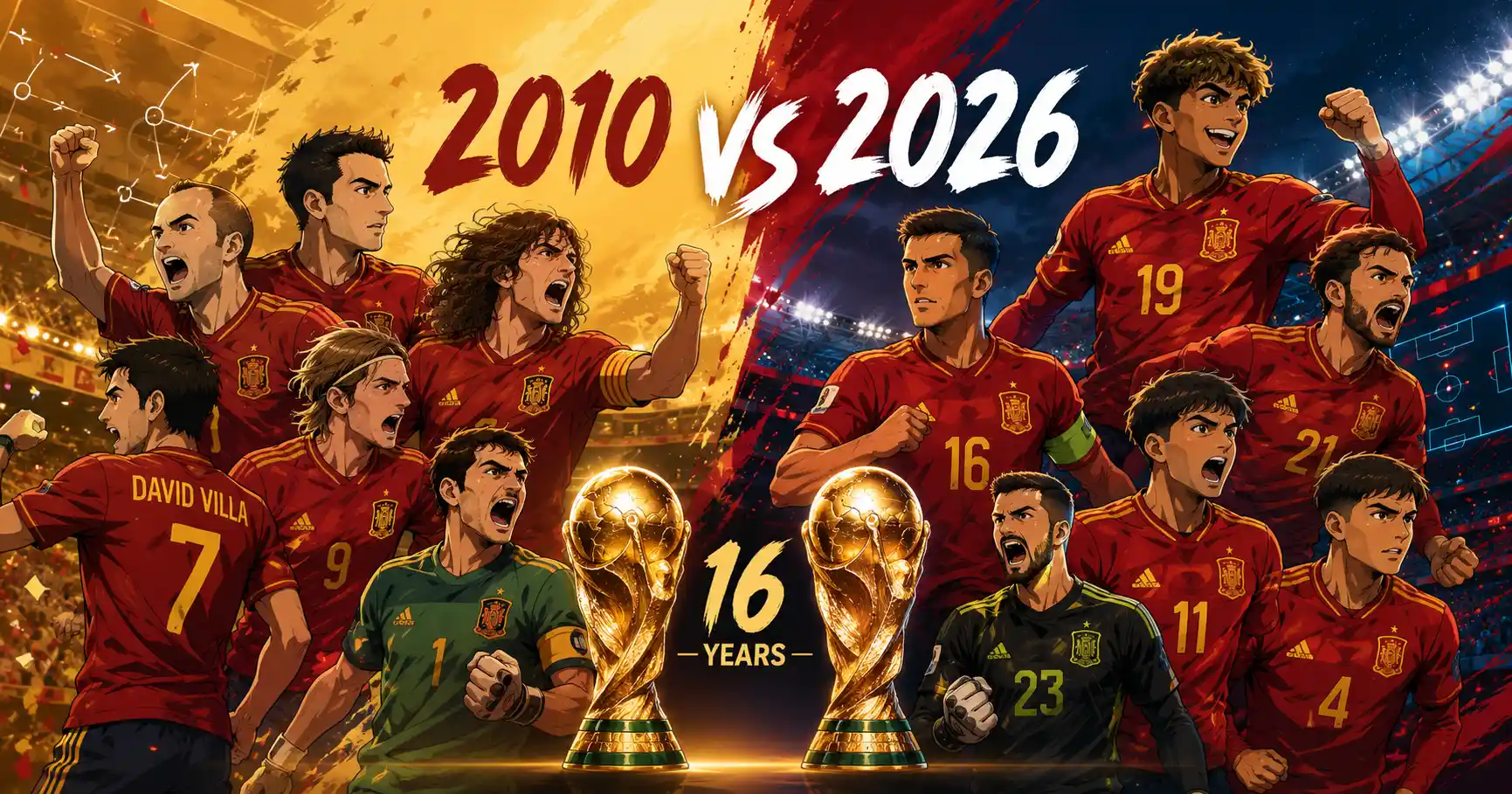
 Two Spanish generations, two World Cup titles sixteen years apart: is this Spain team better than the 2010 champions once you actually compare them position by position?
Spain has now won the World Cup twice, sixteen years apart, and the two triumphs couldn’t have arrived through more different footballing philosophies. The 2010 champions, coached by Vicente del Bosque, built their title on tiki-taka’s suffocating possession game, a style so influential it briefly reshaped how the entire sport thought about ball retention. The 2026 champions, under Luis de la Fuente, won with defensive control so complete it produced the fewest goals conceded by any World Cup winner in history. Is this Spain team better than the 2010 champions? It’s a genuinely closer call than the flashier headlines from either era might suggest.Biggest Upsets FIFA World Cup 2026: Every Shock Result Ranked
The Case for 2010
Spain’s 2010 triumph remains one of the most stylistically influential World Cup wins in the sport’s modern history. Built around Xavi and Andrés Iniesta’s suffocating midfield control, that squad won four consecutive knockout matches by an identical 1-0 scoreline, a genuinely remarkable pattern that reflected both their attacking limitations in that specific tournament and their almost total dominance of possession and territory regardless of the eventual scoreline. Iniesta’s extra-time winner against the Netherlands in the final remains one of the sport’s iconic individual moments, a fitting capstone to a tournament defined by patient control finally rewarded at the latest possible moment.
That 2010 squad also arrived already established as continental champions, having won Euro 2008, and would go on to win Euro 2012 as well, completing a genuinely unprecedented three-tournament sweep of major international titles that no other national team has matched before or since. The sheer sustained dominance of that era, spanning four years and three separate tournaments, gives the 2010 squad a case built on longevity that a single World Cup triumph, however dominant, simply can’t match on its own.
The Case for 2026
Set against that legacy, Spain’s 2026 champions have their own genuinely historic claim: a single goal conceded across the entire tournament, a mark that surpasses even the defensive solidity of the 2010 vintage. Where the 2010 squad ground out low-scoring wins through patient control, the 2026 side combined that same defensive discipline with more varied attacking sources, Fabián Ruiz’s opener against Belgium, Mikel Merino’s habit of scoring decisive goals from the bench in consecutive knockout rounds, Mikel Oyarzabal’s semifinal penalty against France, and finally Ferran Torres’s extra-time winner in the final itself. That spread of attacking contribution across five or six different players arguably reflects a more balanced, harder-to-scout squad than 2010’s approach, which leaned more heavily on its midfield trio to manufacture almost everything going forward.
The 2026 squad also swept the tournament’s individual awards in a way 2010’s golden generation never quite matched in a single edition, Rodri’s Golden Ball, Unai Simón’s Golden Glove, and Pau Cubarsí’s Best Young Player award reflecting excellence recognized across three entirely different positions on the pitch.
Comparing the Midfields: Xavi and Iniesta vs. Rodri
Any honest comparison between these two Spanish generations has to reckon with arguably the two teams’ defining individual difference: 2010’s midfield trio of Xavi, Iniesta, and Sergio Busquets against 2026’s reliance on Rodri as a single defensive and controlling anchor. Xavi and Iniesta’s combined technical brilliance produced a level of sustained attacking creativity that Rodri, whose game is built more around defensive positioning and tempo control than direct creative output, doesn’t individually replicate.
But Rodri’s Golden Ball victory reflects a different kind of midfield dominance, one focused on denying opposition attacks before they develop rather than manufacturing Spain’s own. It’s genuinely difficult to argue one approach is definitively superior to the other; 2010’s midfield created more moments of individual brilliance, while 2026’s midfield, anchored by Rodri, more completely shut down what opponents could produce at the other end. Both approaches delivered the same ultimate result.
Comparing the Defenses and Goalkeeping
Here, the comparison tilts more clearly toward 2026. Iker Casillas was a genuinely excellent goalkeeper for the 2010 squad, but that team still conceded twice as many goals across the tournament as Unai Simón’s 2026 side did, even accounting for the different number of matches played under the modern 48-team format. Pau Cubarsí and Aymeric Laporte’s central partnership in 2026, alongside Simón’s individual Golden Glove-winning campaign, produced a statistically superior defensive record to anything the 2010 vintage, built around Carles Puyol and Gerard Piqué, ultimately managed.
Comparing the Attacking Talent
This is where 2010 retains a stronger individual case. David Villa’s tournament-leading five goals in 2010 came from a genuinely world-class finisher operating near his peak, and Fernando Torres, though less prolific in that specific tournament, remained one of Europe’s most feared strikers at the time. The 2026 squad’s attacking output was more collectively distributed but arguably lacked a single individual finisher operating at quite that same elite scoring level; Ferran Torres’s final goal was decisive, but his broader tournament tally doesn’t match Villa’s 2010 form.
Where 2026 pulls ahead again is in sheer individual ceiling: Lamine Yamal, at 19, playing his first World Cup, represents a level of generational talent that neither 2010 squad’s attacking players, for all their considerable quality, quite possessed at that same age. Yamal’s dribbling numbers led the entire tournament outside of Messi himself, a genuinely remarkable statistic for a teenager still working his way back from a serious injury.
The Verdict
Judged purely on the numbers this specific tournament produced, defensive record, spread of goalscoring contribution, and the sheer sweep of individual awards, the 2026 squad has a legitimate statistical case for being the superior single-tournament team. But 2010’s broader legacy, three consecutive major tournament titles across four years, built around one of the most stylistically influential midfields the sport has ever produced, still carries a weight that a single World Cup win, however dominant, hasn’t yet matched.
The honest answer is that this comparison may not be fully settleable yet. If Yamal, Cubarsí, and this current generation go on to win Euro 2028 or another major tournament in the years ahead, mirroring the sustained dominance of the 2008-2012 era, the case for 2026 being remembered as the superior Spanish generation becomes considerably stronger. For now, 2026 has the better statistical case for a single tournament. 2010 still has the better case as an era. Both, unquestionably, rank among the finest international teams Spanish football has ever produced.
Luis de la Fuente Masterclass: How He Built World Champions
🔹🔹 follow us on facebook 🔹🔹
About the Author