 From Germany’s dramatic shootout exit to Norway’s stunning win over Brazil, the Biggest Upsets FIFA World Cup 2026 reshaped the road to the final.
Every World Cup produces at least one result that rewrites expectations, and the newly expanded 48-team format for 2026 — with its extra round of 32 — gave shock results even more opportunities to happen. Here are the World Cup 2026 upsets that mattered most, ranked by how much they reshaped the tournament.Golden Ball Winner Rodri: The Case for Football’s Quietest Superstar
Golden Glove Winner Unai Simon: The Historic World Cup Goalkeeping Masterclass
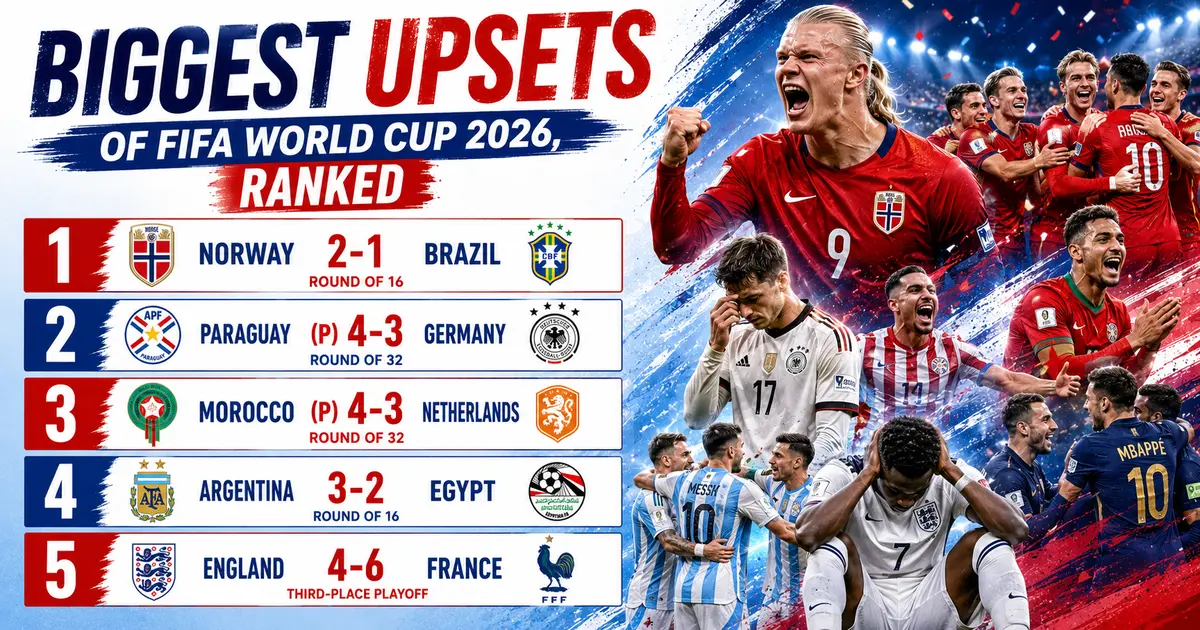
1. Norway 2-1 Brazil (Round of 16)
Nothing else this tournament came close to matching the scale of this result. Brazil arrived at the World Cup as five-time champions and one of the pre-tournament favourites, while Norway — despite possessing a genuine world-class talent in Erling Haaland — had never been considered a serious contender to go deep into the knockout rounds. Norway’s win wasn’t a fluke smash-and-grab either: they controlled long stretches of the match and were the more organized, more clinical side over 90 minutes. It remains the single biggest shock of the tournament, and the moment Norway went from surprise package to genuine knockout threat, a status they backed up by taking England to the wire in the quarterfinal that followed.
2. Paraguay Eliminate Germany on Penalties (Round of 32)
Germany’s exit in the very first knockout round — a competition they’ve won four times — was one of the tournament’s earliest genuine shocks. A 1-1 draw forced penalties, and Paraguay held their nerve to send one of the pre-tournament’s most fancied sides home before the round of 16 had even begun. It was a stark reminder of exactly what the newly introduced round of 32 was capable of producing: an extra knockout hurdle that gave lower-ranked sides one more chance to catch a favourite cold, in a format that offered no such opportunity at previous World Cups.
3. Morocco Eliminate the Netherlands on Penalties (Round of 32)
Following an almost identical script to Germany’s exit, the Netherlands were held to a 1-1 draw by Morocco before losing on penalties in the same round. It sent Morocco on a run that would eventually stretch all the way to the quarterfinals, where they were finally stopped by France — meaning the team that knocked out one of Europe’s traditional heavyweights in the round of 32 went on to outlast plenty of sides many had rated more highly heading into the tournament.
4. Argentina’s Near-Collapse Against Egypt (Round of 16)
This one doesn’t quite qualify as a full upset, since Argentina ultimately won 3-2 — but for roughly seventy minutes, Egypt were on course to produce the shock of the tournament. Egypt led 2-0 in the second half and looked to be cruising toward one of the great World Cup upsets before Argentina scored three times in a frantic closing spell to escape with the win. It’s a reminder that some of the tournament’s nearest misses never make an “upsets” list purely because of how a match actually finished, even when the underlying story was every bit as dramatic as the results that do.
5. England’s Third-Place Collapse Against France
Not a knockout elimination, and therefore not quite in the same category as the results above, but England’s capitulation in the third-place playoff deserves a mention purely for how extreme the swing was. France led 4-0 at halftime, only for England to mount a serious comeback before eventually losing 6-4 — still a defeat for England, but a result that flipped from a comfortable French victory into genuine tension inside 45 minutes, with Bukayo Saka’s second-half hat-trick at the center of the fightback.
Why the Round of 32 Mattered So Much
Look at the pattern across this list, and one detail stands out: two of the tournament’s biggest shocks — Germany’s and the Netherlands’ eliminations — happened in the round of 32, a round that simply didn’t exist at previous World Cups. Expanding the tournament to 48 teams didn’t just add more group-stage matches; it added an entire extra knockout hurdle that gave lower-ranked, in-form sides like Paraguay and Morocco one additional chance to catch a fancied opponent on an off day, in a single-elimination format where anything can happen over 90 or 120 minutes. Whether that’s viewed as a feature or a flaw of the new format probably depends on which side of those results you were rooting for — but there’s no question it added a genuine new layer of unpredictability to how this World Cup unfolded.
The Bigger Picture
For all these individual shocks, it’s worth noting what didn’t happen: none of the pre-tournament favourites who avoided the round of 32 upset bug went on to be eliminated early. Spain, Argentina, France and England all navigated the full gauntlet of an expanded knockout bracket without suffering a genuine shock defeat of their own, right up until Argentina fell to Spain in the final itself — hardly an upset, given how the underlying tournament form pointed. That contrast is what made this edition’s shocks so notable: they didn’t derail the tournament’s biggest storylines so much as they reshaped which teams got to share the stage with them along the way.
🔹🔹 follow us on facebook 🔹🔹
About the Author