 Every Red Card at FIFA World Cup 2026, Explained
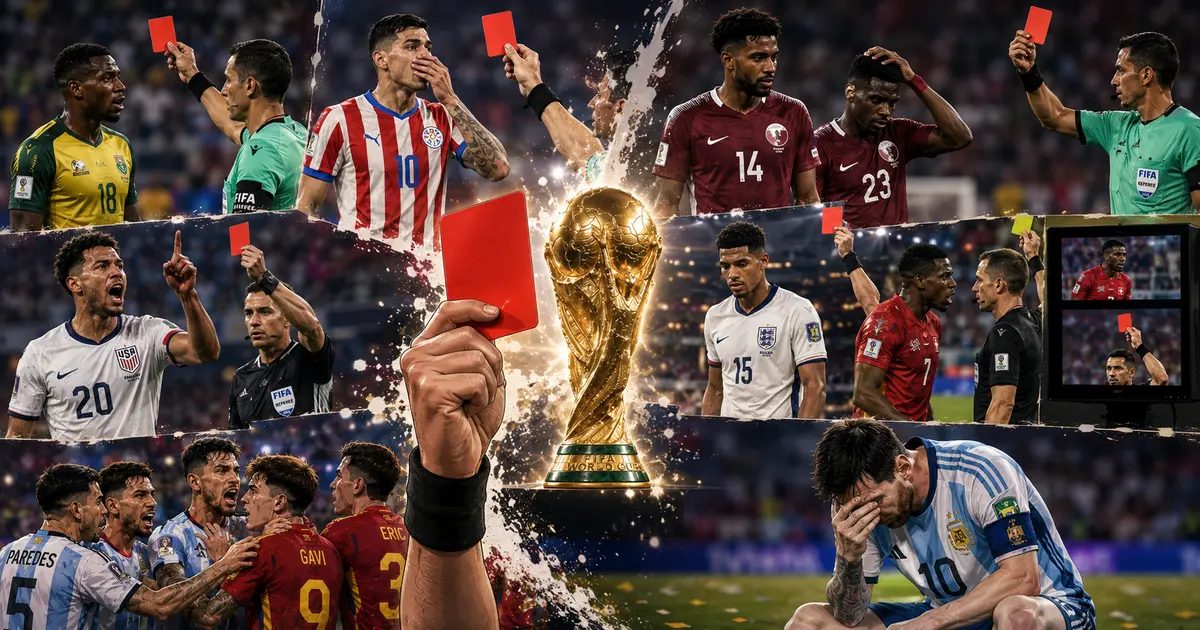
Discipline was a genuine storyline at this World Cup. Thirteen players were sent off across the tournament — more than the combined total from the 2018 and 2022 editions, which produced just four dismissals apiece. A bigger field, more matches, full VAR review, and one brand-new rule all played a part. Here’s every notable World Cup 2026 red card and the story behind it.
Premier League 2026/27 Schedule: This Week and Next Week
LaLiga 2026/27 Schedule: Fixtures, Dates & Times
From Legend to Lightning Rod: Why Messi Is Being Criticized Now
Three Reds in the Opening Match
The tournament didn’t wait long to set its disciplinary tone. Mexico’s opening match against South Africa produced three red cards on its own — an extraordinary start for the very first game of a 104-match tournament. South Africa’s Sphephelo “Yaya” Sithole was the first player sent off at the entire World Cup, dismissed for denying a clear goal-scoring opportunity, with Mexico’s Julián Quiñones also shown red in the same match.
Miguel Almirón: The First Red Card Under a Brand-New Rule
The most historically significant dismissal of the group stage belonged to Paraguay’s Miguel Almirón, sent off against Türkiye for covering his mouth while exchanging words with an opponent during a confrontation. It was the first red card of its kind at a World Cup, issued under a rule introduced specifically for this tournament after a Champions League controversy involving Vinícius Júnior and Benfica’s Gianluca Prestianni, where a covered mouth made it impossible to determine what had actually been said, including allegations of a racial slur. Under the new law, referees no longer need to establish exactly what was said — a covered mouth during a heated exchange is treated as red-card conduct in itself.
Qatar’s Costly Night Against Canada
Qatar had two players dismissed in the same match against Canada: Homam Ahmed and Assim Madibo. Madibo’s sending-off carried extra weight, with FIFA handing him a five-match suspension — an unusually long ban — after he broke the leg of Canada’s Ismaël Koné during the challenge that led to his red card.
Folarin Balogun and the Suspension That Got Reversed
No red card generated more controversy off the pitch than USA striker Folarin Balogun’s dismissal against Bosnia and Herzegovina in the round of 32. Balogun scored the USMNT’s opening goal before being sent off 21 minutes later for a challenge that landed on an opponent’s ankle. The red card itself was straightforward enough, but what followed wasn’t: Balogun’s automatic one-match suspension was later placed on a one-year probationary period and effectively lifted, a highly unusual intervention that drew public criticism from Belgium and UEFA. The decision came shortly after U.S. President Donald Trump confirmed he had personally discussed the case with FIFA president Gianni Infantino, calling the original red card “very unfair.”
Jarell Quansah’s Round of 16 Dismissal
England’s five-goal thriller against Mexico in the round of 16 included a red card for Jarell Quansah, leaving England to navigate the closing stages of a 3-2 win a man light. It’s a detail easy to lose amid the match’s chaotic scoreline, but it made England’s eventual win — built on a Harry Kane penalty won by Anthony Gordon — considerably harder than the final result suggests.
Breel Embolo’s Bizarre Reversal Against Argentina
Switzerland’s quarterfinal exit to Argentina included one of the tournament’s strangest refereeing sequences. Referee João Pinheiro initially booked Argentina’s Leandro Paredes for a foul on Breel Embolo, only to be sent to the monitor by VAR and reverse the call entirely — showing Embolo a second yellow card for simulation instead. Switzerland, level at 1-1 at the time, were reduced to ten men and went on to lose 3-1, with Swiss players furious about a decision that had briefly gone the opposite direction before VAR intervened.
Two Red Cards in the Final Itself
Even the final wasn’t free of disciplinary drama. Argentina’s Enzo Fernández was sent off for a second yellow card in second-half stoppage time, reducing Argentina to ten men just as the match moved into extra time — a numerical disadvantage Spain would eventually exploit for Ferran Torres’ winning goal. Argentina’s night got worse still after the full-time whistle, when substitute Leandro Paredes was shown a straight red for his reaction to the result, an ugly coda to what had otherwise been an admirably competitive final from ten men.
Why This Tournament Produced So Many
Several factors converged to push this World Cup’s red card count well above recent history. The expanded 48-team field meant 104 matches instead of 64 — 40 more opportunities across the tournament for a dismissal to occur. Full VAR review caught incidents that referees might previously have missed in real time, including several second-yellow reversals like Embolo’s. And the brand-new rule against covering one’s mouth during confrontations added an entirely new category of dismissal that simply didn’t exist at any previous World Cup, claiming Almirón as its first-ever recipient inside the group stage.
How This Tournament Compares to World Cup Red Card History
Red cards have been part of the World Cup since its very first edition in 1930, when Peru’s Plácido Galindo became the first player ever sent off, against Romania. The physical red card itself wasn’t introduced until 1970 and wasn’t actually used in practice until 1974, when Chile’s Carlos Caszely was dismissed against West Germany. Since then, the tournament has produced some deeply memorable sendings-off — Zinedine Zidane’s headbutt on Marco Materazzi in the 2006 final remains the most famous of them all, coming in the French captain’s very last match as a professional, in a game Italy went on to win. Cameroon’s Rigobert Song and France’s Zidane are the only two players to have been sent off at multiple World Cups, while three goalkeepers — Italy’s Gianluca Pagliuca, South Africa’s Itumeleng Khune, and Wales’s Wayne Hennessey — have all seen red across World Cup history.
This tournament’s 13 dismissals sit well above the modern-era baseline, but nowhere close to the most card-heavy stretches of the competition’s early decades, when refereeing standards and interpretations varied far more widely between confederations. What makes 2026’s total notable isn’t just the raw number — it’s how many of the individual incidents became genuine storylines in their own right, from Almirón’s rule-defining dismissal to the geopolitical odd couple of Trump and Infantino discussing Balogun’s overturned ban.
Suspension Consequences Across the Tournament
Every red card at a World Cup carries an automatic one-match suspension, a rule that can reshape a team’s entire course through the competition depending on when it happens. A group-stage dismissal, like Almirón’s or Sithole’s, costs a team a player for their next group match — painful, but recoverable if the squad has depth. A knockout-stage red card is far more costly, since every remaining match is now sudden-death elimination football; Quansah’s dismissal against Mexico meant England had to see out the remainder of a five-goal round of 16 thriller with ten men, while Embolo’s second yellow left Switzerland facing the back end of their quarterfinal a player short in a match still level at the time. FIFA’s disciplinary code also allows for suspensions beyond the standard single match in cases of serious foul play, as Qatar’s Assim Madibo discovered when his challenge on Ismaël Koné earned him a five-match ban rather than the standard one.
The Bigger Picture
Thirteen red cards across 104 matches works out to roughly one dismissal every eight games — a notably higher rate than the 2018 and 2022 tournaments, which averaged one every 16 matches with their four apiece. Whether that reflects a genuinely more ill-disciplined tournament, or simply more matches and more technological scrutiny catching incidents that would once have gone unpunished, is a matter of interpretation. What’s clear is that discipline shaped outcomes throughout this World Cup — from Qatar’s costly night against Canada in the group stage, to Switzerland’s man disadvantage in the quarterfinal, right through to Argentina finishing the final itself a player short in the moment it mattered most.
🔹🔹 follow us on facebook 🔹🔹
About the Author