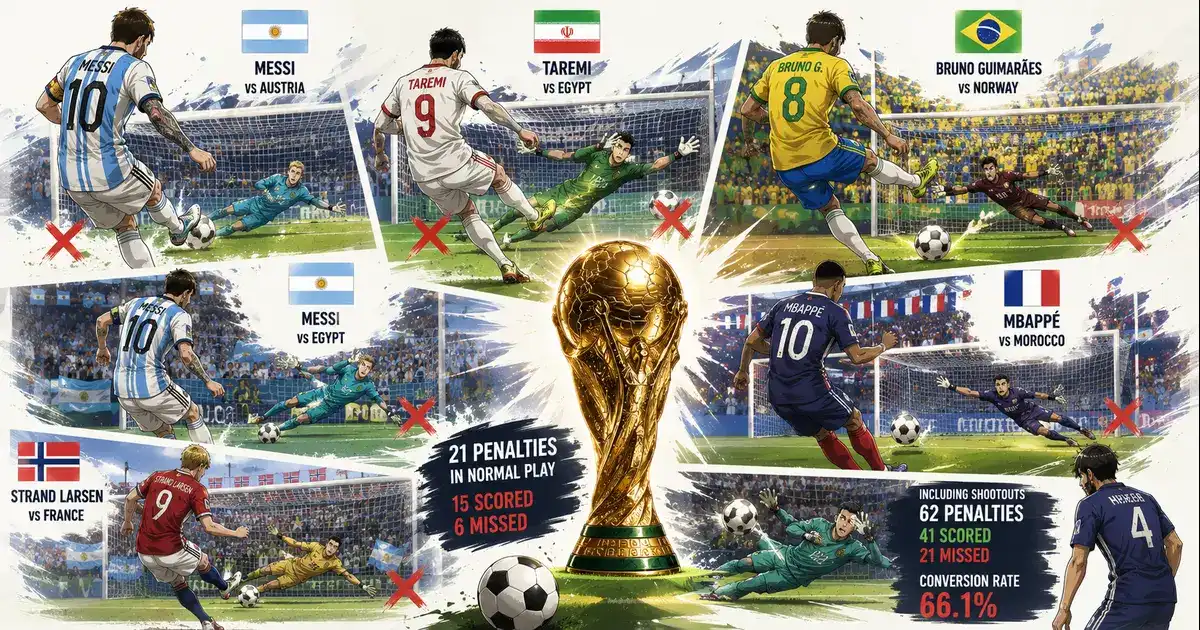
 A penalty looks like the easiest chance in football — twelve yards, one shooter, one goalkeeper to beat. But this World Cup turned that assumption on its head. Of 21 penalties awarded in normal play, only 15 were actually converted, a success rate of 71.4% that still ranks as one of the shakiest in the tournament’s history. Add shootouts into the mix, and the overall conversion rate across all 62 spot-kicks fell to just 66.1% — the lowest at any World Cup since 1966. Here’s every notable World Cup 2026 penalty miss, and the story behind it.
Lionel Messi vs Austria: The Miss That Started It All
Argentina were awarded a penalty in just the fifth minute of their group-stage match against Austria, after Lautaro Martínez was fouled inside the box. Messi, fresh off a hat-trick against Algeria in the previous match, stepped up and sent his effort wide of the target entirely. It barely mattered in the end — Messi scored twice from open play as Argentina won 2-0 — but it was the first sign that even the tournament’s most reliable finishers weren’t immune to the pressure of the spot.Messi to Saka: Every Hat-Trick Scored at FIFA World Cup 2026
Mehdi Taremi vs Egypt: A Costly Miss for Iran
Iran’s group-stage finale against Egypt carried enormous stakes, with Iran needing a win to guarantee their spot in the knockout rounds after draws against New Zealand and Belgium. Captain Mehdi Taremi, Iran’s designated penalty taker, was brought down in the box in the ninth minute and stepped up himself — only for Egyptian goalkeeper Mostafa Shobeir to save it. The match finished 1-1, and Iran were eventually eliminated on goal difference as one of the tournament’s unluckiest third-placed teams, a margin thin enough that Taremi’s missed penalty stands as one of the most consequential of the entire competition.
Bruno Guimarães vs Norway: Brazil’s Costly Handoff
Brazil’s round of 16 exit to Norway included one of the stranger penalty situations of the tournament. After Matheus Cunha was fouled in the box and VAR confirmed the decision, Vinícius Júnior — who had been holding the ball at the spot — unexpectedly handed penalty-taking duties to Bruno Guimarães, a player with a well-documented history of penalty struggles. Guimarães’ slow, stuttering run-up gave goalkeeper Ørjan Nyland time to guess correctly and save it. Norway went on to score twice through Erling Haaland to lead 2-0, and although Neymar pulled one back late, Brazil’s World Cup ended in a 2-1 defeat — with the missed penalty an obvious moment supporters pointed to afterward as a turning point that never needed to happen.
Lionel Messi vs Egypt: An Unwanted Record
Messi’s second penalty miss of the tournament came in Argentina’s round of 16 match against Egypt, after Argentina had conceded an early goal and won a penalty in the 21st minute. Once again, Mostafa Shobeir denied him from the spot — the same goalkeeper who had saved Taremi’s penalty for Iran days earlier. The miss gave Messi the unwanted record for the most penalties missed in normal play across a single World Cup (two), and took his career tally to three missed World Cup penalties overall, against Iceland in 2018 and Poland in 2022 — an outright all-time record. It didn’t cost Argentina in the end; Messi’s later contributions helped them recover for a 3-2 win.
Kylian Mbappé vs Morocco: A Rare Off Night From the Spot
France’s quarterfinal against Morocco saw Kylian Mbappé, usually one of the most reliable penalty takers in the world, fail to convert from twelve yards. Awarded a penalty in the 28th minute after a foul inside the box, Mbappé’s shot came with a hesitant stutter-step in his run-up and was easily saved by Yassine Bounou low to his right. It remained goalless at halftime, but France went on to win the match 2-0, meaning the miss ultimately had no bearing on the result.
Jørgen Strand Larsen vs France: A Group-Stage What-If
The earliest miss of the tournament’s notable penalties came in the group stage, when Norway’s Jørgen Strand Larsen had his second-half penalty saved by France goalkeeper Mike Maignan. France were already cruising in what finished a 4-1 win, so the miss was more a footnote than a turning point — but it’s a reminder that even in one-sided matches, a converted penalty could have meaningfully changed the final scoreline.
Why Penalties Were So Unreliable This Tournament
The 66.1% overall conversion rate, factoring in shootouts, is the lowest recorded at any World Cup since detailed records began in 1966 — a genuinely startling statistic given how much finishing quality was on display elsewhere in the competition. Part of the explanation lies in who was actually taking the kicks: centre-backs were used for 11 shootout penalties across the tournament and converted just five, a 45.4% rate that dragged the overall numbers down considerably. It’s a pattern that speaks to how thin some squads’ reliable penalty-taking options were once shootouts reached extra rounds, forcing outfield defenders into a job they rarely practice.
How This Compares to Penalty History at Previous World Cups
A 66.1% overall conversion rate is a genuinely unusual outlier by historical standards. Penalty success rates at previous World Cups, and across the top European domestic leagues over the past two decades, have typically clustered somewhere in the mid-to-high 70s or low 80s percent range — making this tournament’s number a meaningful, measurable dip rather than ordinary statistical noise. Several theories have been offered for the decline: heavier reliance on VAR meant more marginal penalty calls were awarded in the first place, some for fouls that a taker might not have expected or mentally prepared for in the run-up to taking the kick; increased squad rotation and unfamiliar taking orders, as seen when Vinícius Júnior unexpectedly handed responsibility to Bruno Guimarães against Norway, left some teams without their most practiced penalty taker in crucial moments; and the sheer pressure of a World Cup, magnified further by a 48-team format that put more teams than ever in genuinely high-stakes, must-win group matches simultaneously.
The Goalkeepers Behind the Misses
It’s also worth crediting the goalkeepers on the right side of these moments. Mostafa Shobeir’s saves against both Taremi and Messi made him the tournament’s standout penalty-stopper, denying two of the most experienced international penalty takers in the competition within the same knockout stretch. Yassine Bounou’s save from Mbappé and Mike Maignan’s stop against Strand Larsen were similarly composed pieces of shot-stopping under real pressure — reminders that behind every miss on this list sits a goalkeeper who read the situation correctly and executed under just as much scrutiny as the man taking the kick.
What These Misses Reveal About Pressure at This Level
There’s a common thread running through several of these moments: even the most decorated, technically gifted players in the world aren’t immune to penalty pressure at a World Cup, and reputation offers no real protection once the ball is placed on the spot. Messi’s misses came from a player with over two decades of experience at the highest level; Mbappé’s came from arguably the most clinical finisher of his generation. What separated the players who recovered from those who didn’t wasn’t the quality of the miss itself, but what happened around it — Argentina and France both had enough attacking quality elsewhere to make their misses forgettable footnotes, while Iran and Brazil simply didn’t have the same margin for error once their penalties went astray.
The Bigger Picture
Even Messi and Mbappé, two of the most clinical finishers of their generation, missed from the spot at this World Cup — a reminder that penalty pressure at this stage of the competition doesn’t discriminate by reputation. For Iran and Brazil, misses from Taremi and Guimarães carried real consequences, contributing directly to early exits. For Argentina and France, the misses from their biggest stars turned out to be forgettable footnotes in matches their sides won regardless. That contrast is, in many ways, the story of penalties at any World Cup: the outcome of the same twelve yards can mean everything or nothing at all, entirely depending on what happens around it.
🔹🔹 follow us on facebook 🔹🔹
About the Author