FIFA World Cup 2026 Prize Money Explained: The Final Numbers
 FIFA World Cup 2026 Prize Money Explained: The Final Numbers
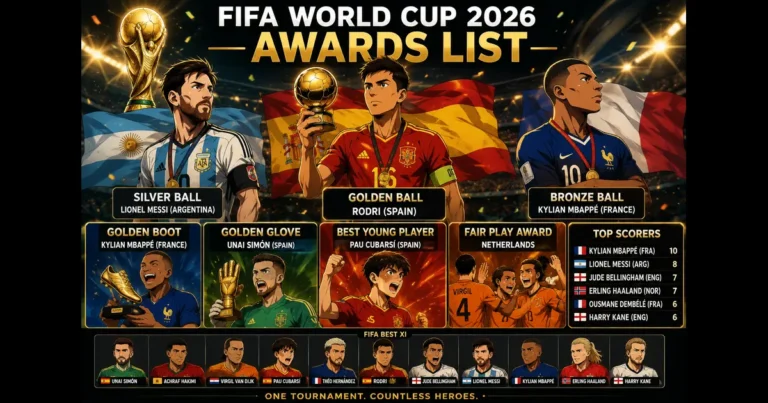
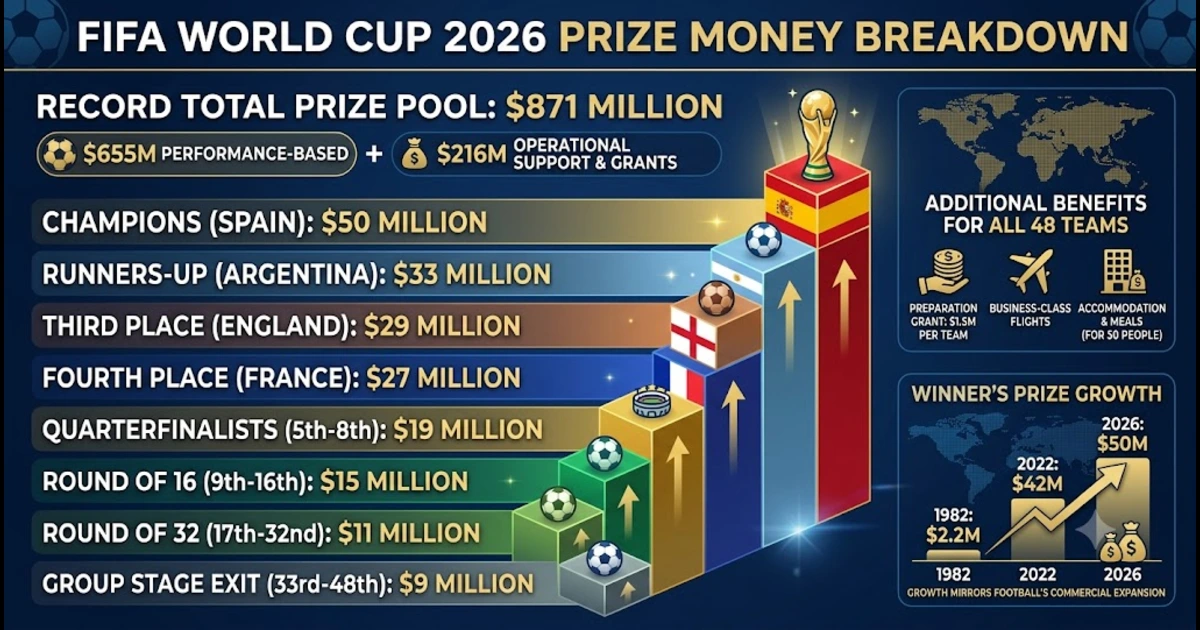
Now that the trophy has actually been lifted, the final FIFA World Cup 2026 prize money figures are confirmed: a record $871 million paid out across all 48 competing nations, with champions Spain collecting $50 million for their extra-time win over Argentina in Sunday’s final. Here’s exactly how that money broke down, stage by stage, and what it means in the context of the tournament’s history.
Spain Won the FIFA World Cup 2026: How La Roja Conquered the World Again
The Final Prize Pool Structure
FIFA’s confirmed payout structure for 2026 ran as follows:
| Stage | Prize Money |
|---|---|
| Champions (Spain) | $50 million |
| Runners-up (Argentina) | $33 million |
| Third place (England) | $29 million |
| Fourth place (France) | $27 million |
| 5th-8th place (quarterfinalists) | $19 million |
| 9th-16th place (round of 16) | $15 million |
| 17th-32nd place (round of 32) | $11 million |
| 33rd-48th place (group stage exit) | $9 million |
That performance-based pool totalled $655 million, with the remainder of the $871 million made up of preparation grants — $1.5 million paid to every one of the 48 qualified nations regardless of results — along with delegation expenses, travel assistance and other operational support FIFA covers directly.
Why the Total Jumped So Late
FIFA originally announced a $727 million total package back in late 2025, itself already a 50% increase on the $485 million distributed at Qatar 2022. That figure grew by more than $100 million in April 2026, after several European federations lobbied FIFA directly over the higher costs of competing across three host countries — the United States, Canada and Mexico — spread across a vastly larger geographic footprint than any previous single-host or dual-host tournament. France’s federation president, Philippe Diallo, was among those who reportedly pressed FIFA president Gianni Infantino on the issue directly, drawing comparisons to the nine-figure sums FIFA had guaranteed top European clubs to secure their participation in the revamped Club World Cup a year earlier.
What the Champions Actually Received
Spain’s $50 million headline payout — reported by some outlets as $51 million once additional components are included — dwarfs the $42 million Argentina collected for winning in Qatar four years earlier, and represents a jump of more than twenty-fold from Italy’s $2.2 million prize for winning the very first tournament with published prize figures, at the 1982 World Cup. That money is paid directly to the Royal Spanish Football Federation (RFEF) rather than to players individually; the RFEF is reported to allocate roughly 45% of the total toward player and staff bonuses, with the remainder supporting broader footballing operations and development programs.
Beyond the headline prize figure, FIFA also covers business-class return flights for every participating delegation, along with accommodation and meals for a 50-person travelling party from five days before a team’s opening match until one day after their elimination — benefits that apply regardless of prize money and represent a meaningful additional cost saving for every federation that qualified, not just the finalists.
How the Rest of the Bracket Was Paid
England’s $29 million third-place payout came after their wild 6-4 win over France in Saturday’s third-place playoff, while France collected $27 million for finishing fourth despite Mbappé’s individual heroics throughout the tournament. The USA, eliminated in the round of 16 by Belgium, took home a reported $15-16 million in performance-based prize money — notable for American fans specifically because U.S. Soccer’s collective bargaining agreements mean that prize money is split with the women’s national team as well, with 80% of the total divided between the rosters of both teams under the terms agreed in 2022.
The Bigger Financial Picture
Prize money, however record-breaking, is still only a fraction of what this World Cup actually generated. Broadcasting rights alone are projected to bring in close to $4 billion for FIFA from the 2026 cycle, with sponsorship revenue adding an estimated $1.8 to $2.8 billion on top of that, and matchday revenue from ticketing and hospitality forecast to jump as much as 220% compared with Qatar, driven by both higher ticket volumes and higher prices across the expanded, three-country format. Expanding the field from 32 to 48 teams pushed the total match count from 64 to 104 — 40 additional games worth of broadcast inventory, sponsorship placement and ticket sales for FIFA to sell, which goes a long way toward explaining how the federation was able to nearly double the total prize pool compared to just four years earlier.
Comparing the Payout Tiers
Looking at the full table, the gap between tiers tells its own story about how FIFA structured the incentives for this expanded format. The jump from group-stage elimination ($9 million) to surviving the round of 32 ($11 million) is a relatively modest $2 million — recognition that simply qualifying for the newly created round represents a real achievement in a 48-team field, but not one that should be rewarded too far out of proportion to a team’s actual tournament run. The gaps widen considerably further up the bracket: from the round of 16 ($15 million) to the quarterfinal ($19 million) is a $4 million jump, and from fourth place ($27 million) all the way to the champions’ $50 million is close to double. That steep late curve is deliberate, designed to make the difference between reaching a semifinal and actually winning the tournament as financially significant as the sporting stakes suggest it should be.
A Quick History of World Cup Prize Money
It’s worth remembering just how recent this level of prize money actually is in the context of the tournament’s near-century of history. FIFA didn’t begin publishing detailed prize figures until the 1980s, and Italy’s $2.2 million payout for winning in 1982 looks almost quaint set against Spain’s $50 million in 2026. Even relatively recent tournaments look modest by comparison — Brazil’s 2002-winning squad collected a fraction of what Spain took home this year, and Argentina’s own 2022 payout of $42 million, itself a record at the time, has already been surpassed by nearly 20% in just one World Cup cycle. The pace of that growth mirrors football’s broader commercial trajectory over the same period: bigger broadcast deals, larger sponsorship portfolios, and now, with the 48-team format, simply more matches to sell to global audiences than ever before.
Other Nations Worth Noting
Beyond the headline finishers, several other federations had reason to be pleased with their payouts once the full picture was accounted for. Norway, whose run to the quarterfinals included their stunning upset of Brazil, collected the $19 million reserved for the tournament’s final eight — a huge financial outcome for a footballing nation of Norway’s size, on top of the reputational boost of reaching that stage for the first time in decades. Morocco’s run through the round of 32, round of 16 and into the quarterfinal similarly delivered $19 million, turning what began as a surprise knockout run into a genuinely significant payday for the Moroccan federation. And Cape Verde, playing in their first-ever World Cup and eliminated in the round of 32, still walked away with $11 million — a transformative sum for one of the smallest football federations in the entire 48-team field, generated in no small part by the emotional, globally-watched run that captured neutral fans everywhere.
What This Means Going Forward
Spain’s triumph, adding to their 2024 European Championship win, gives the Royal Spanish Football Federation both the prize money itself and a substantial boost to its broader commercial position — new sponsorship interest, revalued existing partnerships, and increased global visibility for a playing squad that now includes some of the most marketable young talents in the sport, led by Lamine Yamal and Pau Cubarsí. For FIFA, the scale of this year’s prize pool and the underlying commercial revenue behind it sets a new baseline that future tournaments will likely be measured against, continuing a trajectory of rapid financial growth that shows little sign of slowing as the World Cup continues to expand in size and global reach.
The Bottom Line
From Italy’s $2.2 million payout in 1982 to Spain’s $50 million in 2026, the World Cup’s prize pool has grown at a pace that mirrors the sport’s broader commercial explosion over the past four decades. This tournament’s $871 million total, driven by an expanded field, record broadcasting interest, and direct lobbying from participating federations, marks the clearest evidence yet that as the World Cup keeps growing in scale, the money behind it keeps growing right alongside it.
🔹🔹 follow us on facebook 🔹🔹
About the Author