 Pelé’s Age in 2026: The Bittersweet Answer, and the Legacy That Outlives It
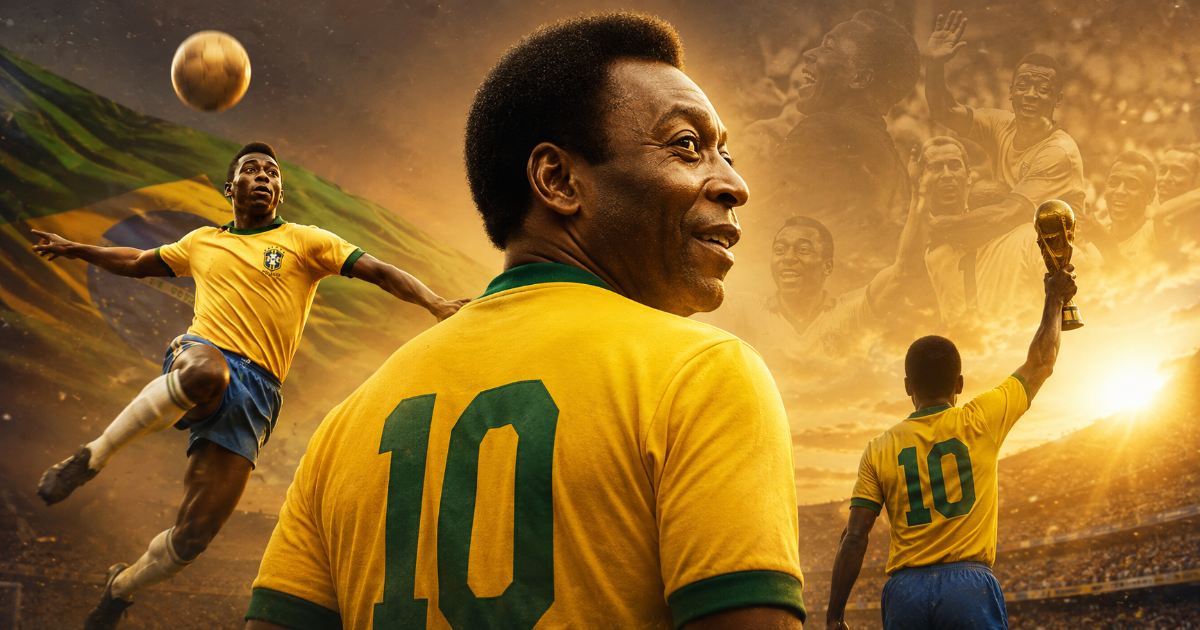
Type “Pelé’s age in 2026” into a search bar and the honest answer isn’t a number — it’s a date. Pelé, born Edson Arantes do Nascimento on October 23, 1940, in Três Corações, Brazil, passed away on December 29, 2022, at the age of 82, following complications from colon cancer. Had he lived to see 2026, he would have turned 85 this past October. Instead, the question of his age has quietly become a question about his legacy — how a man gone for nearly four years remains, by almost every measure, still the standard the sport measures itself against.
El Fenómeno: Why the Ronaldo Nazario Career Remains the Most Complete Journey in Football History
Messi World Cup Goals Record Hits 12, Passing Pele and Mbappe
Insidious: Out of the Further Trailer Review – Familiar Fears, Fresh Nightmares
The Numbers That Made Him “The King”
Pelé’s on-field record remains one of the most extraordinary in sports history, regardless of how much time has passed since his final match. He is the only player ever to win three FIFA World Cups as a player — 1958, 1962, and 1970 — a feat no other footballer has matched in the more than half-century since his final triumph in Mexico. He made his World Cup debut in 1958 at just 17 years old, scoring a hat-trick in the semi-final against France before adding two more in the final against host nation Sweden, instantly transforming a teenager into a global phenomenon.
Across his full career, the exact goal tally depends on which matches are counted — Brazil’s football confederation and Santos credit him with 1,283 goals in 1,367 matches, while FIFA’s own figure sits at 1,281 goals in 1,366 games. Whichever number is used, it remains one of the largest scoring records in the sport’s history, built primarily during an 18-year spell at Santos FC, where he scored 643 goals in 659 competitive appearances and famously netted 127 goals in the 1959 calendar year alone — still believed to be the most goals scored by a club player in a single year.
A Career That Redefined the Sport’s Reach
Pelé’s significance was never purely statistical. He is widely credited as the first true global icon of football, a player whose fame transcended the sport itself during an era when international broadcasts were still in their infancy. His move to the New York Cosmos in the mid-1970s is frequently cited as a pivotal moment in growing soccer’s popularity in the United States, decades before MLS existed. In 1999, the International Olympic Committee named him Athlete of the Century, a recognition that placed him above nearly every other athlete of his era, in any sport.
Why the Legacy Still Feels Present
Part of what makes Pelé’s continued cultural presence so striking is how frequently his records still surface in conversation, even in a sport that has since produced Diego Maradona, Lionel Messi, and Cristiano Ronaldo. Messi’s own pursuit of, and eventual surpassing of, various World Cup scoring benchmarks at the 2026 tournament repeatedly drew direct comparisons back to Pelé’s three-title haul, and Neymar’s equalling of Pelé’s Brazil goal-scoring record in 2022 was treated as a genuinely historic milestone in its own right — proof that Pelé’s name remains the reference point Brazilian football measures its greatest players against, even a player as decorated as Neymar.
His passing in December 2022 prompted a national outpouring of grief in Brazil, including a lengthy public memorial in Santos, the city where he built his club career. Tributes poured in from across the football world, with his daughter Kely Nascimento writing at the time, “Everything that we are, is thanks to you. We love you infinitely. Rest in peace” — a sentiment echoed by players, federations, and fans across dozens of countries who had never seen him play live, but grew up nonetheless in a sport he had fundamentally shaped.
What “Pelé’s Age” Really Means Now
Asking how old Pelé would be in 2026 is, in the end, a way of asking how long ago his era actually was — and the answer is a reminder of just how much football has changed since a 17-year-old scored twice in a World Cup final in 1958. Stadiums have transformed, broadcasting has gone global, transfer fees have reached previously unthinkable figures, and yet Pelé’s specific achievement — three World Cup titles as a player — has remained untouched for over five decades, outlasting entire eras of the sport’s evolution. He would have been 85 this year. His legacy, by every meaningful measure, hasn’t aged a day.
Messi to Saka: Every Hat-Trick Scored at FIFA World Cup 2026
🔹🔹 Follow Us on Facebook 🔹🔹
About the Author


1 thought on “Pelé’s Age in 2026: His Story, Legacy, and Lasting Records”