 The biggest surprises of Fifa World Cup 2026 ranged from Cape Verde’s fairytale run to Rodri beating Messi to the tournament’s top individual prize.
Beyond the individual shock results that reshaped the knockout bracket, this World Cup produced a series of broader storylines that caught even seasoned observers off guard — surprises in how the tournament was structured, who ended up on top of individual award races, and just how competitive the sport’s smallest footballing nations turned out to be. Here are the biggest surprises of the whole tournament.
15 Champions League Players to Watch in 2026/27: Superstars & Young Guns
NBA Schedule 2026-27: Christmas Day Rivalries, Ring Night and the Games to Watch
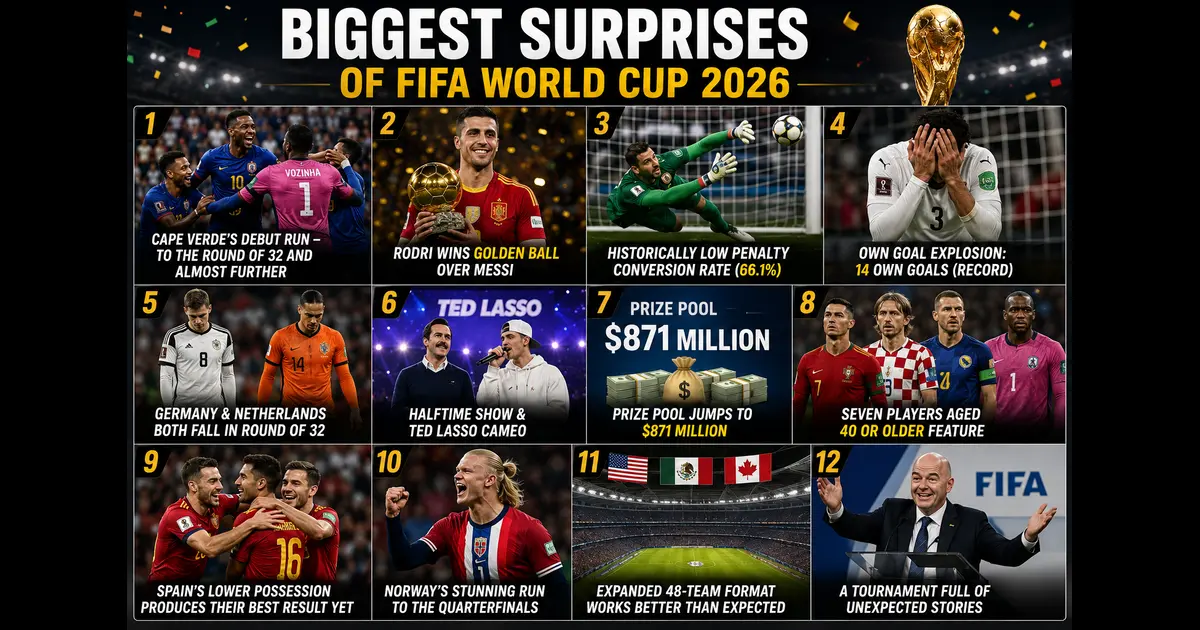
Cape Verde‘s Run to the Round of 32 — And Almost Further
Few storylines caught the football world’s imagination quite like Cape Verde’s debut World Cup campaign. A nation of roughly 600,000 people advanced from the group stage in their first-ever appearance, then took eventual runners-up Argentina all the way to extra time in the round of 32, with 40-year-old goalkeeper Vozinha producing eight saves — five of them directly denying Lionel Messi — before Cape Verde were finally eliminated. It’s the kind of run that, four years earlier in a 32-team format, might never have happened at all; the expanded field gave Cape Verde a route to the tournament that simply didn’t exist previously, and they made the absolute most of it.
Rodri Winning the Golden Ball Over Messi
Individual award voting rarely produces a genuine surprise at the very top, but Rodri’s Golden Ball win — ahead of Lionel Messi, who led the tournament in chances created and produced the two assists that turned Argentina’s semifinal against England — caught plenty of pundits off guard. It reflected a broader shift in how tournament panels are increasingly willing to reward structural, largely invisible defensive and tempo-setting influence over the kind of highlight-reel individual brilliance that’s defined most previous Golden Ball winners, from Maradona to Messi’s own award in 2014.
The Historically Low Penalty Conversion Rate
Few pre-tournament observers would have predicted that penalties — usually among the most reliably converted actions in football — would become one of this World Cup’s defining statistical stories. An overall conversion rate of just 66.1% across all 62 penalties taken, including shootouts, marked the lowest rate recorded since detailed record-keeping began in 1966. Even Lionel Messi and Kylian Mbappé, two of the most clinical finishers in the world, missed from the spot at various points in the tournament — a genuinely unexpected pattern given how routine penalty conversion had become at the elite level in recent years.
The Own Goal Explosion
Fourteen own goals broke the previous record of 12, set at the 2018 World Cup, and dwarfed the mere two recorded at Qatar 2022 just four years earlier. Egyptian defender Mohamed Hany became the first player in World Cup history to score two own goals in the same tournament, while the USA became just the second team ever to benefit from two separate own goals in a single edition. Few would have predicted, heading into the tournament, that this particular statistical quirk would nearly double its previous all-time high.
Germany and the Netherlands Both Falling in the Round of 32
The newly created round of 32 was always going to add an extra layer of unpredictability to the tournament, but few expected it to claim two European heavyweights within days of each other. Germany, four-time champions, lost to Paraguay on penalties; the Netherlands suffered an almost identical fate against Morocco. Both results reshaped the entire shape of the knockout bracket and stood as the earliest genuine confirmation that this expanded format would behave very differently from previous, more predictable 32-team tournaments.
The Halftime Show and a Ted Lasso Cameo
Few would have predicted that a World Cup final would feature an actual scripted halftime concert, let alone one that ran into procedural controversy and included a cameo from the fictional character Ted Lasso alongside Justin Bieber. The decision to stage a Super Bowl-style entertainment spectacle at the biggest match in the sport’s calendar was a genuine departure from World Cup tradition, and it became one of the most talked-about non-footballing storylines of the entire tournament.
The Prize Pool’s Late Jump to $871 Million
FIFA’s initial prize money announcement of $727 million already represented a major increase over Qatar 2022’s $485 million. Few anticipated that figure would grow by more than $100 million further in April 2026, after several European federations lobbied FIFA directly over the costs of competing across three host countries. The final $871 million total, and Spain’s resulting $50 million champion’s payout, ended up dwarfing even the most generous pre-tournament prize money projections.
Seven Players Aged 40 or Older Featuring
This tournament featured seven players aged 40 or above — including Cristiano Ronaldo, Luka Modrić, Edin Džeko, and Cape Verde’s own Vozinha — double the combined total from every previous World Cup in history. It’s a statistic that caught many by surprise given how physically demanding the expanded, 104-match format was widely expected to be, and it says something notable about how far sports science and player longevity have advanced even at the very highest level of the international game.
Spain’s Lower Possession Producing Their Best Result Yet
Perhaps the most tactically counterintuitive surprise of the entire tournament came from the eventual champions themselves. Spain’s average possession share at this World Cup was noticeably lower than either their 2018 or 2022 campaigns — tournaments that ended in earlier eliminations both times. Rather than signaling decline, that reduced possession reflected a deliberate tactical evolution toward faster, more direct verticality, and it produced Spain’s best World Cup result in sixteen years. For a football nation whose identity had been built for over a decade around maximizing time on the ball, winning with less possession than ever before was a genuinely unexpected way for this specific title to be secured.
Norway’s Run to the Quarterfinals
Beyond any single upset result, the broader surprise of Norway’s tournament was how sustainable it proved to be. A nation with no recent history of deep World Cup runs didn’t just beat Brazil in the round of 16 — they took England to the wire in the quarterfinal, playing organized, structurally sound football rather than simply riding a hot streak or a single moment of fortune. For a country many pre-tournament pundits had pegged as a solid group-stage side built around one generational talent in Erling Haaland, the collective depth and tactical discipline Norway showed throughout the knockout rounds caught much of the football world genuinely off guard.
The Expanded Format Working Better Than Expected
Heading into the tournament, a considerable amount of pre-tournament commentary focused on concerns that expanding to 48 teams would dilute overall quality, produce lopsided group-stage mismatches, and stretch player welfare past reasonable limits across a longer, more physically demanding format. While some of those concerns were borne out in specific moments, the broader surprise was how well the new structure actually functioned: record attendance figures, competitive matches even among lower-ranked debutant nations like Cape Verde and Curaçao, and a genuinely unpredictable knockout stage that produced more shocks, not fewer, than recent 32-team editions. Few predicted the expanded format would be received as positively as it ultimately was by the time the final was played.
The Bigger Picture
What connects these surprises is how differently each of them will be remembered depending on which part of the tournament a person paid closest attention to. Neutral fans who followed the knockout bracket will remember Germany and the Netherlands’ shock exits; those who followed individual storylines will remember Cape Verde’s run and Rodri’s Golden Ball; and casual viewers who tuned in mostly for the spectacle will likely remember the halftime show above almost anything that happened on the pitch itself. A tournament this large, spanning 104 matches across three countries, was always going to produce surprises at every level — and 2026 delivered them in genuinely unexpected places, on the pitch, in the awards ceremony, and in boardrooms negotiating prize money increases long after most fans had stopped paying attention to anything but the football itself.
About the Author