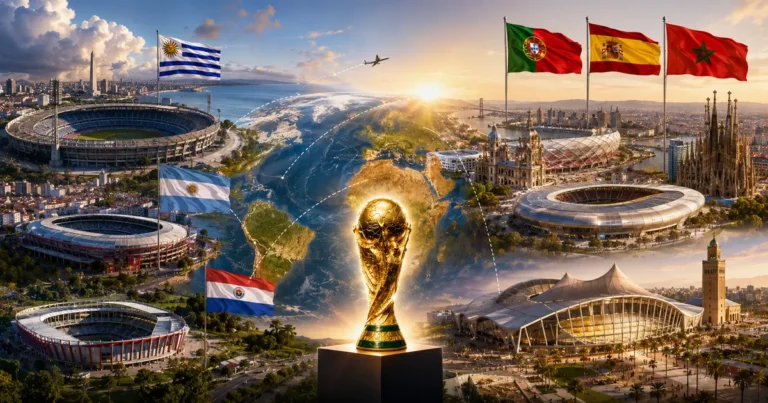
 Every World Cup cycle produces a handful of players whose career arc lines up almost too perfectly with the tournament calendar — too young to be the finished product this time around, but exactly the right age to be the finished product next time. With 2030’s centenary tournament set to span Morocco, Portugal, Spain, Uruguay, Argentina and Paraguay, here’s a scouting report on the best young players who could dominate World Cup 2030, built around the specific age window that tends to produce a player’s absolute peak.Top 20 Young Stars to Watch After the FIFA World Cup 2026
Why Age 23 to 27 Matters More Than Talent Alone
Before getting into individual names, it’s worth explaining the logic behind this list. Football’s history is full of teenage prodigies who never quite made the leap to genuine tournament dominance, and just as full of established stars who peaked a cycle too early or too late relative to a specific World Cup. The players most likely to actually dominate 2030 aren’t necessarily this year’s most hyped teenagers — they’re the players whose age in 2030 lines up with the 23-to-27 window that has historically produced the most complete versions of elite footballers: physically mature, tactically seasoned, and not yet on the decline curve that eventually catches up with everyone.
Lamine Yamal — Spain, Will Be 23
Start with the most obvious name on any list like this. Yamal enters 2030 not as a promising teenager but as a reigning World Cup winner with a Best Young Player runner-up finish already behind him, at an age — 23 — that sits squarely in the sport’s historical prime window. He’s already shown he doesn’t shrink from the biggest occasions, drawing the penalty that opened the scoring in Spain’s 2026 semifinal win over France and starting a World Cup semifinal as a teenager. By 2030, with four more years of Champions League and international experience layered on top of that foundation, Yamal projects as arguably the single most complete attacking talent set to enter that tournament.
Pau Cubarsí — Spain, Will Be 23
Cubarsí’s case is built on substance rather than hype. He didn’t just start every match of Spain’s World Cup-winning campaign in 2026 — he did it well enough to win FIFA’s Best Young Player award ahead of his own more heavily marketed teammate, anchoring a defense that conceded a single goal across eight matches. Center-backs typically peak slightly later than attackers, making Cubarsí’s projected age of 23 in 2030 arguably even more favorable for his specific position than it is for a winger or striker. If Spain’s defensive identity carries into the next cycle, Cubarsí is the most likely candidate to be its centerpiece.
Ayyoub Bouaddi — Morocco, Will Be 22
Bouaddi’s rise from relatively unknown Lille midfielder to a reported $100 million valuation happened almost entirely within a single tournament, and his underlying game — positional discipline, composure under pressure, genuine two-way contribution — is exactly the profile that tends to translate cleanly from one cycle to the next rather than fading once the shock value of a breakout tournament wears off. With Morocco co-hosting in 2030, Bouaddi could be entering the tournament as both a home player and one of the most sought-after midfielders in Europe, a combination that has historically produced some of the format’s most dominant individual campaigns.
Yan Diomande — Ivory Coast, Age Projection Favorable
Diomande’s rare statistical profile — becoming the first player this century to record ten-plus completed dribbles and ten-plus created chances across his first three World Cup matches — suggests a genuinely special level of one-on-one quality that tends to age well rather than decline sharply, provided his physical development continues on a normal curve. Whichever club ultimately wins the transfer battle currently being waged between Paris Saint-Germain and Liverpool will have four full years to build their attacking identity around him before 2030 arrives, and if that development goes as expected, Diomande projects as one of the most explosive wide players in the entire tournament field.
Désiré Doué — France, Will Be 25
Already Europe’s reigning Golden Boy heading into this cycle, Doué’s trajectory suggests his genuine ceiling may not even be fully visible yet. Scoring twice and assisting once in a Champions League final at PSG is not the résumé of a player still finding his level — it’s the résumé of someone already performing at an elite standard who simply needs the accumulated tournament experience that comes with time. At 25 in 2030, sitting comfortably inside the sport’s prime years, Doué could be the attacking focal point of a French squad that has reached the final four in four of the last five major tournaments.
Warren Zaïre-Emery — France, Will Be 24
Few players anywhere in world football combine Zaïre-Emery’s positional versatility with his sheer accumulated experience at such a young age — more than 180 competitive matches for PSG before turning 21. That kind of game-time typically produces a tactical maturity that shows up most clearly in exactly the pressure-cooker moments a World Cup tends to create. At 24 in 2030, with several more seasons of continued development behind him, Zaïre-Emery projects as one of the most tactically complete midfielders of his generation.
Antonio Nusa — Norway, Will Be 25
Nusa’s breakout campaign for Norway this summer, combined with the concrete transfer interest it has already generated from clubs like Tottenham, suggests a player whose talent is finally being matched by the platform to showcase it consistently. At 25 in 2030, with four years at a genuinely ambitious club likely to sharpen his end product, Nusa has a real case as one of the tournament’s most dangerous wide attacking threats — assuming Norway itself can navigate qualifying for a tournament the nation has historically struggled to reach.
Kenan Yildiz and Arda Güler — Turkey, Both Approaching Peak Years
Turkish football’s two brightest attacking exports both enter this conversation with genuinely favorable timelines. Yildiz’s game — close control, composure in tight spaces, end product beyond his years — continues to develop inside one of Europe’s most demanding footballing environments at Juventus, while Güler’s technical range and set-piece quality have long marked him as one of the most gifted players to emerge from Turkish football in a generation, even as he continues fighting for consistent minutes in a stacked Real Madrid attack. Both project as genuine difference-makers for Turkey by 2030, assuming continued first-team development between now and then.
The Wildcard Tier: Names Still Too Early to Fully Project
A handful of names deserve mention specifically because their trajectories remain harder to project with confidence, even if the early signs are promising. Lennart Karl, still just 17, has already turned heads at Bayern Munich with an early scoring output that draws comparisons best left unnamed at this stage of his career — by 2030, at 21, he’ll be right at the edge of the sport’s prime window, making him one of the more fascinating long-term projections on this entire list. Geovany Quenda’s directness and finishing instincts at Sporting have already made him a full senior international, and a rumored move to one of Europe’s superclubs before 2030 could accelerate his development considerably faster than a normal development curve would suggest.
What Connects This Group
What’s striking about compiling a list like this is how clearly it maps onto broader footballing geography. Spain’s academy pipeline continues to produce elite talent at a rate no other footballing nation currently matches, France’s production line shows no signs of slowing regardless of which generation departs, and emerging football nations — Morocco, Ivory Coast, Norway — are increasingly producing individual talents capable of competing with the traditional powers on pure ability alone. If even half of the names on this list develop as their current trajectories suggest, World Cup 2030 could feature one of the most talented concentrations of prime-age players the tournament has ever assembled in one place. Four years is a long time in football, and plenty will change between now and then. But as early scouting reports go, the names above represent about as strong a starting point as the sport can currently offer.
About the Author