BMO Field World Cup 2026 Guide: Canada’s Historic Opener, CN Tower Views & Toronto’s Football Fever
On June 12, 2026, Canada plays their first home World Cup match. Ever. In Toronto. At BMO Field. Against Bosnia and Herzegovina. The most multicultural country in the world hosts the most global tournament in sport — and it does it here, on the western shore of Lake Ontario, in a city where 180 languages are spoken before kick-off.
The World Cup has found its perfect city.
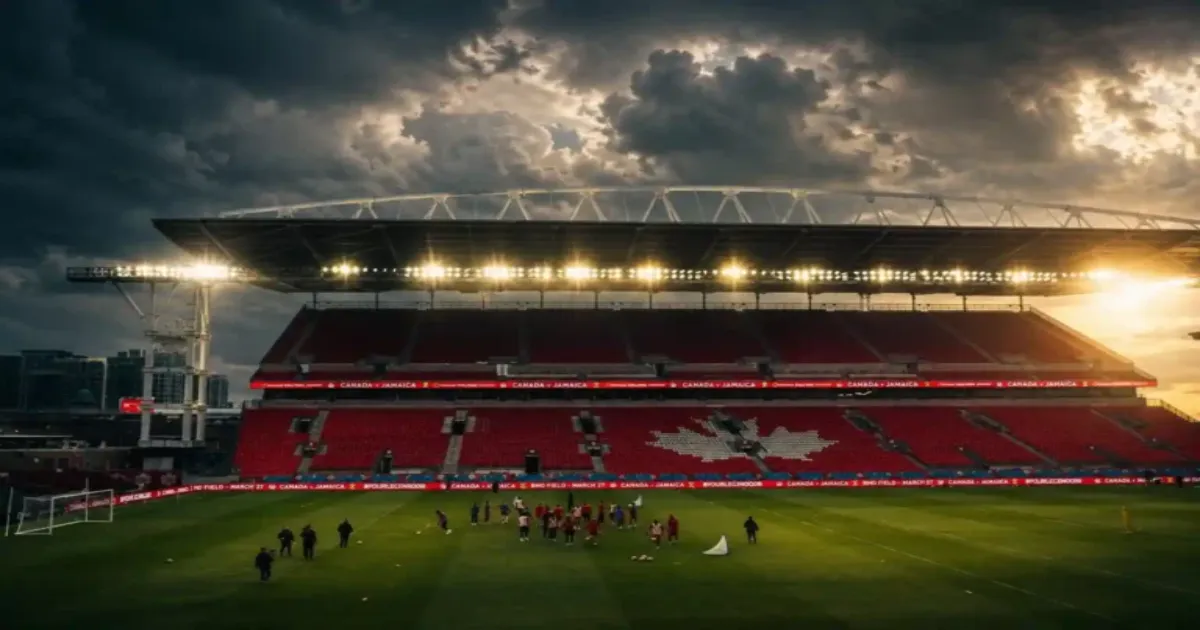
A Nation’s First Home World Cup Match
Let us establish exactly what June 12, 2026 represents for Canadian football.
Canada qualified for its first World Cup since 1986 at Qatar 2022. Before that, there had been 36 years of hurt, near-misses, and quiet ambition in a country where ice hockey is religion and football has always been the immigrant’s game — the sport that the millions who came from Europe, the Caribbean, West Africa, East Asia, and Central America brought with them, and which has only in the last decade found its way into the national sporting consciousness.
Canada opens its tournament here against Bosnia and Herzegovina on June 12, with the stadium’s capacity temporarily expanded to 45,736 seats and renamed Toronto Stadium for the event.
It is the first time a men’s national team has played a World Cup match on Canadian soil. And it is happening in Toronto — the most diverse city in the world, where 52% of the population was born outside Canada.
There is no better place on earth for this match to take place.
Stadium Snapshot
| Official FIFA Name | Toronto Stadium |
| Commercial Name | BMO Field |
| Location | 170 Princes’ Blvd, Exhibition Place, Toronto, ON M6K 3C3 |
| Opened | 2007 (expanded multiple times since) |
| Standard Capacity | ~30,000 (MLS configuration) |
| World Cup Capacity | 45,736 (temporary north and south stands added) |
| World Cup Matches | 6 — five group stage + Round of 32 |
| Canada Match in Toronto | June 12 ONLY — other Canada matches are in Vancouver |
| Home Teams | Toronto FC (MLS), Toronto Argonauts (CFL), Canada national teams |
| FIFA Name Note | Renamed Toronto Stadium — commercial names not permitted |
| Transit | GO Train to Exhibition Station + TTC 509/511 streetcar |
| Visa Note | No US visa required — Canadian eTA only |
The Critical Fan Planning Note: Canada Only Plays Once Here
Most fans think the entire Canadian group stage happens in Toronto. It doesn’t. Only the historic opener is here; the other two are in Vancouver. That single fact reshapes travel plans for thousands.
If you are planning to attend all of Canada’s group matches, you need to be in Toronto for June 12 and Vancouver for June 18 and June 24. These cities are a five-hour flight apart. Plan accordingly — book accommodation and flights for both cities if you want the full Canadian group-stage experience.
The Match Schedule at Toronto Stadium
BMO Field will host six FIFA World Cup 2026 matches: five group stage games and one Round of 32 knockout fixture between June 12 and July 2, 2026:
| Round | Date | Time (ET) | Match |
|---|---|---|---|
| Group L | June 12, 2026 | 3:00 PM | Canada vs Bosnia and Herzegovina |
| Group E | June 16, 2026 | TBC | Curaçao vs Germany |
| Group L | June 20, 2026 | TBC | Germany vs Ivory Coast |
| Group Stage | June 23, 2026 | TBC | TBC |
| Group Stage | June 26, 2026 | TBC | TBC |
| Round of 32 | July 2, 2026 | TBC | TBC |
Six matches. One historic. The Canada opener on June 12 is the most emotionally significant domestic sporting event in Canadian football history.
The Transformation of BMO Field
BMO Field in its standard MLS configuration holds approximately 30,000 people — more than adequate for Toronto FC but well below FIFA’s minimum requirements for a World Cup venue. The solution: temporary stands.
The temporary stands aren’t just about capacity — they dramatically change the acoustics. Sound that used to escape through the open ends now bounces around a closed bowl. Expect noise levels unlike anything BMO Field has produced before.
At 45,736, Toronto Stadium becomes a proper international football arena — smaller than the American venues but intimate in the way that Europe’s great club grounds are intimate: close, steep, loud, and deeply connected to the action on the pitch.
The Lake Ontario shoreline sits directly behind the stadium’s southern stand. On a clear June evening, with the CN Tower visible to the northeast and the lake glimmering behind the goal, BMO Field in World Cup configuration is one of the most beautiful settings for football in the tournament.
Getting There: Toronto’s Transit Network
Toronto’s transit system — a combination of subway, streetcar, GO commuter rail, and bus — serves the stadium efficiently, and FIFA strongly recommends it over driving for all World Cup matches.
By Streetcar (Primary Option): Take Line 1 (subway) to Union Station, then TTC 509/511 streetcar west to Exhibition Loop — a direct station at the stadium. Journey from Union Station: approximately 15 minutes. The 509 Harbourfront and 511 Bathurst routes both serve Exhibition Loop.
By GO Train (For Commuters and Out-of-Town Fans): The first option is to take a GO Train directly to the Exhibition GO Station inside the stadium. For fans staying in suburban Toronto, Hamilton, Mississauga, or Brampton, GO Train service directly to the stadium’s doorstep is the most efficient option available.
By Car: The cost of parking ranges from $15 to $30, depending on how far you are willing to walk. Due to the anticipated crowds during World Cup matches, tailgating is not allowed on tournament gamedays. When using a rideshare service, direct your driver to drop you off and pick you up at the designated zone located in the Green Lot near the Southeast entrance.
From Pearson International Airport (YYZ): UP Express from Pearson Airport Terminal to Union Station (25 minutes, CAD $12.35) → TTC 509/511 streetcar to Exhibition Loop (~15 minutes). Total journey: 40–45 minutes. This is the cleanest airport connection of any Canadian World Cup venue.
Visa Note: Attending World Cup 2026 games at Toronto Stadium does not require a US visa. Fans from visa-exempt countries need only a Canadian eTA (electronic Travel Authorization). This includes most of Europe, Australia, New Zealand, Japan, South Korea, and dozens of other nations.
Toronto: The Most Diverse City on Earth
Toronto is, by objective measure, the most ethnically diverse large city in the world. More than 52% of its population was born outside Canada. Over 180 languages are spoken within its boundaries. Its neighbourhoods — Little Portugal, Little Italy, Chinatown, Greektown, Koreatown, Little India, the West Indian community of Scarborough, the Portuguese community of Kensington Market — represent a kind of United Nations of culinary and cultural experience that no other World Cup host city can approach.
For an international football tournament involving 48 nations from every confederation, Toronto is not just a host city. It is a preview of the world that football represents.
Must-Visit Landmarks
CN Tower At 553 metres, it was the world’s tallest freestanding structure for 32 years (1975–2007). The glass-floor observation deck at 342 metres is vertigo-inducing and unforgettable. The EdgeWalk — a hands-free walk around the outside of the tower’s main pod, 356 metres above the street — is available for the brave. The revolving restaurant has views of Lake Ontario and the Toronto Islands that, at sunset, are genuinely spectacular.Lumen Field World Cup 2026: Why Seattle Could Deliver the Tournament’s Most Electrifying Atmosphere
Ripley’s Aquarium of Canada At the base of the CN Tower, the aquarium houses one of North America’s most impressive shark collections, a 94-metre underwater tunnel, and a touch-tank for rays and horseshoe crabs. An essential family destination and surprisingly captivating for adults.
Toronto Islands A cluster of small islands in Lake Ontario, accessible by a 10-minute ferry from the foot of Bay Street. Centre Island has an amusement park, beaches, and bicycle rentals. Hanlan’s Point (at the western tip) has the city’s only nude beach and the best view of the downtown skyline available from the water. On a warm June afternoon, an hour on the Toronto Islands is the finest thing you can do in this city.
Distillery District A Victorian industrial complex converted into a pedestrian-only neighbourhood of galleries, studios, restaurants, and boutiques. The cobblestones, red brick, and industrial architecture make it the most photogenic neighbourhood in the city. Pre-match and post-match dining here, away from the stadium crowds, is a sophisticated choice.
Royal Ontario Museum (ROM) One of the largest museums in North America: Egyptian mummies, a Chinese tomb, Canadian natural history, Inuit and Indigenous art, European decorative arts, and the legendary Crystal addition — Daniel Libeskind’s jagged glass and aluminium extrusion from the building’s original Edwardian facade. Free on the first Tuesday of the month.
Kensington Market Toronto’s most characterful neighbourhood: a dense block of vintage clothing stores, cheese shops, fishmongers, bakeries, Caribbean spice shops, Mexican taquerias, and Ethiopian coffee houses. The city at its most honest, most affordable, and most alive. Go on a Saturday morning.
Toronto Food: A World in a City
Toronto’s food culture is, simply, the most diverse on earth. It is not the most polished (New York) or the most progressive (San Francisco) or the most historic (Mexico City) — but it is the most comprehensively global, and for a World Cup with 48 nations and fans from every corner of the planet, that matters.
Peameal Bacon Sandwich Toronto’s signature food. Peameal bacon — back bacon rolled in cornmeal, a Toronto invention from the 1800s — is served on a kaiser roll with or without mustard. The Carousel Bakery in St. Lawrence Market has been serving what is widely considered the definitive version since 1977. St. Lawrence Market itself, open Tuesday through Saturday, is the best food market in Canada. The weekend farmers’ market on Saturdays is extraordinary.
Portuguese Food, Little Portugal Toronto’s Portuguese community arrived primarily in the 1960s and built a neighbourhood around Dundas Street West that still serves some of the most honest, exceptional Portuguese food in North America. Bacalhau (salt cod), piri-piri chicken, and pastéis de nata (custard tarts) at Chiado or the dozens of cafés on Dundas West. This is the neighbourhood for fans from Portugal, Spain, and Brazil to feel a warm cultural continuity.
Dim Sum, Chinatown Toronto’s Chinatown on Spadina Avenue is one of the largest in North America, and the dim sum culture here is excellent. King’s Noodle for roast duck and BBQ pork; Swatow for late-night noodle soups; Casa Imperial for formal weekend dim sum with pushcart service.
Ethiopian and East African Food Toronto has a significant Ethiopian community, concentrated in the area around Danforth and Bloor. Injera — spongy fermented flatbread — served with berbere-spiced stews, lentils, and salads eaten communally by hand. For fans arriving from East Africa to support teams including Ethiopia, Kenya, or South Africa, this is the neighbourhood that feels like home.
Caribbean Food, Scarborough The eastern suburb of Scarborough is the heartbeat of Toronto’s Caribbean community — Jamaican patties, jerk chicken, roti, and curry goat at spots along Eglinton Avenue East and Scarborough’s strip malls. Randy’s Patties, Golden Beef Patty and dozens of home-style Jamaican restaurants provide some of the most value-driven, flavour-dense eating in the city.
Korean Food, Koreatown Bloor Street West between Christie and Bathurst: Korean BBQ, Korean fried chicken, kimchi jiggae, and bingsu (shaved ice dessert) at a density of restaurants that rivals any Koreatown in North America. Open late, affordable, and exceptional.
Roti and South Asian Food, Little India Gerrard Street East — known as the Gerrard India Bazaar — is the longest South Asian commercial strip in North America. Roti from Gandhi Roti, biryani, chaat, and mithai (Indian sweets) available at dozens of restaurants and shops. For fans from India, Pakistan, Sri Lanka, and Bangladesh attending World Cup matches in Toronto, this neighbourhood is a cultural return.
The Fan Festival: Fort York and The Bentway
The official Toronto FIFA Fan Festival sites are Fort York National Historic Site and The Bentway — offering free match screenings, food, live music, and family activities.
A suggested Toronto World Cup day looks like this: Morning: Explore Fort York National Historic Site → Afternoon: Fan Fest at The Bentway, live entertainment, CN Tower backdrop → Pre-match: Board TTC 509/511 streetcar or walk 8–10 minutes to BMO Field → Match: Canada’s opener, 3:00 PM ET → Post-match: King West/Entertainment District for celebrations.
Fort York — the site of the Battle of York in 1813, where American forces burned the city’s government buildings and Canadians subsequently burned the White House in retaliation — is a piece of North American history sitting five minutes from a football stadium. The Bentway, a public space built beneath the Gardiner Expressway, has become one of Toronto’s most innovative cultural venues: an arts and events space hidden in the infrastructure of the city.
Together, they give Toronto’s World Cup street-level experience a depth and character that the larger American venues, for all their scale, cannot match.
What to Wear in Toronto
Toronto in June is genuinely warm and pleasant — one of the most comfortable climates for World Cup football in the tournament.
- Typical June temperatures: 18–25°C (65–77°F). Warm afternoons, comfortable evenings.
- Rain: Summer thunderstorms are common in Toronto — they arrive fast and leave fast. A lightweight waterproof layer is a sensible addition.
- Match Day: National team colours are everywhere and celebrated. A half-and-half scarf mixing Canadian and opposing nation colours is the ultimate Toronto souvenir.
- City Exploring: Toronto is a walking and cycling city in summer. Comfortable shoes, layers, sunglasses.
Cultural note: Toronto is one of the most polite, welcoming major cities in the world. The cliché of Canadian friendliness is grounded in observable reality — particularly toward international visitors. Ask for directions and you will likely be accompanied to your destination. This is a city that is genuinely pleased you are here, and it will show.
About the Author




1 thought on “Toronto World Cup 2026 — BMO Field, Six Matches & the Most Multicultural Fan Experience on Earth”