BC Place Stadium World Cup 2026 Guide: Mountains, Ocean and Football in Canada’s Most Beautiful Host City
Look east from BC Place on a clear morning and you will see the snow-capped Coast Mountains rising from the edge of the city. Look west and you will see the Pacific. Between them sits Vancouver — the only World Cup host city on earth where you can kayak at sunrise, watch a match at noon, and ski a glacier in the afternoon.
This is not hyperbole. This is a Tuesday in June.
The City That Cannot Help Being Beautiful
Every World Cup host city brings something to the tournament. Dallas brings scale. Los Angeles brings glamour. Mexico City brings history.
Vancouver brings something none of the others can: a landscape so extravagant, so improbably gorgeous, that visiting football fans have consistently reported feeling vaguely offended by how beautiful a city is allowed to be.
Set between the Pacific Ocean and the Coast Mountains, Vancouver is arguably one of the most scenic host cities at this year’s FIFA World Cup. It is also one of the most liveable — a city of cycling infrastructure, world-class public transit, a multicultural food culture that reflects the 180 nationalities who call it home, and an event-hosting legacy that includes the 2010 Winter Olympics.
The city has also staged major international events including the 2010 Winter Olympics, the FIFA Women’s World Cup final in 2015, rugby sevens tournaments, and numerous international football matches.
And unlike either of Canada’s other two tournament venues — Toronto to the east — it retains one of the great architectural distinctions of the 2026 FIFA World Cup: BC Place is one of two stadiums in the entire tournament that retains its existing name, rather than being rebranded by FIFA. The Azteca is the other. In a tournament of renamed buildings, BC Place stands proudly as itself.
Stadium Snapshot
| Official FIFA Name | BC Place (retains its name — one of only 2 in the tournament) |
| Location | 777 Pacific Blvd, Vancouver, BC V6B 4Y8, Canada |
| Opened | 1983 |
| Roof | Retractable — fully climate-controlled when closed |
| Standard Capacity | 54,500 |
| World Cup Capacity | 54,000 |
| World Cup Matches | 7 — five group stage + Round of 32 + Round of 16 |
| Canada Matches | 2 — Group B: June 18 (Canada vs Qatar) + June 24 (Canada vs Switzerland) |
| Home Teams | Vancouver Whitecaps (MLS), BC Lions (CFL) |
| Entry Requirement | No US visa needed — Canadian eTA sufficient for most nationalities |
| SkyTrain | Use Main Street–Science World Station (NOT Stadium-Chinatown — CLOSED on match days) |
The Match Schedule at BC Place
BC Place hosts five group stage fixtures across June 12–26, plus one Round of 32 and one Round of 16 match:
| Round | Date | Time (PT) | Match |
|---|---|---|---|
| Group D | June 12, 2026 | 9:00 PM | Australia vs Türkiye |
| Group B | June 18, 2026 | 3:00 PM | Canada vs Qatar |
| Group G | June 21, 2026 | 6:00 PM | New Zealand vs Egypt |
| Group B | June 24, 2026 | 12:00 PM | Canada vs Switzerland |
| Group G | June 26, 2026 | 8:00 PM | New Zealand vs Belgium |
| Round of 32 | July 2, 2026 | 8:00 PM | TBC |
| Round of 16 | July 7, 2026 | 1:00 PM | TBC |
Seven matches. Two Canada home games. The Round of 16 is the highest-stakes fixture at BC Place — the last venue in Canada to host a knockout match before every game moves to American soil.
The Transit Alert Every Fan Must Read
This is the single most important logistical fact for every fan attending a match at BC Place:
Stadium-Chinatown SkyTrain Station is CLOSED to fans on all World Cup match days. Transit apps and general travel guides will show Stadium-Chinatown as the closest station to BC Place. On match days, access from that station to the stadium is not permitted. The only correct station is Main Street–Science World (Expo Line). From there, follow the designated Last Mile pedestrian route through Concord Lands to the stadium entrance — approximately 10–15 minutes on foot.
Do not rely on Google Maps or a transit app to navigate you to BC Place on match days. Use Main Street–Science World. Walk west. Follow the signage.
All Transit Options:
- SkyTrain Expo Line → Main Street–Science World Station (only match-day option from the east)
- Canada Line → Yaletown-Roundhouse Station (10-minute walk to stadium)
- Bus routes 17, 19, N8 — serve downtown core, stops within 5 minutes of stadium
- Vancouver is one of North America’s easiest host cities to navigate without a car. The SkyTrain network links downtown with Vancouver International Airport in around 25 minutes.
From Vancouver International Airport (YVR): Canada Line SkyTrain from YVR International Station → Yaletown-Roundhouse → 10-minute walk to BC Place. Journey time: approximately 30 minutes. Cost: approximately CAD $10.45.
From Seattle: Three-hour drive north on Highway 99 through the Peace Arch border crossing. Allow additional time for border processing, which can be significant during the tournament. Amtrak Cascades runs twice daily between Seattle and Vancouver (2h46m by rail — the beautiful route along Puget Sound). Book in advance.
Visa Note: Attending World Cup 2026 games at BC Place does not require a US visa. Toronto is in Canada. Fans from visa-exempt countries need only a Canadian eTA (electronic Travel Authorization). This makes Vancouver and Toronto the easiest points of entry for international fans who wish to attend North American World Cup matches without dealing with US immigration.
The BC Place Experience
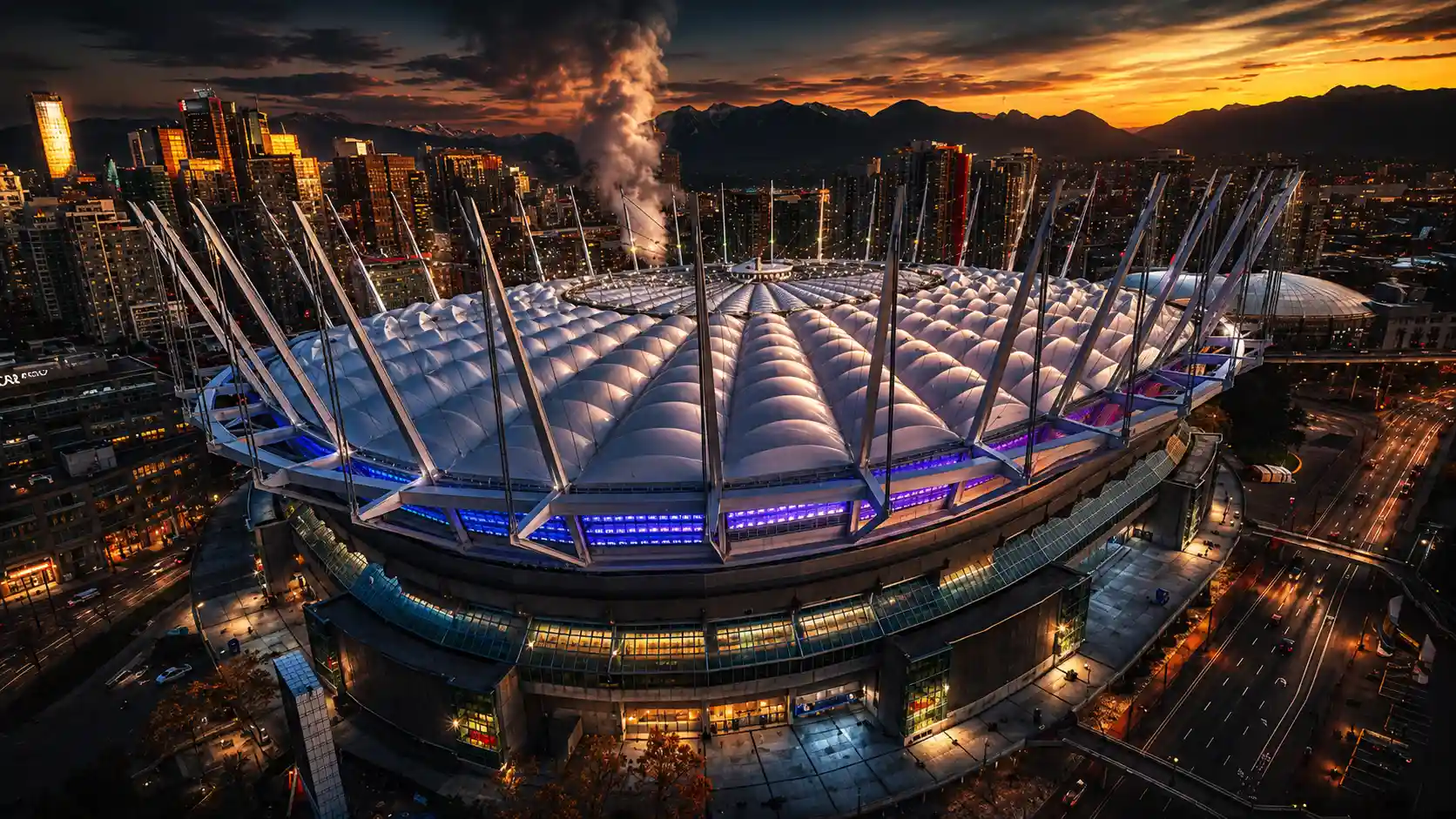
BC Place opened in 1983 as the largest air-supported domed stadium in the world at the time — a massive inflatable roof held up by pressurised air. In 2011, the stadium was completely renovated: the air roof replaced with a retractable PTFE fabric roof (one of only four such structures in North America), new seats installed throughout, and the playing surface upgraded.
For the 2026 World Cup, the retractable roof gives BC Place a weather advantage that few of the North American venues can match. Vancouver in June and July is pleasantly warm but can bring rain — the roof means weather is never a concern. The stadium can be fully open for sunny afternoon matches and closed for wet evenings, all within minutes.
The enclosed-when-closed acoustic environment creates an atmosphere unlike any outdoor stadium — sound builds and circulates inside the bowl in a way that stadium architects spend years trying to replicate in open venues. For Canada’s two home matches — June 18 and June 24 — with the roof closed and 54,000 Canadian supporters pressed into that acoustic space, the experience will be extraordinary.
Vancouver: The City Between Mountains and Sea
The Great Outdoors — Literally Around the Corner
Stanley Park A 1,001-acre temperate rainforest park at the tip of the downtown peninsula — larger than Central Park, bordered on three sides by the Pacific. The 8.8km seawall around its perimeter is one of the great recreational walks in world travel: old-growth Douglas firs on one side, container ships and the North Shore mountains on the other. Rent a bicycle from the shops on Denman Street for the full circuit.
Capilano Suspension Bridge Suspended 70 metres above the Capilano River gorge, this 140-metre bridge in North Vancouver has been attracting visitors since 1889. The adjacent Cliffwalk — a series of cantilevered walkways extending from the cliff face above the river — was added in 2011. Access by shuttle from downtown Vancouver.
Grouse Mountain Accessible via the Gondola from North Vancouver (15 minutes by car from downtown, 30 minutes by transit), Grouse Mountain in June and July offers: hiking trails above the tree line, a resident grizzly bear habitat, paragliding, zip lines, and mountain biking. The views of Vancouver, the Fraser River delta, and the Gulf Islands from the summit on a clear day are among the finest urban panoramas in Canada.
Whistler (Day Trip) The Sea-to-Sky Highway north of Vancouver is one of the great drives in North America: 120km of coastal fjord, granite walls, and boreal forest leading to Whistler — Canada’s premier ski resort and the site of the 2010 Winter Olympics. In summer, Whistler pivots to mountain biking, hiking, and gondola rides. A day trip from Vancouver is absolutely worthwhile.
Granville Island An island accessible by public ferry from the foot of Hornby Street, Granville Island houses the Public Market (fresh produce, seafood, artisan products), a working brewery, glass-blowing studios, theatre companies, and a floating community of artists. The market is the cultural heart of Vancouver’s food scene — arrive hungry.
The Neighbourhoods
Gastown Vancouver’s oldest neighbourhood, built around the famous steam clock on Water Street. Cobblestones, Victorian brick buildings, independent restaurants and bars. The best introduction to the city for first-time visitors.
Yaletown Former warehouse district transformed into the city’s most fashionable neighbourhood: boutique hotels, cocktail bars, patio restaurants, and a waterfront Seawall connection to the stadium. Walking distance to BC Place.
Commercial Drive (The Drive) Vancouver’s bohemian, multicultural main street: Italian cafés alongside Ethiopian restaurants alongside Colombian bakeries. During the World Cup, The Drive’s football-watching culture — always significant, given Vancouver’s diverse Latin American and European communities — will become one of the great public gathering experiences of the entire tournament.
Richmond — The Food City The suburb directly south of Vancouver is home to one of the world’s great concentrations of Chinese, Hong Kong, and Taiwanese restaurants. The Richmond Night Market (open May–October) is the largest outdoor night market in Canada — hundreds of food vendors, live entertainment, and the kind of cheap, extraordinary eating that food writers travel thousands of miles to find.
Vancouver Food: Pacific Edge Dining
Vancouver’s food culture is one of the finest in North America — a natural larder combining Pacific seafood, Pacific Rim culinary influences, and a multicultural restaurant community that encompasses over 180 nationalities.
Pacific Salmon Wild Pacific salmon — sockeye, chinook, coho — is at its peak in June and July. At Rodney’s Oyster House on Hamilton Street, at the Granville Island Public Market’s seafood counters, and at dozens of neighbourhood restaurants across the city, it is available smoked, poached, grilled, and served in sushi. No visitor to Vancouver should leave without eating it at least once.
Sushi and Japanese Food Vancouver has one of the finest Japanese food cultures outside of Japan, driven by a substantial Japanese-Canadian community and proximity to Japan via the Pacific. Miku (Robson Street) for the signature aburi (flame-seared) sushi that Vancouver created. Tojo’s (Broadway) for the chef who is widely credited with inventing the California roll.
Chinese and Cantonese Cuisine Richmond’s Chinese restaurant concentration is unmatched outside of Hong Kong and mainland China. Kirin Seafood Restaurant and Fisherman’s Terrace for dim sum; Parker Place Food Court for affordable Taiwanese and Cantonese street food. International fans arriving from East Asia will feel an immediate culinary continuity.
Japadog A Vancouver original: hot dogs topped with Japanese ingredients — teriyaki sauce, nori, daikon, bonito flakes. There are brick-and-mortar locations on Burrard Street, but the original street cart on Burrard and Smythe is where to find them. A $7 Japadog standing on a Vancouver street corner is one of the quintessential modern Canadian food experiences.
Tim Hortons No guide to Canadian food is complete without acknowledging the country’s national coffee chain. A double-double (two cream, two sugar) and a Timbit (doughnut hole) at a Tim Hortons is as Canadian as it gets. There are multiple locations within walking distance of BC Place. International fans will either love it or understand it as a cultural artefact — either is valid.
Poutine Canada’s national dish: french fries, cheese curds, and brown gravy. It originated in Quebec but has spread to every corner of the country. La Belle Patate on Davie Street serves what Vancouverites consider the finest poutine west of Montreal.Jonathan David, Alphonso Davies, and Canada’s Once-in-a-Generation World Cup Chance: Canada 2026 World Cup
What to Wear in Vancouver
Vancouver in June and July: air is fresh, evenings cool, and rain showers are possible even if days can be clear and sunny.
- Typical June/July temperatures: 18–24°C (65–75°F). Warm during the day, cool evenings.
- Rain: More likely than Seattle in June. Pack a compact waterproof jacket — this is the Pacific Northwest, and the Coast Mountains create their own weather patterns.
- Indoor stadium advantage: When the BC Place roof is closed for rain, the temperature inside is comfortable and the acoustics magnificent. Layers are still recommended.
- City exploring: Smart-casual, layers. Vancouver is a cycling and walking city — comfortable footwear is essential.
Fan Zones & World Cup Atmosphere
The official FIFA Fan Festival will be held at Hastings Park’s PNE grounds, where giant screens, live entertainment, cultural programming, and food vendors will create a tournament atmosphere throughout the competition. Additional public viewing events and activations are planned across the city, including at popular destinations such as Granville Island.
The FIFA Fan Festival at Hastings Park gives Vancouver one of the most spacious, park-set fan festival environments of any host city. Combined with the Granville Island viewings and the neighbourhood watch parties along Commercial Drive, Vancouver’s World Cup street-level experience will extend far beyond the stadium’s 54,000 seats.
About the Author








1 thought on “Vancouver World Cup 2026 — BC Place Stadium, 7 Matches & the Most Scenic FIFA Journey You’ll Ever Take”