Brazil 1-7 Germany: A Night No One Saw Coming
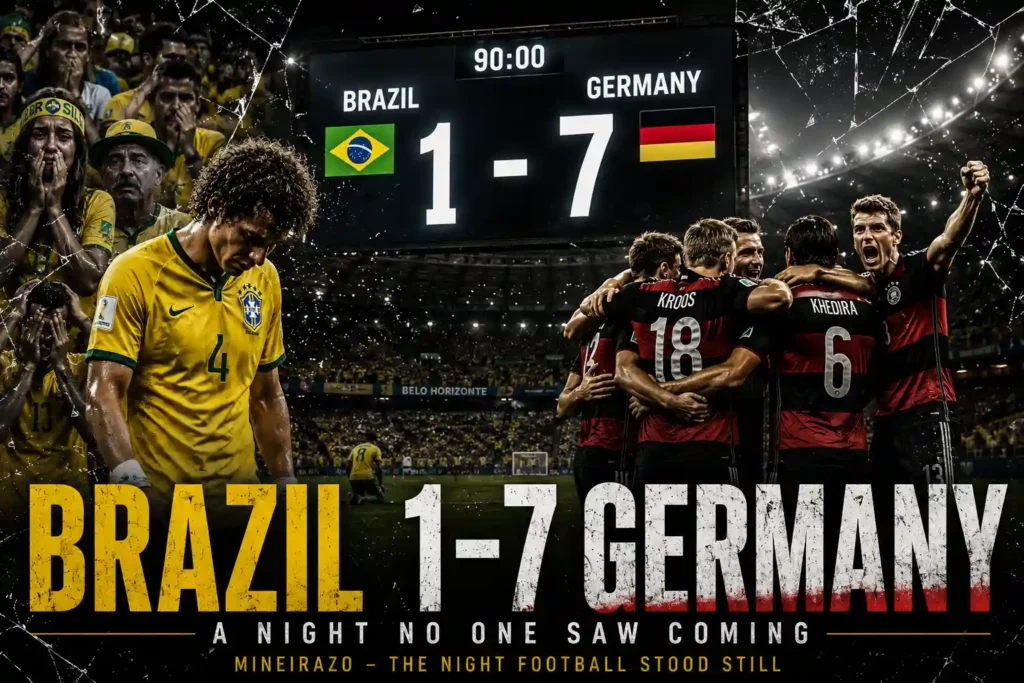
There are moments in sport that transcend the scoreline. Games that don’t just end — they shatter something. On the night of July 8, 2014, in a packed Estádio Mineirão in Belo Horizonte, Brazil experienced exactly that. The Brazilian national team — the Selecão, five-time world champions and the tournament’s emotional hosts — were dismantled, humiliated, and ultimately destroyed by a clinical German side in one of the most extraordinary results in football history.
The final score read Brazil 1, Germany 7. But numbers alone cannot capture the magnitude of what happened. This was not merely a football defeat. For a country that had built its national identity around jogo bonito — the beautiful game — it was a cultural wound, instantly seared into the national memory as “7 a 1” (seven-one), a result so traumatic it has become Brazilian shorthand for any catastrophic, humiliating collapse.
This is the full story of how it happened, why it happened, and why it still echoes today.
The Context: Brazil’s Burden in 2014
To understand the magnitude of the collapse, you need to understand the pressure Brazil carried into that tournament. Hosting the World Cup for the first time since 1950 was already a political flashpoint — protests had rocked the country in the months before the tournament, with citizens angry about billions spent on stadiums while public services deteriorated.
The Brazilian Football Confederation (CBF) had made winning the World Cup on home soil a near-religious mission. Head coach Luiz Felipe Scolari had assembled a squad built around emotion and talent, captained in spirit by Neymar Jr., who had been the tournament’s driving force going into the semifinal.
But this Brazil was brittle in ways that weren’t always visible in the win column. Their route to the semifinal had been far from convincing — a tense penalty shootout win over Chile in the round of 16, followed by a bruising, foul-strewn quarter-final against Colombia that Brazil won 2-1, but at a brutal cost.
Late in that Colombia match, Neymar was caught by a knee from defender Juan Camilo Zúñiga and was stretchered off with a fractured vertebra, ruling him out for the rest of the tournament. Brazil’s talisman — their heartbeat, and their top creative outlet — was gone.
To make matters drastically worse, captain and defensive cornerstone Thiago Silva was suspended for the semifinal after picking up his second yellow card of the tournament against Colombia. Brazil therefore walked out at the Mineirão without their best attacker and without their defensive leader — missing, in effect, the spine of the team.
The Match: A First Half That Will Never Be Forgotten
Germany, managed by Joachim Löw, were one of the most cohesive, tactically disciplined sides in the tournament. Their squad featured Manuel Neuer in goal, Philipp Lahm as captain, the midfield craft of Toni Kroos and Bastian Schweinsteiger, the movement of Thomas Müller, and the veteran poacher Miroslav Klose — who entered the match one World Cup goal short of Brazilian legend Ronaldo’s all-time record of 15.
Brazil started the game brightly, winning a corner within 37 seconds of kick-off. It was the high point of their evening.
11th minute: From Germany’s first corner of the match, Thomas Müller was left completely unmarked at the back post and side-footed home, his 10th World Cup goal. David Luiz, assigned to track him, lost him entirely.
23rd minute: Miroslav Klose poked in a close-range finish to make it 2-0 — his 16th World Cup goal, surpassing Ronaldo’s long-standing record, fittingly scored in the city where Ronaldo had begun his career, with Ronaldo himself watching from the stands.
25th minute: Toni Kroos curled in a left-footed strike from the edge of the area to make it 3-0.
26th minute (just 69 seconds after his first): Kroos struck again, robbing the ball off Fernandinho near the halfway line before combining with Sami Khedira to slot home Germany’s fourth — the fastest brace in World Cup history.
29th minute: Khedira completed a sweeping move, finishing after a give-and-go with Mesut Özil, to make it 5-0.
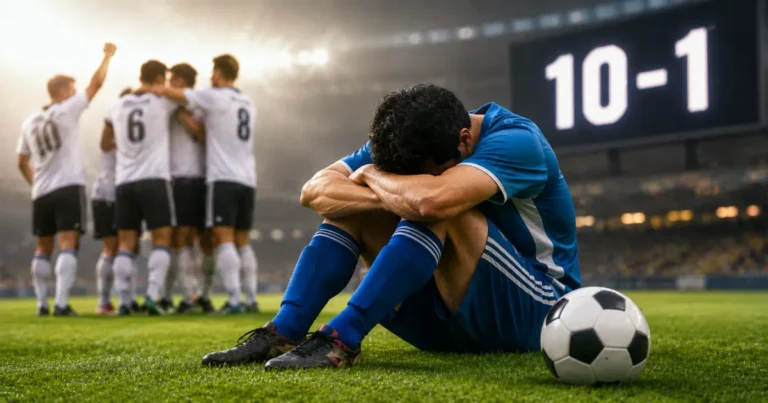
In a six-minute, 41-second spell before half-time, Germany had scored four goals. Brazil’s players wandered the pitch in visible disarray; home supporters at the Mineirão were left in stunned silence, some reportedly leaving the stadium before half-time had even arrived — an almost unheard-of sight at a World Cup semifinal in the host nation.
Germany held just 25 passes of possession between the 20th and 30th minute, yet managed six shots and four goals from them — a statistic that still ranks among the most extraordinary in tournament history.
The Second Half: Mercy, Then More Pain
Germany eased off considerably after the break, but the rout continued. Substitute André Schürrle came on and scored twice — in the 69th minute, side-footing in from close range after a low cross from Philipp Lahm, and in the 79th minute, meeting a Müller cross with a powerful first-time finish to make it 7-0.
At 7-0, with their team’s place in the final long secured, the remaining home supporters at the Mineirão rose to applaud Germany’s performance — a remarkable gesture of sporting respect amid the wreckage of national heartbreak.
Brazil’s only moment of pride came in the 90th minute, when substitute Oscar received a long ball and beat Neuer to make it a final score of 1-7. It was treated by all involved less as a goal and more as a small mercy.
Toni Kroos, with two goals, an assist, and 93% pass accuracy, was named Man of the Match.
The result equalled Brazil’s worst-ever defeat (a 6-0 loss to Uruguay in 1920) and ended a 62-match unbeaten run in competitive home fixtures stretching back to 1975. It remains the largest margin of victory in a World Cup semifinal or final in history.What Does a Football Manager Actually Do? The Job Behind the Tactics Board — A Full Week in the Life
Why Did It Happen? The Tactical and Psychological Breakdown
Several factors combined to produce this perfect storm of failure.
The absence of Neymar and Thiago Silva cannot be overstated. Neymar was Brazil’s primary attacking outlet and emotional figurehead; without him, the team had no clear creative focus. Thiago Silva, meanwhile, was the calm organiser at the back. Without him, the Brazilian defence — David Luiz, Dante, Maicon, and Marcelo — looked disorganised and reactive rather than structured.
Tactical fragility compounded the problem. Brazil’s full-backs pushed forward instinctively and were repeatedly caught out of position in transition. Germany, by contrast, pressed as a cohesive unit and exploited the spaces left in central midfield with ruthless efficiency — striker Fred, heavily booed by his own fans, reportedly failed to register a single tackle, cross, successful dribble, or interception throughout the match.
The psychological weight of representing a host nation desperate for the World Cup, without their most important players, appeared to overwhelm Brazil almost from kick-off. What started as nervous energy curdled into panic within the first half-hour, and the team never recovered their composure.
Germany, conversely, played with calm, almost ruthless efficiency — pressing intelligently, recycling possession quickly, and punishing every defensive lapse without hesitation.
The Aftermath: A Nation in Mourning
The images from that night remain etched into football memory: Brazilian supporters in tears, players standing motionless, and a German side that — by full time — celebrated with visible restraint rather than triumphant excess.
In Brazil, the reaction was seismic. Scolari called it the “worst loss by a Brazilian national team ever” and publicly accepted responsibility, resigning shortly after the tournament ended following a 3-0 defeat to the Netherlands in the third-place play-off. Stand-in captain David Luiz and goalkeeper Júlio César both issued public apologies to the Brazilian people. Striker Fred announced his retirement from international football after the tournament, describing the result as the worst of his career.
Germany went on to beat Argentina 1-0 in the final, courtesy of Mario Götze’s extra-time winner, becoming the first European team to win a World Cup staged in the Americas.
For Brazil, the defeat triggered deep introspection about the structure of the national game — questions about youth development, tactical sophistication, and the dangers of building an entire footballing culture around individual brilliance rather than collective resilience.
Legacy: What “7-1” Means Today
More than a decade on, “Brazil 1-7 Germany” remains one of football’s most referenced results — a shorthand, even within Brazil itself, for total and unexpected collapse. It is studied in coaching circles as a case study in what happens when structure disappears and psychological pressure overwhelms technical ability.
It is also remembered as a showcase of German football at its most ruthless — disciplined, well-organised, and utterly merciless once an opponent’s resistance broke. The two nations have met only a handful of times since, including a poignant Olympic final rematch in 2016, won by Brazil on penalties — a result many in Brazil still describe as a measure of redemption, if never quite closure.
▪️▪️ Follow us on Facebook▪️▪️
About the Author