A deeper look at the tactical patterns behind Brazil vs Haiti, where two early goals from Matheus Cunha and a stoppage-time strike from Vinícius Júnior dismantled a brave Haitian setup.
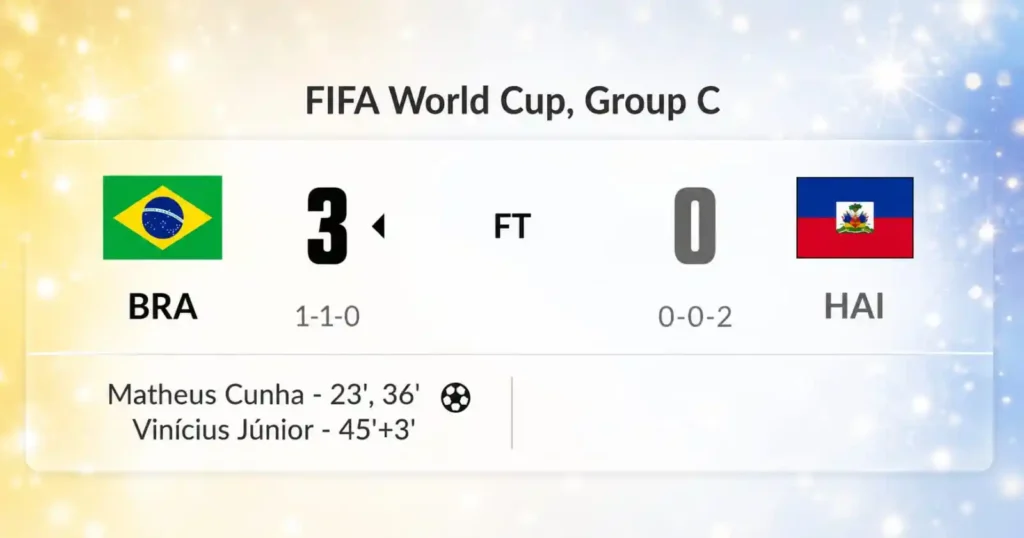
Scorelines rarely tell the full story, and the 3-0 final margin in Brazil vs Haiti at Lincoln Financial Field undersells just how competitive the opening forty-five minutes actually were. This analysis breaks down the structural decisions, personnel changes, and tactical patterns that ultimately separated the two sides in Philadelphia.
The Starting Setup: A Calculated Gamble
Carlo Ancelotti made one notable change to his front line, bringing in Matheus Cunha for Igor Thiago. On paper this looked like a like-for-like swap, but in practice it altered Brazil’s attacking shape significantly. Cunha does not occupy the penalty area in the same fixed manner Thiago does; instead, he drifts into half-spaces between the lines, which forced Haiti’s central defenders into a constant decision-making problem: step out and engage, or hold the shape and concede the underlay pass.
That decision-making problem produced the opening goal. Haiti’s back line, set up with five at the back to compress space against Brazil’s wide threats, was pulled out of position trying to track Cunha’s movement, and the resulting disorganisation led directly to Hannes Delcroix turning the ball into his own net. It was a structural breakdown as much as an individual error.
Haiti’s High-Risk, High-Reward Defensive Line
Sébastien Migné’s decision to deploy five defenders was a sound one against a Brazil side this talented, and for a period it worked. Haiti’s compactness limited central passing lanes and forced Brazil into wide areas, where overlapping full-backs initially struggled to combine effectively with Raphinha and Vinícius Júnior.
The cost of that approach revealed itself in moments of transition. When Haiti pushed bodies forward to support attacks, the recovery distance for their back line increased, and Brazil’s front four are simply too sharp in behind to be given that kind of room repeatedly. Raphinha’s disallowed effort in the 11th minute, ruled out for offside, was an early signal of how often Brazil were getting in behind that high line, even if the finishing touch wasn’t always rewarded by the assistant referee’s flag.
Cunha’s Brace: Movement Over Power
Both of Matheus Cunha’s goals, in the 23rd and 36th minutes, came from variations of the same pattern: Brazil overloading one side of the pitch before switching quickly to find Cunha arriving late into the box from a deeper starting position. This late-arrival movement is difficult to defend against a back five because it requires a midfielder, not a centre-back, to track the run, and Haiti’s double pivot was consistently a half-step behind.
By half-time, Brazil led 3-0 after Vinícius Júnior added a third in stoppage time, finishing a move that again exploited space generated by Cunha dragging a defender out of position. The half-time scoreline, while emphatic, slightly overstated Brazil’s control; Haiti’s expected-goals output from their own moments of transition suggested a side that was competing well within phases of the game, just not when it mattered most.Vinícius Júnior FIFA World Cup 2026: Profile, Stats & Career | StrikerReport
Second-Half Management and the Raphinha Concern
With the result effectively secure, Brazil’s intensity dropped noticeably after the break, managing tempo rather than chasing additional goals. Gabriel Martinelli’s effort off the crossbar and a marginal offside call against a well-worked Endrick finish suggest Brazil could easily have scored more had they maintained first-half urgency, but the priority shifted to conserving energy for the group decider against Scotland.Raphinha FIFA World Cup 2026: Profile, Stats & Career | StrikerReport
The one genuine concern from a Brazilian perspective was Raphinha’s withdrawal in the first half with discomfort in his right thigh. Given Brazil’s reliance on his combination play down the right channel, any fitness doubt ahead of facing Scotland on the final matchday will be monitored closely by the medical staff over the coming days.
What This Means for Group C
The result confirms Haiti’s elimination after back-to-back defeats, a tough outcome for a side that, tactically, gave a reasonable account of itself for large periods. For Brazil, the win pulls them level on points with Morocco at the top of Group C, setting up a final-round meeting with Scotland that will likely decide who tops the group outright.
Tactically, Brazil vs Haiti offered a clear lesson: a disciplined low-or-mid block can frustrate a top side for a half, but against attackers capable of generating overloads and late box arrivals, the margin for error eventually runs out. Brazil found that margin twice in quick succession, and a third time almost by default, turning a tight first half into a comfortable scoreline by the final whistle.
🔹🔹 Follow us on Facebook 🔹🔹
About the Author