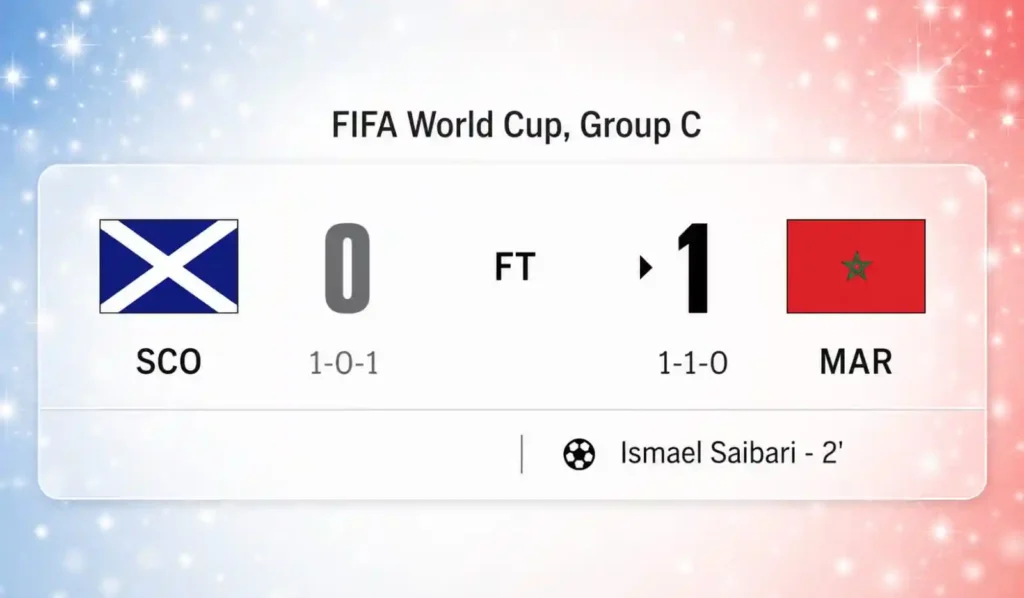
A lightning-quick Ismael Saibari strike was enough to settle Scotland vs Morocco at Gillette Stadium, leaving Steve Clarke’s side to chase history on the final matchday.
There are matches that take ninety minutes to reveal themselves, and there are matches that reveal everything before the crowd has even settled into its seat. Scotland vs Morocco belonged firmly to the second category. By the time most of the 60,000-plus inside Gillette Stadium had registered what was happening, Morocco were already a goal up, and Scotland’s perfect start to this World Cup had a crack running straight through it.
The damage was done with a finish so quick and so clean that replays barely had time to load. Grant Hanley, usually the picture of composure, was caught flat-footed as Brahim Díaz slipped a delivery into space behind him. Ismael Saibari did not need a second invitation. He met the ball first time and drilled it past Angus Gunn and into the roof of the net before the stadium clock had ticked past 70 seconds. It was the fastest goal of the tournament so far, and it set the tone for everything that followed.
What made the moment sting even more was the context. Scotland arrived at this Group C showdown having beaten Haiti 1-0 in their opener, sitting proudly at the top of the table with a clean sheet to their name. A win here would have all but guaranteed something this nation has never managed at a major tournament: a place in the knockout rounds. Instead, they were chasing the game from almost the first whistle, and chasing a team that, on the balance of play, barely needed to get out of second gear.
Morocco controlled the rhythm for long stretches without ever feeling the need to chase a second goal. Saibari himself continued to look like the most dangerous man on the pitch, completing the vast majority of his passes and consistently finding pockets of space between Scotland’s midfield and defence. Achraf Hakimi marshalled things calmly from the right, while the Atlas Lions’ off-the-ball discipline made it difficult for Scotland to build any sustained pressure.WORLD CUP 2026 POINTS TABLE: GROUP STANDINGS TRACKER FOR ALL 12 GROUPS — UPDATED LIVE
To their credit, Scotland did not collapse. They simply could not break through. John McGinn went down under a challenge from Neil El Aynaoui and appealed loudly for a penalty that was waved away. Later, Scott McTominay suffered a similar fate, convinced he had been fouled in a promising position, only for the referee to see it differently. Both decisions will be debated long after this tournament ends, and both will sting Scottish supporters who felt their side deserved at least a way back into the contest.
The numbers tell their own uncomfortable story. Scotland needed 46 minutes to register their first shot of the match. By full time, they had managed six attempts on goal and not a single one had tested Yassine Bounou between the posts. Gunn, by contrast, was forced into several smart saves to keep the deficit at one, a reminder that without their goalkeeper this could have been considerably more painful.
Late substitutions injected some urgency, with McTominay and Lyndon Dykes both pushing for an equaliser in the closing stages. Neither chance arrived with enough conviction to beat Bounou, and Morocco’s back line, so often praised for its organisation throughout this World Cup cycle, held its nerve when it mattered most.
The result reshapes Group C in a meaningful way. Morocco move above Scotland on goal difference, knowing their final fixture against a struggling Haiti side gives them every chance of topping the section outright. Scotland, meanwhile, must regroup quickly. Their final group game against Brazil on June 24 is no longer a formality or a dead rubber; it is now a must-win occasion if Steve Clarke’s side want to keep their historic ambitions alive.
For all the late drama and the late chances, this was ultimately a game settled in the time it takes to tie a bootlace. Scotland vs Morocco will be remembered less for what happened across ninety minutes and more for what happened in the first one. Saibari’s strike was the kind of moment that decides tournaments, and Scotland now have just one match left to prove it does not decide theirs.
About the Author