Raphinha FIFA World Cup 2026: The Kid from Restinga Who Became Barcelona’s Heartbeat — and Brazil’s Best Hope
By StrikerReport Editorial Team | May 31, 2026
“Rejected by every major Brazilian academy. Coached on the streets of a Porto Alegre favela. Now he is the Champions League’s top scorer and Brazil’s leader at the World Cup. Raphinha’s story doesn’t follow rules.”
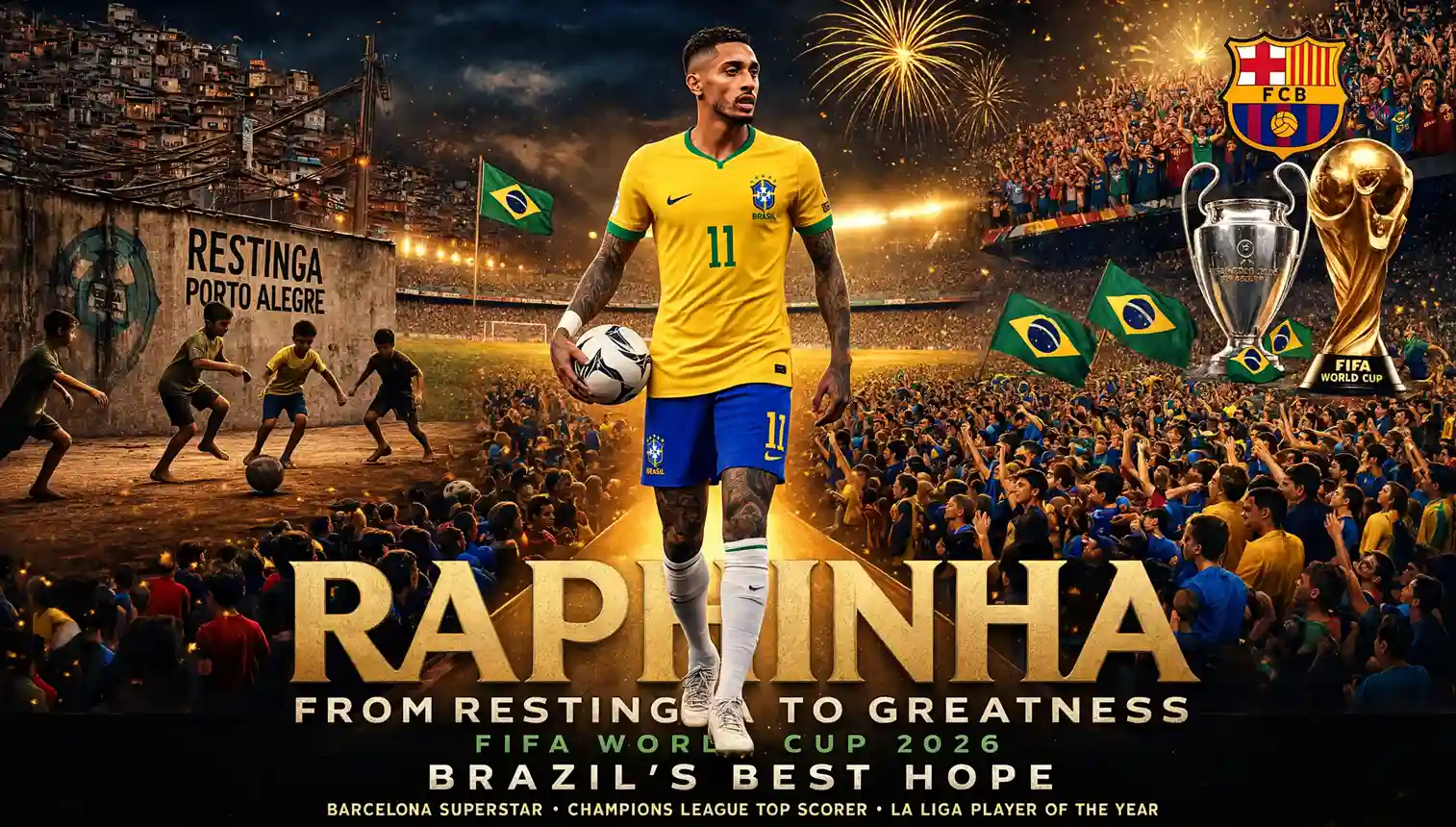
Raphinha — FIFA World Cup 2026 Fast Profile
🇧🇷 Brazil | Left Winger / Forward | Age at WC 2026: 29
⚽ Current Club: FC Barcelona | Jersey: #11
- 2024–25: 34 goals + 22 assists in 57 appearances — UEFA Champions League top scorer
- 2025–26: 13 goals + 3 assists in La Liga (22 apps) — injury-reduced season
- 2024–25 La Liga Best Player award winner
- Market Value: €80 million
- Age at World Cup 2026: 29 years old
Quick Facts: Raphinha at FIFA World Cup 2026
| Full Name | Raphael Dias Belloli |
| Date of Birth | December 14, 1996 |
| Age at World Cup 2026 | 29 years old |
| Nationality | Brazilian 🇧🇷 |
| Height | 1.76 m (5′ 9″) |
| Preferred Foot | Left |
| Current Club | FC Barcelona (Spain) |
| Jersey Number | #11 |
| Position | Left Winger / Forward / Attacking Midfielder |
| Transfer Fee (to Barcelona) | €58 million (Leeds United, 2022) |
| Market Value | €80 million |
| Contract Until | June 2027 |
| @raphaelraphinha | |
| Estimated Net Worth | ~$20 million USD |
The Story: Why Raphinha FIFA World Cup 2026 Is the Tournament’s Most Compelling Underdog-Made-Elite
There is a photograph somewhere in Porto Alegre of a skinny boy with quick eyes and a football at his feet, on a dirt pitch in the Restinga neighbourhood — one of the city’s poorer, more overlooked corners. The boy had already been rejected by Internacional. He had already been turned away by Grêmio. Two of Brazil’s most celebrated football academies looked at him and said: not quite.
That boy is now the Champions League’s most recent top scorer. He gave a pre-final team speech so fierce at the Spanish Super Cup that his Barcelona teammates said it was the most motivated they had ever felt before a football match. He wears the number 11 at one of the greatest clubs in football history. And he arrives at the Raphinha FIFA World Cup 2026 as the most complete and experienced forward in the Brazilian squad — the leader that a nation’s football dreams are partly resting on.
Football loves a redemption arc. It loves the story of the player who was told no and responded by building a career that makes those rejections look ridiculous. Raphinha’s story is exactly that — and it carries extra emotional weight because he is fully aware of it. He speaks about his origins with gratitude and defiance in equal measure. He grew up watching Ronaldinho, the greatest Brazilian footballer of his generation, and was six years old when Brazil won the 2002 World Cup. That trophy, that image, that particular shade of gold — it has lived inside him ever since.
Now, at 29, at a World Cup in North America alongside Vinícius Júnior and a returning Neymar, Raphinha has the platform that the Restinga kid could only dream about. And based on what he has produced over the past two seasons, he has the quality to make the dream real.
Biography: From Restinga to the Camp Nou
Raphael Dias Belloli was born on December 14, 1996, in Porto Alegre — the capital of Brazil’s southernmost state, Rio Grande do Sul. He grew up in Restinga, a working-class neighbourhood on the city’s periphery where football was life, necessity, and escape simultaneously. His father, Maninho Belloli, was a musician of Italian descent who played in a samba band — a man whose connection to music and culture shaped the household, and whose support of his son’s football dreams was unconditional.
The early rejections came quickly. Internacional and Grêmio — the two great clubs of Porto Alegre, clubs that between them have produced some of Brazil’s finest players — both passed on the young Raphinha. The reason was always the same: too slight, too small, not physically ready. It is a judgement that talent evaluators have been making about slight, quick technical players since football began, and being wrong about just as often.
Eventually Avaí FC, a club from the southern state of Santa Catarina, spotted him and brought him into their youth setup at 18. It was a later start than most elite players manage — most are signed by major academies at 12 or 13. Raphinha was 18 before he had a professional pathway. The urgency that created never fully left him.
At Avaí, his development was rapid enough to attract European interest. In 2016, Portuguese Primeira Liga side Vitória de Guimarães signed him — a move to Europe at 19 that required courage and adaptability. He thrived. His directness, his left foot, his ability to both score and create separated him from the typical winger, and within two years Sporting CP — one of Portugal’s three giants — had signed him. Under the same system that had developed Bruno Fernandes, a player who would become his close friend and mentor, Raphinha won the Taça de Portugal and Taça da Liga double in 2018–19. Portugal had finished the journey that Brazil’s academies had declined to begin.
Rennes signed him from Sporting in 2019 for a fee that reflected growing European interest. His one season in Ligue 1 was excellent — direct, dangerous, consistently productive — and when Marcelo Bielsa’s Leeds United came calling in 2020, the combination of the manager’s reputation and the Premier League’s platform was irresistible.
Club Career Highlights: Leeds Cult Hero to Barcelona’s Irreplaceable Number 11
Raphinha’s arrival at Leeds United in October 2020, for €18.6 million, was the transfer that announced him to the English-speaking football world. Under Marcelo Bielsa — the Argentine coach whose intensity and tactical vision transformed careers — he became one of the Premier League’s most exciting attacking players almost immediately. His direct running, his ferocious left-foot shooting, his willingness to defend from the front and then appear at the other end to score — all of it fitted Bielsa’s high-energy system perfectly.
In two seasons at Elland Road, he scored 17 goals and created 10 assists. More importantly, in Leeds’ desperate final run-in of the 2021–22 season — a relegation battle that consumed the entire club — Raphinha was the player who carried the team on his back. His goals in the final weeks of that campaign were the difference between Premier League survival and the Championship. Leeds stayed up. Raphinha left that summer as a cult hero, with Barcelona coming to collect.
The move to Barcelona, for €58 million in July 2022, was the fulfilment of a childhood dream. He had grown up watching Ronaldinho at the Camp Nou — watched his father’s samba band play at Ronaldinho’s leaving party, as a child who could barely see above the tables. Now he was the one arriving at the club to wear blue and red.
The first two seasons at Barcelona were solid but not spectacular — 10 goals and 12 assists in 2022–23, 10 goals and 11 assists in 2023–24. Good numbers for a winger in a settling-in period, but not the transformational impact that the fee and the profile demanded. Critics wondered, not unkindly, whether Raphinha had plateaued.
Then Hansi Flick arrived in 2024, and everything changed. The German coach — who had won the Champions League with Bayern Munich — saw something in Raphinha that previous managers had not fully unlocked. With Lamine Yamal taking the right wing and breaking every age record in existence, Flick moved Raphinha to a left wing and attacking midfield hybrid role — a position that gave him more central involvement, more involvement in build-up play, and more goalscoring opportunities from runners into the box.
The 2024–25 season was, by any measure, one of the greatest individual seasons any Barcelona player has produced in the modern era. Raphinha scored 34 goals and provided 22 assists in 57 appearances. Barcelona won the domestic treble — La Liga, Copa del Rey, Supercopa de España. And in the Champions League, Raphinha finished as the competition’s top scorer — the first Brazilian to achieve that distinction in the tournament’s modern format. He won La Liga’s Best Player award. He was Ballon d’Or nominee. He was, simply, the best player in world football for long stretches of that calendar year.
The 2025–26 season has been disrupted by injury — a muscular issue limiting him to 22 La Liga appearances by late May, with 13 goals and 3 assists. But he arrives at the World Cup with the benefit of rest and full fitness confirmed by the Brazilian federation. The body is recovered. The hunger — knowing this is his peak World Cup, his moment — is burning.
International Career: Late Bloomer, Instant Impact, and the Weight of the Seleção
Raphinha never played for Brazil’s youth teams. It is an unusual biographical detail for a player of his quality — most elite forwards are identified young enough to represent their country through every age group. But Raphinha’s unconventional career path — the rejections, the late European move, the gradual ascent through Portugal, France, and England — meant that by the time he was good enough for the senior squad, the youth teams were already behind him.
His senior debut came in October 2021, in a World Cup qualifier against Venezuela. He was 24. He made an immediate impression — two assists on debut — and scored his first two international goals against Uruguay days later. For a player who had waited so long for the call, the arrival was electric.
He was part of Brazil’s squad for the 2022 World Cup in Qatar, featuring in every match as Brazil cruised through the group stage and then suffered that devastating quarterfinal defeat to Croatia on penalties. Raphinha’s performances — direct, energetic, creative — were among the positive stories from a tournament that ended in national heartbreak.
Under Carlo Ancelotti, who took over the national team and united the same tactical philosophy he used to unlock Vinícius Júnior at Real Madrid, Raphinha has become Brazil’s most important attacking asset alongside Vinícius. He operates from the left wing in Ancelotti’s 4-3-3, with Vinícius Júnior either starting on the same flank or rotating centrally, creating a front three of pace, power, and creativity that no defensive structure has found a consistent answer to.
Heading into the 2026 World Cup, Raphinha has around 40 caps and ~13 goals for Brazil — a return that understates his importance, since his assists and chance creation are where his international contribution is most visible. He is the player who makes the others better: the one whose directness pulls defenders out of position, whose crosses find Vinícius, whose set-piece delivery creates danger from dead balls. He is not Brazil’s most famous name. He is, arguably, their most indispensable one.
Career Timeline: The Road from Restinga to the World Stage
📅 2016 — European Debut at Vitória de Guimarães
After being rejected by both Internacional and Grêmio in his home city, Raphinha moved to Portugal at 19 to begin his professional journey at Vitória de Guimarães. It was the beginning of a European education that would take him through Portugal, France, England, and ultimately Spain — and that turned the rejections of his youth into the foundation of his resilience.
📅 2019 — Double Winner with Sporting CP
Won the Taça de Portugal and Taça da Liga double with Sporting CP in 2018–19, his one full season at the Lisbon club. It was his first senior silverware and confirmed that the talent identified by Portuguese scouts when Brazil’s academies looked away was genuine, significant, and developing fast.
📅 2020–22 — Leeds United Cult Hero Under Bielsa
Transformed into a Premier League force under Marcelo Bielsa at Leeds. Scored 17 goals and created 10 assists in two seasons. Was the primary reason Leeds United survived Premier League relegation in 2022, carrying the team through a desperate final run-in with goals that made him a permanent legend at Elland Road.
📅 October 2021 — Brazil Senior Debut: Two Assists in First Match
Made his senior Brazil debut at 24 — years later than most elite forwards but immediately impactful. Two assists on debut against Venezuela, first two goals against Uruguay days later. No youth team career. No gradual build. Just instant delivery at the highest international level.
📅 July 2022 — Childhood Dream Fulfilled: Signs for FC Barcelona
Completed a €58 million move to Barcelona — the club he idolised as a child watching Ronaldinho, the club his father’s samba band played for at a leaving party when Raphinha was barely six years old. The symmetry of the moment was not lost on him or anyone who knew the full story.
📅 2024–25 — The Greatest Season: 34 Goals, 22 Assists, UCL Top Scorer
Under Hansi Flick at Barcelona, produced one of the most extraordinary individual seasons in recent football history: 34 goals, 22 assists in 57 appearances. Won the Champions League top scorer award — the first Brazilian in the modern format’s history to do so. Won La Liga’s Best Player award. Barcelona won the domestic treble. Raphinha was at the absolute centre of all of it.
📅 2026 — Brazil’s Leader at His Peak World Cup
Named in Carlo Ancelotti’s 26-man Brazil squad for the North American World Cup. At 29 — the ideal age for a footballer of his profile, at the absolute intersection of physical prime and tactical experience — Raphinha arrives at the tournament that has been the destination of every difficult choice he has ever made in football.
2025–26 Season Stats
Club Stats — FC Barcelona (2025–26)
| Competition | Apps | Goals | Assists | G+A |
|---|---|---|---|---|
| La Liga | 22 | 13 | 3 | 16 |
| UEFA Champions League | 7 | 3 | 2 | 5 |
| Copa del Rey / Supercopa | ~5 | ~3 | ~1 | ~4 |
| All Competitions | ~35 | ~19 | ~6 | ~25 |
* Injury-reduced season compared to 2024-25 (34G+22A in 57 apps). Numbers reflect partial season due to muscular issue from November–January.
International Stats — Brazil (Senior Career)
| Competition | Caps | Goals | Assists |
|---|---|---|---|
| Senior Brazil (all) | ~40 | ~13 | ~15 |
| FIFA World Cup 2022 | 5 | 2 | 1 |
| Copa América 2024 | ~5 | ~2 | ~3 |
| FIFA World Cup 2026 | Second appearance | — | — |
Playing Style Breakdown: What Makes Raphinha So Dangerous at FIFA World Cup 2026
1. Attacking Qualities
Raphinha is a left-footed winger who can play on either side, in an attacking midfield role, or as a wing-back — a tactical versatility that makes him uniquely valuable in a tournament where managers need to adapt across seven matches against opponents who have all prepared specifically to neutralise their opponents’ best players. His natural instinct is to run at defenders, drive into the box, and either finish or cut back. He scores from distance — his left-foot thunderbolts are a genuine weapon from 25 metres — and he is excellent in the penalty area, timing his arrivals from wide positions to finish chances that most wingers would leave for the striker. His 34-goal season in 2024–25 was built on exactly this dual threat: the long-range strike and the penalty-area finish, with 22 assists confirming his creation capabilities alongside his scoring.
2. Technical Skills
His left foot is elite. The power and accuracy he generates from his stronger side — in shooting, crossing, and set-piece delivery — is comparable to any left-footed forward in world football. His close control in tight areas is exceptional, shaped by years of playing in smaller spaces in Portugal and France before the Premier League’s physicality added resilience to his game. His free kick delivery — as Barcelona opponents have discovered repeatedly — is precisely curved and genuinely dangerous. His dribbling, while not as instinctively flamboyant as Vinícius Júnior’s, is highly effective because it is purposeful: every touch with the ball is designed to create a shooting or passing opportunity, not to entertain.
3. Physical Attributes
At 1.76m and compact in build, Raphinha has the body of a player built for endurance and intensity rather than aerial dominance or raw power. His engine is extraordinary — he covers enormous distances per match, pressing from the front and arriving in the box from wide positions in the same movement. His top speed, recorded at 33.5 km/h in Champions League data, places him among the faster wide players in European football. His stamina — the ability to maintain that intensity across 90 minutes and across a tournament’s multiple matches — is one of the qualities Carlo Ancelotti trusts most.
4. Tactical Intelligence
The 2024–25 season, in which Hansi Flick moved him from the right wing into a left-sided hybrid role, revealed a tactical intelligence that pure wide forwards rarely possess. Raphinha adapted to a position that required him to drop into midfield to receive, to press centrally rather than along the touchline, and to time his runs into the box from deeper starting positions. He did all of it at the highest European level — and improved his numbers dramatically in the process. Under Ancelotti’s Brazil, he performs a similar hybrid function: wide enough to stretch defences, central enough to influence build-up play, and goalscoring enough to punish when space appears.
5. Weaknesses / Areas to Watch
The injury history is the primary concern. A muscular issue disrupted his 2025–26 season significantly — reducing him to 22 La Liga appearances when his 2024–25 baseline was 57 across all competitions. His fitness was confirmed by the Brazilian federation before the World Cup squad announcement, but managing his physical load across a tournament of this intensity requires careful handling. His aerial game is modest — he wins few headed duels and is not a threat from crosses. And against very deep, disciplined defensive blocks — the kind that the better-organised World Cup sides will deploy specifically against Brazil — his tendency to shoot from outside the box can mean wasted possession if the shots miss.
Skill Ratings: Raphinha at World Cup 2026
| Attribute | Rating / 100 | Assessment |
|---|---|---|
| ⚽ Finishing | 91 | Elite left-foot striker; long-range and box finishing both world-class |
| ⚡ Pace | 89 | Top speed 33.5 km/h; rapid over short and medium distances |
| 🎯 Dribbling | 88 | Purposeful and effective; direct, low-centre-of-gravity style |
| 🎯 Passing | 87 | 22 assists in 2024–25 tells the story; excellent final ball |
| 👁 Vision | 88 | Sees runners early; creates for teammates as often as he scores |
| 🏃 Movement | 90 | Covers enormous distances; tireless engine, box arrivals lethal |
| 💪 Physicality | 82 | Compact and strong; not dominant aerially but hard to knock off ball |
| 🛡 Defensive Work | 85 | Outstanding pressing winger; rare defensive discipline for a forward |
| 👑 Leadership | 89 | De facto Barcelona captain; pre-match speech legend; vocal leader |
Records & Milestones
🏆 UEFA Champions League Top Scorer 2024–25 — First Brazilian in Modern Format
📊 Finished the 2024–25 Champions League as the competition’s top scorer — the first Brazilian player to achieve this distinction in the tournament’s modern group-stage format. His 13 Champions League goals that season were part of a record-breaking total of 34 goals across all competitions.
📅 May 2025
🏆 La Liga Best Player Award 2024–25
📊 Named La Liga’s best player for the 2024–25 season following a campaign in which he scored 34 goals and registered 22 assists — a combined tally that places him among the greatest individual offensive seasons in La Liga history for a wide forward.
📅 May 2025
🏆 Barcelona Domestic Treble 2024–25
📊 Key figure in Barcelona’s treble-winning season under Hansi Flick — La Liga, Copa del Rey, and Supercopa de España all won in the same campaign. Raphinha was the club’s leading scorer and assist provider across all three competitions combined.
📅 2024–25
🏆 Leeds United’s Relegation Saviour — 2022
📊 Scored crucial goals in the final weeks of the 2021–22 Premier League season to help Leeds United avoid relegation. His performances in that desperate run-in are remembered at Elland Road with a reverence reserved for players who save clubs from genuine crisis.
📅 May 2022
🏆 Two Assists on Brazil Senior Debut — First International Appearance at 24
📊 Made his Brazil senior debut at 24 years old — unusually late for a player of his quality — and provided two assists against Venezuela immediately. Never represented Brazil at any youth level. The most unconventional path to international football of any player in the 2026 squad.
📅 October 2021
🏆 The Rejected Boy — From Grêmio and Internacional Refusal to European Elite
📊 Rejected by both Internacional and Grêmio as a teenager for being too slight. Went on to play for Avaí, Vitória de Guimarães, Sporting CP, Rennes, Leeds United, and FC Barcelona — one of football’s most remarkable career trajectories built entirely on proving every doubter wrong.
📅 Career record
Raphinha FIFA World Cup 2026 Preview: The Leader Brazil Has Been Waiting For
When Carlo Ancelotti named his Brazil squad, there were two certainties about the attacking structure: Vinícius Júnior would start on the left, explosive and direct, and Raphinha would operate either on the right or in the attacking midfield position — the connective tissue between Brazil’s creative midfield and their devastating forward line.
In practice, Ancelotti’s Brazil under Raphinha is a different animal from recent Brazilian tournament sides. The work rate is extraordinary. The pressing from the front is organised and relentless. And when the ball is won back high on the pitch — which it regularly is when Raphinha and Vinícius are pressing in tandem — the transition speed is terrifying for any opponent.
Raphinha’s specific role in the 2026 Brazil system is to be the player who makes everything work for everyone else. He provides the defensive pressing that gives the midfield time on the ball. He stretches defences wide when needed and narrows them by cutting inside. He delivers set pieces that convert into goals. He creates the space that allows Vinícius to receive the ball in his preferred positions. And he scores — often, from distance, from tight angles, from situations that only forwards with elite technical confidence attempt.
Brazil’s group stage — opening against Morocco, then Mexico and Cameroon — is highly manageable. The knockout rounds represent the real test. The question of whether Brazil can navigate the quarterfinal and semifinal stages that have eliminated them from the last two tournaments is not about individual quality — they have that in abundance. It is about collective temperament, penalty shootout composure, and the ability to win ugly when beautiful football is not available.
Raphinha, more than any other Brazilian player, has the mentality for exactly those moments. He was the player who gave a speech before a Super Cup final that his teammates described as the most motivating they had ever heard. He is the player who, when Barcelona were struggling in a Clásico, was the one visibly demanding more from teammates. He is not simply a footballer. He is a leader. And Brazil, at this World Cup, need a leader as much as they need a goalscorer.
StrikerReport Prediction: Raphinha finishes this tournament in the top five for assists and among the top ten for goals. Brazil reach at minimum the semi-finals, with Raphinha the most consistently dangerous player in their squad across the full tournament. If he is fit and firing — and all signs suggest he will be — this World Cup will define his legacy as one of the greatest Brazilian forwards of his generation.
Head-to-Head: Raphinha vs Nico Williams — The Battle of the Left Wings
Two left-sided forwards. Two different generations. Two of the tournament’s most anticipated wide players. Raphinha for Brazil, Nico Williams for Spain. On opposite flanks for their respective national teams, they represent the finest wide attacking talent in the 2026 World Cup field.
| Category | Raphinha 🇧🇷 | Nico Williams 🇪🇸 |
|---|---|---|
| Age at WC 2026 | 29 | 22 |
| 2024–25 Club Goals | 34 | ~16 |
| 2024–25 Club Assists | 22 | ~14 |
| UCL Top Scorer | ✅ 2024–25 | ❌ |
| Market Value | €80m | €100m |
| Pace Rating | 89 | 94 |
| Finishing Rating | 91 | 85 |
| Leadership Rating | 89 | 75 |
| Tournament Threat Rating | ★★★★½ | ★★★★ |
The case for Raphinha: His 2024–25 season — 34 goals, 22 assists, Champions League top scorer — is the benchmark individual offensive campaign in world football over the past 12 months. His finishing is superior. His leadership is irreplaceable. His experience of playing in four of Europe’s top leagues before arriving at a World Cup in peak condition gives him a breadth of football intelligence that Williams, at 22, is still accumulating. In a tournament that rewards composure and big-moment delivery, Raphinha’s profile is better suited to the knockout rounds.
The case for Nico Williams: Euro 2024 winner. One of the most devastating left wingers in Europe when he has space to run into. His pace exceeds Raphinha’s and his directness against tired defenders in the second half of knockout games is genuinely alarming. At 22, he is unburdened by expectation in the way that a Champions League top scorer who is also Brazil’s leader inevitably is. He may well be the fresher, more explosive force across a full tournament.
Final Verdict: Raphinha edges the head-to-head on finishing quality, creative output, and experience. But if Spain and Brazil meet in the knockout rounds — a scenario that fills match preview writers with joy — Nico Williams on one side and Lamine Yamal on the other will test Brazil’s fullbacks in a way that might make the individual comparison moot. Team football wins tournaments. Both of these players understand that completely.
Fun Facts & Personal Life: The Man Who Makes Barcelona’s Dressing Room Burn
- The samba band connection: Raphinha’s father Maninho was a musician in a samba band in Porto Alegre. When Ronaldinho left Barcelona in 2008, the band was hired to play at his farewell party. A six-year-old Raphinha attended and was overwhelmed by Ronaldinho’s presence. Almost 20 years later, Raphinha wore Ronaldinho’s club’s shirt — the same one he idolised that night. Football does not always complete its circles this perfectly.
- The pre-match speech that became Barcelona legend: Before the 2026 Spanish Super Cup final against Real Madrid, Raphinha delivered a dressing-room speech that his teammates have described as the most intense and motivating they have ever heard before a match. He reportedly called it a “war,” demanded revenge for Real Madrid’s behaviour in previous encounters, and left the Barcelona squad visibly emotional. They won. The speech has since taken on an almost mythological status at the club.
- Italy tried to poach him: Before Raphinha had established himself with Brazil’s senior team, the Italian Football Federation reportedly explored whether his Italian-descent father’s lineage could qualify him for an Italian passport — and potentially the Azzurri. The approach came to nothing; Raphinha’s commitment to Brazil was never in question. But the attempt speaks to how highly European football rated him before his international career had barely begun.
- Bruno Fernandes: the mentor: His friendship with Manchester United and Portugal midfielder Bruno Fernandes began at Sporting CP. Fernandes is widely credited with advising Raphinha to consider the Premier League move to Leeds, telling him that his directness, left foot, and work rate were perfectly calibrated for English football. The advice transformed Raphinha’s career visibility and ultimately led to Barcelona. Football friendships that shape careers are rare. This one did exactly that.
- The rejected boy’s tattoo: Raphinha reportedly has a tattoo referencing his origins in Restinga — a neighbourhood that rejected him early, that shaped him permanently, that he has never stopped referencing in interviews as the foundation of everything he became. “Where you come from never leaves you,” he told a Brazilian journalist in 2025. “Restinga is in every goal I score.” For a player whose entire career was built on answering no with yes, it is the most fitting possible symbol.
StrikerReport Verdict: Raphinha at FIFA World Cup 2026
9.0 / 10
StrikerReport World Cup 2026 Rating
Raphael Dias Belloli — the boy from Restinga who was told he was too small, too slight, not quite good enough — arrives at the 2026 FIFA World Cup as one of the three or four most complete forwards in the tournament. He is the Champions League’s most recent top scorer. He was La Liga’s best player. He is Barcelona’s emotional and tactical leader. He has spent his entire career using rejection as fuel.
The injury that disrupted his 2025–26 club season is a question mark. The fitness confirmation is reassuring. At 29, this is his prime World Cup — the intersection of physical peak and accumulated wisdom that players of his profile wait their whole careers to reach. Brazil need goals, creativity, leadership, and the mentality to win when the tournament gets difficult. Raphinha provides all four.
The boy from Restinga was told no. He turned every no into something extraordinary. This World Cup is his greatest stage yet — and if his career tells us anything, it is that Raphinha saves his best for when the stage is biggest.
Also read : Pedri FIFA World Cup 2026: Profile, Stats & Career | StrikerReport
About the Author

2 thoughts on “Raphinha FIFA World Cup 2026: Profile, Stats & Career | StrikerReport”