Federico Valverde FIFA World Cup 2026 — Uruguay’s Falcon Is Ready to Soar on the Biggest Stage
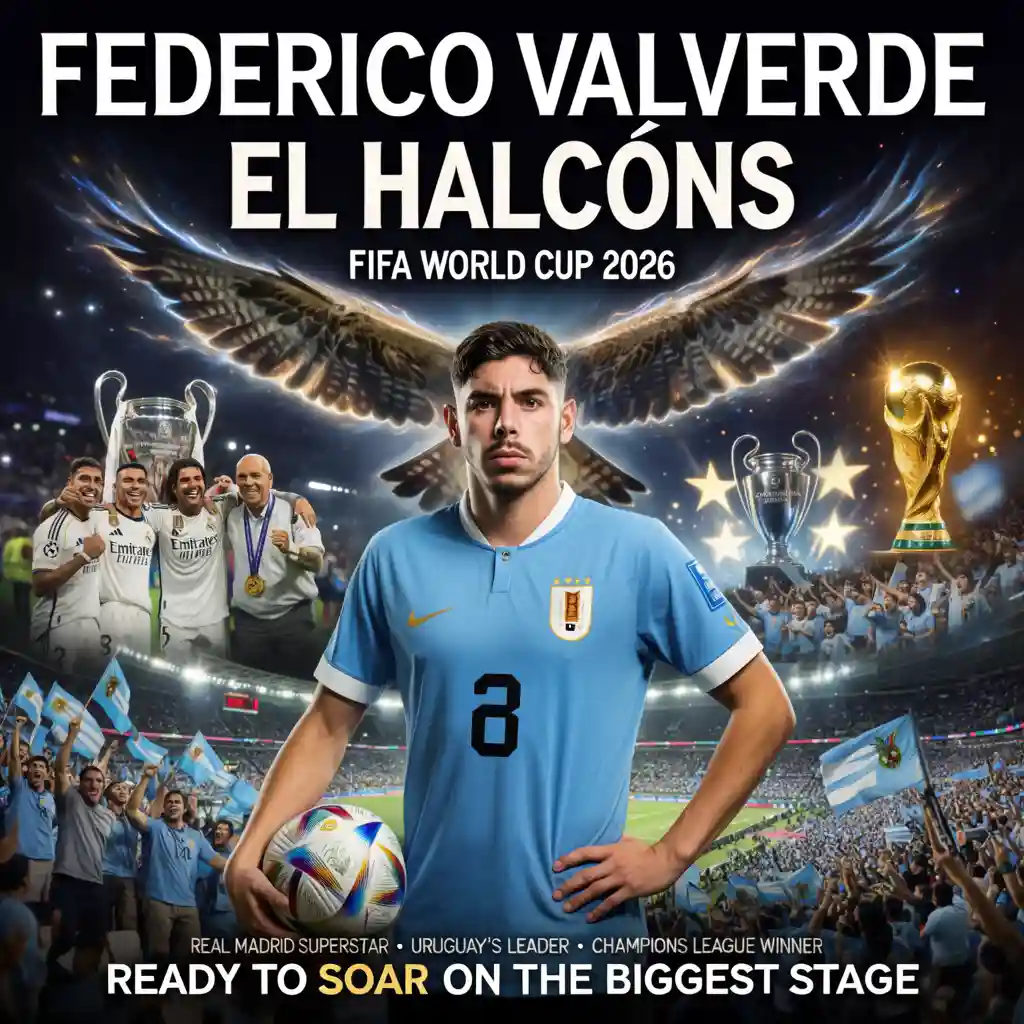
Uruguay | Central Midfielder | Age at WC 2026: 27 | Real Madrid | Champions League Winner (x2)
- Two-time UEFA Champions League winner with Real Madrid — 2021–22 and 2023–24
- 3 goals and 4 assists in 11 Champions League appearances in 2025–26 | Top speed: 35.79 km/h
- Led Uruguay to World Cup 2026 qualification — started the decisive 3-0 win over Peru in Montevideo
- Market value: €130 million | Real Madrid contract until 2029 | Weekly wage: €320,577 gross
- Nicknamed “El Halcón” (The Falcon) — one of the most complete box-to-box midfielders in world football
Quick Facts — Federico Valverde FIFA World Cup 2026
| Category | Details |
|---|---|
| Full Name | Federico Santiago Valverde Dipetta |
| Date of Birth | 22 July 1998 |
| Age at World Cup 2026 | 27 years old |
| Nationality | Uruguayan (also holds Spanish passport) |
| Place of Birth | Montevideo, Uruguay |
| Height | 1.82 m (6 ft 0 in) |
| Weight | 73 kg |
| Preferred Foot | Right |
| Current Club | Real Madrid (La Liga) |
| Jersey Number | #8 (Real Madrid) | #15 (Uruguay) |
| Position | Central Midfielder / Right Winger / Box-to-Box Midfielder |
| Nickname | El Halcón (The Falcon) / Fede |
| Market Value (Est.) | €130 million |
| Real Madrid Contract Until | 2029 |
| Weekly Wage (Gross) | €320,577 per week |
| Annual Salary (Est.) | €16.7 million per year |
| Wife | Mina Bonino (married 2022) |
| Children | Benicio (born Feb 2020), Bautista (born 2023) |
| Net Worth (Est.) | $20–25 million USD |
| Religion | Christianity |
Federico Valverde FIFA World Cup 2026 — The Falcon of the Bernabéu Takes Flight on the World Stage
In the vast, sunlit expanses of Montevideo, where football is not merely a sport but a national religion passed down through generations like scripture, a boy nailed a goalpost to his living room wall at the age of two and spent years scoring goals against his family. It sounds like the kind of detail that biographers invent to make origin stories feel cinematic. But those who know Federico Valverde’s family confirm it without hesitation, because the boy who grew up in the Union neighbourhood of Uruguay’s capital and spent his childhood obsessing over football with a ferocity that alarmed even those who loved him most has become, at twenty-seven, one of the two or three most complete midfielders in world football — and the most important player Uruguay has ever sent to a FIFA World Cup in the modern era.
His nickname at Real Madrid tells you almost everything you need to know. They call him El Halcón. The Falcon. A name earned not through marketing or media campaigns but through the way he plays — the long-range sight of the opening, the sudden explosive acceleration, the strike from distance that arrives with the speed and precision of something dropped from a great height. He has won two UEFA Champions League titles at the Bernabéu. He is one of Carlo Ancelotti’s most trusted and most deployed midfielders. He is a player who, when Jude Bellingham requires double-marking, or when the opposition compresses the middle of the pitch to stop the passing lanes, simply picks up the ball thirty-five yards from goal and hits it into the top corner before a goalkeeper has time to react.
The Federico Valverde FIFA World Cup 2026 narrative carries the full weight of a nation. Uruguay — with their extraordinary football history, their two World Cup titles from 1930 and 1950, their garra charrúa, that untranslatable Uruguayan fighting spirit — arrive at this tournament knowing that their best chance of a deep run in North America runs almost entirely through the engine room that Fede Valverde controls. He is twenty-seven years old. He is at the absolute peak of his physical and technical powers. And on the biggest stage the sport provides, El Halcón is ready to hunt.
Biography — From a Living Room Goalpost in Montevideo to the Santiago Bernabéu
Federico Santiago Valverde Dipetta was born on 22 July 1998 in the Union neighbourhood of Montevideo, Uruguay’s capital city. The Union district is a working-class barrio where football is woven into the daily rhythm of life — where the sound of a ball against a wall is as ordinary as birdsong, and where a child showing football talent is not unusual but a child showing extraordinary football talent is still cause for the neighbourhood to take notice. Federico Valverde was that child. His parents, Julio Valverde and Doris Dipetta, supported his passion wholeheartedly from the beginning. He grew up alongside his older brother Diego and two stepbrothers, Pablo and Matias, in a family environment that was warm, grounded, and entirely oriented around the values of hard work and personal responsibility.
The goalpost nailed to the living room wall at the age of two is not merely an endearing anecdote. It is a window into a character that has never been satisfied with approximation. From those earliest moments, Valverde was not interested in playing football in the casual, recreational sense. He was interested in practising, in repeating, in perfecting — in the kind of focused obsession that, when it meets sufficient natural ability, produces elite athletes. His parents enrolled him in Estudiantes de la Unión, the local club close to their home, when he was just three years old. By five, he was already competing against players two and three years older than him, and performing with enough quality that the coaches were already having a different kind of conversation about his future.
The trial that changed everything came in 2008, when he was nine years old and tried out for Peñarol — one of the two most storied clubs in Uruguayan football history, with a youth academy that has produced national team players across generations. He was scouted and selected by Uruguayan football legend Néstor González, a detail that Valverde has cited in interviews as a defining moment: being chosen by someone of that calibre, at that club, gave him his first real understanding of what was possible. He spent the next several years rising through Peñarol’s youth ranks, developing the physical power, the technical range, and the tactical intelligence that would eventually attract the attention of Real Madrid — the most successful club in the history of European football.
He made his senior debut for Peñarol against Cerro in the first game of the 2015–16 season, aged seventeen. The professional journey had begun. And it would move, within two years, from Montevideo to Madrid with a speed that surprised even those who had watched him most closely.
Club Career Highlights — From Peñarol to the Pinnacle of European Football
Real Madrid signed Federico Valverde from Peñarol in the summer of 2016, paying a modest fee for a teenager who was still largely unknown outside of Uruguay. The club’s South American scouting network had identified him early, and the decision to bring him to Madrid — initially to play for Real Madrid Castilla, the reserve team — was the kind of long-term, patient investment that the club’s recruitment philosophy has consistently rewarded across decades. He was loaned to Deportivo La Coruña in 2017–18 to gain senior experience in La Liga, making 28 appearances and absorbing the physical and tactical demands of Spanish top-flight football in a way that accelerated his development significantly.
He returned to Real Madrid for the 2018–19 season and immediately made an impression under Julen Lopetegui and then Santiago Solari. His Champions League debut came in October 2018, in a group stage match against Viktoria Plzeň, and the ease with which he moved at that level suggested that the step up had not surprised him at all. Under Zinedine Zidane in subsequent seasons, Valverde’s role gradually evolved from squad player to trusted contributor, with his ability to play at multiple midfield positions — central, defensive, advanced, and even wide right — giving the manager tactical flexibility that proved invaluable across congested fixture schedules.
The 2021–22 season was transformative. Real Madrid’s historic Champions League triumph — one of the greatest European campaigns in the competition’s history, featuring remarkable knockout victories over Paris Saint-Germain, Chelsea, Manchester City, and Liverpool — featured Valverde as a consistent and increasingly irreplaceable presence. His goal in the semi-final second leg against Manchester City at the Bernabéu — a thunderbolt from outside the area in the 67th minute that sent the stadium into delirium — encapsulated everything that El Halcón represents: the power, the accuracy, the audacity to shoot from that distance in that moment. Real Madrid won the Champions League. Valverde had his first medal.
In 2023–24, he was at the heart of another Champions League triumph — Real Madrid’s fifteenth European Cup — with performances that demonstrated the full maturity of a player who had grown from a teenager of enormous potential into one of the most reliable midfielders in the world. His ability to cover defensive ground, win the ball, and immediately transition into attack — to go from deep-lying recovery to thirty-yard goalscoring opportunity in a matter of seconds — has become one of the defining qualities of Carlo Ancelotti’s most successful Madrid side. In 2025–26, still operating at the highest level with 3 goals and 4 assists across 11 Champions League appearances, a top speed recorded at 35.79 km/h, and 4 assists in La Liga, Valverde confirms with every match that the level is not declining. If anything, the intelligence with which he manages his energy and positions his influence has continued to deepen.
International Career — Uruguay’s Most Important Modern Player — Federico Valverde FIFA World Cup 2026
Federico Valverde made his senior debut for Uruguay in 2017 and has since become the most important midfielder — and arguably the most important outfield player — in the national team’s current setup. Uruguay’s football identity is forged from a tradition of toughness, collective discipline, and the garra charrúa — the fighting spirit that has defined their greatest tournament runs and their most celebrated upsets against more fancied opponents. Valverde embodies that tradition while adding to it the individual quality and tactical sophistication of a player forged at the very summit of European club football.
He was part of the Uruguay squad at the 2018 FIFA World Cup in Russia, where La Celeste reached the quarter-finals before falling to France — who would go on to win the tournament. At the 2022 FIFA World Cup in Qatar, Uruguay’s campaign was deeply disappointing — they were eliminated at the group stage, failing to progress despite finishing level on points with South Korea. Valverde’s performances were among the few to emerge with credit from that campaign, but the collective failure left a scar that has driven the entire squad’s preparation for the 2026 edition with a focus and a hunger that those around the team describe as palpable.
The 2026 qualifying campaign, played across the demanding crucible of CONMEBOL South American qualifying, was a test of character as much as quality. Uruguay faced the same gruelling schedule that all South American nations navigate — home and away against ten opponents over more than two years — and Valverde was central throughout, his combination of stamina, technical quality, and leadership from midfield proving indispensable in the high-altitude venues and physically punishing conditions that define CONMEBOL qualification. The decisive match came in September 2025: a 3-0 victory over Peru at the historic Estadio Centenario in Montevideo, with Valverde starting and completing the full ninety minutes. Uruguay were going to the World Cup. And their most important midfielder would be at the front of every conversation about what they might achieve there.
Under Uruguay’s current coaching setup heading into Federico Valverde FIFA World Cup 2026, he is the non-negotiable first name in midfield — the player through whom the team’s best attacking play is initiated and around whose energy the defensive structure is organised. He has accumulated 60+ senior caps and carries into this tournament the authority of a two-time Champions League winner, a player who has performed in the highest-pressure moments European football provides and delivered. Uruguay believe. And with Fede Valverde in the middle of the pitch, the world should too.
Career Timeline — Federico Valverde FIFA World Cup 2026 Journey
📅 2015 — Senior Debut at Peñarol, Age 17
Federico Valverde made his professional debut for Peñarol against Cerro in the 2015–16 season opener, aged seventeen. It was a quiet beginning — a brief appearance in Uruguayan football’s domestic calendar — but it marked the formal start of a professional journey that would, within three years, place him at the centre of Real Madrid’s midfield plans. Those who watched him play for Peñarol in those early appearances describe a player who already looked too good for the competition around him.
📅 2017 — Real Madrid Signs Valverde and Loans Him to Deportivo La Coruña
Real Madrid completed the signing of Valverde from Peñarol in 2016 and sent him on loan to Deportivo La Coruña for the 2017–18 season to develop in the demanding environment of La Liga. He made 28 appearances for Deportivo, gaining the senior experience — the physical duels, the tactical organisation, the week-to-week pressure — that prepared him for the expectations of the Bernabéu. His performances confirmed that the step up to Real Madrid’s first team was not a question of if but when.
📅 2018 — Champions League Debut with Real Madrid
Valverde made his Champions League debut for Real Madrid in October 2018 in a group stage match against Viktoria Plzeň. It was the beginning of a relationship between El Halcón and Europe’s greatest club competition that would produce two winning medals, multiple Player of the Match awards, and some of the most memorable individual goals scored in the competition’s recent history. From that debut appearance, Ancelotti and his predecessors recognised that they had something special on their hands.
📅 2022 — Champions League Winner — The Bernabéu Semi-Final Goal vs Manchester City
Real Madrid’s 2021–22 Champions League campaign is widely described as one of the most dramatic in the competition’s history — a sequence of miraculous late comebacks that culminated in victory. Valverde’s thunderbolt goal in the semi-final second leg against Manchester City, struck from outside the penalty area in the 67th minute and arrowing into the top corner before the goalkeeper could move, was the moment that encapsulated his qualities to the entire watching world. Real Madrid went on to win the trophy. Valverde had his first Champions League medal. He was twenty-three years old.
📅 2024 — Second Champions League Title and La Liga Championship
In 2023–24, Valverde was central to Real Madrid’s fifteenth European Cup triumph and their La Liga title — a domestic and European double that confirmed the club’s continuing dominance of Spanish and European football. His contributions across the Champions League campaign were consistent and decisive, and his partnership with Jude Bellingham and Toni Kroos in Madrid’s midfield was described by analysts as one of the finest three-man units the competition had seen in years.
📅 2025 — Uruguay Qualify for World Cup 2026
In September 2025, Uruguay sealed their place at the FIFA World Cup 2026 with a 3-0 victory over Peru at the Estadio Centenario in Montevideo. Valverde started and played the full ninety minutes — a fitting symbol of his centrality to the national team’s campaign. The qualification was hard-earned across two years of demanding CONMEBOL fixtures, and Valverde’s consistency throughout was the single most important individual factor in Uruguay’s success.
📅 2026 — Federico Valverde FIFA World Cup 2026 — Uruguay’s Greatest Weapon
At twenty-seven, in the form of his career, representing a Uruguay side carrying the full weight of a nation’s footballing passion, Federico Valverde arrives at the FIFA World Cup 2026 in North America with everything in place for the tournament performance of his life. Two Champions League medals. La Liga titles. A market value of €130 million. And a hunger, forged in Montevideo and sharpened at the Bernabéu, that no training ground can manufacture and no transfer fee can buy.
2025–26 Season Statistics — Federico Valverde FIFA World Cup 2026
Club Statistics — Real Madrid
| Competition | Apps | Goals | Assists | Avg Rating |
|---|---|---|---|---|
| La Liga 2025–26 | 11 | 0 | 4 | 7.3 |
| UEFA Champions League | 11 | 3 | 4 | 7.6 |
| Copa del Rey | 2 | 1 | 0 | 7.2 |
| Supercopa de España | 1 | 0 | 0 | 7.1 |
| Total 2025–26 | 25 | 4 | 8 | 7.45 |
International Statistics — Uruguay
| Competition | Apps | Goals | Assists | Note |
|---|---|---|---|---|
| WC 2026 Qualifying (CONMEBOL) | 14 | 3 | 4 | Key figure throughout |
| Copa América 2024 | 5 | 1 | 2 | Quarter-final exit |
| World Cup 2022 (Qatar) | 3 | 0 | 1 | Group stage exit |
| Senior Career Totals | 60+ | 12+ | 18+ | Uruguay Captain |
Playing Style Breakdown — Federico Valverde FIFA World Cup 2026
1. Attacking Qualities
Federico Valverde’s attacking qualities are built on two foundations that are rarely found at the same level in the same player: explosive forward carries from deep positions, and a long-range shooting ability that has produced some of the most technically stunning goals in recent Champions League history. His ability to burst forward from midfield at pace — accelerating from a walking position to a full sprint in two or three strides, covering ground that most midfielders cannot cover in the same time — consistently creates dangerous situations that opposing defensive structures struggle to account for. They cannot press him too high, because he has the quality to play through the press. They cannot sit deep, because he has the range and the power to shoot from thirty-five yards and find the top corner. El Halcón is always hunting. And the angle of attack changes before defenders can adjust.
2. Technical Skills and Range of Passing
Valverde’s passing in the 2025–26 Champions League campaign has been completed at an 89.82% accuracy rate across 11 appearances — a figure that reflects both the volume and the quality of his distribution. He is not merely a safe passer who keeps possession for the sake of it. He is a player who identifies the progressive pass — the ball that breaks a defensive line rather than circling around it — and executes it at the pace and weight that make it immediately actionable for the receiving player. His switching passes across the width of the pitch are delivered with a crispness that changes the structure of the game in a single touch. His first-time passing under pressure, a skill that separates good midfielders from elite ones, is consistently among the highest quality in European football.
3. Physical Attributes
Standing at 1.82 metres and 73 kilograms, Valverde is physically equipped for the full demands of the box-to-box role he plays at Real Madrid. His top speed of 35.79 km/h — recorded in Champions League data this season — is elite even among the fastest players at the tournament, and it is the combination of that top speed with his power in physical duels that makes him so difficult to dispossess when he is in full stride. His stamina across ninety minutes is exceptional by the standards of any position: he covers more ground per game than almost any other midfielder in La Liga, and he does so without the accumulation of physical errors — mistimed tackles, loss of concentration — that typically accompanies heavy physical output late in matches. He arrives at thirty-five yards from goal in the sixty-fifth minute and hits it as hard as he did in the fifteenth. That does not diminish. That is the Valverde standard.
4. Tactical Intelligence
Carlo Ancelotti has described Valverde as one of the most positionally intelligent midfielders he has worked with in a career that includes managing some of the finest players in the history of the game. The intelligence is not just about understanding his own position — it is about understanding the positions of every other player on the pitch simultaneously and making instantaneous decisions about which role the team needs him to occupy at any given moment. When Real Madrid need defensive cover, Valverde drops and screens. When they need width on the right, he stretches into the channel. When they need a forward runner into the box, he accelerates from deep at exactly the right moment. His versatility is not merely positional — it is tactical, and it is what makes him the most valuable individual piece in Ancelotti’s midfield puzzle. At the World Cup, where Uruguay will face very different tactical challenges in every match, this adaptability is not an asset. It is essential.
5. Areas to Watch / Weaknesses
Uruguay’s quality beyond Valverde is the central tactical concern at World Cup 2026. He is the most technically gifted player in the squad by a significant margin, and the system around him — while solid and well-organised — does not possess the attacking depth of France, Brazil, or Argentina. If Valverde is well-marked, if an elite opposing midfield successfully neutralises his forward carrying and shooting opportunities, Uruguay’s ability to create without him is limited. The other consideration is the physical demands of the tournament: seven matches across five weeks, in North American summer conditions, make demands on every player, and Valverde’s high-energy box-to-box role requires significant physical output in every match. His fitness management across the group stage will be a critical calculation for the coaching staff.
Skill Ratings — Federico Valverde FIFA World Cup 2026
| Skill | Rating |
|---|---|
| Finishing | 83 / 100 |
| Pace | 92 / 100 |
| Dribbling | 84 / 100 |
| Passing | 88 / 100 |
| Physicality | 91 / 100 |
| Vision | 86 / 100 |
| Movement / Positioning | 91 / 100 |
| Defensive Work | 89 / 100 |
| Leadership | 87 / 100 |
Records & Milestones — Federico Valverde FIFA World Cup 2026
🏆 Two-Time UEFA Champions League Winner — 2022 and 2024
Federico Valverde has won the UEFA Champions League twice with Real Madrid — in 2021–22 and 2023–24 — making him one of the most decorated players from Uruguay in the history of the competition. His contribution to both campaigns went beyond squad presence: he was a regular starter and decisive performer in both knockout runs, with multiple Man of the Match awards across the two campaigns. Achieved: May 2022 and May 2024.
🏆 Champions League Semi-Final Goal vs Manchester City — The Bernabéu Thunderbolt
In April 2022, Valverde scored one of the most celebrated individual Champions League goals in recent history — a long-range strike from outside the penalty area in the semi-final second leg against Manchester City that flew into the top corner and sent the Bernabéu into one of the most electric nights in the stadium’s storied history. The goal has been viewed hundreds of millions of times online and remains the single moment that introduced the broader global football audience to exactly what El Halcón is capable of. Achieved: April 2022.
🏆 La Liga Champion — Three Titles with Real Madrid (2020, 2022, 2024)
Valverde has won La Liga three times with Real Madrid, contributing across all three campaigns with the increasing authority of a player who grew from promising squad member to indispensable first-team starter across the span of those four years. The 2023–24 La Liga and Champions League double represented the peak of his domestic achievement with the club. Achieved progressively: 2019–20, 2021–22, 2023–24.
🏆 Uruguay’s World Cup 2026 Qualification — The Centenario Moment
In September 2025, Valverde started and completed the full ninety minutes as Uruguay sealed their World Cup 2026 qualification with a 3-0 victory over Peru at the historic Estadio Centenario in Montevideo — the very stadium where Uruguay won their first World Cup in 1930. The symmetry was lost on no one. Achieved: September 2025.
🏆 Champions League Hat-Trick Goal — March 2026
In March 2026, Valverde scored a hat-trick goal in the Champions League — a moment that UEFA highlighted with its own dedicated video feature and that confirmed his status, at twenty-seven, as one of the elite individual performers in European football’s premier competition. The goal contributed to a Champions League 2025–26 tally of 3 goals and 4 assists across 11 appearances. Achieved: March 2026.
🏆 €130 Million Market Value — Uruguay’s Most Valuable Player Ever
As of 2026, Valverde carries a market value of €130 million — the highest ever recorded for a Uruguayan player in football history, and a figure that reflects his standing as one of the top fifteen most valuable midfielders in the world game. He was signed from Peñarol for a fraction of that amount a decade earlier. The return on investment represents one of the greatest pieces of South American player development in the modern era. Ongoing.
World Cup 2026 Preview — Can Valverde Carry Uruguay Deep into the Tournament? — Federico Valverde FIFA World Cup 2026
Uruguay arrive at the FIFA World Cup 2026 carrying the particular weight that comes with being a small nation of fewer than four million people whose football history is so vast — two World Cup titles, the Maracanazo of 1950, the garra charrúa that has made them competitive against nations many times their size across a century of international football — that every tournament brings both expectation and the quiet fear of underperformance. The 2022 Qatar campaign, which ended at the group stage, left that fear more prominent than it had been in a generation. And the response, across the qualification campaign and the preparations for North America, has been to organise everything around the one player who carries the quality, the experience, and the mental fortitude to make the difference: Federico Valverde.
Uruguay’s tactical setup under their coaching staff for World Cup 2026 is likely to deploy Valverde in a central midfield role — box-to-box, with licence to carry forward when space opens and the discipline to track back and maintain defensive shape when possession is lost. Around him, the squad combines experienced hands with younger players whose development has accelerated in the years since Qatar 2022. Darwin Núñez provides the direct, powerful forward presence. Rodrigo Bentancur — when fit — offers midfield depth and intelligence alongside Valverde. Giorgian de Arrascaeta provides creative quality in the attacking third. It is a squad built on collective resilience and tactical organisation, with Valverde as the individual difference-maker: the player capable of producing the moment of brilliance that changes a tight match in Uruguay’s favour when no one else in the squad can.
The group stage should present Uruguay with opportunities to establish themselves, and the quality across the squad is sufficient to progress without Valverde needing to be at his absolute maximum in every minute of every match. The knockout rounds are where the real question becomes pressing: can Uruguay — a compact, well-organised, garra-driven side — go deep against the tournament’s larger nations? The historical record suggests they can, provided the individual moments arrive at the right time. Against France, Brazil, or Argentina — the opponents most likely to face Uruguay in the knockout stage — El Halcón’s ability to win the match in a single action, from a position no one else would consider shooting from, is Uruguay’s most potent weapon and their most realistic path to an upset that would send the sport into shock.
The tournament prediction for Uruguay is a quarter-final, with a genuine case for the semi-final if the bracket opens favourably and Valverde delivers performances at the level his 2025–26 Champions League form suggests he is entirely capable of. For Valverde personally, a World Cup that finally shows the global audience — the billions watching in North America and around the world — what those of us who watch Real Madrid every week already know, would complete a career narrative that is still, at twenty-seven, very much in its ascending phase.
Head-to-Head: Federico Valverde FIFA World Cup 2026 vs Jude Bellingham (England)
| Attribute | Federico Valverde (Uruguay) | Jude Bellingham (England) |
|---|---|---|
| Age at WC 2026 | 27 | 22 |
| Club | Real Madrid | Real Madrid |
| Champions League Titles | 2 (2022, 2024) | 1 (2024) |
| Market Value (Est.) | €130 million | €200 million |
| La Liga Goals 2025–26 | 0 | 8+ |
| UCL Goals 2025–26 | 3 | 4+ |
| Top Speed (km/h) | 35.79 | 34.5 |
| Pass Accuracy (UCL) | 89.82% | 87% |
| Defensive Work Rate | 89 / 100 | 81 / 100 |
| Threat Rating 2026 | 9.0 / 10 | 9.3 / 10 |
The Case for Valverde
At twenty-seven to Bellingham’s twenty-two, Valverde is the more experienced, more physically complete version of the same archetype: the dynamic, box-to-box midfielder capable of winning the ball, driving forward, and delivering decisive moments in the highest-pressure environments. His Champions League record — two titles, multiple man-of-the-match performances, and one of the most celebrated individual goals in recent tournament history — reflects a player who has already been tested by the absolute summit of European competition and passed with distinction. His defensive contribution, his stamina across ninety minutes, and his top speed of 35.79 km/h make him the most physically complete midfielder at this World Cup. He and Bellingham are, in many respects, the two best box-to-box midfielders in the world — and they happen to share a dressing room at Real Madrid, making their performances in matches against each other’s international teams the most compelling bilateral storyline of the tournament.
The Case for Bellingham
Jude Bellingham at twenty-two is already one of the highest-valued midfielders in football history, and the numbers he has produced in La Liga — consistently among the top goal-scoring midfielders in the division — reflect an attacking quality and a clutch performance record that exceeds what most midfielders achieve at any age. His ability to ghost into the penalty area and finish — combining a midfielder’s build-up quality with a forward’s goal instinct — is unique in the current game, and it gives England a match-winner from midfield who operates in a space that most defensive systems are not organised to cover. He is five years younger than Valverde and already performing at comparable levels in the same league. The ceiling is extraordinary.
Verdict
In 2026, the two players are remarkably closely matched — which makes sense, given that they share a club and train together daily. Bellingham’s goal return and market value give him a fractional edge on attacking output. Valverde’s defensive work rate, physical data, and passing accuracy give him a fractional edge as a complete midfielder. The more interesting question is which of them performs better when their nation needs it most — and that question will only be answered in North America, across the matches that define careers. This rivalry deserves a knockout stage meeting. Football would be fortunate if it gets one.
Fun Facts & Personal Life — The Man Behind El Halcón
Federico Valverde’s wife, Mina Bonino, is an Argentinian journalist and television presenter who covers football professionally — and who has been a Real Madrid fan since childhood, a detail that makes her relationship with a Real Madrid midfielder feel, as she has noted in interviews with warm self-awareness, somewhat convenient. They met through mutual friends in 2018, began dating in 2019, and Mina made the decision to leave Buenos Aires and relocate to Madrid after just two months of their relationship. They married in a private ceremony in 2022. Their first son, Benicio, was born in February 2020, and Valverde’s habit of celebrating his goals by making a thumb-upward gesture — a dedication to his partner and their pregnancy at the time — became one of the most recognised and warmly received goal celebrations in world football during that period. Their second son, Bautista, was born in 2023.
His nickname transformation from “Pajarito” — baby bird — to “El Halcón” — The Falcon — is one of the more poetic self-reinvention stories in professional football. He was called Pajarito as a young player at Real Madrid Castilla, a name that reflected a certain lightness and youth. As he grew physically stronger, more assertive, and more capable of the kind of explosive, predatory attacking play that now defines his game, the nickname evolved. El Halcón carries a different weight. It implies power, precision, and the capacity for sudden, devastating action from a position of apparent stillness. It is, by any measure, more accurate.
He holds a Spanish passport, having received Spanish citizenship in 2020 — a detail that made him technically eligible to represent Spain, a possibility that was widely reported and equally quickly dismissed by everyone who knew him. The idea of Federico Valverde representing any nation other than Uruguay — the country where the goalpost was nailed to the living room wall, where he kicked his first ball at Estudiantes de la Unión, where the Estadio Centenario stands as the monument to Uruguayan football’s greatest glory — was never a genuine consideration. His Uruguayan identity is not merely biographical. It is essential.
Away from football, Valverde is known within the Real Madrid dressing room for his warmth and his sense of humour — qualities that have made him a popular figure with teammates from Luka Modrić to Kylian Mbappé despite the obvious cultural and linguistic distances between them. His Spanish is, by all accounts, excellent, and his ease in the dressing room environment of one of the most internationally diverse squads in European football reflects the same social intelligence that characterises his reading of the game on the pitch.
His family remain based in Montevideo — his parents, his brother Diego, his stepbrothers — and he has spoken in multiple interviews about the role their continued presence in Uruguay plays in keeping him grounded. He visits when the calendar allows and maintains the kind of connection to his roots that the Bernabéu’s glamour and the pressures of European superstar status have not eroded. He is, at his core, a boy from the Union neighbourhood of Montevideo who nailed a goalpost to his living room wall and never stopped believing that one day he would score in the biggest stadiums the world has to offer. He was right. He still is.
StrikerReport Verdict — Federico Valverde FIFA World Cup 2026
StrikerReport Rating: 9.2 / 10
There are footballers who win trophies because they are part of great teams. And then there are footballers who are part of great teams because, without them, those teams would be something considerably less. Federico Valverde belongs to the second category. At Real Madrid — a club that has won more Champions League titles than any institution in the history of the competition, a club whose history includes Alfredo Di Stéfano, Zinedine Zidane, Ronaldo, and Cristiano Ronaldo — Carlo Ancelotti has chosen Valverde as one of his most trusted starters. That is not a small thing. That is the highest possible endorsement a club football environment can provide.
He arrives at the Federico Valverde FIFA World Cup 2026 with two Champions League medals, three La Liga titles, a market value of €130 million, and a Champions League campaign this season that has already produced 3 goals and 4 assists across 11 appearances. He is twenty-seven years old. He is at the very summit of his physical powers. He is the fastest he has ever been, the most tactically sophisticated he has ever been, and the most experienced he has ever been. And he plays for Uruguay — a nation of four million people whose football passion, competitive identity, and garra charrúa tradition demand that every player in a sky-blue shirt gives everything they have, every minute they are on the pitch.
El Halcón does not need to be asked. The hunger is already there. The talent is already proven. The stage is finally big enough. And in North America, across the most watched sporting event in human history, Federico Valverde will show the world what those who have been watching Real Madrid already know: that the boy from Montevideo who nailed a goalpost to his living room wall grew up to become one of the finest midfielders of his generation — and that his greatest performance is still, at twenty-seven, ahead of him.
This is Federico Valverde FIFA World Cup 2026. El Halcón is ready to fly.
Read more : Lionel Messi Becomes Billionaire: How the Football Icon Built a $1 Billion Empire
About the Author