Estadio Akron World Cup 2026: Where Mariachi, Tequila, and the World Cup Meet in the Heart of Jalisco
This is the city that gave Mexico its soul. Mariachi music began on these streets. Tequila was born in the hills visible from its rooftops. The Chivas — the football club that only signs Mexican players, as a matter of deep-held principle — call this stadium home. And on the evening of June 18, 2026, Mexico’s green shirts stream into Estadio Akron for their most emotional home fixture.
No city at this World Cup is more deeply, proudly, specifically itself than Guadalajara.
The Second City That Refuses to Be Second
Guadalajara is Mexico’s second-largest city — and no city in Mexico is more insistent on that ranking meaning nothing. Where Mexico City is global, complex, and cosmopolitan, Guadalajara is particular, proud, and rooted. It is the capital of Jalisco state, the birthplace of mariachi music and tequila, the home of the Chivas de Guadalajara — one of the great cult football clubs of the Americas — and a city with a cultural identity so specific and so fiercely defended that its residents have a word for themselves: tapatíos.
To be tapatío is to be from Guadalajara. To support the Chivas. To understand that tequila is not a cocktail ingredient but a heritage product. To believe that mariachi music, played properly in its birthplace, is one of the most powerful expressions of collective identity in the world.
When Mexico plays South Korea here on June 18, tens of thousands of Guadalajarans and Mexican fans from across the world will understand this in their bones.
Stadium Snapshot
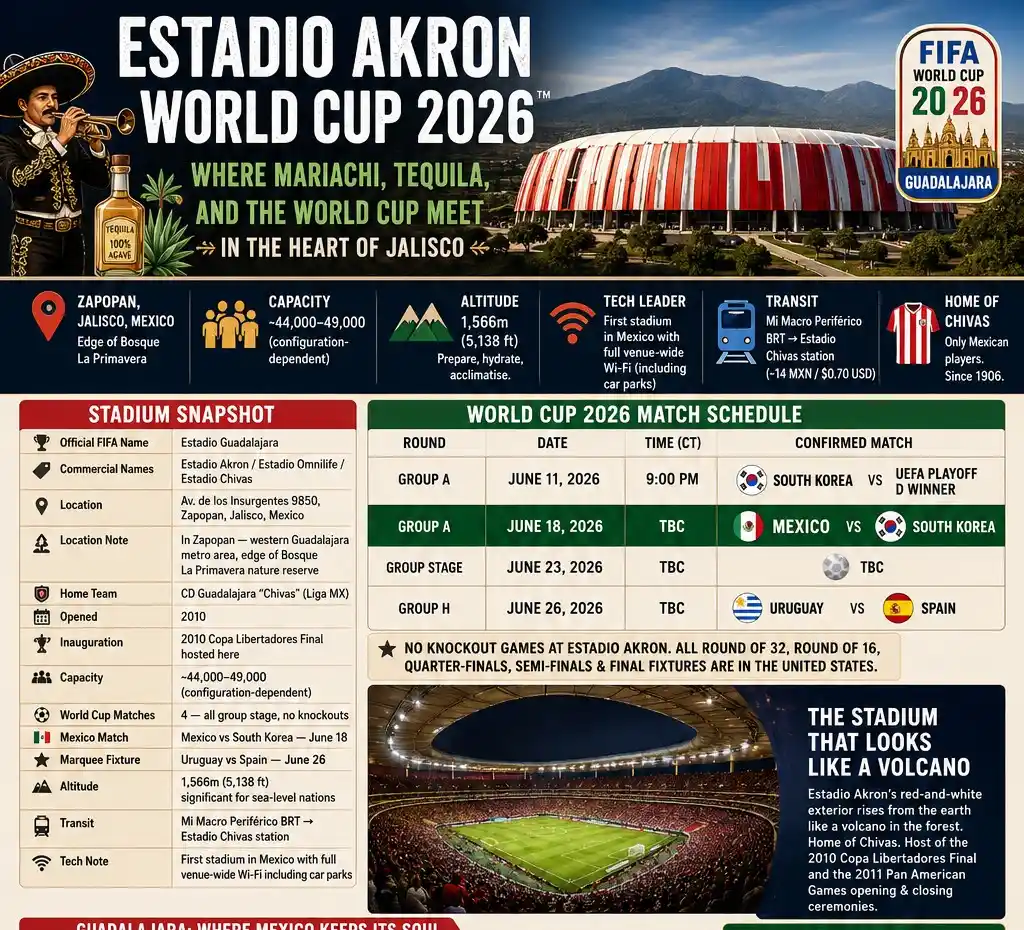
| Official FIFA Name | Estadio Guadalajara |
| Commercial Names | Estadio Akron / Estadio Omnilife / Estadio Chivas |
| Location | Av. de los Insurgentes 9850, Zapopan, Jalisco, Mexico |
| Location Note | In Zapopan — western Guadalajara metro area, edge of Bosque La Primavera nature reserve |
| Home Team | CD Guadalajara “Chivas” (Liga MX) |
| Opened | 2010 |
| Inauguration | 2010 Copa Libertadores Final hosted here |
| Capacity | ~44,000–49,000 (configuration-dependent) |
| World Cup Matches | 4 — all group stage, no knockouts |
| Mexico Match | Mexico vs South Korea — June 18 |
| Marquee Fixture | Uruguay vs Spain — June 26 |
| Altitude | 1,566m (5,138 ft) — significant for sea-level nations |
| Transit | Mi Macro Periférico BRT → Estadio Chivas station |
| Tech Note | First stadium in Mexico with full venue-wide Wi-Fi including car parks |
No Knockout Games — What This Means for Fans
Guadalajara hosts four group-stage matches only. There are no Round of 32, Round of 16, quarter-final, semi-final, or final fixtures at Estadio Akron. Every single knockout-round match in the 2026 World Cup takes place at venues in the United States.
If you are following Spain, Uruguay, Mexico, South Korea, or Colombia into the knockout rounds after the group stage, you will need to cross the US border. Check the World Cup 2026 visa requirements for US ESTA and visa documentation before you travel — your World Cup journey is just beginning in Guadalajara.
The Stadium That Looks Like a Volcano
Estadio Akron’s exterior is one of the most striking in Latin American football — a circular structure clad in alternating red-and-white panels (the Chivas colours) that rise from the ground in a smooth, slightly conical profile. Comparisons to a volcano are inevitable and accurate. The building sits at the western edge of Zapopan in the shadow of the Bosque La Primavera — a protected biosphere reserve — giving the approach to the stadium a forested, elevated character unlike any other World Cup ground.
A complete renovation ahead of the 2026 World Cup installed high-speed Wi-Fi across the entire venue including the car parks — making Akron the first stadium in Mexico with complete connectivity for fans throughout the site.
The stadium hosted the 2010 Copa Libertadores Final and the opening and closing ceremonies for the 2011 Pan American Games, demonstrating its capacity for large-scale international spectacle well beyond a Chivas home fixture.
Guadalajara’s altitude of 1,566 metres affects visiting teams unacclimatised to altitude. The practical advice: if arriving from sea level, allow 48 hours acclimatisation if possible, hydrate aggressively, reduce alcohol on arrival, and stay hydrated throughout match day.
The Match Schedule at Estadio Akron
| Round | Date | Time (CT) | Confirmed Match |
|---|---|---|---|
| Group A | June 11, 2026 | 9:00 PM | South Korea vs UEFA Playoff D Winner |
| Group A | June 18, 2026 | TBC | Mexico vs South Korea |
| Group Stage | June 23, 2026 | TBC | TBC |
| Group H | June 26, 2026 | TBC | Uruguay vs Spain |
June 11 at 9:00 PM local time — Match 2 of the entire tournament — the World Cup comes to Guadalajara on opening night itself. Mexico vs South Korea on June 18 is one of the most emotionally loaded home fixtures of the tournament. Uruguay vs Spain on June 26 is potentially a group-decider between two of the top-ten ranked teams.
The Chivas Identity: A Football Club Unlike Any Other
To understand Estadio Akron, you must first understand who plays here. CD Guadalajara — the Chivas — are not simply a football club. They are a cultural institution and a philosophical statement.
Since the club’s founding in 1906, the Chivas have maintained a unique policy in Mexican football: they only sign Mexican players. No foreign players. In a Liga MX where foreign imports are the norm, the Chivas’ commitment to exclusively Mexican-born talent is both a commercial handicap and the engine of their passionate, loyal fanbase.
The Chivas are the people’s club of Mexico — the team supported by those who believe that Mexican football should develop Mexican talent. Their red-and-white stripes are the most recognisable kit in the country. Their home ground was built specifically for them in Zapopan in 2010.
When Mexico plays here on June 18, the Chivas’ stadium becomes the national team’s emotional second home. The World Cup fixture brings green where normally only red and white fly — but the passion is the same DNA.
Getting There
By BRT (Recommended): The Mi Macro Periférico BRT system serves the stadium at the Estadio Chivas station — a short walk from the entrance. From downtown Guadalajara, journey time is approximately 60–90 minutes. Fare: approximately 14 MXN (around $0.70 USD).
New for 2026 — Mi Tren Lines 4 and 5: Guadalajara’s new light rail extension was scheduled to connect the city’s airport directly to the stadium area ahead of the World Cup. Confirm operational status via Guadalajara’s Mi Movilidad transit authority before match days.
By Rideshare: Uber is the most practical option from central Guadalajara — 25–35 minutes in normal traffic, approximately 150–250 MXN ($8–$13 USD). On match days, ask drivers to drop you short of the main entrance rather than sitting in the approach bottleneck.
From Guadalajara Airport (GDL): 25–40 minutes by rideshare, well-signed via Periférico to Av. Yañez.
From Mexico City: GDL–MEX flights take approximately one hour. ADO luxury coach: 5–6 hours. For fans attending matches at both Azteca (Mexico City) and Akron (Guadalajara), the flight is strongly recommended.
Guadalajara: Where Mexico Keeps Its Soul
The Historic Centre
Guadalajara’s historic centre is built around the Cathedral of Guadalajara — begun in 1558, finished in the 17th century, rebuilt after earthquake damage in the 19th century, and still presiding over the city in twin yellow-tiled towers. The adjacent Teatro Degollado (1866) is one of the finest opera houses in Mexico. Behind the Cathedral, the Instituto Cultural Cabañas — a UNESCO World Heritage Site — contains the great murals of José Clemente Orozco, painted 1938–39 and widely considered the finest examples of Mexican muralism outside of Rivera’s work in Mexico City.
Plaza de los Mariachis
Guadalajara’s Plaza de los Mariachis on Avenida Juárez is the city’s dedicated mariachi performance space — dozens of bands in traditional charro suits (wide-brimmed hats, embroidered jackets, silver-buckled trousers) playing Jalisco’s defining music for hire and for love.
Mariachi music originated in Jalisco in the 19th century. The modern form — with trumpet, violin, vihuela, guitarrón, and iconic falsetto vocals — was codified in Guadalajara in the early 20th century. Sit at a table on a June evening, order a tequila, and hire a band to play “Cielito Lindo” or “El Rey.” This experience is available nowhere else on earth in quite this form. During the World Cup, the plaza will be full every night.All 48 FIFA World Cup 2026 Teams in Alphabetical Order: Complete Squads & Schedule
Tlaquepaque and Tonalá
Ten minutes from the historic centre, the arts and crafts suburb of San Pedro Tlaquepaque is one of the finest artisan shopping districts in Mexico — blown glass, talavera ceramics, silver jewellery, handwoven textiles, and painted furniture. El Parian, the covered bar complex at the town’s centre, is where mariachi bands play for evening crowds and tequila flows freely.
Tonalá, adjacent to Tlaquepaque, is Guadalajara’s wholesale crafts market — less polished, more authentic, and significantly cheaper. The Thursday and Sunday markets draw buyers from across Mexico and from international export businesses.
Lake Chapala Day Trip
Lake Chapala — 45 minutes south of Guadalajara — is the largest natural lake in Mexico and one of the most scenic landscapes in the country. The lakeside town of Ajijic has been home to a large North American expat community for decades. Boat trips on the lake, colonial-era churches, and fish restaurants serving local pescado blanco (lake whitefish) make it the ideal half-day excursion between World Cup fixtures.
Jalisco Food: Birria, Pozole and the Torta Ahogada
Guadalajara’s food culture is one of the most distinctive in Mexico — and has demonstrated its global influence in the past decade via the worldwide birria phenomenon.
Birria Guadalajara’s global food export. A stew of goat (traditionally) or beef, slow-cooked in a rich dark chile broth with guajillo, ancho, and pasilla peppers, cumin, cloves, and cinnamon. Served in a bowl for dipping, or in tacos with the broth as consommé — the “birria quesatacos” that became a social media sensation worldwide from around 2019 originated here, in Jalisco.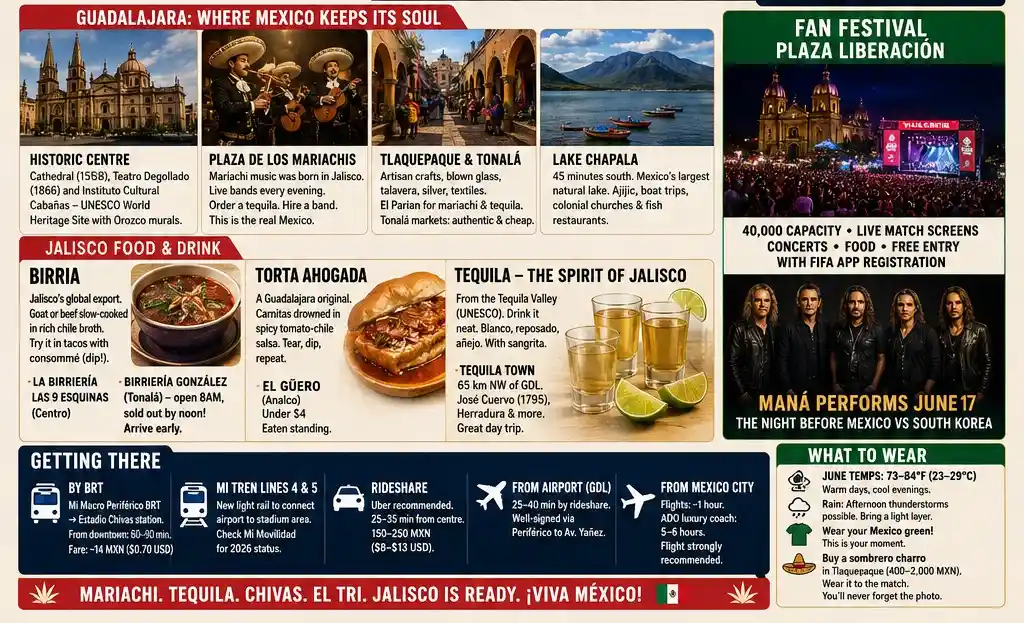
La Birriería Las 9 Esquinas in Guadalajara’s centre is the city’s most celebrated birria destination. Birriería González in Tonalá (open from 8 AM, sold out by noon) serves what many food writers consider the finest version in the world. Arrive early. This is not a suggestion.
Torta Ahogada A Guadalajara original: a crusty birote salado roll (a bread unique to Guadalajara’s water chemistry) stuffed with fried carnitas, then submerged — drowned — in a spicy tomato-chile de arbol salsa. Eaten by tearing off pieces and dipping them back into the sauce. El Güero in the Analco neighbourhood is the institution. Under $4, eaten standing.NRG Stadium World Cup 2026: Crawfish, NASA and Knockout Football in America’s Most Underrated World Cup City
Tequila — The Beverage of Jalisco The town of Tequila, 65 kilometres northwest of Guadalajara, is the origin of the world’s most famous Mexican spirit. Blue agave plants grow in the red volcanic soil of the Tequila Valley — a UNESCO World Heritage Site. José Cuervo (founded 1795), Herradura, and dozens of artisanal producers run distilleries that can be visited on a day trip.
The best tequilas are blancos (unaged, pure agave flavour), reposados (rested 2–12 months in oak), and añejos (aged 1–3 years, almost whisky-like in complexity). Drink them neat, at room temperature, with a side of sangrita (a Mexican chaser of tomato, orange, and chile juice). This is how tequila is drunk in Jalisco, and it bears no resemblance to a margarita.
Fan Festival: Plaza Liberación
The official FIFA Fan Festival for Guadalajara is at Plaza Liberación — the open plaza in front of the Cathedral. Capacity: 40,000, with live match screenings, concerts, and food across surrounding plazas. Entry free with FIFA app registration.
Maná performs on June 17 — the night before Mexico’s match — at the fan zone. Guadalajara’s own global rock-pop institution plays a free outdoor concert the evening before El Tri’s crucial Group A fixture. For the city, this is not merely a concert. It is a ritual.
Watching Mexico vs South Korea on a giant screen in the shadow of a 17th-century cathedral, surrounded by 40,000 tapatíos, with mariachi music drifting in from Plaza de los Mariachis a few blocks away — this is the World Cup experience that money cannot manufacture.
What to Wear in Guadalajara
- Typical June temperatures: 73–84°F (23–29°C). Warm days, genuinely cool evenings. Guadalajara’s altitude moderates the heat dramatically compared to Mexico City or Monterrey.
- Rain: June marks the beginning of Jalisco’s rainy season. Afternoon thunderstorms are possible — usually brief and intense, followed by clear skies. A light waterproof layer is worth carrying.
- Mexico kit: If you own a green Mexico shirt, this is where to wear it. The Chivas’ home stadium hosting El Tri is a once-in-a-generation intersection of club and country identity.
- Charro hat: If you wish to buy a traditional sombrero charro, the markets of Tlaquepaque are the correct place to acquire one. It costs between 400 and 2,000 Mexican pesos depending on quality. Wear it to the match. The photograph will last a lifetime.
🔹🔹 Follow us on Facebook 🔹🔹
About the Author