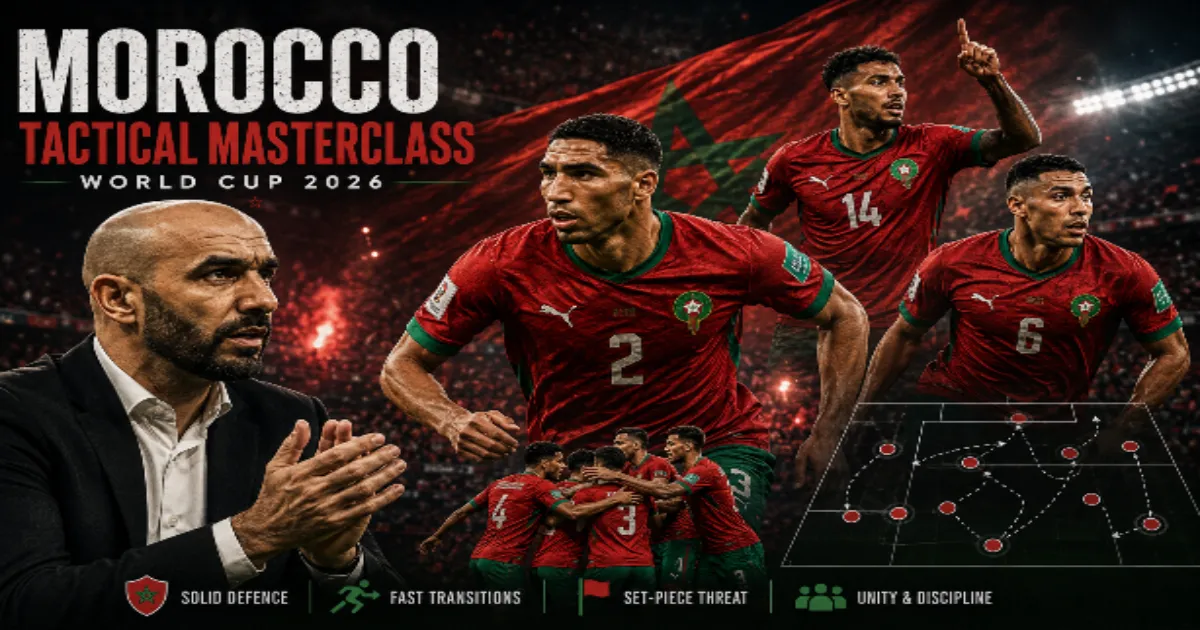
Morocco’s Tactical Masterclass at World Cup 2026: The System Regragui Built That Nobody Has Solved
Qatar 2022 was supposed to be an anomaly — the one tournament where Morocco defied all reasonable expectations and reached a semi-final no African nation had reached before. World Cup 2026 is confirming that what happened in Qatar was not an accident. It was a blueprint.
When Walid Regragui was appointed Morocco head coach in August 2022 — less than three months before the World Cup began — the appointment was greeted with polite scepticism. Morocco’s qualification had been achieved under Vahid Halilhodžić, a coach with genuine tournament pedigree, who had been dismissed in circumstances that were opaque and the timing of which seemed, to most external observers, either brave or reckless. Achraf Hakimi FIFA World Cup 2026: Profile, Stats & Career | StrikerReport
NBA Schedule 2026-27: Christmas Day Rivalries, Ring Night and the Games to Watch
The semi-final run that followed was one of the most discussed achievements in World Cup history. It was discussed from many angles — the emotional, the political, the historical — but the tactical angle was perhaps the most underexplored at the time. Morocco had not been lucky. They had been organised, systematic, and intelligent in a way that took on Spain, Portugal, and Brazil (before the loss to France) and found vulnerabilities in all of them.
The Morocco tactical masterclass that has characterised their World Cup 2026 group stage is the second proof point of a thesis Regragui began building in Qatar: that a high-performing defensive block, combined with elite transition football and a set-piece system that leverages specific physical attributes, can compete with any team in world football.
Here is exactly how it works.
The Defensive Structure: A 5-4-1 Block That Shifts to 4-4-2 Out of Possession
Morocco’s base formation in possession is typically a 4-2-3-1, with Hakimi operating as an advanced right back who often functions as a right midfielder in the attacking phase. Out of possession, however, the shape transforms into something considerably more conservative and considerably harder to break down.
When the opposition have the ball in their own half, Morocco drop into a 4-4-2 mid-block. The two forwards press the centre-backs aggressively but with specific instruction to channel play toward the touchlines rather than closing centrally. This is a press designed not to win the ball in the opposition’s half but to dictate where it goes — to force it wide, where Morocco’s fullbacks are physically imposing and aerially strong, and where the central space they vacate by pressing is already covered by the two defensive midfielders sitting compact between the lines.
When the opposition enter Morocco’s half with the ball, the 4-4-2 compresses into what Regragui’s coaching staff have referred to in pre-match footage as a “5-4-1 defensive shell” — the right back dropping into the defensive line to create a back five, with the two central midfielders and the two wingers forming a flat four in front. The lone striker holds a position designed to prevent distribution from the goalkeeper to centre-backs.
The distances between the lines are the critical variable. Morocco’s compactness is not merely a matter of every player being goal-side of the ball. It is about specific distances: the gap between the defensive line and the midfield four is maintained at approximately eight to ten metres throughout. That gap is small enough to eliminate the space that most modern attacking systems rely on in the central zones, but large enough that the defenders are not so high that balls in behind become threatening.
In their three group games, Morocco conceded from open play once. That concession came from a transition where their defensive line was caught for one of only a handful of moments across nine hours of football in a pushed-up position against Portugal — a moment that proved the system is not perfect but also showed that its vulnerabilities require very specific, very high-quality exploitation to find.
The Pressing Triggers: How Morocco Invite Pressure to Create Transition
The most sophisticated element of the Morocco tactical approach is not their defensive block — which, while excellent, is a variation on principles that multiple elite teams employ. It is their pressing trigger system: the specific conditions under which they transition from compact defensive shape to aggressive, coordinated forward press.
Regragui’s system identifies four primary pressing triggers:
Trigger 1: Goalkeeper in possession. When the opposition goalkeeper has the ball and is preparing to distribute, Morocco’s striker and the nearest central midfielder step forward simultaneously to close the passing options to centre-backs. If the goalkeeper plays short, Morocco’s second line engages. If the goalkeeper plays long, Morocco transition to their aerial duel recovery shape — where the physical strength of Nayef Aguerd and Romain Saïss becomes the primary weapon.
Trigger 2: Centre-back receives under pressure. If Morocco’s initial press forces a centre-back to receive the ball with a nearby player closing, the nearest winger on that side engages immediately. This creates a two-v-two situation (striker + winger vs. centre-back + covering centre-back) that Morocco aim to win aerially or force a rushed clearance from.
Trigger 3: Backward pass in wide areas. If an opposition full-back passes backward to their centre-back while Morocco’s wingers are near the halfway line, the corresponding winger closes immediately and the central midfielder on that side shifts to cover the passing lane back to the goalkeeper. This trigger is designed to force long balls that Morocco’s defensive line can win.
Trigger 4: Miscontrol or delayed touch. Morocco’s defensive midfielders — specifically Sofyan Amrabat’s role has evolved significantly, but the principle continues with his successors in this tournament — are specifically trained to identify the moment when an opposition player controls the ball poorly and to close immediately. This sounds obvious. The execution of it, at World Cup speed, against opposition who are technically excellent, is anything but.
Against Portugal in their group decider, this trigger system produced three counter-attacks in the first thirty minutes that each created clear opportunities. Morocco scored once from them. They could credibly have scored twice more.
Transition Football: The Hakimi Dimension
Achraf Hakimi is the axis around which Morocco’s attacking transition is built. His role in the system is, on paper, a right back. In practice, during Morocco’s attacking transitions, he functions as the most advanced player in the team — a forward runner with fullback defensive responsibilities who creates width, stretches defensive blocks horizontally, and delivers the kind of cross from deep positions that most teams only get from wingers.
His goal against Portugal — described in the best goals article — came from a run that began in Morocco’s own half. The context: Morocco had won the ball through Trigger 1 pressing, the ball was played quickly to Hakimi’s channel by a centre-back who had been coached to identify the specific situation where Hakimi’s overlapping run had been identified by the pass — a planned sequence, not spontaneous.
Hakimi’s 33.9 km/h sprint to arrive at the six-yard box was not a physical accident. It was a player who had been told, in the event of that specific ball, to run at that specific angle, and who had the physical capacity to do it at World Cup speed against a Portugal backline that had allowed only four goals in qualifying.
On the left side, the transition options are more varied. Hakim Ziyech, when fit and selected, provides the creativity from deep. The left back — Morocco rotated this position across group games — provides the width. The interplay between Morocco’s attacking runners in transition is less structured than Hakimi’s role on the right but no less dangerous: it relies on the specific individual quality of the players involved rather than a predetermined pattern, which makes it harder for opposition analysts to plan against.Achraf Hakimi FIFA World Cup 2026: Profile, Stats & Career | StrikerReport
Set-Piece Analysis: The Hidden Weapon
Morocco’s set-piece delivery has been one of the least-discussed aspects of their tactical approach in both 2022 and 2026, which is remarkable given how consistently it has produced goals and dangerous moments.
Their corner routine involves two distinct phases. The initial delivery is consistently outswinging from the right and inswinging from the left — a pattern that reverses most teams’ standard approach and creates a different aerial threat profile for the opposition to manage. Their first-post runner (typically a central midfielder rather than a forward) is not expected to score but to create a flick-on or distraction that allows the second and third runners arriving at the far post to meet the ball in space.
Their free-kick attacking pattern involves a standing player near the wall who drifts toward the far post as the ball is delivered, creating a third option that the opposition’s set-piece defensive shape rarely accounts for. Twice in the group stage, this runner arrived unmarked at the far post. Once, the delivery was accurate enough to convert. The second time, the ball was slightly overhit.
At defensive set-pieces, Morocco’s zonal marking system — rare at international level, where most coaches prefer man-marking for its psychological clarity — is executed with precision that suggests extensive drilling. Their zonal positions are maintained even when opponents make deliberate blocking runs, with the defensive line trusting the zones rather than following individual runners. This requires significant defensive coordination and discipline under pressure. Morocco have it.
The Portugal Game: A Tactical Case Study
The Morocco v Portugal group fixture was the most technically demanding test of Morocco’s system in the group stage, and it deserves granular analysis.
Portugal set up in their standard 4-3-3 with Bruno Fernandes as the advanced midfielder, intending to use Fernandes as the third-man receiver between Morocco’s midfield and defensive lines — precisely the space Morocco’s compactness is designed to eliminate.
In the opening twenty-five minutes, Portugal found that space twice. Both times, Fernandes received in the pocket between the lines and turned — and both times Morocco’s defensive structure recovered quickly enough to prevent a shot on target. The second of these recoveries involved Aguerd making a twelve-metre sprint to close down Fernandes from a position that appeared, for a moment, to be too far away to arrive in time. He arrived.
After thirty minutes, Portugal adjusted. Rafael Leão began dropping deeper to receive the ball as a false nine — pulling Aguerd or Saïss out of the defensive line to create space behind them. Morocco’s response was to shift their defensive midfielders into a deeper starting position that could cover behind the centre-backs when they were drawn out, sacrificing some of their transition speed but maintaining defensive security.
Hakimi’s goal came from this tactical context. Portugal, adjusting their defensive line to account for the threat of Moroccan transitions, momentarily left space behind their left back. Morocco’s first Trigger (goalkeeper distribution) created the initial ball. Hakimi read it faster than anyone else. The goal was as much a tactical reward as a physical and technical one.
What It Means for the Knockout Rounds
The Morocco tactical masterclass in the group stage has left the field with three confirmed characteristics: a defensive system that requires elite execution to break down, a transition mechanism that punishes hesitation at the highest level, and a coaching staff capable of in-game tactical adjustments that respond to what the opposition is trying to do rather than simply executing a predetermined plan.
These are the characteristics of a team built for tournament football specifically — not the most stylish team in the competition, not the team that generates the highest xG over ninety minutes, but a team whose design is optimised for the conditions a World Cup knockout game creates: high stakes, compact spaces, conservative opposition, and the premium placed on set-piece moments that can decide tight games.
In 2022, the world was surprised. The question for 2026 is whether surprise is still available to Morocco, or whether every remaining opponent has had enough time to study, prepare, and find the specific vulnerabilities that exist in any system.
The answer, based on three group games that included matches against opponents who had studied 2022 extensively and arrived with specific tactical plans to address Morocco’s methods, is that Regragui’s Morocco tactical masterclass is not just a system. It is a living document — one that evolves game by game, opposition by opposition, with adjustments that suggest a coaching staff operating at the tactical frontier of international football.
Morocco shocked the world in Qatar. They are, once again, doing something that looks very much like the same thing. The question is whether this time, the world is surprised to be surprised.
NBA Schedule 2026-27: Christmas Day Rivalries, Ring Night and the Games to Watch
Thiago Messi: Club Career, Playing Style, Lifestyle and Future Prospects
▪️▪️ Follow us on Facebook ▪️▪️
About the Author


1 thought on “The Blueprint Nobody Copied: Inside Morocco’s Tactical Masterclass at World Cup 2026”