Spain tactics under Luis de la Fuente have evolved beyond tiki-taka into a balanced system built to win the FIFA World Cup final.
 Spain tactics under Luis de la Fuente have evolved beyond
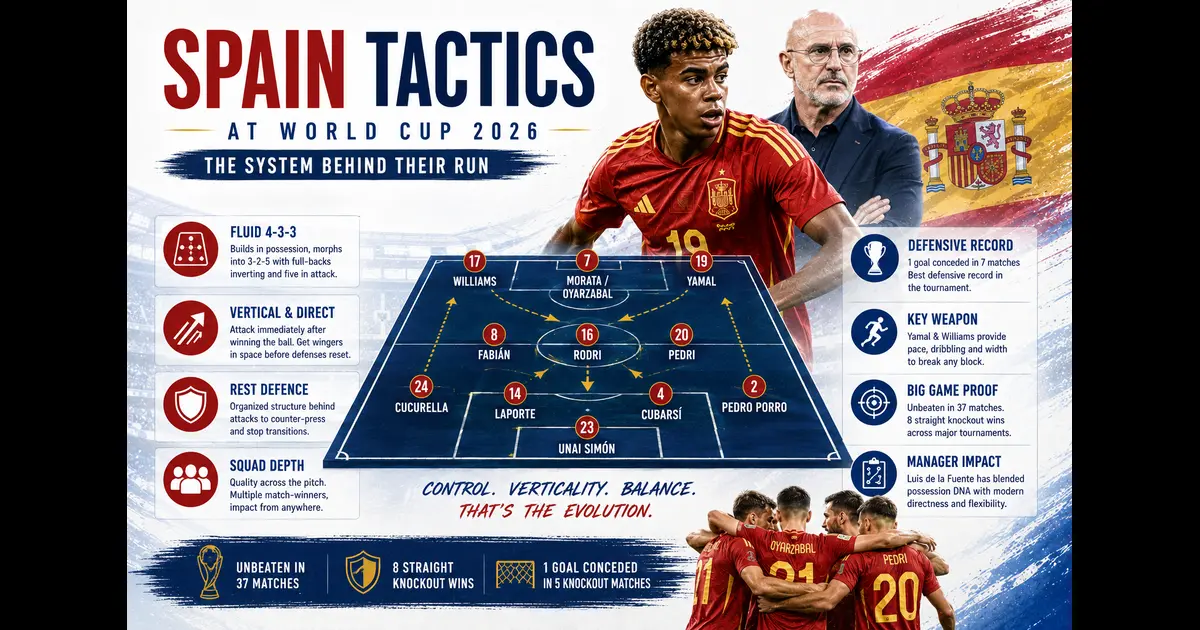
 Spain arrive at the World Cup 2026 final unbeaten in 37 matches, having won eight straight knockout games across major tournaments, and having conceded precisely once in five knockout matches at this World Cup. Numbers like that don’t happen by accident, and they don’t happen through nostalgia either. What Luis de la Fuente has built with this Spain side is a deliberate departure from the possession-for-possession’s-sake identity that once defined the national team — and understanding that shift is the key to understanding why Spain are one match from a second World Cup title.
Breaking With the Old Blueprint
To understand where Spain are now, it helps to understand where they came from. The Spain side that won back-to-back European Championships and a World Cup between 2008 and 2012 built its identity on suffocating ball retention — patient, horizontal, built to strangle a game rather than tear through it. That approach delivered a golden generation of trophies, but it also had a shelf life. A group-stage exit at the 2014 World Cup and shootout losses to Russia in 2018 and Morocco in 2022 exposed the same flaw each time: teams that sat deep and compact could nullify Spain’s control almost entirely, forcing them into sterile, low-shot-value possession that rarely broke a defensive block down.
De la Fuente, who took over after the Morocco exit, has been candid about the need for change without abandoning Spain’s technical identity altogether. Rather than a full rebuild, the shift has been about adding tools rather than replacing the toolkit — keeping the midfield control that Spain has always had, while giving the team far more ways to actually convert territory into goals.
The Base Shape: A 4-3-3 That Isn’t Always a 4-3-3
Spain start from a 4-3-3 under de la Fuente, with a single holding midfielder — usually Rodri when fit — anchoring possession in front of the back four. But describing it as a static 4-3-3 undersells how fluid the shape becomes once Spain have the ball. In sustained periods of pressure, the structure regularly morphs into something closer to a 3-2-5 or 2-3-5, with full-backs pushing high and inverting into midfield, wingers hugging the touchline for width, and as many as five players occupying the final third simultaneously. It’s positional play in the truest sense — built around triangles, underloads and overloads created deliberately in different zones of the pitch, rather than simply passing the ball around until an opening appears.
The clearest evidence of that evolution is Pedro Porro’s role from right-back. Rather than a conventional full-back staying disciplined in a back four, Porro has repeatedly been found in advanced positions this tournament, scoring against Austria in the round of 32 and again in the semifinal win over France — goals that simply wouldn’t happen from a traditional, risk-averse full-back set-up.
Verticality Over Patience
The single biggest philosophical shift from the tiki-taka era is what happens the moment Spain win the ball back. Instead of the old pattern of recycling possession safely through midfield until a gap appears, this Spain side looks to attack immediately — releasing wingers into space before an opponent’s defensive shape has had time to reset. It’s a form of positional play with a transition-first mentality bolted on, and it’s a direct response to the lesson of 2014, 2018 and 2022: give a well-organized defensive block time to set, and even total ball dominance won’t be enough to break it down.
That directness is only possible because of the players available to execute it. Lamine Yamal and Nico Williams give Spain a level of individual pace and one-on-one threat out wide that simply wasn’t present in the 2010-winning squad, and de la Fuente has built his attacking structure specifically to get the ball to them in space as quickly as possible, rather than working it through slower, more patient buildup every time.
Rodri, Control, and the Platform Underneath It All
None of the verticality works without control underneath it, and that’s where Rodri’s role becomes essential. As Spain’s single pivot, he’s tasked with dictating tempo, screening the back four, and — critically — organizing what’s often described as “rest defence”: the positioning of players who aren’t directly involved in an attack, set up specifically to win the ball back immediately if possession is lost in a dangerous area. It’s a detail that separates elite modern possession sides from the more porous versions of years past — Spain can afford to commit five players forward in the final third precisely because the structure behind that commitment is built to prevent the counter-attacks that used to punish overly expansive sides.
Rodri’s importance was underlined further by his individual honors coming into the tournament, arriving as a recent Ballon d’Or winner and widely regarded as one of the two or three best deep-lying midfielders in the world. Losing him to injury or suspension would be the single biggest structural risk to how Spain want to play in the final.
Where It’s Worked Best: The Knockout Rounds
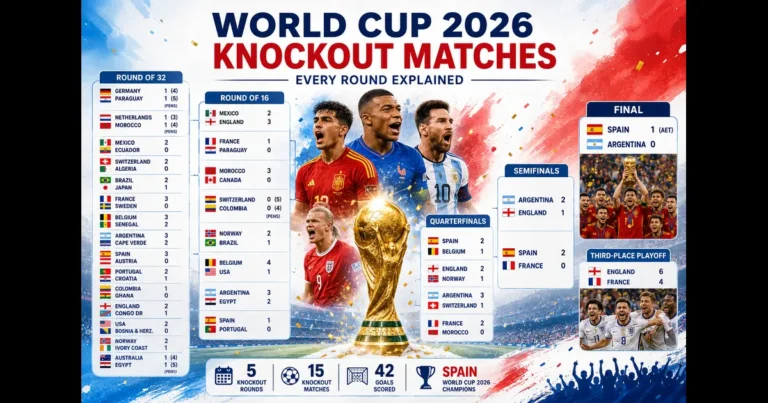
Spain’s knockout form has been the clearest demonstration of the system functioning as designed. A 3-0 win over Austria in the round of 32 showed the vertical attacking speed at its most ruthless. A tighter 1-0 win over Portugal in the round of 16 showed the control-first version of the same identity, grinding out a single moment of quality against a well-organized opponent. The 2-1 quarterfinal win over Belgium — the only match in which Spain have conceded in the knockout stage — showed some of the system’s residual vulnerability in transition defense, a detail worth watching heading into the final. And the semifinal demolition of France, built on a Mikel Oyarzabal penalty and a well-worked Porro finish, showed the fully realized version: control for large periods, and a directness in the moments that mattered most.
The Test Awaiting Them
Argentina present a different kind of puzzle than anything Spain have faced so far this tournament. Where Austria, Portugal, Belgium and France all, in different ways, tried to organize a settled defensive structure against Spain, Argentina’s whole knockout campaign has been built around absorbing pressure, sometimes chaotically, and hitting on the counter through moments of individual brilliance from Messi and his supporting cast. That’s a fundamentally different threat profile than a structured low block, and it will test exactly the part of Spain’s system — the rest-defence organization behind their high, expansive attacking shape — that showed the first signs of vulnerability against Belgium.
If Spain’s tactical evolution has been about adding directness without sacrificing control, Sunday’s final is the ultimate examination of whether that balance holds against the one opponent at this World Cup built specifically to exploit the moments when it doesn’t.
🔹🔹 follow us on facebook 🔹🔹
About the Author