 The Spain World Cup Final Case: Why La Roja Are the Team to Beat
Favorites tags at major tournaments usually attach to the team with the flashiest attacking numbers or the biggest individual star. Spain’s case heading into Sunday’s final is built on something quieter and, in many ways, more convincing: they have simply not been beaten, and they have barely been threatened. The Spain World Cup final case doesn’t require any single dramatic storyline to hold up. It just requires looking at what this team has actually done for seven matches running.
The Defensive Record That Explains Everything
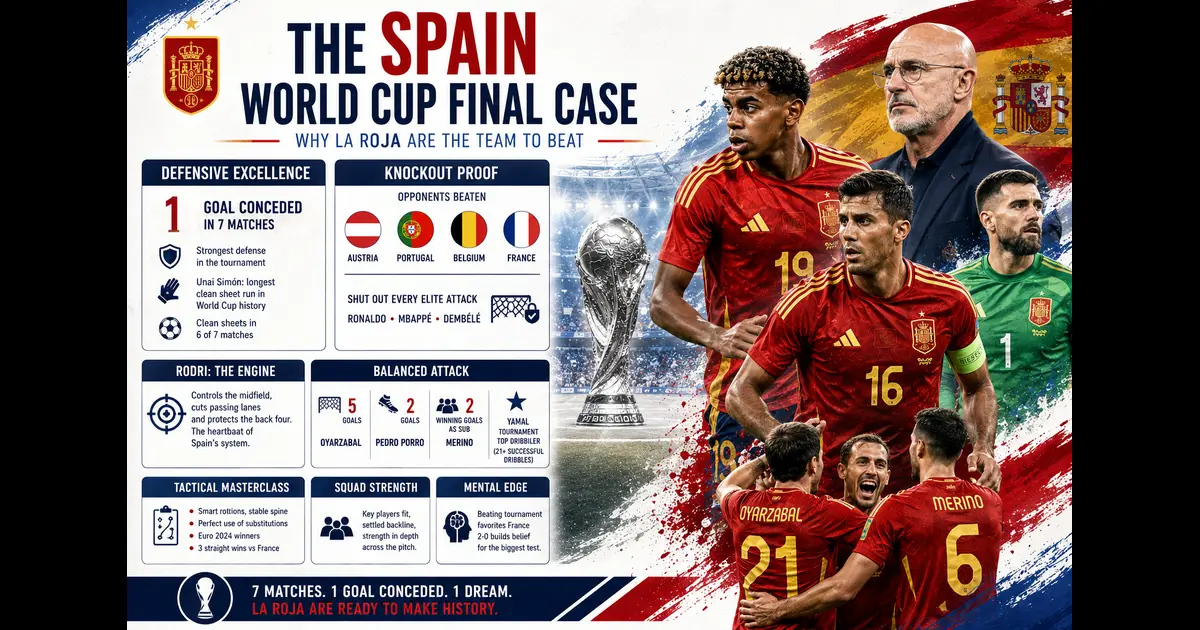
Start with the number that matters most: Spain have conceded exactly one goal across seven matches at this World Cup. Not one goal per match. One goal, total, since the tournament began. That’s not a fluky run of favorable matchups either; Spain’s knockout opponents have included Austria, Portugal, Belgium, and France, four sides with genuinely different attacking profiles, from Portugal’s individual quality built around a farewell Cristiano Ronaldo campaign to France’s frontline pairing of Kylian Mbappé and Ousmane Dembélé, the tournament’s joint-leading scorer heading into the final. Spain shut all of them down.
Goalkeeper Unai Simón deserves specific credit here; he has now gone longer without conceding a goal at a single World Cup than any goalkeeper in the tournament’s history, a genuinely historic individual mark that reflects both his own form and the defensive structure protecting him. In front of him, the central pairing of Aymeric Laporte and Pau Cubarsí has remained settled and unchanged for the entire knockout stage, a continuity that matters enormously in a tournament where fatigue and squad rotation tend to expose weaker defensive partnerships by the semifinal stage.
Rodri: The Player Making Everything Else Work
If Spain’s back four is the foundation, Rodri is the load-bearing wall in front of it. The Manchester City midfielder’s positioning at the base of Spain’s structure has been central to nearly every defensive success this tournament, cutting off passing lanes before they become genuine chances and giving Laporte and Cubarsí a settled, protected platform to defend from. Rodri’s influence doesn’t always show up in a highlight reel the way a dribble or a goal does, but ask any opposing coach from this tournament which Spanish player they spent the most time designing a game plan around, and Rodri’s name comes up as often as anyone’s.
This matters specifically against Argentina, whose entire attacking approach in the knockout rounds has relied on patient buildup through central areas before finding the pass that unlocks a defense in behind. Rodri occupying exactly the zone Lionel Messi prefers to drop into isn’t a coincidence; it’s the same defensive principle that’s already worked against every other elite attacking talent Spain has faced this summer.
An Attack That Doesn’t Need One Superstar
It would be easy to assume a team this defensively dominant must be sacrificing something going forward, but Spain’s attack has actually been efficiently varied rather than one-dimensional. Mikel Oyarzabal leads the squad with five goals, timing his runs into the box with a consistency that’s made him one of the tournament’s most underrated attacking threats. Pedro Porro has chipped in from right-back. Mikel Merino, introduced from the bench in consecutive knockout matches, has produced the winning goal against both Portugal and Belgium, an almost unprecedented run of decisive substitute impact. And Lamine Yamal, still building toward full match sharpness after a spring hamstring injury, already leads the entire tournament in successful dribbles alongside only Messi himself.
That spread of attacking contribution across five or six different players, rather than dependence on a single talisman, is precisely the kind of profile that tends to hold up under the specific pressure of a World Cup final, where an opponent’s game plan usually focuses on shutting down one obvious individual threat. Spain doesn’t hand you an obvious single threat to focus a defense around.
A Manager Who Has Solved Every Puzzle Put in Front of Him
Luis de la Fuente doesn’t get discussed with the same reverence as some of the more storied managerial names in this tournament, but his tactical management across seven matches has been close to flawless. He’s rotated personnel without disrupting defensive continuity, introduced Merino at precisely the moments his impact has mattered most, and kept Yamal’s re-integration patient enough that the teenager arrives at the final finally approaching his best physical condition rather than being rushed back too early. De la Fuente also has previous experience solving exactly this kind of pressure; his side won Euro 2024 playing a similar patient, possession-based system, and beat France in that tournament’s semifinal in a preview of exactly the kind of knockout composure Spain has now shown three summers running.
The Psychological Weight of Already Beating This Tournament’s Form Team
There’s a genuine psychological dimension to Spain’s semifinal win over France worth factoring in here. Heading into that match, France were widely considered the tournament’s most fearsome attacking side, having scored freely throughout their run and boasting Mbappé in career-best individual form. Spain didn’t just beat them; they suffocated them, limiting France to a single shot on goal for most of the match before a pair of stoppage-time consolation efforts arrived too late to matter. Beating the tournament favorites that comprehensively, in a World Cup semifinal, tends to instill exactly the kind of belief a team needs walking into a final against an even bigger name.Spain vs Argentina Prediction: Who Will Win the FIFA World Cup 2026 Final?
There’s also a squad-continuity argument worth adding to the ledger. Unlike several rivals who’ve had to reshuffle their spine due to injuries or suspensions deep into the tournament, Spain’s key personnel, Simón, Laporte, Cubarsí, Rodri, have remained fit and available throughout, meaning de la Fuente hasn’t been forced into unwanted experimentation at the exact stage of the competition where settled understanding between defenders matters most.
The One Genuine Question Mark
None of this means Spain are without risk on Sunday. Their one blemish this tournament, a goalless draw against Cape Verde in the group stage, is a reminder that patient, possession-heavy football can occasionally stall against a well-organized low block, and Argentina, for all their knockout-stage drama, have shown real defensive resilience of their own when protecting a lead becomes necessary. Spain’s system also hasn’t yet been tested against a player with Messi’s specific combination of experience and end-of-match decisiveness; every other elite attacker Spain has faced this tournament has been younger and, arguably, less battle-tested in exactly these circumstances.
But test the case for Spain against nearly any objective measure available, defensive record, squad depth, managerial in-game management, recent head-to-head psychology against elite opposition, and the pattern is consistent. This is a team that has answered every question asked of it so far, usually convincingly. Sunday is simply the biggest question yet.
About the Author