World Cup 2026 Best Players Ranked: The Top 96 Stars — Two From Every Nation
The 2026 FIFA World Cup features 48 nations and 1,248 players. We have ranked the 96 best — two from every competing team — because every nation at a World Cup has someone worth watching. This is who they are.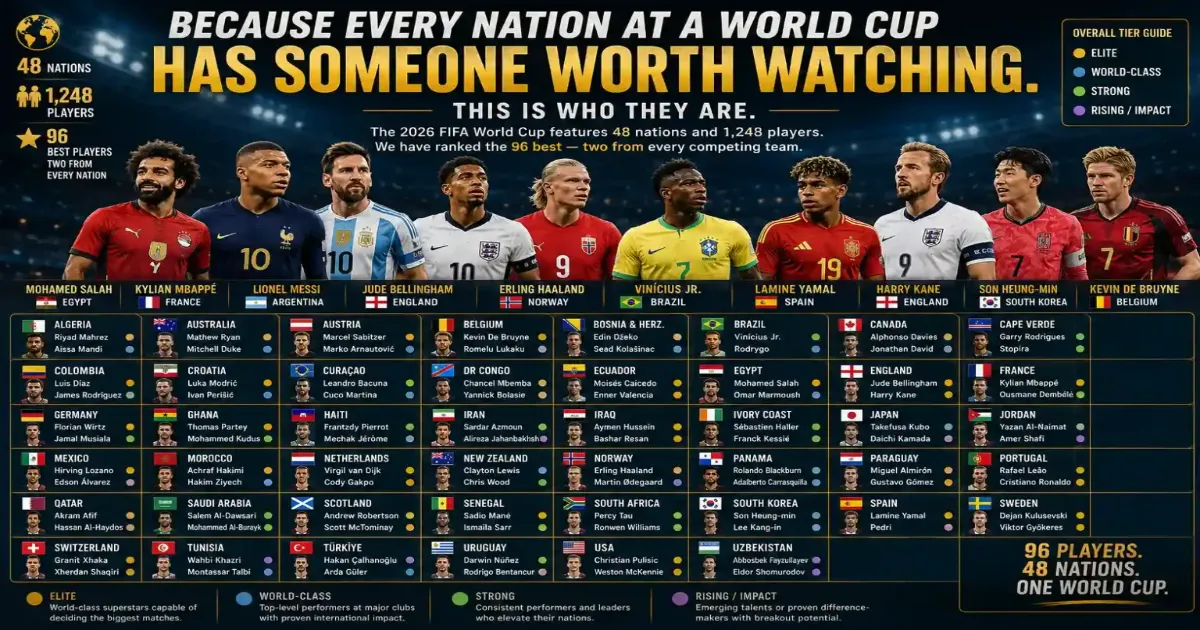
How This Ranking Works
This list covers two players from each of the 48 World Cup 2026 nations — 96 players in total. Rankings are based on current form at the time of the tournament (based on 2025–26 club season performance), international pedigree, and World Cup impact potential. This is not a career ranking. Messi at 38 and Ronaldo at 41 are ranked on what they bring to this specific tournament — not what they have contributed across 20 years.
Spain Won the FIFA World Cup 2026: How La Roja Conquered the World Again
Golden Ball Winner Rodri: The Case for Football’s Quietest Superstar
Players are grouped by nation (alphabetically), with an overall tier indicator. The Top 10 Individual Players are highlighted separately at the end.
GROUP A NATIONS
Algeria : Riyad Mahrez (Al-Ahli) — The veteran winger turned 35 this year but remains Africa’s most creative wide player. His ability to unlock defences with pace and technique has defined Algeria’s attacking play across two World Cup cycles. Still has the big-match gene. Aissa Mandi (Villarreal) — The captain. The organiser. Algeria’s defensive structure depends on his positional intelligence and communication at centre-back. Arguably at the peak of his powers.
Australia : Mathew Ryan (AZ Alkmaar) — The Socceroos’ most reliable performer across a decade of qualification campaigns. His shot-stopping and distribution give Australia a foundation that compensates for the quality gap between them and most opponents. Mitchell Duke (Fagiano Okayama → renegotiated for 2026) — Big-game scorer. His 2022 World Cup goal against France was no accident. A physical, intelligent centre-forward who gives Australia attacking bite.
Austria: Marcel Sabitzer (Borussia Dortmund) — Sabitzer’s technical quality, high work rate, and box-to-box mobility make him the engine of the Austrian midfield. His Champions League experience is Austria’s greatest competitive advantage. Marko Arnautović (Inter Milan) — At 37 in 2026, Arnautović remains Austria’s most dangerous forward. His hold-up play, physical presence, and experience in major knockout football give Austria options that pure pace-based forwards cannot provide.
Belgium: Kevin De Bruyne (Manchester City) — Still, despite the mileage, one of the finest playmakers in world football. De Bruyne’s vision, range of passing, and set-piece delivery make him Belgium’s most important player regardless of age. A 2026 World Cup run could define the final chapter of a magnificent career. Romelu Lukaku (Napoli) — The all-time Belgian goalscorer. Physical, powerful, and still producing in Serie A. His combination with De Bruyne gives Belgium’s attack a quality that belies their “golden generation’s twilight” narrative.
Bosnia and Herzegovina : Edin Džeko (Fenerbahçe) — At 40, Džeko is the World Cup’s oldest outfield player. His inclusion is not sentimental — he remains Bosnia’s most capable link player and his movement and intelligence compensate for any decline in pace. As noted elsewhere, why are there so many over-40 players at this World Cup? Longevity is a skill. Sead Kolašinac (Marseille) — The attacking left-back brings Premier League-tested physicality and delivery quality to Bosnia’s wide positions.
Brazil Vinícius Jr. (Real Madrid) — The most exciting wide attacker in world football. Vinícius’s directness, pace, and finishing quality have been at their peak across the 2025–26 season. If Brazil win the World Cup, he will be at the heart of it. Rodrygo (Real Madrid) — The junior partner in the Real Madrid Brazil contingent is increasingly the senior partner in terms of consistency. Rodrygo’s positioning, off-the-ball movement, and clutch goal-scoring make him Brazil’s second-most dangerous attacking weapon.
Canada Alphonso Davies (Bayern Munich) — Canada’s greatest football export. The left-back’s explosive pace, crossing quality, and ability to function as a winger when his team needs width make him the most complete Canadian player since Paul Stalteri. On home soil in 2026, Davies plays in front of his own people for the first time at a senior World Cup. Jonathan David (Lille) — The most prolific Canadian striker in history. David’s goalscoring record in Ligue 1 — consistent 20+ goal seasons — gives Canada a genuine international-class finisher for the first time.
Cape Verde : Garry Rodrigues (Panathinaikos) — The winger who has been Cap Verde’s most consistent performer across two Africa Cup of Nations campaigns. His direct running and ability to create from wide positions represent their best attacking threat. Stopira (Nantes) — The experienced centre-back gives Cape Verde’s defensive structure the organisational backbone their debut requires. Been waiting for this moment since the 2013 AFCON.
Colombia: Luis Díaz (Liverpool) — One of the most exciting wide forwards in world football. Díaz’s pace, technical ability, and work rate at Liverpool have made him a consistent performer at the highest level. Colombia’s most dangerous attacker and potentially the tournament’s most watchable winger. James Rodríguez (Rayo Vallecano) — The 2014 Golden Boot winner returns for a likely farewell World Cup at 34. James at his best — seeing passes others cannot, delivering from distance — remains capable of defining a tournament.
Croatia Luka Modrić (Al-Qadsiah) — Luka Modrić at 40 years old is still Croatia’s most important player. Modrić’s ability to control tempo, distribute with precision, and arrive late in dangerous positions is unmatched in this Croatian generation. He has been left out of the NBC Sports top 25 despite being one of history’s greatest players — a ranking crime. Ivan Perišić (Hajduk Split, returned) — The versatile wing-back brings athleticism and big-game experience that Croatia’s younger players are still developing.
Curaçao (World Cup debut) : Leandro Bacuna (Middlesbrough) — The captain and most experienced player on a squad making history. His leadership and Premier League-seasoned midfield play give Curaçao their best competitive tool. Cuco Martina (Stoke City) — The right-back’s versatility and international experience across multiple CONCACAF campaigns makes him Curaçao’s most tactically reliable option.
DR Congo : Chancel Mbemba (Marseille) — One of Africa’s finest centre-backs. Mbemba’s reading of the game, aerial dominance, and composure on the ball have been consistently excellent in Ligue 1. The Leopards’ defensive spine runs through him. Yannick Bolasie (free agent) — Despite his nomadic club career, Bolasie remains DR Congo’s most creative wide player with the ability to embarrass defenders at this level.
Ecuador: Moisés Caicedo (Chelsea) — The 22-year-old midfield enforcer has become one of the Premier League’s finest defensive midfielders in just two seasons at Chelsea. His ball-winning, distribution, and engine give Ecuador a world-class player in their most important position. Enner Valencia (Internacional, Brazil) — Ecuador’s all-time leading scorer at World Cups. Still producing and still Ecuador’s most reliable source of goals at international level.
Egypt : Mohamed Salah (Liverpool) — The greatest African footballer of his generation, possibly of all time. At 33, Salah is at or very close to the peak of his powers — scoring 28 Premier League goals in the 2025–26 season. Egypt at the World Cup is essentially Salah plus ten others, and the tournament knows it. Omar Marmoush (Manchester City) — The Bundesliga sensation who moved to City in January 2025. Marmoush’s explosive pace and finishing quality give Egypt a second attacking weapon that no previous Egyptian World Cup squad has possessed.
England : Jude Bellingham (Real Madrid) — Extraordinary talent, world-class technique, Champions League winner, and only 22 years old entering the tournament. Bellingham’s ability to arrive late into the box, his defensive work rate, and his big-game mentality make him England’s most important midfielder. Thomas Tuchel’s system will be built around him. Harry Kane (Bayern Munich) — The most reliable goalscorer in England’s history. Kane’s movement, link-up play, and finishing from range and in the box make him the complete modern centre-forward. He has won everything with Bayern except the thing he wants most.
France : Kylian Mbappé (Real Madrid) — The best player in the world by most rankings entering the tournament. NBC Sports ranks him #1. Bleacher Report’s panel puts him at the top of their list. Mbappé’s combination of pace, technical ability, goalscoring instinct, and big-game presence at Real Madrid makes the case that this tournament could see him produce the defining individual performance since Maradona in 1986. Ousmane Dembélé (PSG) — The most underrated player in this French squad, ranked 3rd by NBC Sports’s top 25. Dembélé’s direct dribbling, delivery quality, and willingness to take on defenders in 1v1 situations give France an alternative attacking dimension beyond Mbappé.
Germany: Florian Wirtz (Bayer Leverkusen) — The 22-year-old playmaker who finished the 2024–25 Bundesliga season as arguably its finest performer. Wirtz’s technical quality, creativity, and finishing threat from the No.10 position give Germany a player capable of defining the tournament’s creative landscape. Jamal Musiala (Bayern Munich) — Ranks 24th in NBC Sports’ top 25 but deserves consideration for the top 10. Musiala’s close control, directness, and ability to operate in tight spaces make him the heir to Thomas Müller’s role as Germany’s most creative attacking midfielder.
Ghana : Thomas Partey (Arsenal) — When fit, Partey is one of the finest defensive midfielders in the Premier League. His ability to screen the defence, win the ball, and distribute cleanly gives Ghana a midfield foundation that most African nations cannot match. Mohammed Kudus (West Ham) — Kudus’s electric pace and unpredictability in the final third made him one of the Premier League’s most exciting players in 2025–26. Ghana’s most dangerous attacking weapon.
Haiti : Frantzdy Pierrot (CD Olimpia, Honduras) — Haiti’s most prolific regional scorer over the past two qualification campaigns. His physicality and movement give Haiti something to work with in Group C despite the enormous quality gap. Mechak Jérôme (formerly MLS) — The experienced defender gives Haiti their best chance of limiting the damage against Brazil, Morocco, and Scotland.
Iran: Sardar Azmoun (Bayer Leverkusen) — One of the most technically gifted strikers to emerge from Asia. Azmoun’s movement, link-up play, and finishing quality have been consistently impressive in the Bundesliga. If Iran advance from the group stage, he will be the reason. Alireza Jahanbakhsh (Al-Qadsiah) — The experienced wide forward’s ability to create and score from wide positions has been the backbone of Iran’s attacking play across multiple qualification cycles.
Iraq : Aymen Hussein (Al-Shorta) — Iraq’s most prolific goal scorer in recent AFC qualification, Hussein’s direct style and finishing ability give the Mesopotamia Lions their best attacking option at their first World Cup since 1986. Bashar Resan (Al-Zawraa) — The creative midfielder whose technical quality and playmaking give Iraq’s midfield the craft their direct approach requires.
Ivory Coast. Sébastien Haller (Borussia Dortmund) — After returning from testicular cancer with goals in the Champions League knockout rounds, Haller has produced back-to-back strong seasons. His aerial ability, positioning, and clinical finishing make him Ivory Coast’s most dangerous forward. Franck Kessié (Al-Qadsiah) — The physical, technically gifted central midfielder brings Barcelona and AC Milan-quality experience to Ivory Coast’s engine room.
Japan . Takefusa Kubo (Real Sociedad) — Japan’s most creative attacking player, with a full La Liga season of consistent performances that have established him as a genuine world-class talent. His combination of pace, dribbling, and final-third delivery makes Japan genuinely dangerous. Daichi Kamada (Crystal Palace) — The technically excellent attacking midfielder whose ability to play between the lines and arrive late into the box gives Japan a second creative threat. Japan’s collective organisation makes these individuals far more dangerous than their individual rankings suggest.
Jordan (World Cup debut) : Yazan Al-Naimat (Al-Faisaly) — Jordan’s most experienced international attacker and their leading scorer in the AFC qualification campaign that earned this historic debut. Amer Shafi (Al-Wihdat) — The goalkeeper whose performances in the AFC playoff rounds were central to Jordan’s qualification. Shafi is Jordan’s most internationally experienced player.
Mexico: Hirving “Chucky” Lozano (PSV Eindhoven) — Mexico’s most effective wide attacker for the better part of a decade. At 30, Lozano arrives at a home World Cup as the experienced elder statesman of Mexico’s forward line, still capable of pace, directness, and the decisive moment. Edson Álvarez (West Ham) — The defensive midfielder who has been one of West Ham’s most consistent performers since joining the Premier League. Álvarez’s ability to screen the defence, read passing lanes, and distribute gives Mexico the midfield protection that makes their attacking play possible.
Morocco : Achraf Hakimi (PSG) — One of the finest attacking right-backs in world football. Hakimi’s pace, crossing quality, and ability to function almost as a winger in Morocco’s defensive-compact-then-counter system makes him the most dangerous full-back at the tournament. Hakim Ziyech (Galatasaray) — The technical wizard whose left foot can open any defence. Ziyech’s ability to score and create from dead balls and open play gives Morocco an X-factor that their defensive organisation alone cannot produce.
Netherlands : Virgil van Dijk (Liverpool) — At 6’5″ with pace, positioning, and Champions League-winner quality, Van Dijk is arguably the finest centre-back at the tournament. Fox Sports ranks him the #2 best defender in the event. The Dutch captain gives Netherlands their most defensively reliable structure at a World Cup since 2014. Cody Gakpo (Liverpool) — The tall, direct left-winger whose ability to score goals and create from wide positions gives Netherlands an attacking weapon that complements Dumfries and Depay’s contributions.
New Zealand : Clayton Lewis (Sydney FC) — The most consistent performer in the All Whites’ midfield across two cycles of OFC qualification. His ability to work both sides of the ball gives New Zealand their best chance of competing in Belgium’s group. Chris Wood (Nottingham Forest) — The Premier League-experienced striker who remains New Zealand’s most reliable source of goals at international level. A physical, intelligent forward with the finishing quality of someone who has scored 60+ Premier League goals.
Norway Erling Haaland (Manchester City) — The most prolific goalscorer in current world football. Haaland’s 2025–26 season produced 35+ goals across all competitions with Manchester City. At a World Cup, where space is tighter than the Premier League, the question is whether his movement and link-up play supplement his finishing. The answer, based on Norway’s qualification campaign, is yes. Martin Ødegaard (Arsenal) — The Arsenal captain and playmaker who drives Norway’s creative rhythm. Ødegaard’s technique, vision, and ability to combine in tight spaces give Norway the orchestrator that Haaland’s directness requires.
Panama : Rolando Blackburn (Independiente) — Panama’s most experienced forward and the player who gave CONCACAF qualification matches their most dangerous attacking dimension. His physical presence and movement are Panama’s best chance of a points return in Group L. Adalberto Carrasquilla (Herediano) — The midfield conductor whose ability to control possession and create chances represents Panama’s best technical quality.
Paraguay: Miguel Almirón (Newcastle United) — The Premier League’s most underrated creative midfielder for three seasons running. Almirón’s directness, pressing, and ability to score important goals make him Paraguay’s most dangerous attacking weapon — and the player USA’s defence most needs to contain in the opening match. Gustavo Gómez (Palmeiras) — The experienced captain and centre-back whose leadership and defensive quality give Paraguay the backline organisation that makes their counter-attacking style viable.
Portugal: Rafael Leão (AC Milan) — Already covered in our player profile series. The most direct, paciest, and most physically imposing winger at the tournament. At his best, Leão is unguardable. At a World Cup where Portugal are expected to go deep, his form across the group stage will determine how far they can go. Cristiano Ronaldo (Al Nassr) — The elephant in every room. At 41, CR7 arrives at what is likely his sixth and final World Cup. His goalscoring instinct, aerial ability, and set-piece quality remain functional at the highest level. His movement has declined. His big-game mentality has not.
Qatar : Akram Afif (Al-Sadd) — The two-time Asian Football Confederation Player of the Year and the most talented footballer Qatar has ever produced. His dribbling ability, direct running, and goalscoring have driven Qatar’s impressive recent form. The group stage will test whether that translates to a competition at this level. Hassan Al-Haydos (Al-Sadd) — The experienced captain and most-capped Qatari player of all time. His technical quality and leadership give Qatar the nucleus of their tactical structure.
Saudi Arabia: Salem Al-Dawsari (Al-Hilal) — The player who scored one of the great shock World Cup goals against Argentina in 2022. His pace, direct running, and clinical finishing make him Saudi Arabia’s most dangerous attacker and one of the great tournament wildcard names. Mohammed Al-Burayk (Al-Hilal) — The left-back whose attacking contributions and defensive reliability give Saudi Arabia width and depth in their most important positional area.
Scotland: Andrew Robertson (Liverpool) — The Liverpool captain and one of the world’s finest left-backs. Robertson’s energy, crossing quality, and defensive reliability have been consistent at the highest level for nearly a decade. Scotland’s most reliable performer. Scott McTominay (Napoli) — The explosive box-to-box midfielder whose Serie A form in 2024–25 — scoring 10+ goals from midfield as Napoli challenged for the Scudetto — has established him as one of Scotland’s most valuable tournament players.
Senegal : Sadio Mané (Al-Nassr) — The African Football Player of the Year in 2022 remains Senegal’s most important footballer. At 34, Mané’s pace has diminished but his positioning, finishing, and leadership remain world-class. Ismaïla Sarr (Crystal Palace) — The direct, pacy right winger whose ability to run at defenders and produce goals and assists in the Premier League makes him Senegal’s most dynamic attacking option alongside Mané.
South Africa : Percy Tau (Al-Ahly) — South Africa’s most creative forward and the player best equipped to cause problems at altitude in Mexico City against Mexico on June 11. His technical quality and directness are Bafana Bafana’s best attacking tool. Ronwen Williams (Mamelodi Sundowns) — One of the great goalkeepers of the AFCON era. Williams’s shot-stopping quality has been the consistent foundation of South Africa’s defensive performances.
South Korea: Son Heung-min (Tottenham Hotspur) — The most decorated Asian footballer in Premier League history. At 33, Son remains among the most technically gifted wide forwards in world football — his movement, finishing, and ability to operate in behind defenders give South Korea an attacking dimension that no other Asian nation possesses. Lee Kang-in (PSG) — The technically brilliant playmaker whose Champions League experience and creative instinct have made him one of the most exciting Korean players of his generation.
Spain: Lamine Yamal (FC Barcelona) — The 18-year-old who has already been named La Liga Player of the Year. 16 goals, 12 assists in 28 La Liga appearances in 2025–26. Six goals in 10 Champions League matches. Blistering speed, a fantastic finishing touch, and a touch of magic that makes experienced defenders look ordinary. NBC Sports ranks him #2 in the world. The argument for #1 is growing. Pedri (FC Barcelona) — The midfield architect who gives Spain’s possession game its heartbeat. Pedri’s ability to receive in tight spaces, progress the ball, and create from deep positions makes him the fulcrum around which Spain’s World Cup campaign is built.
Sweden : Dejan Kulusevski (Tottenham Hotspur) — The dynamic wide midfielder whose versatility and technical quality have been among Spurs’ most consistent positives in 2025–26. At international level, Kulusevski is Sweden’s most complete attacker. Viktor Gyökeres (Sporting CP) — The most prolific European striker outside the top five leagues in 2024–25. Gyökeres’s goal record in Portugal — 40+ goals in all competitions — has made him one of the most watched players heading into this tournament.
Switzerland: Granit Xhaka (Bayer Leverkusen) — The veteran midfield conductor whose technical quality and leadership have been consistently excellent since joining Leverkusen. Switzerland’s most experienced and important player. Xherdan Shaqiri (Chicago Fire) — At 34, Shaqiri’s pace and dribbling ability are diminished from their peak. His technical quality and big-game experience remain the most significant weapons in Switzerland’s attacking arsenal.
Tunisia: Wahbi Khazri (Al-Ittihad) — The creative forward whose technical quality and experience in Ligue 1 make him Tunisia’s most dangerous attacking player. His set-piece delivery is Tunisia’s most reliable source of dead-ball danger. Montassar Talbi (Lorient) — The centre-back whose performances in Ligue 1 have established him as one of North Africa’s finest defenders.
Türkiye: Hakan Çalhanoğlu (Inter Milan) — One of the finest deep-lying playmakers in Europe. Çalhanoğlu’s ability to control tempo, deliver passes of extraordinary precision, and score from range make him Turkey’s most important player — and one of the most underrated in the tournament. Arda Güler (Real Madrid) — The 19-year-old prodigy whose technical ability at Real Madrid suggests a player capable of defining Turkey’s tournament. His dribbling, creativity, and ability to unlock compact defences give Türkiye something extraordinary.
Uruguay : Darwin Núñez (Liverpool) — Raw, explosive, and potentially the most dangerous out-and-out forward at the tournament on his day. Núñez’s pace, physicality, and clinical finishing when in form give Uruguay an attacking weapon that gives any defensive line pause. Rodrigo Bentancur (Tottenham Hotspur) — The composed central midfielder whose technical quality and defensive intelligence give Uruguay the midfield control their counter-attacking game requires.
USA: Christian Pulisic (AC Milan) — The captain. The talisman. The most decorated American footballer of his generation. Pulisic’s 2025–26 season at AC Milan — 13 Serie A goals and 10 assists — was his finest at club level. On home soil, in front of his own people, against Paraguay in Los Angeles on June 12, he carries the weight of American football’s greatest-ever moment. Weston McKennie (Juventus) — The box-to-box midfielder whose work rate, defensive contribution, and late arrivals into the box make him arguably the USA’s most complete midfield player. His attempted volley at the Great Park Sports Complex open practice session on June 8, photographed by the LA Times, showed a player who has not gone to a home World Cup to be a passenger.
Uzbekistan (World Cup debut) : Abbosbek Fayzullayev (Lokomotiv Moscow) — The creative midfielder whose technical quality and playmaking drove Uzbekistan’s AFC qualification campaign. The most exciting player this debut nation possesses. Eldor Shomurodov (Roma) — The Serie A-experienced striker who brings genuine European top-flight quality to Uzbekistan’s attack. His movement and finishing make him the most dangerous attacker this debut nation will present.
THE TOP 10 INDIVIDUAL PLAYERS — The Definitive Countdown
#10 — Mohamed Salah (Egypt) The 2025–26 Premier League season may have been his finest. 28 goals. 14 assists. At 33, doing things that 23-year-olds cannot. Egypt at the World Cup is essentially one man plus ten others, and that one man is among the greatest to ever play the game.The Egyptian King Bids Farewell: Mohamed Salah’s 9 Glorious Years at Anfield Come to an Emotional End
#9 — Erling Haaland (Norway) The most prolific goalscorer in current world football. The question at a tournament is always whether space exists for his game. Norway’s structure answers that question with yes. If Haaland gets chances, they go in.Erling Haaland — FIFA World Cup 2026 Profile, Stats & Career
#8 — Vinícius Jr. (Brazil) The most exciting wide attacker in world football. His pace, directness, and finishing quality make him genuinely unguardable on his best days. Brazil’s World Cup run will be defined by how many of his best days they can produce.Vinícius Júnior FIFA World Cup 2026: Profile, Stats & Career | StrikerReport
#7 — Kevin De Bruyne (Belgium) Still, after everything, one of the finest playmakers the game has produced. His vision, passing range, and ability to control a match’s tempo from deep are unmatched at this tournament. A World Cup winner’s medal is the only thing missing from a career that has produced everything else.
#6 — Harry Kane (Bayern Munich) The complete modern centre-forward. 30+ goals every season. A partnership with Bellingham that gives England the most dangerous strike-and-create combination they have had since the 1990s. Kane has won everything at club level. The World Cup is the one.Harry Kane FIFA World Cup 2026: England’s Captain, Record-Breaker & Last Chance at Glory
#5 — Son Heung-min (South Korea) The most technically gifted Asian footballer ever to play in the Premier League. His movement, finishing quality, and ability to operate both wide and central give South Korea — and this tournament — one of its most watchable individual performers.
#4 — Jude Bellingham (Real Madrid) Twenty-two years old. Champions League winner. Two-time La Liga title contributor. His ability to dominate a match both offensively and defensively marks him as the most complete young midfielder in world football. England’s best chance of winning the World Cup arrives through this player.
#3 — Lamine Yamal (Spain) Eighteen years old. La Liga Player of the Year. Six Champions League goals. The fastest, most technically explosive wide player at the tournament. The argument that he is already the best player in the world — at 18 — is not absurd. It is based on evidence.Lamine Yamal FIFA World Cup 2026: Profile, Stats & Career | StrikerReport
#2 — Lionel Messi (Inter Miami / Argentina) At 38, Messi is the outlier on this list — ranked on what he brings to this specific tournament rather than career legacy alone. His ability to see the game two moves ahead, his touch, and his positioning remain functional at world level. His load management at Inter Miami has been meticulous. His motivation — one more tournament, one more chance — is absolute. The question is how many minutes Scaloni can ask of him. The answer, in the knockout rounds, will be: all of them.Lionel Messi Becomes Billionaire: How the Football Icon Built a $1 Billion Empire
#1 — Kylian Mbappé (Real Madrid) The best player in the world. NBC Sports ranks him first. Bleacher Report ranks him first. Fox Sports ranks him first. The 2024–25 Champions League Final performance — two goals, relentless directness, physical and technical dominance for 90 minutes — was the most complete individual display in the biggest European club match in years. At 27, at the peak of his physical and technical powers, playing in a tournament held on a continent where football is played at pace and on open pitches: this is Mbappé’s moment.
If France win the 2026 World Cup, Kylian Mbappé will be the undisputed best player on earth by a consensus wider than any individual achievement has produced since Messi’s 2022 Final.
About the Author




4 thoughts on “World Cup 2026 Player Rankings: Every Nation’s Two Best Players Rated From #96 to #1”