 How the World Cup Was Invented: Jules Rimet the Man Who Invented the World Cup
The story of Jules Rimet, the FIFA president whose stubborn vision turned a fractured, amateur-obsessed sport into a genuine global tournament.
Every four years, billions of people around the world tune in to watch the World Cup, yet the tournament’s very existence was far from inevitable. It took the stubborn vision of one man, French football administrator Jules Rimet, working against a football establishment deeply divided over professionalism, national rivalries, and the sport’s very identity, to turn the idea of a global championship into reality. This is the story of how the World Cup was invented, and why it very nearly wasn’t.
FIFA World Cup Bidding Process: How Host Countries Are Chosen
2034 FIFA World Cup: Saudi Arabia’s Hosting, Explained
Football’s Early Identity Crisis
To understand why creating a World Cup required such a fight, it helps to understand the state of international football in the early twentieth century. FIFA itself had been founded in 1904, but for its first two decades the organization struggled to establish a truly global competition that could rival the prestige of any single nation’s domestic league. International football at the time existed largely as scattered friendlies and, most significantly, the football tournament held at the Olympic Games, which by the 1920s had become the closest thing the sport had to a genuine world championship.
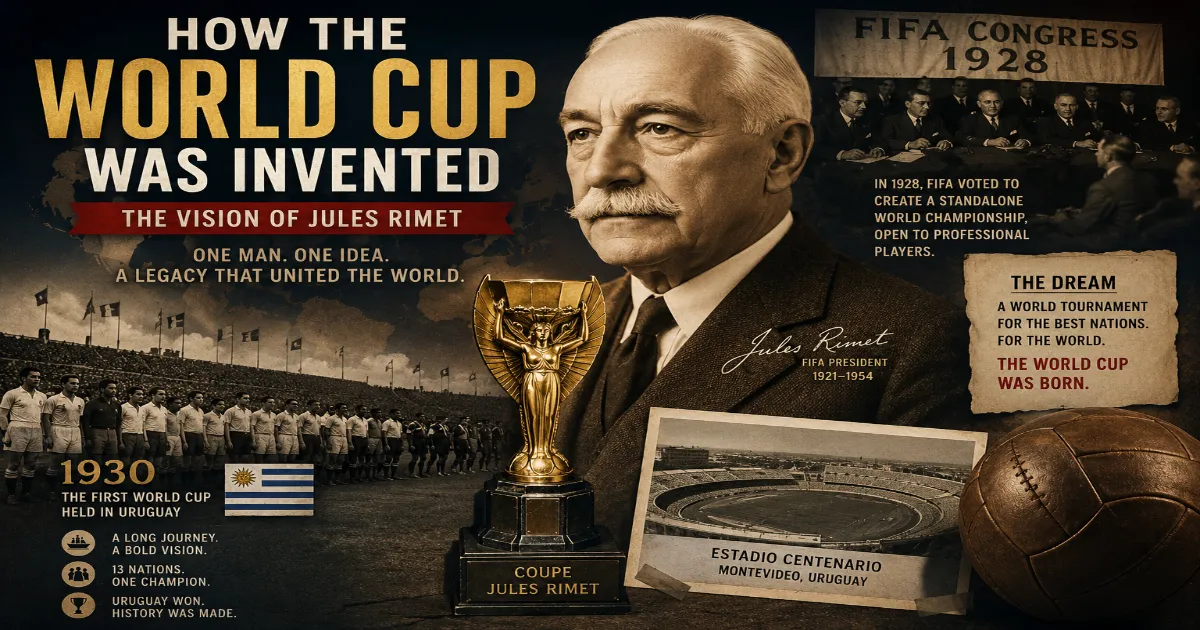
The Olympic tournament, however, came with a fundamental limitation that increasingly frustrated football’s growing professional class: strict amateurism rules that barred professional players from competing at all. As football professionalized rapidly across parts of Europe and South America through the 1920s, with players in countries like England, Italy, and Uruguay increasingly earning wages to play, the Olympic tournament’s insistence on amateur-only competition meant the world’s actual best players were routinely excluded from the sport’s biggest international stage. Jules Rimet, who became FIFA president in 1921, saw this contradiction clearly and became convinced that football needed its own standalone tournament, independent of Olympic bureaucracy and open to professional players, one that could genuinely claim to determine the best national team on Earth rather than merely the best amateur one.
Rimet’s Long Campaign
Rimet’s vision didn’t materialize overnight. Throughout the 1920s, he worked patiently within FIFA’s congress structure to build support for a standalone world championship, navigating considerable skepticism from national federations wary of the costs, logistics, and political complications involved in organizing a genuinely global tournament during an era when international travel remained slow, expensive, and often arduous. The Olympic football tournaments of 1924 and 1928, both held in Paris and Amsterdam respectively, proved to be important turning points, drawing large, enthusiastic crowds and demonstrating that a well-organized international football competition could generate genuine public excitement and commercial viability, even within the constraints of amateur-only competition.
Those successful Olympic tournaments gave Rimet the practical evidence he needed to make his case more forcefully within FIFA’s congress. In 1928, the organization formally voted to create a new, standalone world championship, open to professional players and independent of the Olympic movement entirely, a landmark decision that set the stage for the very first World Cup to be held just two years later. The vote didn’t resolve every practical challenge involved in actually staging the tournament, but it represented the crucial institutional breakthrough Rimet had spent years working to secure.
An Unlikely Host
Selecting a host nation for this brand-new tournament proved to be its own significant challenge, ultimately resolved by FIFA’s 1929 congress in Barcelona, which awarded the inaugural tournament to Uruguay, a decision that surprised many observers given the small South American nation’s relatively modest size and distance from Europe’s football-heavy population centers. Several factors nonetheless made Uruguay a genuinely compelling choice. The country had won consecutive Olympic football gold medals in 1924 and 1928, establishing them as the reigning, if amateur, world champions heading into the new professional tournament. Uruguay’s football federation also made an unusually generous practical offer, agreeing to cover travel and accommodation costs for all participating nations and committing to construct an entirely new, purpose-built stadium, the Estadio Centenario, timed deliberately to coincide with the centenary of Uruguay’s constitution in 1930.
That generous financial offer proved essential in convincing at least some European nations to make the arduous journey, since traveling to South America in 1930 required a lengthy sea voyage of two weeks or more, an enormous logistical and financial commitment for football federations still operating on comparatively modest budgets. Even with Uruguay’s financial support, however, participation from Europe remained limited. Ultimately, only four European nations, France, Belgium, Romania, and Yugoslavia, made the journey to compete, while several of the continent’s most prominent footballing nations, including Italy, Spain, and notably England, whose Football Association had already withdrawn from FIFA entirely over an unrelated dispute regarding player compensation and amateurism rules, were absent from football’s first-ever World Cup.
The Tournament That Started It All
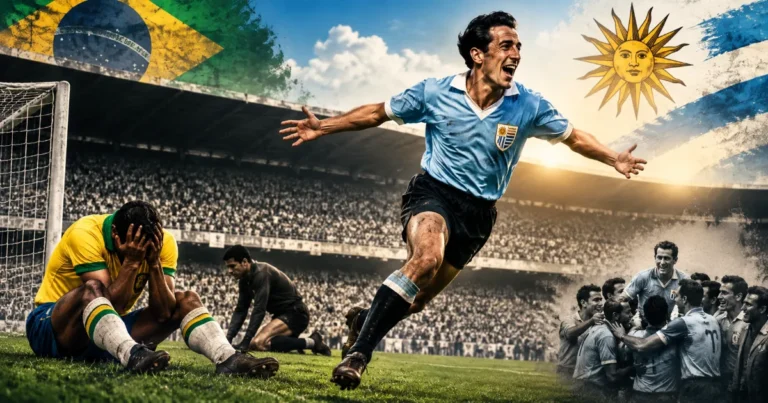
Thirteen teams in total competed in that inaugural 1930 World Cup, a modest number by the standards of the modern, 48-team tournament, but a genuinely unprecedented gathering for its time. France’s Lucien Laurent scored the first-ever World Cup goal, a moment now enshrined in football history as the tournament’s true starting point, though the historical spotlight ultimately fell on host nation Uruguay, who progressed through the competition and met neighboring rivals Argentina in the final at the newly completed Estadio Centenario.
The atmosphere surrounding that first final captured the kind of fervent, deeply personal national investment that would go on to define the tournament for the following century. Uruguay ultimately triumphed 4-2 in front of a passionate home crowd, becoming the World Cup’s first-ever champions and validating, in dramatic fashion, Rimet’s yearslong argument that a standalone global tournament could generate exactly the kind of intense public interest and sporting prestige that Olympic football, constrained by its amateur-only rules, had never been able to fully achieve on its own.
A Trophy Named in His Honor
The tournament’s original trophy, a gold-plated statuette designed by French sculptor Abel Lafleur depicting Nike, the Greek goddess of victory, was initially known simply as the “Victory” trophy or the World Cup trophy. In 1946, following the interruption of two tournaments during the Second World War, FIFA formally renamed the trophy in honor of the man whose vision had made the entire competition possible, and it became known from that point forward as the Jules Rimet Trophy, a lasting tribute to the FIFA president who had spent decades of his working life fighting to bring the tournament into existence.
That original trophy’s own story eventually took a genuinely dramatic turn. Under FIFA’s rules at the time, any nation that won three World Cup titles would be awarded permanent ownership of the trophy itself, an honor that fell to Brazil following their third championship in 1970. The trophy remained on display at the Brazilian Football Confederation’s headquarters for over a decade, until it was stolen in 1983 in a theft that has never been solved, with the trophy itself, believed by investigators to have been melted down for its gold content shortly after the theft, never recovered. FIFA had already commissioned a new trophy design for the 1974 tournament onward, the now-familiar golden trophy designed by Italian sculptor Silvio Gazzaniga, meaning the Jules Rimet Trophy’s disappearance, while a genuine historical loss, didn’t disrupt the ongoing tournament itself.
Rimet’s Broader Legacy
Jules Rimet went on to serve as FIFA president for an extraordinary 33 years, from 1921 until 1954, a tenure defined almost entirely by his commitment to growing football’s global reach through the tournament that would eventually carry his name. He oversaw the World Cup’s expansion through its first several editions, guided FIFA through the considerable disruption of the Second World War, when the tournament was suspended entirely for twelve years between the 1938 and 1950 editions, and lived to see the competition firmly established as football’s single most prestigious prize by the time he stepped down from FIFA’s presidency.
Rimet’s underlying philosophy, that football’s global appeal justified a genuinely international, professional-caliber championship independent of Olympic bureaucracy, proved entirely vindicated by the tournament’s subsequent growth. What began as a thirteen-team gathering requiring a two-week ocean voyage for its few European participants has since grown into a 48-team spectacle broadcast to billions of viewers worldwide, a trajectory that traces back directly to one administrator’s stubborn refusal to accept that football’s biggest stage should remain confined to the restrictive amateur rules of the Olympic movement.
Why the Origin Story Still Matters
Understanding how the World Cup was invented adds genuine context to why the tournament carries the institutional weight and symbolic prestige it does today. It wasn’t simply football’s inevitable next step, but the direct product of one administrator’s multi-year campaign against considerable institutional inertia, national skepticism, and the practical logistical challenges of organizing a genuinely global sporting event in an era before commercial air travel existed. The very first tournament’s modest scale, absent several major European football nations and played out in a stadium built specifically for the occasion in a country most of the football world had never previously visited, stands in remarkable contrast to the sprawling, globally broadcast spectacle the World Cup has since become.
That contrast is precisely what makes Rimet’s original vision so significant nearly a century later. Every World Cup final played since, from Uruguay’s inaugural triumph in Montevideo to the most recent tournament staged across an entire continent, traces its lineage directly back to a FIFA congress vote in 1928 and one president’s decade-long conviction that football deserved a genuinely global, professional championship of its own, entirely independent of the Olympic movement that had, until that point, been the closest thing the sport had to a world championship at all.
The Political Obstacles Rimet Had to Navigate
Beyond the practical logistics of organizing a brand-new global tournament, Rimet also had to manage a considerable amount of political friction within football’s governing structures, friction that nearly derailed the entire project on multiple occasions. England’s Football Association, along with the other Home Nations of the United Kingdom, had already withdrawn from FIFA in 1920 over disagreements involving the participation of the wartime Central Powers in international competition, and further disputes over amateurism and player compensation kept English football fully outside FIFA’s structure until 1946, meaning the nation widely credited with inventing modern football played no role whatsoever in the World Cup’s first three editions. Rimet, a Frenchman deeply invested in continental European football politics, had to build enough momentum and credibility for the new tournament without the involvement of one of the sport’s most historically significant footballing nations, a considerable obstacle to establishing the World Cup’s legitimacy in its earliest years.
Rimet also faced skepticism from within his own continent, since several major European football federations remained unconvinced that a South American host nation, however successful on the pitch, could realistically deliver the infrastructure and organizational capacity required for a genuinely world-class tournament. Uruguay’s construction of the Estadio Centenario specifically to host the event, completed just days before the tournament’s opening matches after a frantic rush to finish, went a long way toward addressing those doubts, but the tight timeline and lingering uncertainty leading up to kickoff reflected just how unproven the entire concept of a standalone World Cup still was in 1930.
How the Format Evolved From That First Tournament
The World Cup that Rimet helped create in 1930 looked considerably different from the tournament fans recognize today, and much of its subsequent format evolution reflects lessons FIFA learned directly from those earliest editions. The inaugural tournament involved no qualification process at all, since FIFA simply invited nations directly and hoped enough would accept given the practical challenges of transatlantic travel at the time, a stopgap approach that quickly proved unsustainable as interest in the tournament grew and qualification became necessary to manage an increasingly large pool of interested nations. By the 1934 tournament in Italy, a proper qualification process had been introduced for the first time, a structural change that has remained a permanent feature of the competition ever since and that now determines the composition of an increasingly large field, expanding from the original 13 teams to 16, then 24, then 32, and now 48 teams as of the most recent tournament.
The World Cup’s interruption during the Second World War, with no tournament held between 1938 and the competition’s return in 1950, also tested the durability of Rimet’s original vision in ways he could scarcely have anticipated when the project first began. That the tournament successfully resumed after a twelve-year gap, held once again in a South American host nation, Brazil, and once again drawing enormous public interest, stands as further validation of just how deeply Rimet’s original conception of a standalone global championship had embedded itself in football’s institutional identity by the time peacetime competition finally returned.
A Legacy Still Visible Today
Nearly a century after Rimet first began advocating for a standalone world championship, the structural DNA of his original vision remains clearly visible in the modern tournament. The emphasis on genuine global participation rather than a Europe-centric competition, the insistence on including the sport’s best professional players rather than restricting the tournament to amateurs, and the basic four-year cycle that Rimet helped establish from the very first edition, all remain foundational elements of the World Cup as it exists today. Few individual administrators in the history of any sport can claim to have shaped a single competition’s fundamental identity so completely, and so durably, as Jules Rimet did with the tournament that, for over two decades, carried his name on its trophy.
▪️▪️ Follow us on Facebook ▪️▪️
About the Author