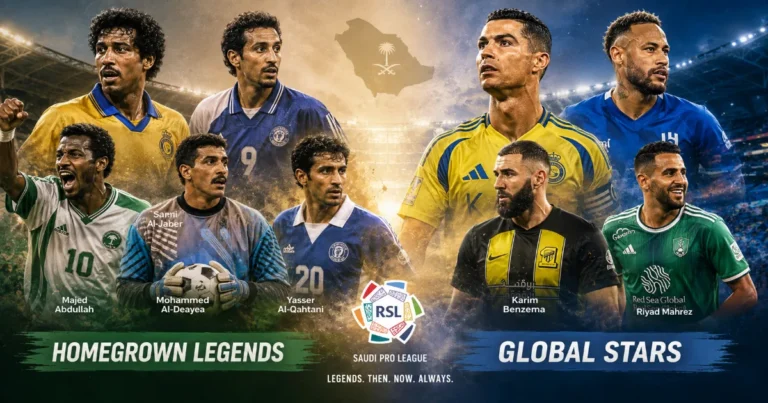
 The Superstar Era Is Changing, Not Ending: Saudi Pro League 2026-27
Cristiano Ronaldo remains at Al-Nassr, but a new generation of prime-age stars and elite coaches is reshaping Saudi football’s ambitious global project.
The Saudi Pro League entered the 2026-27 season with a question that seemed unavoidable just a few months ago: what happens when the Cristiano Ronaldo era eventually comes to an end?
Five matches into the new campaign, however, the answer looks considerably more complicated.
Ronaldo is still at Al-Nassr. He remains the club’s captain, remains one of the league’s biggest attractions and has already pushed his career goal tally to 978. Al-Nassr have also started the title defense with four consecutive league victories, while new manager Ange Postecoglou has quickly established himself as another major storyline around the club.
At the same time, Al-Hilal have demonstrated that Saudi football’s next phase will not necessarily depend on replacing Ronaldo with another single superstar.
Instead, the league is beginning to build something broader.
Ollie Watkins has arrived from Aston Villa. Crysencio Summerville has joined from West Ham United. Gabriel Martinelli has now moved from Arsenal on a four-year contract. Simone Inzaghi is in charge of Al-Hilal, while several other clubs continue to attract established international players.
The result is a Saudi Pro League that increasingly looks less like a competition built around a handful of aging icons and more like a league attempting to become a permanent destination for elite footballers.
Saudi Pro League History: From Regional Competition to Global Superstar Destination
Saudi Pro League Stars at World Cup 2026: Ronaldo and SPL’s Global Impact
Ronaldo Is Still the Center of Attention
When Ronaldo arrived in Saudi Arabia in December 2022, his transfer changed the perception of the entire competition.
The five-time Ballon d’Or winner brought extraordinary global attention to Al-Nassr and the Saudi Pro League, followed by an unprecedented wave of international signings.
Three years later, the question of his future remains important, but the circumstances have changed.
Rather than entering the 2026-27 campaign as a player apparently preparing to leave Al-Nassr, Ronaldo has remained at the club and is operating under a new manager.
Ange Postecoglou has taken over at Al-Nassr, and the Australian coach has openly acknowledged that the opportunity to work with Ronaldo was an important factor in his decision to move to Saudi Arabia.
That relationship will be one of the most closely watched stories of the season.
Ronaldo is now 41, but his competitive importance has not disappeared. He scored in Al-Nassr’s 2-1 victory over Al-Taawoun on August 28, taking his career tally to 978 goals. The goal also helped Al-Nassr maintain their perfect opening record.
The immediate question is therefore no longer simply whether Ronaldo will leave.
It is whether Al-Nassr can build a team capable of competing at the highest level while Ronaldo approaches the final phase of his playing career.
Al-Nassr’s New Era Has Already Started
Al-Nassr entered the campaign as defending Saudi Pro League champions after finally winning the title during the 2025-26 season.
Their start to the new campaign has been equally impressive.
Before their September 5 trip to Al-Ittihad, Al-Nassr had won all four of their opening league matches, scoring 12 goals and conceding only three. Their victories included a 3-0 win over Al-Fateh, a 4-0 victory at Al-Riyadh, a 3-2 win at Al-Ettifaq and a 2-1 victory over Al-Taawoun.
Ronaldo has scored twice in those opening league matches, while João Félix and Sadio Mané have also emerged as important attacking contributors.
The biggest change, however, is on the touchline.
Postecoglou has replaced the previous coaching structure and is attempting to put his own tactical identity on the reigning champions.
That makes the 2026-27 season about more than Ronaldo.
It is also the first major test of whether Al-Nassr can turn their title-winning squad into a sustainable competitive project.
The League Table Is Already Setting Up Another Al-Hilal-Al-Nassr Battle
The early standings suggest that the title race could again revolve around the two Riyadh giants.
Before Al-Nassr’s September 5 match at Al-Ittihad, both Al-Hilal and Al-Nassr had won their first four league matches and collected 12 points.
Al-Hilal led on goal difference after scoring 15 goals and conceding only three, compared with Al-Nassr’s 12 goals scored and three conceded.
Al-Hilal subsequently strengthened its position with a 2-0 victory over Al-Shabab on September 4, with Sergej Milinković-Savić and Rúben Neves scoring. That result extended their perfect league start to five victories.
The early picture is therefore clear:
Al-Nassr have the reigning champions and Ronaldo. Al-Hilal have the deeper-looking new-generation superstar project.
World Cup Retirement: Ronaldo, Neymar and the Legends Saying Goodbye
The Weirdest Football Superstitions Even Messi, Ronaldo and Neymar Swear By
Al-Hilal Have Changed the Conversation
If the original Saudi Pro League transformation was about bringing established legends to the Kingdom, Al-Hilal’s current recruitment strategy suggests something different.
The club is increasingly targeting players who remain in their prime.
Ollie Watkins, 30, arrived from Aston Villa on a three-year contract. He had scored 108 goals in all competitions for Villa and was part of the team that won the 2025-26 Europa League.
Then came Gabriel Martinelli.
The 25-year-old Brazilian joined from Arsenal on a four-year deal after seven seasons in England. Arsenal’s former winger accumulated 62 goals for the club and arrived in Saudi Arabia after helping Arsenal win the Premier League in 2025-26.
Martinelli’s arrival is particularly significant because it represents the type of recruitment that could define the next stage of Saudi football.
He is not a veteran approaching retirement.
He is 25.
He has significant Champions League experience, remains a Brazilian international and could potentially spend the best years of his career in Saudi Arabia.
That is a very different proposition from the Ronaldo or Benzema model.
Summerville, Watkins and Martinelli: A New Recruitment Model?
Al-Hilal’s squad now includes several players who would still command significant attention in Europe’s major leagues.
Crysencio Summerville arrived from West Ham United, Watkins came from Aston Villa and Martinelli has now joined from Arsenal.
The club’s official squad list confirms all three players are part of the 2026-27 first-team group.
This is important because it challenges the idea that Saudi Arabia’s recruitment strategy is simply about collecting famous names at the end of their careers.
Instead, Al-Hilal are increasingly combining:
- established international stars;
- players in their prime;
- younger high-value talent;
- experienced Saudi internationals;
- and a world-class coaching name in Simone Inzaghi.
Inzaghi himself represents another important development.
The former Inter Milan coach has brought European tactical pedigree to one of the league’s biggest clubs, creating another layer of competition beyond the celebrity appeal of individual players.
Karim Benzema Shows How Quickly the Model Can Change
The evolution is also visible through the players leaving the original superstar generation.
Karim Benzema, one of the most famous signings of the 2023 recruitment boom, has now left Al-Hilal and is a free agent.
The former Ballon d’Or winner joined Al-Hilal earlier in 2026 after leaving Al-Ittihad but departed again after a short spell. Reports indicate that he scored 10 goals in 16 appearances for Al-Hilal before the parties agreed to terminate his contract.
His situation illustrates the increasingly fluid nature of Saudi squad building.
A club can now replace one global superstar with a younger elite player without necessarily reducing its international profile.
That is a major change from the league’s first phase.
Ronaldo’s Potential Departure Is Still a Future Question
Ronaldo’s eventual departure remains one of the most important long-term questions facing the Saudi Pro League.
But it should no longer be presented as an imminent certainty.
His current situation is much more nuanced.
He remains with Al-Nassr, has started the season strongly and is continuing to chase the extraordinary milestone of 1,000 career goals.
With his tally now at 978, only 22 goals separate Ronaldo from that landmark.
That milestone could itself become a major part of the league’s global commercial narrative.
Instead of Saudi football preparing for a Ronaldo-less season immediately, the competition may now be entering a period in which Ronaldo’s final seasons and the emergence of younger stars happen simultaneously.
That is arguably more interesting.
The Golden Boot Race Has Become More Competitive
The early 2026-27 season has also produced a fascinating attacking battle.
Ronaldo remains one of the league’s leading scorers, but he is facing serious competition from other established international forwards.
Ivan Toney has started strongly for Al-Ahli, while new Al-Hilal signing Ollie Watkins has immediately entered the conversation.
Toney had four league goals after his first three appearances, according to the Saudi Pro League’s own coverage, while Ronaldo had two after Al-Nassr’s opening four matches.
Watkins then scored on his Al-Hilal debut against Al-Ahli, giving the English forward an immediate impact in his new league.
The Golden Boot race could therefore become one of the season’s most compelling subplots.
For perhaps the first time since Ronaldo’s arrival, his individual scoring dominance is being challenged by several players who are also major international names.
Saudi Arabia Is No Longer Selling Only a Retirement Destination
This may ultimately be the most important change.
The early Saudi Pro League model was frequently portrayed in Europe as a destination for established stars seeking lucrative contracts late in their careers.
That description is becoming increasingly incomplete.
Martinelli’s move at 25 is difficult to explain through a retirement narrative.
Watkins joining at 30 is similarly different from the classic veteran model.
The recruitment of younger or prime-age footballers suggests that Saudi clubs increasingly want players who can contribute competitively and commercially for several seasons.
That could make the league much more sustainable.
The Competition Beyond the Big Four Is Growing
The focus naturally remains on Al-Nassr, Al-Hilal, Al-Ittihad and Al-Ahli, but the competitive landscape is gradually becoming broader.
Al-Qadsiah have started strongly, while Al-Kholood, NEOM and Al-Diriyah are also part of a changing league structure.
The early table has already shown that the gap between the traditional powerhouses and ambitious challengers cannot simply be assumed.
Al-Qadsiah, for example, were sitting among the early leaders after collecting 12 points from their first five matches.
That matters because a sustainable domestic league cannot depend exclusively on two clubs.
The long-term objective must be to create meaningful competition throughout the table.
The New Season’s Scheduling Adds Another Challenge
The 2026-27 campaign is also taking place under a demanding calendar.
The Saudi Pro League has introduced a tier-based fixture scheduling system designed to organize the competition more effectively, while clubs are simultaneously managing domestic football alongside AFC Champions League commitments.
For Al-Nassr, the Asian schedule is particularly significant.
The club has already received its AFC Champions League Elite roadmap, with Ronaldo set to compete in another continental campaign with the Saudi side.
The ability to manage multiple competitions could ultimately decide whether Al-Nassr successfully defend the league title.
Postecoglou vs Inzaghi Could Become the Tactical Story of the Season
One of the most intriguing elements of the new season is that the biggest coaching battle may be just as important as the biggest player battle.
Ange Postecoglou and Simone Inzaghi represent very different football philosophies and have arrived with enormous expectations.
Postecoglou now has the responsibility of managing Ronaldo and a reigning champion squad.
Inzaghi is tasked with turning Al-Hilal’s enormous collection of attacking talent into a cohesive team capable of challenging for domestic and continental trophies.
That makes the Saudi Pro League increasingly interesting from a tactical perspective.
The league is no longer simply importing players.
It is importing ideas, coaching expertise and football structures.
What Happens When Ronaldo Eventually Leaves?
The question from the original version of this article remains valid, but the answer has changed.
When Ronaldo eventually leaves Saudi Arabia, the league will lose an extraordinary global ambassador.
There will be no simple replacement.
Mohamed Salah, Vinícius Júnior or another superstar could theoretically become the next major commercial face of Saudi football, but replacing Ronaldo’s specific combination of sporting history, social-media reach, international recognition and career longevity would be extremely difficult.
The more realistic objective is therefore not to find another Ronaldo.
It is to make sure the league no longer needs one.
And the current evidence suggests that is exactly what Saudi football is attempting.
The Next Saudi Pro League Could Be Built Around Depth, Not One Superstar
The most significant development of 2026-27 may ultimately be the shift from a single-star strategy to a multi-star ecosystem.
Ronaldo remains at Al-Nassr.
Martinelli is at Al-Hilal.
Watkins is at Al-Hilal.
Summerville is at Al-Hilal.
Toney remains at Al-Ahli.
João Félix is playing for Al-Nassr.
Simone Inzaghi and Ange Postecoglou are now part of the league’s coaching landscape.
That is a fundamentally different league from the one Ronaldo entered in late 2022.
The Saudi Pro League is still using superstar power to attract attention, but it is increasingly combining that strategy with players who can potentially become the next generation of headline names.
The Real Test Is Sustainability
The biggest question for Saudi football is no longer whether it can attract famous footballers.
That has already been demonstrated.
The harder question is whether it can create a football ecosystem that remains compelling when the original generation eventually disappears.
That means:
- stronger domestic academies;
- better Saudi player development;
- competitive clubs beyond the biggest PIF-backed teams;
- sustainable stadium attendances;
- stronger continental performances;
- improved international broadcasting;
- and continued recruitment of players before they reach the final years of their careers.
The early evidence from 2026-27 is encouraging.
The arrival of Martinelli at 25 is particularly significant. So is the arrival of Watkins at 30 and the presence of coaches such as Inzaghi and Postecoglou.
These moves suggest that Saudi Arabia wants the league to be considered a serious football destination rather than simply a lucrative final stop.
A New Chapter, Not the End of the Superstar Era
The original question was: What happens when the superstar era ends?
The first few weeks of the 2026-27 season suggest that the better question is:
What happens when the superstar era evolves?
Ronaldo has not disappeared.
He remains one of the league’s biggest stars, remains at Al-Nassr and is closing in on 1,000 career goals.
But around him, the Saudi Pro League is changing.
Al-Hilal have built a squad capable of competing with Al-Nassr without waiting for Ronaldo to leave. Younger stars are arriving. Prime-age internationals are choosing Saudi Arabia. European-level coaches are taking charge. Challengers are becoming more ambitious.
And that could be the real legacy of Ronaldo’s arrival.
He may not be replaced by another Ronaldo.
Instead, he may eventually be replaced by an entire ecosystem of stars.
For Saudi football, that would represent a far more important transformation.
As of September 5, 2026, the Saudi Pro League is not preparing for the end of its superstar era. It is testing whether it can turn that era into something much bigger and much more sustainable.
🔹🔹 Follow us on Facebook 🔹🔹
La Liga History 1929: From Franco’s Spain to the Era of Messi vs Ronaldo
Spain Finally Explode at World Cup 2026: Yamal and Oyarzabal Tear Saudi Arabia Apart in 4-0 Rout
About the Author