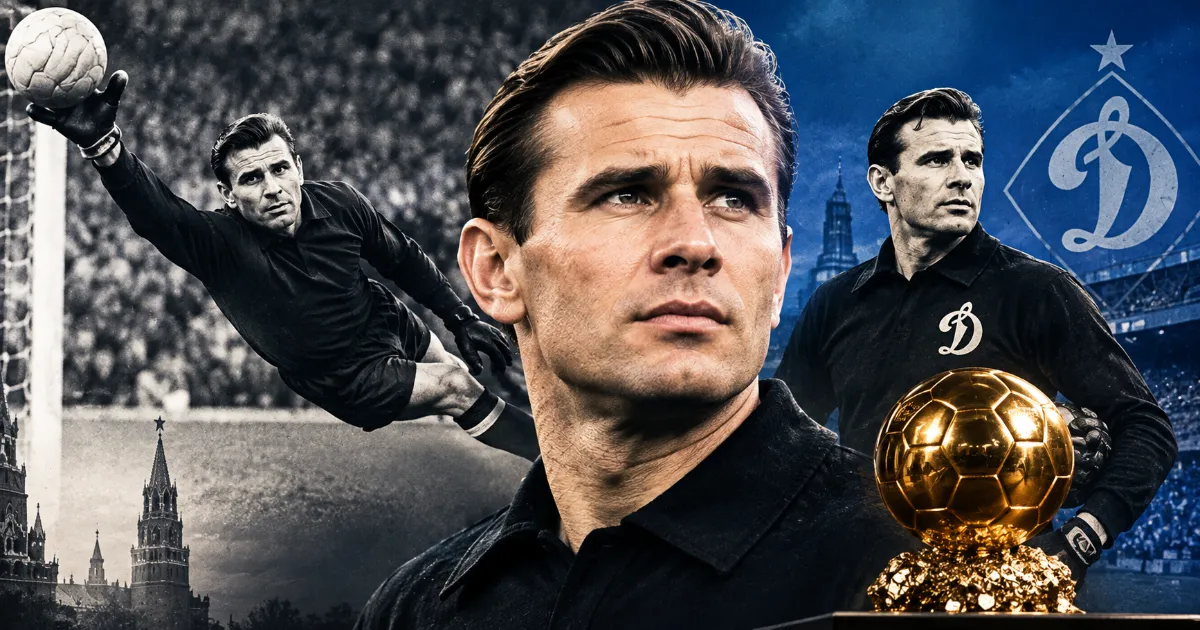
 The only goalkeeper in history to win the Ballon d’Or spent his entire career redefining what the position could be.
More than three decades after his death, Lev Yashin remains the answer to one of football’s most enduring trivia questions: the only goalkeeper in history to win the Ballon d’Or. That single, still-unmatched achievement barely scratches the surface of a career that fundamentally redefined how the goalkeeping position could be played, turning a role once viewed as purely reactive into a genuine platform for commanding, game-shaping brilliance.
Ronaldo Nazário: Why El Fenómeno Still Has the Greatest Career in Football History
Diego Maradona: The Rise, the Ruin and the Religion He Became
From Factory Worker to Football Icon
Yashin’s path to football stardom began far from any elite youth academy. Born in Moscow in 1929, his early years were shaped by the hardship of World War II, during which he worked in a munitions factory as a teenager to support his family, an experience that instilled a level of discipline and toughness that would later become a defining characteristic of his approach to goalkeeping. He joined Dynamo Moscow’s youth setup after the war, initially splitting his early sporting attention between football and ice hockey, a common dual-sport path for talented young Soviet athletes of the era, before eventually committing fully to football and establishing himself as Dynamo’s first-choice goalkeeper by the mid-1950s.
A Career Spent Entirely at Dynamo Moscow
In an era when player movement between clubs was already becoming increasingly common across much of Western European football, Yashin’s decision to spend his entire 20-year senior career at a single club, Dynamo Moscow, reflected both the particular structure of Soviet football at the time and his own deep personal loyalty to the institution that had developed him from his earliest playing days. Across more than 800 appearances for the club, Yashin won five Soviet league titles and three Soviet Cups, establishing Dynamo Moscow as one of the dominant forces in Soviet domestic football throughout his lengthy tenure, while his own individual performances made him the club’s most globally recognized figure by a considerable margin.
Redefining the Goalkeeping Position
What made Yashin such a genuinely revolutionary figure wasn’t simply his shot-stopping ability, considerable as that was, but his fundamentally different approach to the position as a whole. Rather than remaining fixed on his goal line, Yashin pioneered a far more active, commanding style of goalkeeping, regularly leaving his line to intercept crosses, organizing his defense vocally and with obvious authority, and even initiating attacking moves with his distribution in a manner that anticipated the modern sweeper-keeper role by several decades. His reflexes and positioning were considered extraordinary even by the standards of his own era, and he became particularly renowned for his penalty-saving ability, with some estimates crediting him with saving somewhere in the region of 150 penalties across his career, an almost unbelievable tally that, whatever its precise accuracy, reflects the sheer scale of his reputation as a penalty-stopping specialist.
The Black Spider
Yashin’s now-iconic all-black kit, worn specifically because he believed the color would help intimidate opposing forwards, gave rise to his enduring nickname, “the Black Spider,” sometimes rendered as “the Black Panther,” a moniker that captured both his imposing physical presence between the posts and the sense that any shot heading toward his goal risked being caught in an inescapable web. That visual identity, combined with his genuinely dominant on-field performances, made him instantly recognizable on the international stage at a time when Soviet athletes competing in Western sporting contexts were still a relatively unusual and closely watched phenomenon amid the broader tensions of the Cold War.
International Glory With the Soviet Union
Yashin’s international career delivered genuine team success alongside his individual acclaim. He was a key figure in the Soviet Union’s gold medal-winning campaign at the 1956 Melbourne Olympics, and his performances were similarly instrumental in the USSR’s triumph at the inaugural European Nations’ Cup in 1960, the tournament that would eventually evolve into today’s European Championship. That 1960 triumph remains one of Soviet football’s most significant international achievements, and Yashin’s goalkeeping played a direct and substantial role in securing it.
His World Cup career, spanning three tournaments in 1958, 1962, and 1966, included the Soviet Union’s best-ever World Cup finish, a fourth-place result at the 1966 tournament in England, a genuine high point for Soviet football on the global stage that Yashin’s own individual excellence between the posts helped make possible.
The Historic Ballon d’Or
Yashin’s crowning individual achievement arrived in 1963, when he became the first, and to this day only, goalkeeper ever to win the Ballon d’Or, France Football’s prestigious award recognizing the finest player in European football that year. The award reflected a specific season of genuinely extraordinary individual performances, and its significance has only grown in the decades since, as no subsequent goalkeeper has come particularly close to replicating the feat, a testament to just how exceptional Yashin’s specific combination of shot-stopping brilliance and broader tactical influence over his team’s defensive structure genuinely was relative to his goalkeeping contemporaries, both during his own era and in the decades that have followed.
A Legendary Farewell
Yashin’s eventual retirement in 1971 was marked by a genuinely special send-off, an exhibition match at Moscow’s Lenin Stadium that drew a host of the era’s biggest international stars, including Pelé, who reportedly embraced Yashin during the match in a gesture widely interpreted as one legendary player publicly recognizing the greatness of another. That moment, a global icon of attacking football paying tribute to the sport’s most celebrated goalkeeper, offered a fitting symbolic conclusion to a career that had done so much to elevate the broader perception and respect afforded to the goalkeeping position throughout world football.
Life After Playing
Following his retirement, Yashin remained closely involved in Soviet football’s administrative structure, working with the Soviet Football Federation and continuing to serve as one of the sport’s most recognizable ambassadors both within the USSR and internationally. His later years were complicated by declining health, including circulatory problems that eventually led to the amputation of a leg, health struggles that stood in stark contrast to the physical vitality that had defined his playing career. Yashin passed away in 1990, at the age of 60, with tributes pouring in from across the football world recognizing the passing of a genuine pioneer of the sport.
A Lasting Institutional Legacy
Yashin’s influence on the sport has been formally recognized in the decades since his death through FIFA’s decision to name its World Cup award for the tournament’s best goalkeeper the Yashin Trophy, first introduced at the 2018 World Cup in Russia, a fitting tribute given Yashin’s own Soviet and later Russian heritage and his standing as the position’s most historically significant individual figure. That the award carries his name specifically, rather than being named for any other historically significant goalkeeper, speaks directly to the enduring consensus around his status as the finest to have ever played the position.
Why Yashin’s Legacy Endures
More than half a century after his retirement, Yashin’s case as the greatest goalkeeper in football history remains remarkably durable, even as the sport’s tactical evolution and the goalkeeping position’s own continued development have produced numerous subsequent candidates for that same title. What separates Yashin from many of those later challengers is the sheer scale of his influence on how the position itself came to be understood, pioneering an active, commanding, sweeper-keeper style of play that wouldn’t become standard practice across elite football for several more decades after his own retirement. Combined with his unmatched individual Ballon d’Or achievement and his central role in genuine Soviet international success at both the Olympics and the European Championship, Yashin’s case as football’s greatest-ever goalkeeper remains built on a foundation few subsequent candidates have managed to fully match, a legacy that continues to be honored every four years whenever FIFA presents the World Cup award that carries his name.
The Cold War Context Behind His Global Fame
It’s worth understanding just how significant Yashin’s global recognition actually was given the broader geopolitical context of his playing career. Soviet athletes competing in international sporting competitions during the height of the Cold War carried genuine symbolic weight well beyond pure sporting achievement, representing the broader ideological rivalry between the Soviet bloc and the Western world in the eyes of much of the global public and media. Yashin’s genuine, widely acknowledged excellence, recognized and celebrated even by football fans and media in Western Europe despite the considerable political tension of the era, offered a rare example of sporting achievement transcending Cold War divisions in a way relatively few other Soviet cultural or athletic figures managed to achieve with quite the same universal, cross-ideological respect.
A Standard Still Referenced Today
Modern goalkeeping analysis continues to reference Yashin’s pioneering approach whenever discussing the historical development of the sweeper-keeper role that has become standard practice among elite goalkeepers today. Coaches and goalkeeping specialists still cite his willingness to leave his line, organize his defense vocally, and treat distribution as a genuine attacking weapon as foundational concepts that predate by decades the tactical innovations often credited to more recent goalkeeping generations. That his specific stylistic innovations remain directly traceable through to the modern game, well over half a century after his playing career concluded, stands as perhaps the clearest evidence of just how genuinely ahead of his time Lev Yashin actually was.
Comparing Yashin to Modern Goalkeeping Greats
Any serious attempt to compare Yashin directly against modern goalkeeping greats runs into an inevitable challenge: the sport, and the position itself, has changed so dramatically since his playing days that direct statistical comparison becomes almost meaningless. Modern goalkeepers benefit from vastly improved training methods, sports science, protective equipment, and, crucially, a back-pass rule introduced in 1992 that fundamentally transformed how goalkeepers use their feet and participate in build-up play, a rule that didn’t exist during any part of Yashin’s own career. Despite these considerable differences in context, football historians and goalkeeping specialists continue to rank Yashin among the very top tier of all-time greats specifically because his stylistic innovations, rather than simply his shot-stopping statistics, anticipated so much of what would eventually become standard practice decades after his retirement, a form of influence that transcends the specific eras being compared far more effectively than raw save percentages or clean sheet counts ever could.
A Name That Will Always Be Remembered
Whatever debates continue about precisely how Yashin would fare under today’s radically different tactical and technological conditions, his historical significance to the goalkeeping position, and to football more broadly, remains beyond serious dispute. He didn’t simply play the position well; he expanded what the position could be, blending shot-stopping brilliance with genuine tactical leadership and attacking initiative in a way that few of his contemporaries could have imagined possible before watching him do it. That combination of individual excellence and genuinely lasting stylistic influence is precisely why, more than three decades after his death, Lev Yashin’s name remains the first one raised whenever football fans, historians, and pundits debate who truly deserves to be called the greatest goalkeeper the sport has ever produced.
The Physical and Mental Toughness Behind the Legend
Beyond his technical and tactical innovations, Yashin’s reputation was built substantially on a level of physical courage and mental resilience that his contemporaries frequently cited as genuinely exceptional even by the standards of elite goalkeeping. Playing in an era with considerably less protective regulation for goalkeepers than exists in the modern game, Yashin regularly absorbed significant physical punishment diving at the feet of onrushing forwards, a willingness to sacrifice his own physical safety for the good of his team that became as central to his reputation as his shot-stopping technique itself. That toughness extended to his mental approach as well, with teammates and opponents alike describing a goalkeeper who rarely, if ever, appeared rattled by pressure, maintaining the same calm, commanding demeanor whether facing a routine save or the most consequential penalty of a major international final.
Recognition From Football’s Governing Bodies
Beyond the Ballon d’Or and the trophy that now carries his name, Yashin’s standing within football’s official institutional memory has been repeatedly reinforced through various honors and recognitions across the decades since his retirement. He was named to FIFA’s Dream Team and various other all-time greatest XI selections compiled by football’s governing bodies and media organizations, consistently the only goalkeeper included among lists otherwise dominated by attacking players whose statistical achievements are more immediately quantifiable and comparable across eras. That consistent institutional recognition, spanning organizations and publications with otherwise quite different criteria and voting methodologies, reflects just how broad and durable the consensus around Yashin’s greatness has remained across generations of football historians and analysts who never had the opportunity to watch him play live.
A Legacy That Extends Beyond Russia
While Yashin’s legacy holds particular significance within Russian and broader post-Soviet football culture, his influence and recognition have never been confined purely to that specific region or football tradition. Goalkeeping coaches and analysts across Europe, South America, and beyond continue to reference his pioneering approach when discussing the historical development of the position, a genuinely global recognition that transcends the specific national and political context in which he originally built his reputation. That international, cross-cultural respect, earned during an era when Cold War tensions made such universal recognition for a Soviet athlete considerably rarer than it might be today, stands as one of the clearest testaments to just how transcendent Yashin’s specific footballing genius genuinely was, admired and studied by goalkeeping traditions well beyond the one that originally produced him.
🔹🔹 Follow us on Facebook 🔹🔹
The 10 Best Bundesliga Players of All Time — A Definitive Ranking
Korean Dramas You Must Watch in Your Lifetime, Across Every Genre
AI Toothbrush: The Quiet Tech Revolution Happening in Your Bathroom
About the Author