 Cafu: The Best Right Back in Football History — Brazil’s Unbeatable Shield
Marcos Evangelista de Moraes, known to the football world simply as Cafu, holds a record that may never be broken: the only player in history to appear in three consecutive World Cup finals. That single, remarkable statistical achievement anchors a career built on relentless energy, defensive reliability, and a level of sustained international excellence that has left Cafu with a genuinely strong claim to being the finest right-back the sport has ever produced.
What to Expect From the Ligue 1 2026-27 Season
The 10 Best Bundesliga Players of All Time — A Definitive Ranking
From São Paulo’s Streets to Professional Football
Cafu grew up in a working-class family in São Paulo, his path to professional football shaped by the same kind of street football culture that has produced generations of Brazilian talent. He began his professional career with São Paulo FC, quickly establishing himself as one of the most dynamic and physically relentless full-backs in Brazilian domestic football, his combination of stamina, attacking energy, and defensive discipline marking him out as a genuinely complete player even in his earliest professional seasons.
Building International Pedigree
Cafu’s rise through the Brazilian national team setup began in the early 1990s, and he was part of Brazil’s victorious 1994 World Cup squad, though his role during that specific tournament remained relatively limited compared to the central importance he would go on to hold in subsequent campaigns. That first World Cup experience, even in a supporting capacity, gave him invaluable exposure to the pressures and demands of tournament football at the very highest level, preparing him for the far more significant role he would go on to play in the World Cups that followed.
An Unmatched World Cup Record
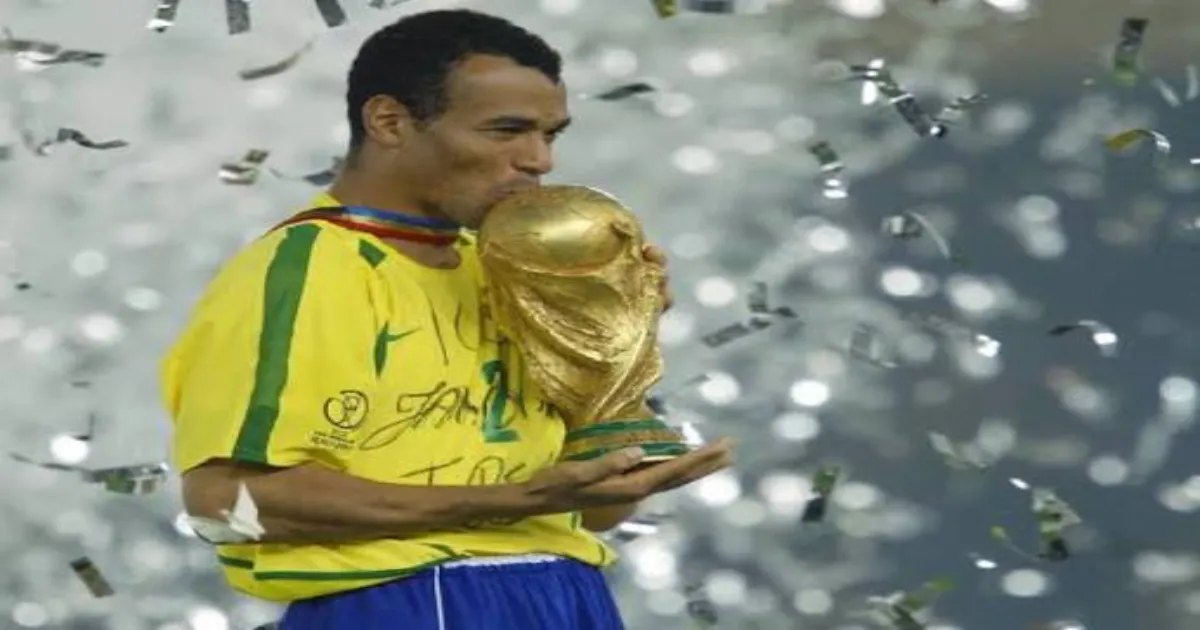
What makes Cafu’s international career so historically significant is the sheer consistency of his presence across three consecutive World Cup finals, a feat no other player in the tournament’s history has ever managed to replicate. He featured in Brazil’s runner-up campaign at the 1998 World Cup in France, playing a significant defensive and attacking role as Brazil reached the final before losing to the host nation. Four years later, at the 2002 World Cup in South Korea and Japan, Cafu captained Brazil to the tournament’s title, delivering his second World Cup winner’s medal and cementing his status as one of the most significant leadership figures in the history of Brazilian international football. That 2002 triumph, achieved as team captain rather than simply a contributing squad member, added a genuinely significant layer of individual distinction to his already unmatched World Cup final appearance record.
The Attacking Full-Back Revolution
Alongside Roberto Carlos on the opposite flank, Cafu formed one half of arguably the most feared full-back pairing international football has ever produced, with both players combining genuine defensive responsibility with sustained, high-level attacking output down their respective touchlines. Cafu’s specific brand of relentless overlapping runs, covering seemingly endless ground across a full ninety minutes, made him a nightmare matchup for opposing wingers and wide midfielders, who found themselves forced to track his attacking contributions on top of managing their own offensive responsibilities. That combination of two attacking full-backs operating simultaneously on opposite flanks helped define an era of Brazilian football built on width, pace, and genuine attacking threat from every area of the pitch, a tactical approach that proved directly influential in Brazil’s sustained international success throughout this period.
Roma’s Scudetto Triumph
Cafu’s club career reached a significant peak during his time with Roma, where he played a central role in the club’s remarkable 2000-01 Scudetto triumph, Roma’s first Italian league title in eighteen years. His sustained defensive reliability and attacking contribution throughout that campaign made him one of the most important individual figures in a genuinely significant moment of the club’s modern history, delivering silverware to a fanbase that had waited nearly two decades for a genuine title challenge to finally succeed.
The Move to AC Milan
Cafu’s subsequent transfer to AC Milan in 2003 extended his career into yet another significant European chapter, joining a club with genuine Champions League ambitions and a squad built around some of the finest players of that entire generation. His arrival at Milan came at a stage of his career when many observers might have expected a gradual decline given his advancing age and the sheer physical demands of his relentless playing style, yet Cafu continued performing at an elite level well into his late thirties, a testament to his exceptional underlying physical conditioning and professional dedication.
Champions League Glory and Heartbreak
Cafu’s Milan career delivered both the most painful and the most triumphant European nights of his entire career. The 2005 Champions League final against Liverpool remains one of the most dramatic matches in the competition’s history, with Milan surrendering a commanding 3-0 halftime lead before eventually losing on penalties, a genuinely crushing collective collapse that denied Cafu what had appeared to be a certain European triumph. Two years later, Milan and Cafu received a measure of redemption, defeating the very same Liverpool side in the 2007 Champions League final, delivering Cafu his own Champions League winner’s medal and providing a fitting conclusion to one of the most significant individual European careers of his generation.
A Career Built on Relentless Physical Excellence
What separated Cafu from many of his full-back contemporaries was the sheer sustained physical intensity of his playing style, covering extraordinary distances across every single match throughout a career that extended well into his late thirties at the very highest level of European and international competition. His stamina and work rate became genuinely legendary among teammates and opponents alike, with his ability to contribute meaningfully in both defensive and attacking phases of play across a full ninety minutes, match after match, season after season, reflecting an extraordinary level of professional dedication to physical conditioning that few players in any position have managed to sustain across such an extended career.
International Longevity
Beyond his three consecutive World Cup finals, Cafu’s broader international career with Brazil spanned an extraordinary 142 caps, a tally that placed him among the most capped players in the history of Brazilian international football at the time of his eventual international retirement. His sustained excellence across such an extended international career, spanning multiple different generations of Brazilian teammates and several distinct tactical eras for the national team, further reinforces his standing as one of the most significant and consistently reliable figures in the entire history of Brazilian football.
Life After Playing
Following his retirement from professional football, Cafu has remained closely involved with the sport through various ambassadorial roles, media work, and continued public appearances celebrating Brazilian football’s rich history. His genuine warmth and popularity among fans across multiple countries, built through his sustained excellence at São Paulo, Roma, and Milan alongside his central role in Brazilian national team success, has ensured he remains one of the most respected and beloved figures from his specific generation of Brazilian football legends.
Why His Case as the Greatest Right-Back Endures
More than a decade removed from his playing retirement, Cafu’s claim to being the finest right-back in football history rests on a genuinely rare combination of factors: unmatched World Cup final consistency, genuine team captaincy success at the very highest level of international competition, sustained club excellence across multiple major European leagues, and a physical playing style built on relentless, sustained excellence that few full-backs before or since have managed to replicate across such an extended career. His specific record of three consecutive World Cup finals remains a genuinely unique statistical achievement, one that, given the sheer difficulty of maintaining elite form and squad selection across three separate four-year tournament cycles, appears likely to remain unmatched for the foreseeable future, if not permanently.
A Legacy Measured in Consistency
Ultimately, what makes Cafu’s career so genuinely remarkable isn’t any single moment of individual brilliance, but the sheer sustained consistency of his excellence across an extraordinarily long and demanding career. From his early days at São Paulo through his Roma title triumph and his eventual Champions League redemption with Milan, Cafu’s career reads as a study in relentless professional dedication and sustained physical excellence, a full-back whose defining characteristic wasn’t a single unforgettable individual moment but rather an almost unbelievable level of week-to-week, tournament-to-tournament reliability sustained across nearly two full decades at the highest level of the sport. That combination of longevity, consistency, and genuine trophy-winning success at both club and international level is precisely why Cafu’s name remains central to any serious conversation about the greatest right-back, or indeed the greatest full-back of either flank, the game of football has ever produced.
The Numbers That Support the Legend
Cafu’s statistical record across his career, spanning São Paulo, Zaragoza, Palmeiras, Roma, and Milan, alongside his 142 caps for Brazil, reflects a genuinely rare combination of longevity and consistent selection at the highest possible level. Few defenders in football history have managed to remain first-choice options for both a major European club and their national team across such an extended period, a testament to the specific combination of physical conditioning, tactical reliability, and sustained individual quality that defined Cafu’s entire professional journey from his earliest days in Brazilian domestic football through to his eventual Champions League triumph with Milan more than two decades later.
Captaincy and Leadership in 2002
Cafu’s role as Brazil’s captain during their 2002 World Cup triumph deserves particular attention, since leading a squad containing several of the sport’s most significant individual talents, including Ronaldo, Ronaldinho, and Rivaldo, required a specific kind of leadership that extended well beyond simple on-field defensive responsibility. Teammates from that triumphant squad have repeatedly described Cafu’s role as a genuinely unifying presence within the dressing room, someone whose relentless work ethic and consistent professionalism set a clear standard that the squad’s more individually flamboyant attacking talents respected and, in many cases, actively sought to emulate. That leadership quality, translating his own personal discipline into a broader squad culture of professionalism and collective commitment, represented a genuinely significant, if less statistically quantifiable, contribution to Brazil’s ultimate tournament success that year.
How Cafu and Roberto Carlos Changed Tactical Thinking
The specific tactical innovation represented by Cafu and Roberto Carlos operating simultaneously as attacking outlets on opposite flanks deserves recognition as one of the more significant tactical developments in early 2000s international football. Rather than viewing full-backs as purely defensive, reactive players, Brazil’s coaching setup during this era built genuine attacking structure around both wide defensive positions, using Cafu and Roberto Carlos’s combined pace and stamina to stretch opposing defenses horizontally in ways that created considerably more space for Brazil’s already dangerous central attacking talents to exploit. That tactical approach, treating both full-back positions as genuine attacking assets rather than simply defensive necessities, influenced how subsequent international teams and club sides thought about wide defensive recruitment, part of a broader tactical evolution that, alongside Roberto Carlos’s own individual influence, helped establish the modern template for attacking full-back play that remains standard practice across elite football today.
A Model of Professional Longevity
Cafu’s ability to remain a first-choice option at an elite defensive level well into his late thirties, both for Milan and for the Brazilian national team, offers a genuinely instructive case study in professional athletic longevity. Unlike many players whose relentless, physically demanding playing styles typically produce a more rapid decline as they age, Cafu maintained his characteristic work rate and defensive reliability for years longer than most observers might reasonably have expected, a testament to a genuinely disciplined approach to fitness, recovery, and overall professional conditioning that few of his contemporaries managed to match with the same sustained consistency across such an extended career at the very highest level of the sport.
A Final Word on an Unmatched Record
Football continues to evolve, tournaments continue to expand, and new generations of full-backs continue to emerge with genuinely elite attacking and defensive quality. Yet Cafu’s specific record, three consecutive World Cup finals, remains untouched more than two decades after he last set foot on the pitch for Brazil’s national team. Given the sheer difficulty of maintaining both individual form and squad selection across three separate four-year international cycles, a feat requiring sustained excellence, good fortune with injuries, and a national team capable of reaching the tournament’s ultimate match on three separate occasions, it’s a record that may genuinely never be broken. For a player whose career was defined as much by relentless consistency as by any single unforgettable moment, that permanence feels entirely fitting, a lasting testament to a full-back whose greatness was built, match after match and tournament after tournament, on a foundation of sustained excellence that few players in the sport’s history have ever managed to replicate, and one that ensures Cafu’s name will remain permanently attached to a record that may well stand for as long as the World Cup itself continues to be played.
🔹🔹 Follow us on Facebook 🔹🔹
The 10 Best Bundesliga Players of All Time — A Definitive Ranking
13 Best Korean Dramas Ever Made — From Romance to Revenge Thriller
About the Author