 Andres Iniesta: The Quiet Genius Behind Spain’s Golden Generation
The shyest player in the Barcelona dressing room scored the goal that won Spain their first-ever World Cup.
Of all the players who defined Spanish and Barcelona football’s most successful era, none combined genuine footballing genius with such a quiet, understated personality quite like Andrés Iniesta. A player so shy off the pitch that teammates and coaches frequently remarked on the stark contrast between his humble, soft-spoken demeanor in interviews and the sheer, dazzling audacity of his dribbling and decision-making once a match kicked off, Iniesta’s career remains one of the most complete and quietly extraordinary in the sport’s modern history.
Messi Retires: Inside the Rise, Falls, and Redemption of a Legend
From Roberto Carlos to Messi: Ranking the Best Free Kicks in History
From La Mancha to La Masia
Iniesta grew up in Fuentealbilla, a small town in Spain’s rural Castilla-La Mancha region, his prodigious footballing talent identified early enough that he joined Barcelona’s famed La Masia academy at just twelve years old, a move that required him to leave his family and hometown behind at a remarkably young age. That early homesickness, which Iniesta has openly discussed in later interviews as one of the most emotionally difficult periods of his life, gave way over time to a deep, sustained commitment to Barcelona’s specific developmental philosophy, one built around technical excellence, positional intelligence, and constant close-quarters combination play that would come to define his entire playing style.
Breaking Into a Golden Generation
Iniesta made his senior Barcelona debut in 2002, gradually establishing himself within the first team over the following several seasons before becoming one of the club’s most indispensable players by the mid-2000s. His emergence coincided with a broader wave of exceptional La Masia graduates breaking into Barcelona’s senior squad around the same period, including Xavi Hernández, Carles Puyol, and eventually Lionel Messi, forming the core of what would become arguably the finest club side the sport has ever produced under Pep Guardiola’s management beginning in 2008.
The Perfect Partnership With Xavi
Iniesta’s central midfield partnership with Xavi remains one of the most celebrated combinations in football history, the two players developing an almost telepathic understanding built through years of shared development at La Masia and countless matches played together at the highest level. While Xavi’s game centered on controlling tempo through positional discipline and relentless, precise passing, Iniesta brought a more dynamic, dribbling-oriented dimension to the partnership, capable of gliding past opposing midfielders in tight spaces with a combination of close control, balance, and sudden changes of direction that made him one of the most technically gifted dribblers of his entire generation.
Barcelona’s Unprecedented Trophy Haul
Across his eighteen years in Barcelona’s first team, Iniesta won an extraordinary collection of silverware, including nine La Liga titles and four Champions League trophies, cementing his status as one of the most decorated players in the club’s entire history. His sustained excellence throughout Guardiola’s transformative 2008-2012 tenure, and continuing well beyond it under subsequent managers, made him a genuine constant throughout one of the most successful sustained periods any club has ever produced, his individual quality remaining central to Barcelona’s tactical identity even as teammates, coaches, and broader tactical approaches shifted around him across nearly two decades at the club.
The Goal That Won a World Cup
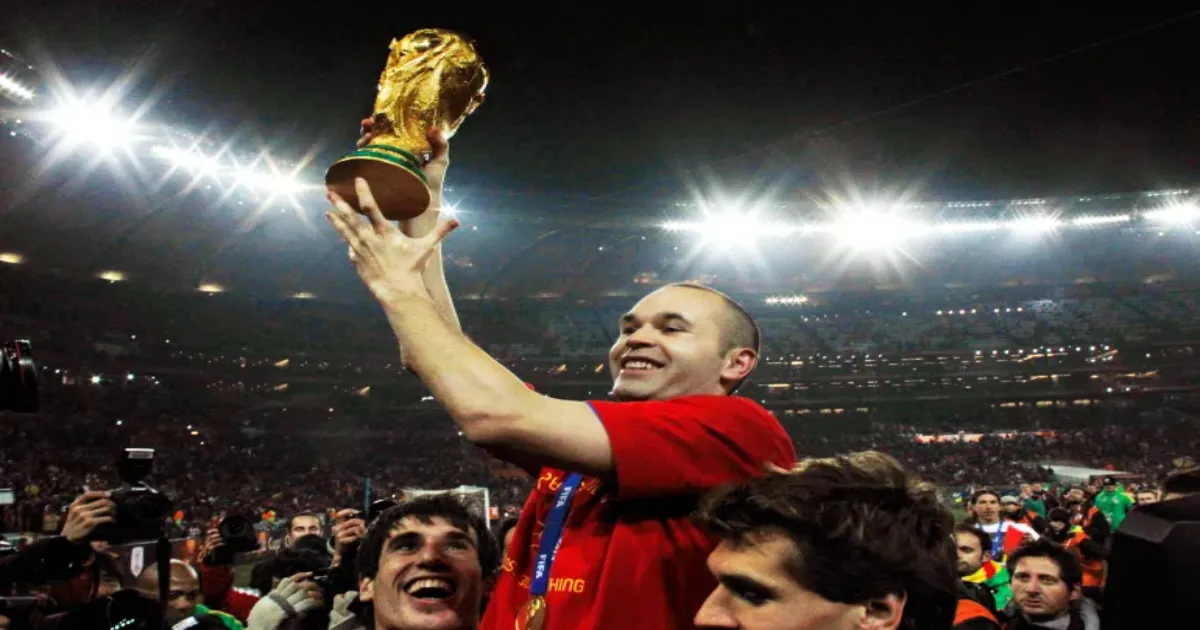
No single moment in Iniesta’s career, or arguably in the entire history of Spanish football, carries quite the same historical weight as his extra-time winning goal in the 2010 World Cup final against the Netherlands. With the match deadlocked at 0-0 deep into extra time, following a genuinely brutal, physically combative final that saw the Netherlands repeatedly attempt to disrupt Spain’s rhythm through aggressive challenges, Iniesta received a pass inside the penalty area and struck a controlled, first-time volley into the bottom corner, delivering Spain’s first-ever World Cup title with virtually the last significant action of the match.
That goal remains one of the most replayed and celebrated individual moments in Spanish football history, delivered by a player whose characteristic humility meant he dedicated the achievement, in the immediate aftermath, to the recent passing of a close friend and former teammate rather than centering his own individual role in delivering the trophy. The specific manner of the goal, understated and technically composed rather than spectacular or showboating, perfectly reflected Iniesta’s broader footballing character: even in the single most significant moment of his entire career, his focus remained on quiet technical execution rather than personal celebration or self-promotion.
Euro 2008 and Euro 2012
Iniesta’s World Cup triumph formed the centerpiece of a broader run of sustained Spanish international dominance, with the same core group of players, Iniesta prominently included, also delivering European Championship titles in both 2008 and 2012, making Spain the first nation in football history to win three consecutive major international tournaments. His individual performances throughout this remarkable run, including being named man of the match in the 2012 Euro final itself, a 4-0 demolition of Italy, cemented his status as one of the most consistently important players across this entire golden era of Spanish football, a player whose quiet excellence proved just as decisive to the team’s sustained success as any of his more individually celebrated teammates.
Ballon d’Or Recognition
Despite his considerable individual quality and central role in both Barcelona’s and Spain’s most successful periods, Iniesta never won the Ballon d’Or outright, finishing as runner-up in 2010, the same year of his World Cup-winning goal, to teammate Lionel Messi. That near miss, arriving in the very year of his single most significant individual achievement, has become something of a footnote in broader debates about football’s individual award voting, with many observers arguing that Iniesta’s specific contribution to Spain’s World Cup triumph deserved greater individual recognition than the award’s ultimate outcome reflected, even as few would dispute Messi’s own extraordinary individual quality during that same period.
A Beloved Departure to Japan
Iniesta’s decision to leave Barcelona in 2018, joining Japanese club Vissel Kobe, represented a significant and somewhat unexpected career transition, moving to a league considerably less prestigious than the one that had defined his entire career to that point. His time in Japan, however, proved genuinely significant for the growth of football’s profile within the country, with Iniesta’s continued individual quality and considerable star power helping raise both attendance figures and broader public interest in Vissel Kobe specifically and Japanese domestic football more broadly, a pattern of established global stars using late-career moves to help grow emerging football markets that has become increasingly common across the sport in recent years.
A Character as Celebrated as His Talent
Beyond his considerable footballing achievements, Iniesta has become almost equally celebrated within football culture for his genuine humility and understated public persona, a stark contrast to the more outspoken or flamboyant personalities that have defined several of his generation’s other elite players. Teammates and coaches across his lengthy career have consistently described him as one of the most respected and well-liked figures in any dressing room he occupied, his quiet leadership and consistent professionalism earning him genuine reverence that extended well beyond simply his technical footballing quality.
Why His Legacy Endures
Iniesta’s case as one of the finest midfielders in football history rests on a genuinely rare combination of factors: sustained trophy-winning excellence across nearly two decades at Barcelona, a central role in Spain’s unprecedented run of three consecutive major tournament titles, and a single, historically significant individual goal that delivered his country’s first-ever World Cup title. Combined with a genuinely beloved public character built on humility and quiet professionalism rather than self-promotion, Iniesta’s overall legacy extends considerably beyond his individual statistics or trophy count alone, representing a genuinely complete embodiment of both technical footballing excellence and the kind of understated personal character that has made him one of the most universally respected figures in the sport’s modern history.
A Dribbling Style Studied by Coaches Worldwide
Iniesta’s specific dribbling technique, built on subtle body feints, close control in tight spaces, and an almost uncanny ability to receive the ball under pressure while already anticipating his next several movements, remains a frequently studied reference point for coaches teaching young players how to retain possession in congested midfield areas. Unlike more explosively athletic dribblers who rely primarily on raw pace to beat defenders, Iniesta’s genius operated at a considerably more subtle, technical level, using deception and body positioning rather than pure speed to consistently escape pressure in spaces where most players would struggle simply to retain possession, let alone progress the ball forward with genuine purpose and control.
A Legacy That Extends Beyond Trophies
Ultimately, what makes Andrés Iniesta’s career so genuinely significant isn’t reducible to his considerable trophy collection alone, however remarkable that collection undeniably is. It’s the specific combination of technical brilliance, sustained excellence across nearly two decades at the highest level, a single transcendent moment of World Cup-winning history, and a personal character so consistently humble and well-regarded that it became as celebrated within football culture as his considerable on-field talent itself. That rare combination of genius and genuine humility is precisely why Andrés Iniesta remains one of the most universally beloved and respected figures in the entire history of Spanish and Barcelona football.
The Emotional Weight of a Country’s First Title
It’s worth dwelling further on just how much genuine national significance rode on Iniesta’s extra-time winner in 2010. Spain had entered the tournament as one of the favorites, backed by the same core group of players who had already delivered the country’s first major title in 44 years at Euro 2008, yet decades of previous World Cup disappointment meant genuine skepticism persisted about whether this specific generation could finally deliver the ultimate prize. When Iniesta’s shot found the net in the 116th minute, it didn’t just win a football match, it settled a decades-long national conversation about whether Spanish football’s obvious individual talent could ever translate into the sport’s single biggest trophy. That his goal arrived from a player known throughout his career for prioritizing team success over personal glory made the moment feel, to many Spanish fans, like an especially fitting way for that specific question to finally be answered.
Injuries and Resilience Throughout His Career
Iniesta’s career was not without its own significant physical challenges, including a serious knee injury sustained relatively early in his Barcelona career that required a lengthy recovery period and threatened, at the time, to derail what many scouts and coaches had already identified as generational talent. His successful recovery from that injury, and his subsequent return to the kind of sustained excellence that would eventually define his entire career, offered an early demonstration of the same quiet resilience and professional dedication that would come to characterize his approach throughout nearly two decades at the highest level of the sport, a reminder that even the most naturally gifted players often require genuine perseverance to fully realize their potential.
Continued Involvement in Football
Since his playing retirement, Iniesta has remained connected to football through various ambassadorial roles and continued public appearances, including work with UNICEF and other charitable organizations that reflect the same quiet, service-oriented character that defined his approach to the game throughout his playing career. His genuine popularity among fans across multiple countries, spanning Spain, Japan, and the broader global footballing community that watched his career unfold across nearly two decades, has ensured he remains one of the most consistently respected and beloved figures from his specific golden generation of Spanish football, a legacy built as much on his character as on his considerable footballing accomplishments.
A Legacy Told Through a Single Image
If a single image could capture Andrés Iniesta’s entire career, it might be the photograph of him celebrating his 2010 World Cup winning goal while wearing a t-shirt underneath his jersey honoring his recently deceased friend and former teammate, Dani Jarque. That image, combining the single greatest individual moment of his career with a gesture of genuine personal loyalty and remembrance rather than pure self-celebration, offers perhaps the clearest visual summary of everything that made Iniesta such a uniquely beloved figure throughout Spanish and Barcelona football’s most successful era: extraordinary talent delivered with genuine humility, precisely when the stakes could not possibly have been higher.
His Place Among Spain’s Golden Generation
Within the broader context of Spain’s golden generation, a squad that also included Xavi, Casillas, Puyol, Ramos, Torres, and Villa among others, Iniesta occupied a genuinely unique position: universally acknowledged by teammates as perhaps the single most talented individual within a squad already overflowing with world-class ability, yet consistently the least outwardly demanding of individual recognition or acclaim. Coaches who worked with that generation have frequently noted that Iniesta’s willingness to subordinate his own individual statistics and spotlight to the team’s collective success, even as his individual quality would have justified a more prominent public profile, played a genuinely significant role in maintaining the squad harmony and shared purpose that underpinned Spain’s unprecedented run of tournament success. That willingness to let his football do the talking, in a footballing culture increasingly defined by personal branding and individual promotion, remains one of the more quietly remarkable aspects of his entire career, a player whose humility never once appeared to limit the ambition or magnitude of what he was capable of achieving on the pitch itself, precisely when his country needed him most, a combination that ensures Andrés Iniesta will be remembered not merely as one of the finest midfielders the game has ever produced, but as one of its most genuinely admirable characters, a player whose greatest legacy may ultimately be proving that humility and historic greatness were never mutually exclusive in the first place.
13 Best Korean Dramas Ever Made — From Romance to Revenge Thriller
About the Author