From Carlo Ancelotti to Lionel Scaloni: Managers Ranked, Rated & Ruthlessly Analysed
The 2026 FIFA World Cup has been called many things: the largest, the most logistically complex, the most commercially ambitious. But among tactical analysts, the conversation has settled on a different descriptor — the most intellectually fascinating managerial tournament in the history of the sport.
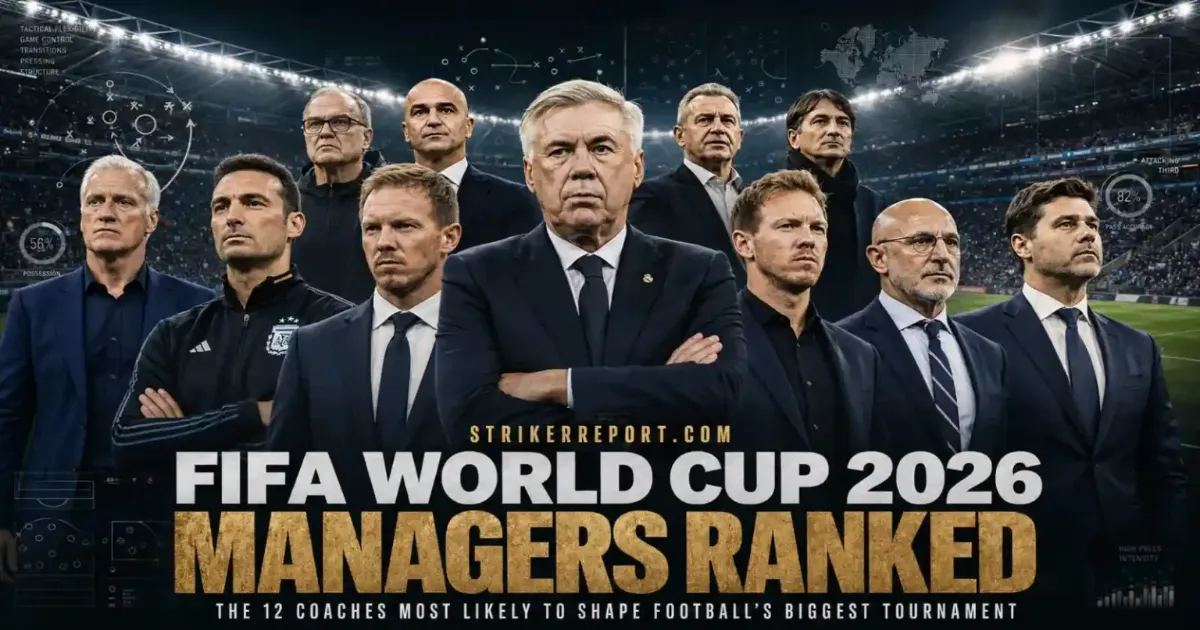
Forty-eight nations. One hundred and four matches. And on the touchlines, a collection of football management minds that may never again be assembled simultaneously in the same competition. From five-time Champions League winner Carlo Ancelotti to Julian Nagelsmann, who became the Bundesliga’s youngest permanent head coach at 28, to Didier Deschamps, who has managed France for 14 years and refuses to lose finals quietly — this is a tournament where the dugout rivalry is as compelling as anything on the pitch.Best Managers at FIFA World Cup 2026, Ranked
What Does a Football Manager Actually Do? The Job Behind the Tactics Board — A Full Week in the Life
StrikerReport ranks the 12 most powerful managerial presences heading into North America. These are the coaches most searched, most discussed, and most capable of delivering the unexpected on football’s biggest stage.
Why the 2026 Managerial Lineup May Be the Greatest in World Cup History
Context first. The 2026 World Cup’s managerial field stands apart not because of volume but because of concentration. At no previous tournament have so many elite-level club managers simultaneously occupied international roles. Ancelotti, Tuchel, Pochettino, and Nagelsmann have collectively managed in six Champions League finals. Deschamps and Scaloni are the only active World Cup-winning coaches in the competition. Marcelo Bielsa has influenced an entire generation of pressing coaches — Guardiola, Pochettino, and Simeone among them.
This is not a cohort of adequate international appointments. These are football’s most recognisable thinking minds, competing against each other across 39 days in a tournament that will produce surprises, heartbreaks, and at least one moment that redefines what international management looks like. Let’s rank them.
THE POWER TIER — Elite Managers Who Can Win the Whole Thing
#1 — Carlo Ancelotti (Brazil): The Professor’s Greatest Lecture?
If there is a single managerial storyline dominating the pre-tournament conversation, it is Carlo Ancelotti and Brazil. The Italian, who holds an unmatched five UEFA Champions League titles, accepted the Seleção role in 2025 in what is simultaneously the most logical and most audacious appointment in international football history. Logical, because Brazil demanded a winner with a CV beyond reproach. Audacious, because this is Ancelotti’s first international role, and managing a nation is fundamentally different from managing a club.
Brazil have not won a World Cup since 2002 — a 24-year drought that has grown into a national wound. Ancelotti arrives earning the tournament’s highest managerial salary, an arrangement that speaks to how desperately Brazil needs this. He brings a 4-3-3 philosophy built on individual freedom within collective structure — a system that suits Vinicius Junior, Raphinha, and Rodrygo with unusual elegance.
Whether Ancelotti can bridge the methodological gap between club and international football in a single tournament cycle is the most fascinating managerial question of 2026.
#2 — Didier Deschamps (France): One Last Symphony
Didier Deschamps has been managing France for 14 years. In that time, he has guided Les Bleus to the 2018 World Cup title, the 2022 World Cup final, the 2016 UEFA European Championship final, and the 2021 Nations League. He announced that 2026 will be his final tournament before stepping down — a farewell that transforms every French match into a chapter of institutional sporting history.
Deschamps is not a romantic tactician. He is a functionalist who builds teams that peak at the right moment, absorb pressure, and convert their moments of quality into decisive outcomes. France’s squad, valued at approximately €1.52 billion by Transfermarkt, is the tournament’s richest collection of talent. Kylian Mbappé leads it. Around him, William Saliba, Desire Doué, Michael Olise, and Ousmane Dembélé form an attacking depth chart that would embarrass most club rosters.
Deschamps has reached three major finals in his tenure. Betting against a fourth is a courageous position.
#3 — Lionel Scaloni (Argentina): The Quiet Architect of Back-to-Back Glory
Lionel Scaloni has won every major tournament available to him with Argentina: the 2021 Copa América, the 2022 World Cup, and the 2024 Copa América. He has done it by building a team with one defining quality — the ability to suffer, dig, and find solutions when logical football runs dry. Scaloni’s Argentina are not about aesthetics. They are about results, identity, and the unconditional support of a squad who trust their manager completely.
His 2026 challenge is unique: he is the defending champion, attempting what no team has done since Brazil’s back-to-back titles in 1958 and 1962. He is managing an ageing Lionel Messi — who turns 39 during the tournament — with the understanding that the tactical universe must be built around protecting what Messi can still offer while enabling the younger generation around him.
Scaloni is understated, precise, and consistently underestimated. That last quality may be his greatest weapon.
THE CONTENDER TIER — Brilliant Coaches One Breakout Performance Away from Greatness
#4 — Thomas Tuchel (England): Germany’s Gift to the Three Lions
Thomas Tuchel became England manager after Gareth Southgate’s departure and immediately established a different cultural energy around the squad. He became the first England manager to begin his reign with eight consecutive clean-sheet wins, and England qualified for the tournament by October — a pace that suggested structural improvement rather than cosmetic change. Tuchel won the 2021 UEFA Champions League with Chelsea in a tactical performance widely regarded as a masterclass in defensive organisation. He is a coach capable of neutralising any attacking system in world football. The question that haunts England’s campaign is simpler: can he unlock a team that has come close — two European Championship finals, a World Cup semifinal — without crossing the line?
Harry Kane and Jude Bellingham give Tuchel individual quality that few squads can match. If this England team does not reach a final, the questions about Tuchel’s international adaptability will be legitimate.
#5 — Julian Nagelsmann (Germany): Football’s Youngest Elder Statesman
Julian Nagelsmann was 28 when he became the Bundesliga’s youngest permanent head coach, taking over Hoffenheim. He is now Germany’s international manager, approaching the 2026 World Cup having led the national side through mixed results — inconsistent friendlies, a quarterfinal exit at Euro 2024 — but with a squad that includes Jamal Musiala and Florian Wirtz, two of the most gifted creative midfielders of their generation.
Nagelsmann’s challenge is intellectual as much as tactical: he must build a system flexible enough to use both Musiala and Wirtz simultaneously while maintaining the defensive discipline Germany require against elite opposition. He is young enough to take risks. Whether the World Cup is the right venue for experimentation is the critical debate.
#6 — Luis de la Fuente (Spain): The Quiet Heir to a Revolution
Spain’s coaching tradition — built through the tiki-taka era and its successors — has embedded a philosophical identity that de la Fuente inherited rather than invented. His Spain won Euro 2024 with a team whose average age suggested a generational transition in full flight. Lamine Yamal, 18 and already among the world’s most valuable players, is the emblem of what de la Fuente has. Pedri and Rodri provide the midfield architecture. Spain are tournament co-favourites for reasons that statistics and aesthetics equally justify.
#7 — Mauricio Pochettino (USA): Poch’s Grand American Experiment
Pochettino’s appointment as USMNT head coach was a statement of intent — this was a hire designed for a home World Cup, not for Nations League consolation prizes. His 3-4-3 system has given the Americans tactical coherence they previously lacked. His ability to motivate players through individual relationships, honed across Tottenham’s Champions League run and PSG’s Ligue 1 campaigns, translates to an international context where squad harmony is everything.
THE WILDCARD TIER — Coaches Who Could Define the Tournament Unexpectedly
#8 — Marcelo Bielsa (Uruguay): El Loco, One Final Masterpiece
Bielsa’s tactical influence is immeasurable — Guardiola, Pochettino, and Simeone have all credited him as a foundational influence. At 71, he manages Uruguay with the same obsessive intensity he has brought to every coaching role across four decades. His pressing systems, his physical conditioning standards, his video analysis obsession — these are characteristics that produce teams capable of defeating opponents with objectively superior individual quality.
Uruguay will not be favourites. Bielsa has spent his career proving that favourites are a bookmaker’s construct rather than a football reality.
#9 — Roberto Martínez (Portugal): The Velvet Glove on the Iron Fist
Martínez spent six years with Belgium’s golden generation before moving to Portugal, where he won the Nations League. His challenge in 2026 is navigating the Cristiano Ronaldo question: how do you build a modern Portugal system around a 41-year-old while not sacrificing the progressive football his other players — Bruno Fernandes, Bernardo Silva, Joao Neves — are capable of delivering?
#10 — Jesse Marsch (Canada): America’s Coach Building Canada’s Dream
Marsch’s European pedigree — RB Salzburg, RB Leipzig, Leeds United — translated into an international appointment that has produced Canada’s strongest-ever squad. His pressing identity, his player-development instincts, and his tactical flexibility make him one of the tournament’s most interesting coaching stories.
#11 — Javier Aguirre (Mexico): The Old General’s Final Campaign
Aguirre’s third stint as Mexico manager has produced consecutive CONCACAF titles. At 67, with two previous World Cup campaigns as El Tri boss, he arrives with a clarity of purpose that younger coaches sometimes lack: this is his last opportunity, and he knows it.
#12 — Zlatko Dalić (Croatia): The Tournament’s Most Consistent Over-Achiever
Dalić guided Croatia to a 2018 final and a 2022 third-place finish. His career World Cup record is arguably the most consistently impressive in the field outside of Deschamps and Scaloni. With Luka Modrić, he manages an ageing midfielder who, on his best days, is still the most complete player in Croatian history.
The Verdict — Who Goes Home With the Trophy?
If forced to a single prediction: Ancelotti’s Brazil or Deschamps’ France. Both have the managerial intelligence, the squad quality, and the tournament experience to navigate 104 matches across seven weeks. The dark horse is Scaloni’s Argentina — a team that has won everything and believes it can win everything again, because it already has.
What makes 2026 unique is not the teams or the expanded format. It is the men on the touchlines. Football has never seen a managerial field quite like this, and it may never again. Watch the dugouts as carefully as you watch the pitch.Messi, Mbappe, Ronaldo and Beyond: Rating the 15 Best Captains at the 2026 Fifa World Cup
🔹🔹🔹Follow us on Facebook🔹🔹🔹
StrikerReport.com — World Cup 2026 Tactical Intelligence | Manager Power Rankings
About the Author