Armband & Glory: The 15 Most Iconic Captains Leading Their Nations at FIFA World Cup 2026
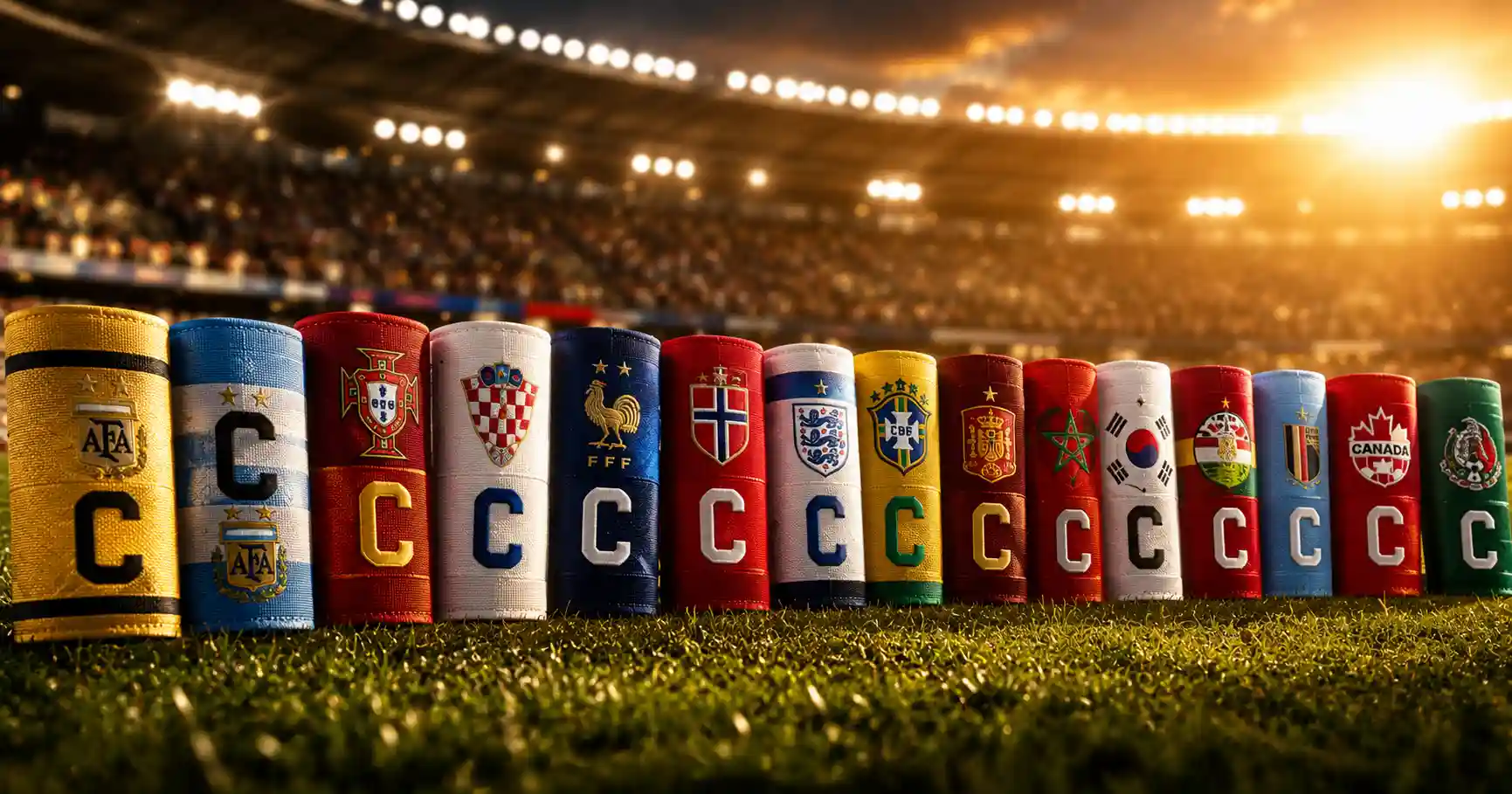
The armband is football’s most loaded symbol. It asks a player to carry not just their own performance but the weight of a squad, a nation, and — in many cases at this tournament — the accumulated expectations of millions of people who have followed a flag across decades of qualifying campaigns, heartbreaks, and close calls.
The 2026 FIFA World Cup, expanded to 48 teams and 104 matches across three nations, features the most remarkable collection of national captains ever assembled for a single tournament. There are legends in their final chapters. There are generational talents wearing the armband for the first time on the world stage. There are proven warriors who have carried their countries through cycles of hope and disappointment. And there are captains so young they were born in the same decade as the smartphones their fans use to follow their every move.
What follows is a portrait of the 15 most significant. Each tells a story about where international football is, and where it is going.
THE LEGENDS — Captains Playing Their Final World Cup Chapter
1. Lionel Messi (Argentina) — The Last Dance of the Greatest
There is no more important sentence in the preamble to this World Cup than this one: Lionel Messi will turn 39 three days before Argentina’s final group stage fixture. He is the greatest player in football history. He is the defending champion. He needs four goals to break Miroslav Klose’s all-time World Cup scoring record of 16. And he plays his club football at Inter Miami — in the country hosting the tournament.
Lionel Messi 2026 World Cup Journey: Why the World Is Watching Closely
The symmetry is almost too perfect to be real. This is Messi’s sixth World Cup, a number that speaks to an extraordinary longevity at the game’s summit. He lifted the trophy in Qatar in December 2022, ending the only meaningful gap in his résumé. In 2026, the question is whether he can do what only Pelé’s Brazil achieved in 1958 and 1962: defend it.
Scaloni’s system protects Messi from defensive duties while positioning him as the creative nucleus. Julian Álvarez and Lautaro Martínez provide the finishing power around him. When Messi operates in this space, Argentina become a different team — slower to appear, faster to punish. He is, at 38, still the most scrutinised player on earth. The World Cup, held in the country where he now lives, may provide the last perfect stage for a farewell defined by one more defining act.
2. Cristiano Ronaldo (Portugal) — 41 and Still Refusing to Leave
Cristiano Ronaldo entered the tournament as the world’s most-capped outfield international player, with well over 200 appearances for Portugal. The number is staggering. The ambition behind it — the refusal to accept that a career must have a natural endpoint — is even more so.“Ronaldo’s Last Dance? A Complete Tactical Breakdown of FIFA World Cup 2026 Group K”
Roberto Martínez has navigated the Ronaldo question carefully: how do you honour a player of his stature while building a Portugal system sophisticated enough to challenge for a first World Cup title? Bruno Fernandes, Bernardo Silva, and Joao Neves provide the modern technical architecture. Ronaldo, in the right moments — off the bench, or opening matches against teams that give him space — remains capable of changing a game with a single action. That capability, residual as it may be, is why he is in the squad and why he wears the armband.
Portugal carry the expectation of a nation that has never won a World Cup, captained by a player who has won everything else.
3. Luka Modrić (Croatia) — The Metronome’s Farewell
Luka Modrić captains Croatia at what most observers accept is his last World Cup. The man who was named FIFA Best Player of the Year in 2018 — the year he took Croatia to a final at 32 — arrives in 2026 at 40. Zlatko Dalić has guided Croatia to extraordinary results with ageing squads for years. Whether the team can replicate the 2018 magic or the 2022 third-place resilience with a squad that is unmistakably an older collection of familiar names is the tournament’s most elegiac storyline.
THE TORCH-BEARERS — Captains Defining the Next Decade of International Football
4. Kylian Mbappé (France) — Born for the Biggest Stages
Kylian Mbappé won the World Cup at 19 in 2018. He scored a hat-trick in the 2022 final — a display of individual brilliance in the highest-pressure moment in sport that has no equal in recent memory. He was named France’s captain in 2023 following Hugo Lloris’s international retirement, and the armband fits him with the natural ease of someone who has spent his entire career preparing for this responsibility.Kylian Mbappé Golden Boot Prediction: Can Anyone Stop Him in 2026?
At 27, playing at Real Madrid after his blockbuster PSG departure, Mbappé enters 2026 as the most valuable player at the tournament. France’s squad, worth approximately €1.52 billion in transfer value, is built around him — but Mbappé has never needed the infrastructure. He is a player who produces when the game is most alive. A tournament defined by 48 nations and 104 matches will inevitably produce moments where France need someone to cut through the impossible. That is precisely when Mbappé becomes the most frightening player on the planet.
5. Erling Haaland (Norway) — The Planet’s Most Lethal Striker, Finally Here
Norway’s World Cup return after 28 years carries one name above all others: Erling Haaland. The Manchester City striker is already Norway’s all-time leading scorer with 55 goals in 49 appearances — a ratio that defies rational statistical analysis. He stands 6-foot-5, combines imposing physical presence with terrifying speed, and has scored more than 300 goals at club level before his 26th birthday.Erling Haaland — FIFA World Cup 2026 Profile, Stats & Career
This is Haaland’s first World Cup. His first major tournament of any kind. The question every analyst is circling is not whether he is good enough — the answer to that is self-evident — but whether the structures and quality around him at international level allow him to operate with the same devastating efficiency he demonstrates for Pep Guardiola’s Manchester City. Norway are not France. But Haaland alone makes them dangerous against anyone.
6. Harry Kane (England) — Goals, Trophies, and a World Cup Debt to Settle
Harry Kane captains England with the quiet authority of a player whose numbers do the talking. England’s all-time leading scorer, Kane arrives at 2026 having finally broken his club-level trophy drought by winning the Bundesliga with Bayern Munich — a psychological release that teammates and analysts alike believe has freed him from the weight that once dogged his biggest moments. He worked under Thomas Tuchel at Bayern before reuniting with him at international level, and that familiarity gives England a tactical shorthand most squads spend months building. Kane at the peak of his powers — leading the line, holding up play, arriving into the box with lethal timing — is one of the most complete centre-forwards in the world. For a nation that has not won a major tournament since 1966, his armband carries an entire country’s most persistent football dream.Harry Kane FIFA World Cup 2026: England’s Captain, Record-Breaker & Last Chance at Glory
7. Marquinhos (Brazil) — The PSG Captain Bearing Seleção’s 24-Year Trophy Drought
Marquinhos captains Brazil into a 2026 World Cup where Ancelotti’s entire project is built around ending a 24-year absence from the world’s summit. The PSG centre-back approaches his 100th cap at this tournament and carries the armband with the calm authority of a player who captained his club to the Champions League title in 2024-25. He is not Brazil’s most explosive name — Vinicius Junior, Raphinha, and the returning Neymar attract the larger headlines — but Marquinhos sets the tone that makes those names possible. His positioning, his leadership of the back four, and his ability to communicate Ancelotti’s defensive structure to the squad in real time make him irreplaceable. Brazil co-captain Casemiro shares the leadership burden in midfield. Together, they form the experienced foundation of a squad carrying one of football’s greatest unresolved ambitions.Mexico El Tri 2026 World Cup: The Fifth Game Problem That Still Haunts El Tri
8. Rodri (Spain) — The Champions League Winner Captaining Football’s Best Squad
Rodri captains Spain with the same composure he brings to every match he plays: composed, authoritative, technically immaculate. The Manchester City defensive midfielder — a Champions League winner and the midfielder around whom Pep Guardiola built his most dominant club sides — now wears the armband for the reigning European champions. Spain under Luis de la Fuente won Euro 2024 with Lamine Yamal drawing the global headlines, but Rodri is the structural reason Spain function as a tournament team rather than a collection of gifted individuals. His ability to control the tempo, break up opposition attacks before they develop, and distribute with the precision of a player who sees the game in slow motion makes him uniquely suited to the captaincy pressure of a World Cup. Alongside Pedri, Gavi, and Yamal, he leads the squad many analysts consider the most balanced in the tournament.Rodri FIFA World Cup 2026 — Spain’s Ballon d’Or Warrior Profile, Stats & Preview
THE PROVEN ELITE — World-Class Captains at the Peak of Their Powers
9. Joshua Kimmich (Germany) — The Brain on the Pitch
Joshua Kimmich captains Germany into a 2026 World Cup that carries the expectation of a four-time champion playing on a continent-sized stage that suits their organisational identity. Officially listed as a defender in the squad, Kimmich functions primarily as a deep-lying midfielder — the most technically and tactically sophisticated role in Nagelsmann’s system. He reads the game a move ahead, presses with intelligence rather than just intensity, and distributes with a range that can switch play from penalty box to penalty box in a single pass. Germany’s 2026 hopes — built around the creativity of Jamal Musiala and Florian Wirtz — depend on Kimmich providing the stable base from which that talent can be unleashed. He is the armband of a nation that demands results, worn by a player built to deliver them.
10. Achraf Hakimi (Morocco) — Africa’s Armband-Bearer and Standard-Setter
Hakimi inherited the Morocco captaincy that was built on the 2022 semifinal run — the greatest in African football history. His PSG performances and his international leadership have positioned him as Africa’s most high-profile footballer. Morocco’s mission in 2026 is to exceed even that standard.Achraf Hakimi FIFA World Cup 2026: Profile, Stats & Career | StrikerReport
11. Son Heung-min (South Korea) — Asia’s Most Complete Football Story
Son has represented South Korea across multiple World Cups with a combination of technical excellence and personal grace. His Premier League career at Tottenham has made him one of Asia’s most globally followed footballers. He brings those 15 years of elite-level experience to a South Korean squad that will need every drop of his leadership to navigate Group A against Mexico, Czech Republic, and South Africa.Son Heung-min FIFA World Cup 2026: Profile, Stats & Career | StrikerReport
12. Mohamed Salah (Egypt) — The Pharaoh Leading His Nation to History
Mohamed Salah’s legacy needs no description. The man who became Liverpool’s greatest modern scorer and the Premier League’s most productive forward over a sustained period now departs Anfield and arrives at the World Cup as Egypt’s captain — determined to make a tournament impact on the global stage his club career has always merited.The Egyptian King Bids Farewell: Mohamed Salah’s 9 Glorious Years at Anfield Come to an Emotional End
13. Youri Tielemans (Belgium) — The Last Ride of the Golden Generation’s Quiet Leader
Youri Tielemans wears Belgium’s captain’s armband under coach Rudi Garcia — a choice that reflects the Aston Villa midfielder’s composure and tactical intelligence over the louder star power of Kevin De Bruyne, Romelu Lukaku, or Thibaut Courtois. At 29, Tielemans represents the bridge generation: too young to have been a protagonist in Belgium’s 2018 third-place finish, experienced enough to captain a squad in which several golden-generation survivors make what are likely their final World Cup appearances. Alongside Amadou Onana in a double pivot, he organises Belgium’s midfield with the press resistance and positional discipline that allows De Bruyne to operate freely in front of him. Tielemans won’t be the name on the scoresheet or the player making the highlight reel. He is the reason Belgium’s more celebrated names can perform.
THE DARK HORSES — Captains Who Could Shock the World
14. Alphonso Davies (Canada) — The Comeback Captain at Home
Davies returns from a hamstring injury to lead Canada on home soil. If he reaches full fitness before the Vancouver group games, he transforms Canada from a contender into a genuine upset threat. The combination of his athleticism and the emotional power of leading your country’s first serious World Cup challenge on home soil makes him one of the tournament’s most compelling storylines.
15. Edson Álvarez (Mexico) — El Tri’s Quiet Engine in the Spotlight
Álvarez captains Mexico as the West Ham midfielder built in the mould of a classic No. 6 — tenacious, intelligent, engine-room dominant. Aguirre’s entire system runs through him. He is not yet a global name in the Mbappé or Kane tier, but within tactical circles, his ability to control a match’s physical tempo is regarded as elite. The Azteca will announce him to an audience of 112,000 on June 11.Julián Álvarez FIFA World Cup 2026: Argentina’s Spider Returns to Defend the Trophy | StrikerReport
The Final Word — Who Lifts the Trophy on July 19?
Fifteen captains. Fifteen stories. Fifteen armbands carrying the weight of national hope across three continents. The World Cup’s most compelling individual question is whether Messi can complete a footballing legacy already beyond criticism by defending the trophy in the country where he plays his club football. The tournament’s most compelling generational question is whether Mbappé’s time to own the summit has finally, definitively arrived.
On July 19 at MetLife Stadium in New Jersey, one captain will lift the most famous trophy in sport. Forty-seven others will return home carrying what they tried to give their nations — effort, leadership, and the kind of pride that transcends any single result.
The armband, in its way, is the tournament.
StrikerReport.com — World Cup 2026 | Captain Profiles & Leadership Analysis
About the Author



3 thoughts on “Messi, Mbappe, Ronaldo and Beyond: Rating the 15 Best Captains at the 2026 Fifa World Cup”