Houston’s Space City Is Ready to Host 7 Matches — Including a July 4 Showdown
Mission Control, Houston. We have a World Cup.
Why Houston?
Ask most international football fans to name the 2026 World Cup host cities and they will rattle through New York, Los Angeles, Dallas, Miami, and Mexico City without hesitation. Ask them to continue and some will pause before Houston.
That pause is unjustified, and by July 4, 2026, it will be forgotten entirely.
Houston is one of the great American cities — the fourth largest in the United States, the most ethnically diverse major city in the country, a metropolis that contains one of the world’s great medical complexes, the nerve centre of the global oil and gas industry, the home of NASA’s Johnson Space Center, and a food culture that the New York Times has called “the most exciting in America.”
It hosts seven World Cup matches. NRG Stadium in Houston, Texas, will host seven matches during the 2026 FIFA World Cup, with five group stage matches scheduled for June 14, 17, 20, 23, and 26, one Round of 32 match scheduled for June 29, and one Round of 16 match scheduled for July 4.
The Most Beautiful World Cup 2026 Stadiums Ranked: From Azteca to SoFi
The Most Beautiful World Cup 2026 Stadiums Ranked: From Azteca to SoFi
A Round of 16 match will be played at NRG Stadium on July 4, 2026 — which is Independence Day in the United States.
A World Cup knockout match, at night, in Houston, on the Fourth of July. Fireworks outside. Football inside. Welcome to Space City.
Stadium Snapshot
| Official FIFA Name | Houston Stadium |
| Commercial Name | NRG Stadium |
| Location | NRG Pkwy, Houston, TX 77054 (NRG Park complex) |
| Opened | 2002 |
| Home Team | Houston Texans (NFL) |
| Standard Capacity | 72,220 |
| World Cup Capacity | 68,311 (FIFA tournament configuration) |
| Roof | Retractable — critical for Houston’s summer heat |
| World Cup Matches | 7 — five group stage + Round of 32 + Round of 16 (July 4) |
| Notable WC History | Hosted Copa America 2024 matches including Argentina vs Ecuador QF |
| Renovation | First NFL stadium with a retractable roof |
The Retractable Roof: Houston’s Secret Weapon
Houston in June and July is brutal. Temperatures routinely hit 95–102°F (35–39°C) with humidity levels that make the air feel like a warm towel. It is, without exaggeration, one of the most demanding outdoor climates at the entire World Cup.
NRG Stadium’s retractable roof is not a luxury feature. In Houston in summer, it is a survival mechanism.
NRG Stadium was one of the first NFL arenas to feature a retractable roof for added fan comfort. The roof opens and closes in approximately 10 minutes and will almost certainly remain closed for afternoon matches during the summer tournament, creating a fully climate-controlled environment that gives Houston a critical atmospheric advantage over other Southern US venues.
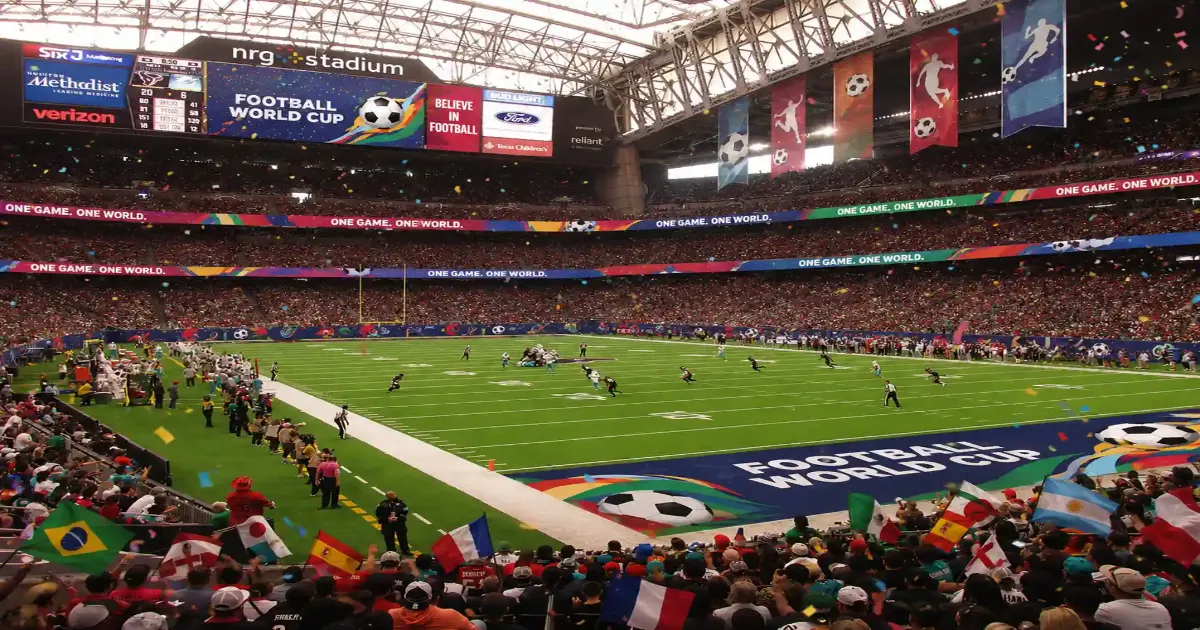
Inside a closed NRG Stadium, with 68,000 fans and the full sound system operational, the experience is more akin to an indoor arena than an outdoor football ground. The two large screens installed behind the goals in 2013 — with an area of almost 1,352 m² — became the largest screens of their kind in stadiums worldwide when they were installed, and will provide every fan with vivid close-up replays regardless of where they are seated.
The Match Schedule at Houston Stadium
| Round | Date | Time (CT) | Confirmed Match |
|---|---|---|---|
| Group E | June 14, 2026 | TBC | Germany vs Curaçao |
| Group K | June 17, 2026 | TBC | Portugal vs DR Congo |
| Group E | June 20, 2026 | TBC | TBC |
| Group K | June 21, 2026 | TBC | Portugal vs Uzbekistan |
| Group Stage | June 23, 2026 | TBC | TBC |
| Group Stage | June 26, 2026 | TBC | TBC |
| Round of 32 | June 29, 2026 | TBC | TBC |
| Round of 16 | July 4, 2026 | TBC | TBC |
Houston hosts two of Portugal’s group matches — making NRG Stadium the ground where Cristiano Ronaldo may play his penultimate group-stage games. The July 4 Round of 16 is the most dramatically timed match in the tournament.
Getting There: Houston’s Transit Reality
Houston is a car city. There is no getting around this. The city was built around the automobile in the mid-20th century and its public transit system, while improved, remains limited compared to the other major host cities.
The best and most efficient way to get to NRG Stadium by public transport during the World Cup is to take the METRORail Red Line light rail, which drops you off just a short walk from the stadium gates. To accommodate World Cup crowds, trains are being upgraded to two-car capacities and will run every 5 minutes during peak tournament hours.
METRORail Red Line runs from Downtown Houston directly to Stadium Park/Astrodome Station — a short walk from the NRG gates. This is the definitive match-day transport choice. From downtown hotels, the journey takes approximately 20 minutes and costs $1.25 each way.
From Airports:
- George Bush Intercontinental (IAH): ~20 miles north. Take the 102 Bush IAH Express bus toward downtown, then connect to the Red Line (~45 minutes total). Rideshare direct: approximately $35–50.
- Hobby Airport (HOU): ~10 miles south of the stadium. Rideshare is the best option — approximately 20 minutes in normal traffic.
By Car: NRG Park has extensive parking on site. However, post-match congestion on the US-59 and I-610 interchange can hold vehicles for 60–90 minutes. Park-and-ride from the Medical Center light rail park-and-ride lot is a smarter option.
Houston: The City That Surprises Everyone
Houston is geographically massive, but NRG Stadium is well-connected to the core via light rail. And once you venture beyond the stadium, the city that most international visitors underestimate reveals itself as one of the most extraordinary in America.
The Space Center
NASA Johnson Space Center Twenty-five miles southeast of downtown, this is where Mission Control lives. The place where “Houston, we have a problem” was uttered. Where Neil Armstrong’s suit is displayed. Where the actual Apollo 17 spacecraft — the last crewed mission to the Moon — sits in a hall where you can walk under it.
Space Center Houston, the public visitor complex adjacent to NASA’s working facility, is one of the great museum experiences in the United States. The historic Mission Control room — used from Gemini through the early Space Shuttle era — has been restored to its 1969 configuration. You can stand behind the consoles used during the Apollo 11 lunar landing.
For a World Cup trip, it is the single most unique non-football experience available at any host city. No other World Cup host city has a lunar landing museum.
Downtown and the Arts
The Museum District Houston’s museum district — clustered around Hermann Park and the Texas Medical Center — is one of the finest in the United States. The Museum of Fine Arts Houston has a permanent collection of 73,000 works; the Houston Museum of Natural Science has a world-class paleontology hall; the Menil Collection houses one of the world’s great private art collections, including the Rothko Chapel — a non-denominational chapel containing 14 massive Mark Rothko paintings, one of the most contemplative spaces in American art.
Buffalo Bayou Park The bayou — the slow-moving waterway that bisects the city — has been transformed over the last decade into a linear park with walking and cycling paths, kayak rentals, public art installations, and stunning downtown skyline views. On summer evenings, the bayou comes alive with runners, cyclists, and impromptu football fans who have claimed its picnic areas for match viewings.
The Heights Houston’s bohemian historic neighbourhood: craftsman bungalows, antique shops, coffee houses, and the city’s best brunch scene. A 20-minute drive from NRG Stadium and a world away from the downtown energy.
Houston Food: America’s Most Diverse Table
This guide is your complete handbook for the Houston World Cup 2026, covering the match schedule at the retractable-roof giant, transport logistics, and the city’s world-famous Viet-Cajun cuisine.
Houston’s food scene is, by any credible measure, one of the finest and most diverse in the United States. The city is home to more than 90 nationalities and the cooking of each is available somewhere in the city’s 11,000+ restaurants. But three culinary traditions stand above all others and together define what makes Houston’s food culture genuinely unlike anywhere else in America.
Viet-Cajun Crawfish — The Defining Houston Food This is Houston’s great culinary invention. Vietnamese immigrants arrived in Houston in large numbers after the Fall of Saigon in 1975, many settling in the Gulf Coast fishing communities where crawfish — small freshwater crustaceans — had been eaten Cajun-style for generations. The Vietnamese community took the Cajun crawfish tradition, added lemongrass, garlic butter, ginger, oyster sauce, and chilli, and created something entirely new.Pelé Lifted the Trophy Here. Maradona Scored the Goal of the Century Here. Now Azteca Stadium Hosts World Cup 2026
Viet-Cajun crawfish is now Houston’s signature dish. The Crawfish & Noodles (in the Hong Kong City Mall) is the internationally recognised benchmark — the restaurant that put this cuisine on the culinary map. Sit at a long plastic table with a tray of mud bugs piled in garlic-butter-lemongrass sauce and work through them with your hands. It is messy, extraordinary, and definitively Houston.
Texas BBQ, Houston Style Houston’s BBQ culture differs from Dallas’s post-oak tradition — here it leans more toward the East Texas style, with beef brisket, pork ribs, and links smoked over hickory. Gatlin’s BBQ in the Heights is the local favourite. Killen’s Barbecue in Pearland (30 minutes south) is considered by Texas Monthly to be among the state’s finest.
Mexican and Tex-Mex Houston’s large Mexican-American community gives the city one of the most authentic Mexican food cultures in the United States — not the Tex-Mex hybrid of San Antonio, but regional Mexican cooking from Oaxaca, Veracruz, and Monterrey. Hugo’s in Montrose for upscale Oaxacan cuisine; the Mercado Arandas neighbourhood for tacos de barbacoa at 7 AM on a Sunday.
Vietnamese Food The Bellaire Chinatown — sometimes called “Asiatown” — contains the largest concentration of Vietnamese restaurants in Texas. Pho Binh has been the neighbourhood’s landmark pho shop since the 1980s. The banh mi from Croissant-D’Or is considered among the finest in the country.
Global Dining Houston’s restaurant scene covers every world cuisine with a seriousness that would surprise visitors expecting only beef and beans. Aga’s for Pakistani karahi. Himalaya for the Indo-Pakistani fusion of chef Kaiser Lashkari, beloved by both the James Beard Foundation and by every Houston cab driver. Nidda Thai for Royal Thai cuisine. The diversity of Houston’s table is the diversity of Houston itself.
The July 4 Night Match: Football and Fireworks
Here is an image for you. It is the evening of July 4, 2026 — Independence Day in the United States. Outside NRG Stadium, the Houston sky is lit with fireworks from a dozen simultaneous municipal displays visible from the stadium’s outer plazas. Inside, 68,000 football supporters from across the world are watching one of the sixteen best national teams remaining at the World Cup battle through a Round of 16 match.
NRG Stadium has hosted football matches in the past, including three games at the 2024 Copa America, including Mexico’s 1-0 win against Jamaica and Argentina’s penalty shootout victory against Ecuador in the quarter-finals. The venue has form for great nights. July 4, 2026 may be the greatest of them all.
What to Wear in Houston
Houston summer heat requires planning. Expect 90°F (32°C) with high humidity. Stay hydrated.
- Inside the stadium: Fully climate-controlled with roof closed. Light clothing, your national team’s shirt, comfortable shoes.
- Outside the stadium: The walk from the Red Line station to the gates and the pre-match plazas are exposed. Light, breathable fabrics are essential. A wide-brim hat in direct sun is not optional — it is medical advice.
- Hydration: Houston’s humidity makes dehydration a genuine risk. Drink water before, during, and after — significantly more than you think you need.
About the Author