Mercedes-Benz Stadium World Cup 2026: Atlanta’s $1.6 Billion Stage Hosts a Semi-Final — Here’s Everything You Need
Atlanta gave the world Coca-Cola, Martin Luther King Jr., the CDC, Tyler Perry, Outkast, and the 1996 Olympics. Now it gives the World Cup its second semi-final. The A is ready.
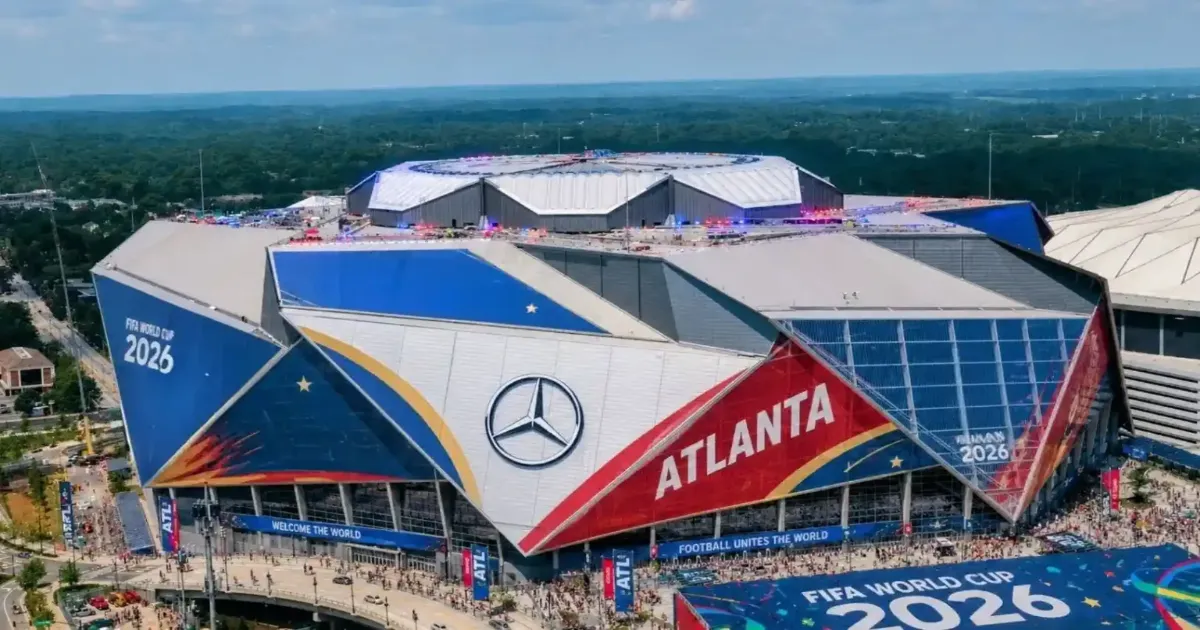
The Building That Changed What Stadiums Could Be
When Mercedes-Benz Stadium opened in 2017 in downtown Atlanta, it did not simply add a new venue to the American sports landscape. It recalibrated what a stadium was allowed to be.
The architecture was the first signal: an eight-petalled retractable roof, inspired by the oculus of the Roman Pantheon, opening skyward like a mechanical flower over a cathedral-like interior space. The second signal was the technology: the Halo Board — a 360-degree, 61,900-square-foot HD video screen circling the roof opening — is the largest in professional sports. The third signal was something almost unprecedented in American stadium culture: affordable food.The 10 Highest-Paid Footballers in the World
Inside the stadium gates, hot dogs, pretzels, and sodas are famously inexpensive — $2–$5. In an era of $18 beers and $14 hot dogs, Mercedes-Benz Stadium’s “Fan First” pricing philosophy became a genuine headline when the building opened. It remains intact for the 2026 World Cup.
Mercedes-Benz Stadium in Atlanta will host eight matches during the 2026 FIFA World Cup, with five group stage matches scheduled for June 15, 18, 21, 24, and 27, one Round of 32 match on July 1, one Round of 16 match on July 7, and a semi-final on July 15.What Is Tiki-Taka? Spain’s Football Philosophy Explained Simply
Eight matches. A semi-final on July 15, 2026. The audience for the semi-final alone is expected to exceed one billion viewers.
Stadium Snapshot
| Official FIFA Name | Atlanta Stadium |
| Commercial Name | Mercedes-Benz Stadium |
| Location | 1 AMB Drive NW, Atlanta, GA 30313 (Vine City, west of downtown) |
| Opened | 2017 |
| Home Teams | Atlanta Falcons (NFL), Atlanta United FC (MLS) |
| Build Cost | $1.6 billion |
| Standard Capacity | 71,000 (expandable to 75,000) |
| World Cup Capacity | 75,000 |
| Roof | Eight-petal retractable — opens like a camera aperture |
| Halo Board | 360°, 61,900 sq ft — largest video display in professional sport |
| World Cup Matches | 8 — five group stage + R32 + R16 + Semi-Final July 15 |
| Fan-First Pricing | Hot dogs from $2, sodas from $3 — confirmed for World Cup 2026 |
| Sustainability | LEED Platinum certified — first professional sports venue to achieve it |
The Halo Board: Football Like You’ve Never Seen It
Stop. Before anything else, the Halo Board needs a proper introduction.
Mercedes-Benz Stadium’s eight-petal retractable roof — inspired by the Roman Pantheon — opens in about eight minutes. Inside, the 360-degree Halo Board wraps the entire circumference of the roof opening in 61,900 square feet of high-definition display. It is not simply the largest screen in sport. It is a completely different category of visual experience.
At a World Cup semi-final, when two of the four best teams in the world are on the pitch beneath it and 75,000 people are watching every touch, every tackle, every save, and every goal replayed in real time across 360 degrees of the building’s interior — there is no screen experience in sport that compares.
Mercedes-Benz Stadium features a retractable seating system in the lower bowl that brings fans closer to the pitch, creating an intimate and high-energy atmosphere. Combined with the Halo Board overhead and a sound system that the Falcons have calibrated over nine seasons of NFL use, the semi-final experience at Atlanta Stadium on July 15 will be unlike anything else at this World Cup.
The Match Schedule at Atlanta Stadium
Five group stage matches run from June 15 through June 27, followed by knockout matches on July 1, July 7, and the semi-final on July 15. Atlanta hosts two of Spain’s group matches, making MBS the stadium where the world’s top-ranked team plays twice.
| Round | Date | Time (ET) | Match |
|---|---|---|---|
| Group H | June 15, 2026 | TBC | Saudi Arabia vs Uruguay |
| Group H | June 18, 2026 | TBC | Spain vs Uruguay |
| Group Stage | June 21, 2026 | TBC | TBC |
| Group H | June 24, 2026 | TBC | Spain vs Cape Verde |
| Group Stage | June 27, 2026 | TBC | TBC |
| Round of 32 | July 1, 2026 | TBC | TBC |
| Round of 16 | July 7, 2026 | TBC | TBC |
| Semi-Final | July 15, 2026 | 3:00 PM ET | TBC |
Eight matches. Spain plays twice here. The semi-final on July 15 — kick-off 3:00 PM ET / 8:00 PM BST — is one of the most globally watched events in the entire tournament.
Getting There: Atlanta’s MARTA Advantage
MARTA is the cleanest option for many fans because it avoids the slow crawl around event parking and rideshare zones.
By MARTA Rail (Recommended): The MARTA Red and Gold Lines both stop at the Vine City Station, which is a 10-minute walk from the stadium. Downtown hotels on Peachtree Street are served directly by MARTA. From Hartsfield-Jackson Atlanta International Airport — the world’s busiest — take MARTA’s Red or Gold Line from the Airport Station directly to Vine City: approximately 25 minutes, $2.50 each way.
This is the World Cup’s smoothest major airport-to-stadium transit connection. Land at Hartsfield-Jackson, take MARTA, walk to the stadium. No car needed.
From Atlanta Airport (ATL): Hartsfield-Jackson Atlanta International Airport is the world’s busiest airport by passenger volume — a global hub that connects to virtually every major city on earth. Atlanta’s position as an international transportation hub through Hartsfield-Jackson facilitates global fan travel without the complications of smaller markets. Direct flights from London, Paris, Amsterdam, Frankfurt, Dubai, Tokyo, São Paulo, Mexico City, Bogotá, and dozens of other major cities make Atlanta one of the most accessible World Cup venues for international fans.
Atlanta: The Capital of Black American Culture
2026 will be the state of Georgia’s first time as a World Cup host city. And it arrives with a cultural identity that deserves a proper introduction to international visitors.
Atlanta is not simply the capital of Georgia. It is the capital of Black American culture, the birthplace of the American civil rights movement, the city that produced more hip-hop stars than any other American metropolis, the home of the world’s largest concentration of HBCUs (Historically Black Colleges and Universities), and the city that, more than anywhere else in the American South, has defined what 21st-century Black excellence looks like in business, entertainment, academia, and sport.
For international visitors, Atlanta in 2026 is an education that no classroom provides.
The Civil Rights Trail
Martin Luther King Jr. National Historical Park The most important site on the Atlanta itinerary for any visitor who wants to understand the United States. The park encompasses Dr. King’s birth home (a Victorian house on Auburn Avenue where he was born in 1929), Ebenezer Baptist Church (where he preached), and his final resting place — a white crypt on a reflecting pool, where he and Coretta Scott King lie together. The Visitor Center provides the historical context. The surrounding streets of Sweet Auburn — the historic Black business district of Atlanta — tell the story of a community that built prosperity under segregation.
The National Center for Civil and Human Rights Adjacent to Centennial Olympic Park, five minutes from the stadium. Four floors documenting the American civil rights movement alongside a global human rights gallery. The lunch counter exhibit — where visitors sit at a simulated 1960s segregated lunch counter and experience recorded audio of verbal abuse and physical intimidation while instructed to remain still — is one of the most emotionally affecting museum experiences in the United States.
The Music
Atlanta gave the world Outkast, Lil Wayne’s early recording home, T.I., Ludacris, Gucci Mane, Young Jeezy, 21 Savage, Cardi B’s early breakout, and — most significantly — trap music. The 808 kick drum and hi-hat pattern that defines modern global pop music was refined in Atlanta’s Westside studios in the early 2000s.
The GRAMMY Museum Experience at Centennial Olympic Park A rotating exhibition space celebrating Atlanta’s extraordinary contribution to American music. Walking distance from the stadium.
Little Five Points Atlanta’s bohemian neighbourhood: record shops, vintage clothing, tattoo studios, and the kind of music bar culture that has been feeding the city’s creative community since the 1980s. The best live music experience in Atlanta for international visitors.Seattle Stadium World Cup 2026 — Six Matches, One Deafening Roar: Your Complete Lumen Field Fan Guide
Sport and the Modern City
Atlanta’s passionate soccer culture, demonstrated through Atlanta United FC setting MLS attendance records since 2017, proves the city’s embrace of the beautiful game. Atlanta United’s inaugural MLS season in 2017 drew an average of 48,200 fans per match — shattering league records. Their 2018 MLS Cup Final at Mercedes-Benz Stadium drew 73,019 fans — still the single-game MLS attendance record.
This is a city that already knows what 75,000 people watching football in this building feels like. They will be ready.
Atlanta Food: Soul, Heat and Everything In Between
Atlanta’s food scene is one of the great revelations for first-time visitors. The city’s culinary identity is rooted in Southern soul food — deeply flavoured, community-centred, historically significant — but has expanded into one of the most diverse and acclaimed restaurant cultures in the American South.
Soul Food — The Foundation Soul food is the cuisine born of African American communities in the Deep South — fried chicken, collard greens slow-cooked with smoked meat, macaroni and cheese, candied yams, cornbread, and black-eyed peas. It is not simply comfort food. It is a cuisine that sustained communities under oppression and represents resilience in every dish.
Busy Bee Café on Martin Luther King Jr. Drive has been serving soul food since 1947 and was a gathering place for civil rights leaders during the movement. Martin Luther King Jr. ate here. Coretta Scott King ate here. It is one of the most historically significant restaurants in the United States, and the fried chicken is extraordinary.
Paschal’s has been an institution since 1947 — the unofficial dining room of the Civil Rights Movement. Andrew Young, Julian Bond, and John Lewis all ate here in the 1960s while planning marches and sit-ins. The current Castleberry Hill location continues the tradition.
Twisted Soul Cookhouse (Westside) brings a modern chef-driven lens to soul food traditions. Chef Deborah VanTrece’s short ribs braised in stout, her collard greens with smoked turkey, and her sweet potato cheesecake represent the cuisine’s evolution without sacrificing its soul.
Chicken and Waffles Atlanta claims the definitive American chicken-and-waffles experience. The combination of crispy fried chicken on sweet Belgian waffles, typically drizzled with syrup and hot sauce, is considered a signature Atlanta brunch dish. The Busy Bee and Gladys Knight’s Chicken and Waffles are the institutions.
Global Dining in Atlanta Atlanta’s Vietnamese community in the Buford Highway corridor gives the city one of the finest pho cultures in the South. Pho Dai Loi No. 2 is the decades-long local favourite. The same corridor contains outstanding Korean, Chinese, Mexican, and Ethiopian restaurants in a multi-mile stretch of international cooking that rivals the ethnic food corridors of much larger American cities.
The Beltline Food Scene The Atlanta BeltLine — a 22-mile loop of former railway corridors converted into walking and cycling trails around the city — passes through Ponce City Market, Krog Street Market, and Old Fourth Ward, all of which are dense with outstanding restaurants. A walking food tour of the BeltLine is the best single afternoon activity in Atlanta.
Fan Zones & Stadium Experience
The Fan-First Pricing Model The stadium features numerous “limitless” soda fountains, allowing fans to refill their drinks for free throughout the match. Hot dogs, pretzels, and popcorn at $2–$5. This pricing model will remain in place for World Cup 2026 — making Atlanta the single most affordable in-stadium food experience of the entire tournament.
Centennial Olympic Park Fan Zone The park adjacent to the stadium — built for the 1996 Summer Olympics — will host the FIFA Fan Festival. With direct MARTA access and walking distance from the stadium, the park creates a natural pre-match and post-match gathering space for tens of thousands of supporters.
Wild Leap Atlanta and Twin Smokers BBQ Wild Leap Atlanta is a massive, multi-level taproom just steps from the stadium, boasting a huge outdoor patio and fire pits. Twin Smokers, located slightly north in the Centennial Park District, is ideal for large groups looking for quick counter-service barbecue food before heading to the match.
What to Wear in Atlanta
Atlanta in June and July: hot, humid, and energetic.
- Temperatures: 88–95°F (31–35°C) with high humidity. More intense than Dallas but the stadium’s enclosed cooling means inside is always comfortable.
- Match Day: Light, breathable clothing for the walk to the stadium. Inside: comfortable and cool.
- ATL Style Note: Atlanta is one of America’s great fashion cities. The streetwear culture that emerged from its hip-hop scene has influenced global fashion. You will see extraordinary outfits on the streets around the stadium — national team kits worn with designer accessories, flags as capes, elaborate face paint alongside luxury trainers. Match energy accordingly.
About the Author




1 thought on “Mercedes-Benz Stadium: The Halo Board, Fan-First Prices & Atlanta’s Untold Story”