Nearly 50 Saudi-Based Players Featured at the 2026 World Cup — What It Really Says About the Saudi Pro League’s Global Rise
From Ronaldo’s final World Cup to Mahrez’s international farewell, Saudi football’s 2026 tournament was about far more than star names
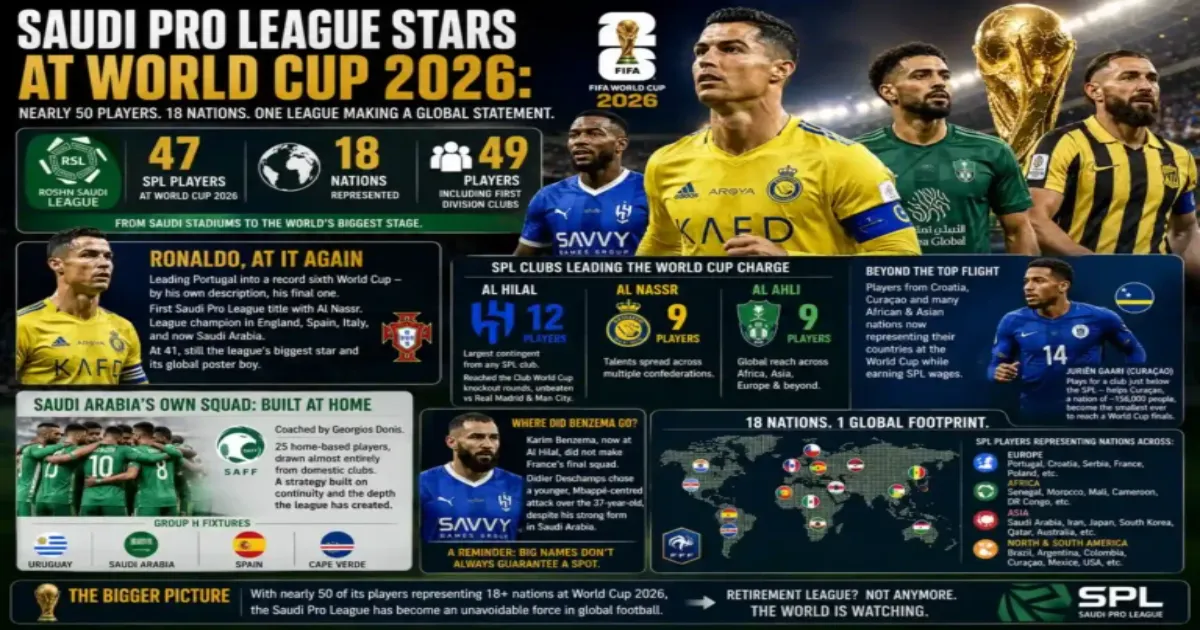 Saudi Pro League stars at World Cup 2026
The Saudi Pro League’s presence at the 2026 FIFA World Cup was one of the clearest indicators yet that Saudi football has moved beyond the novelty phase of its global expansion.
When the final squads were announced, 47 players from the Saudi Pro League were selected for the World Cup. Two more players from the Saudi First Division took the total number of players representing Saudi-based clubs to 49.
That made the Saudi Pro League the sixth-most represented domestic league at the tournament, behind the Premier League, Bundesliga, La Liga, Ligue 1 and Serie A. The figure was also up from 35 SPL players at the 2022 World Cup.2034 FIFA World Cup: Saudi Arabia’s Hosting, Explained
But the most important part of the number is not simply that there were 47 players.
It is who those players were, which countries they represented, and how many of them actually contributed during the tournament.
Cristiano Ronaldo led Portugal at his sixth and final World Cup. Riyad Mahrez captained Algeria before announcing his international retirement. Sadio Mané returned to the global stage with Senegal. Riyad Mahrez, João Félix, Yassine Bounou, Kalidou Koulibaly, Franck Kessié, Ivan Toney and other established international names gave the league a presence stretching across Europe, Africa, South America and Asia.Premier League vs MLS vs Saudi Pro League vs ISL 2026: Full Comparison of Fans, Tickets & Streaming
The Saudi Pro League was no longer merely sending famous players to a World Cup.
It was becoming part of the World Cup’s player-development and international ecosystem.
The Number That Changed the Conversation
The raw figure is difficult to ignore.
47 Saudi Pro League players were selected for the 2026 World Cup.
Two additional players from the Saudi First Division brought the number of World Cup players based in Saudi Arabia to 49. Of those 49, 25 represented Saudi Arabia, while the other 24 represented 15 different national teams.
That distinction matters.
The league’s international footprint cannot be measured simply by counting foreign superstars.
Almost half of the Saudi-based World Cup contingent consisted of players representing countries other than Saudi Arabia.
That means the SPL is becoming a genuine meeting point for international football.
Players arrive from different football cultures, compete together throughout the domestic season, and then return to national teams that may have completely different tactical identities.
That is much closer to the structure of an established global league than the “retirement league” description that followed the competition during the first wave of Saudi investment.
Al Hilal Led the Club-Level World Cup Representation
At club level, Al Hilal had 12 players at the 2026 World Cup, according to FIFA’s squad statistics. That placed the Riyadh club among the most heavily represented clubs in the entire tournament.
That is an extraordinary figure for an Asian club.
It also tells us something about the scale of Al Hilal’s recruitment.
The club’s World Cup contingent included players from multiple continents and national teams, including Yassine Bounou with Morocco, Kalidou Koulibaly with Senegal, Rúben Neves and João Cancelo with Portugal, and Theo Hernández with France. Al Hilal itself highlighted five of those players as advancing to the Round of 32.
This is important because Al Hilal’s model increasingly resembles that of major European clubs.
The club is not simply collecting one or two famous names.
It is building a squad capable of supplying players to elite international teams across several confederations.
That is a much more sustainable form of global influence.
Al Nassr’s Nine-Player World Cup Contingent
Al Nassr also had nine players represented at the World Cup.
FIFA’s list included Cristiano Ronaldo and João Félix for Portugal, Sadio Mané for Senegal, and six Saudi Arabia internationals: Nawaf Al Aqidi, Abdulelah Al Amri, Ayman Yahya, Nawaf Boushal, Abdullah Al Khaibari and Abdullah Al-Hamdan.
That combination is particularly revealing.
Al Nassr’s World Cup presence was not simply built around Ronaldo.
It included a mixture of global stars, established internationals and Saudi players.
That is precisely the type of squad structure the Saudi Pro League needs if its long-term ambition is to become a serious football ecosystem rather than a destination for high-profile transfers.
Cristiano Ronaldo: The Face of the Saudi Project
No player better symbolised the transformation than Cristiano Ronaldo.
When Ronaldo moved to Al Nassr in late 2022, his arrival was widely interpreted as the beginning of the Saudi Pro League’s extraordinary international recruitment drive.
Three and a half years later, the picture looks very different.
Ronaldo arrived at the 2026 World Cup as Portugal’s captain, playing in a record sixth World Cup at the age of 41. FIFA had already confirmed that he entered the tournament with 226 international appearances and 143 goals, both Portugal records.
He then made history again.
Ronaldo scored at his sixth World Cup, becoming the first player to score in six different editions of the tournament. He finished the tournament with three goals, including his first-ever World Cup knockout-stage goal against Croatia. Portugal ultimately lost 1–0 to Spain in the Round of 16.
There was also a significant domestic achievement before the World Cup.
Ronaldo finally won the Saudi Pro League title with Al Nassr, scoring twice in the decisive 4–1 victory over Damac on the final matchday. Al Nassr finished two points ahead of Al Hilal.
So the Ronaldo story is no longer simply about attracting attention to Saudi Arabia.
He became a Saudi league champion and then went to a sixth World Cup and scored three goals.
That is a considerably more substantial football narrative.
Riyad Mahrez’s World Cup Farewell
Riyad Mahrez provided another important example of the league’s growing international relevance.
The Al Ahli winger captained Algeria at the 2026 World Cup.
Algeria reached the Round of 32 before losing 2–0 to Switzerland.
The match then became the end of an era.
Mahrez announced his retirement from international football after the defeat, ending an Algeria career that included 119 appearances and 40 goals. He leaves international football as one of the most decorated players in Algerian history, having also played a major role in the country’s 2019 Africa Cup of Nations triumph.
His final World Cup therefore carried significance beyond the tournament itself.
Mahrez was not simply an SPL player representing his country.
He was a former Premier League champion, Champions League winner and African champion closing the international chapter of his career while playing for a Saudi club.
That would have been almost unimaginable in the traditional football hierarchy a decade ago.
Sadio Mané Returns to the World Cup
Al Nassr forward Sadio Mané also gave the Saudi Pro League an important international presence.
The Senegalese star missed the 2022 World Cup because of injury, making his return in 2026 particularly significant.
FIFA described Mané as one of Senegal’s key veterans when the squad was announced, alongside Kalidou Koulibaly and Edouard Mendy.
For the Saudi Pro League, players such as Mané are important because they challenge the assumption that its biggest names are simply players finishing their careers.
Mané entered Saudi football after already winning the Premier League, Champions League and Africa Cup of Nations.
His international career was already established.
Saudi Arabia became another chapter rather than the final destination.
The League’s Influence Extended Beyond the Famous Names
This is arguably the most important development.
Ronaldo, Mahrez and Mané attract headlines.
But they are not the strongest evidence of structural growth.
The more significant story is that dozens of less famous players from Saudi clubs also appeared on World Cup squads.
FIFA’s club representation data shows Al Ahli had nine World Cup players, including Riyad Mahrez, Roger Ibañez, Franck Kessié, Ivan Toney, Edouard Mendy and three Saudi internationals.
That is a remarkably diverse group.
Brazil.
Algeria.
Côte d’Ivoire.
England.
Senegal.
Türkiye.
Saudi Arabia.
This is what a global league looks like.
It is not one nationality or one generation.
It is a network.
Saudi Arabia’s Own World Cup Story Was Less Successful
There is an important distinction between the SPL’s global rise and the performance of the Saudi national team.
Saudi Arabia’s 2026 World Cup campaign was disappointing.
The Green Falcons opened with a 1–1 draw against Uruguay, lost 4–0 to Spain, and then drew 0–0 with Cape Verde.
They finished last in Group H with two points and were eliminated at the group stage. FIFA confirmed that Saudi Arabia’s final position in the group was fourth.
That is significant because the Saudi football project ultimately has to produce more than commercial visibility.
The domestic league can attract elite players.
It can build better training facilities.
It can increase international attention.
But eventually the national team has to convert that investment into competitive results.
The 2026 World Cup showed that this part of the project remains unfinished.
A Mostly Home-Based Saudi National Team
Saudi Arabia’s national team also demonstrated how deeply the domestic league is connected to the national setup.
When Georgios Donis announced his final 26-man World Cup squad, FIFA described the selection as primarily domestic-based.
Only defender Saud Abdulhamid was playing outside Saudi Arabia, with Lens in France.
The Saudi Pro League therefore supplies not only the international stars representing foreign countries, but almost the entire domestic national team.
That creates an unusual football ecosystem.
The same clubs that employ international superstars also develop and employ many of the players competing for Saudi Arabia.
The question now is whether that proximity eventually produces a stronger national team.
And Then There Is Karim Benzema
The presence of Karim Benzema in Saudi Arabia also illustrates the limits of the league’s growing influence.
Benzema, now at Al Hilal, did not make France’s 2026 World Cup squad.
That matters.
A player can dominate a domestic league and still fail to make a major national team.
International managers do not select players based solely on club reputation or salary.
They select according to tactical requirements, form, age, squad balance and competition for positions.
Benzema’s omission therefore provides a useful counterpoint to the Ronaldo narrative.
The Saudi Pro League can provide the platform.
It cannot guarantee international selection.
From Retirement League to Global Football Hub?
The phrase “retirement league” has been difficult to completely eliminate because Saudi clubs did initially make headlines by signing older global stars.
But the 2026 World Cup makes that description increasingly inadequate.
A retirement league does not normally send 47 players from its top division to a World Cup.
It does not have clubs with nine or 12 World Cup representatives.
It does not supply players to Portugal, Brazil, France, England, Senegal, Algeria, Côte d’Ivoire, Morocco and other international teams.
And it does not become the sixth-most represented league at the world’s biggest football tournament.
That does not automatically make the SPL a top-five league in sporting quality.
That debate requires deeper analysis involving match intensity, tactical quality, academy development, continental performance, squad depth and financial sustainability.
But the World Cup has established something else beyond reasonable dispute:
Saudi football now has global reach.
The Next Challenge: Turning Money Into Football Infrastructure
The next phase of the Saudi Pro League project may be more difficult than the first.
Signing globally famous players is relatively straightforward when financial resources are available.
Building a league that continues producing international players after those stars leave is much harder.
That means investment in:
- Youth academies
- Coaching education
- Sports science
- Scouting networks
- Women’s football
- Stadium infrastructure
- Grassroots participation
- Competitive domestic scheduling
- AFC-level performance
The World Cup numbers show that the foundation is developing.
The next question is whether that foundation becomes self-sustaining.
The 2026 World Cup Was a Progress Report
The Saudi Pro League did not win the World Cup.
No Saudi club reached the final because clubs do not participate in the tournament.
Saudi Arabia itself did not advance from the group stage.
But those facts should not obscure the broader significance of what happened.
Forty-seven SPL players were selected for the tournament.
Forty-nine World Cup players were based in Saudi Arabia when the First Division contingent was included.
Al Hilal had 12 players in World Cup squads.
Al Nassr and Al Ahli had nine each.
Ronaldo scored three goals in his sixth World Cup.
Mahrez played his final tournament and then retired internationally.
Mané returned to the World Cup.
Bounou, Koulibaly, Kessié, Toney, João Félix and numerous others represented their countries while employed by Saudi clubs.
That is not a marketing campaign.
It is a measurable presence.
What the Saudi Pro League’s World Cup Footprint Really Tells Us
The most important change is psychological.
Saudi football no longer needs to prove that it can attract famous players.
It has already done that.
The question has shifted.
Can it become a league that famous players want to join because the football itself is increasingly compelling?
The 2026 World Cup suggests the answer is moving in that direction.
The league had 47 players selected for the finals, compared with 35 four years earlier. Its clubs were among the world’s most heavily represented at the tournament. Its players came from multiple continents. And its most famous recruit, Cristiano Ronaldo, entered the competition as a Saudi league champion and left it having scored at a record sixth World Cup.
There is still a huge distance between the SPL and Europe’s established elite leagues.
That should not be ignored.
But the old argument that Saudi football is merely importing stars for publicity is becoming increasingly difficult to sustain.
The 2026 World Cup offered something much more concrete.
It showed a league whose players were woven into the squads of nations from around the world.
And that may ultimately be the clearest sign of the Saudi Pro League’s rise:
Saudi football is no longer just trying to get the world’s attention. Its players are now part of the world’s biggest football event.
The next challenge is making sure that presence becomes lasting sporting credibility.
About the Author



1 thought on “Saudi Pro League Stars at World Cup 2026: Ronaldo and SPL’s Global Impact”