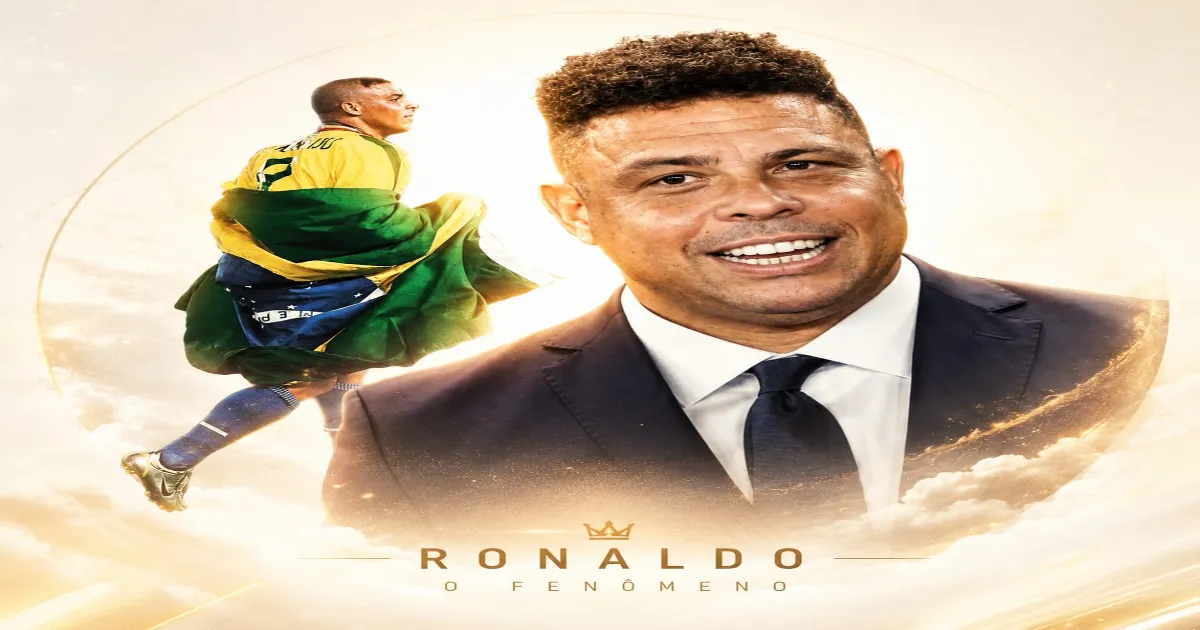
No career in football history combines the heights he reached with the depths he survived. To understand Ronaldo Nazario is to understand what the game can demand of a human body — and what genius looks like when it refuses to be extinguished.
There are two ways to tell the Ronaldo Nazario career story. The first is the triumphant version: two World Cup titles, three FIFA World Player of the Year awards, the most important goals in the history of two separate World Cup finals, and a body of work at club level that makes the statistical argument for him being the most complete striker the game has ever produced. The second is the version people forget too quickly: the years on operating tables, the misdiagnoses, the weight gain that became tabloid fodder, the loneliness of watching a World Cup from a hospital while everyone else played, and the extraordinary, almost incomprehensible act of will that brought him back each time.
Pelé’s Age in 2026: His Story, Legacy, and Lasting Records
Diego Maradona: The Rise, the Ruin and the Religion He Became
More Than a Footballer: How David Beckham Built a Global Brand That Will Outlast His Career
To tell only the first version is to misunderstand the man. To tell only the second is to undermine what he actually achieved. The Ronaldo Nazario career is not one story. It is several, stitched together by a talent so overwhelming that even partial versions of it were more than most defenders could handle.
Belo Horizonte: Where It Began
Ronaldo Luís Nazário de Lima was born on September 18, 1976, in Bento Ribeiro, a neighbourhood in the North Zone of Rio de Janeiro. The family was poor by any reasonable standard — his father Nélio worked various jobs, his mother Sônia raised three children in a cramped house — and the route out, as it was for tens of thousands of Brazilian children of that generation, was football.
He started playing futsal on the street, which is the Brazilian football education that scouts and coaches from other countries consistently underestimate. Futsal develops exactly the attributes that made Ronaldo so dangerous later: rapid decision-making in tight spaces, first-touch certainty, change-of-direction speed, the ability to read movement when the ball arrives at your feet from unexpected angles. He did not develop his touch on grass training pitches. He developed it on concrete, under pressure, with almost no room to move.
By the time he was fourteen, he was playing youth football with Social Ramos. At fifteen, he was spotted by Jairzinho — the legendary Brazil winger from the 1970 World Cup squad — and recommended to Cruzeiro. He joined Cruzeiro in 1993 and, at sixteen, made his professional debut. He scored 44 goals in 47 appearances at the club. At seventeen.
This was not normal. It is, in retrospect, one of the clearest early signals in football history that something categorically different was happening.
The 1994 World Cup: The Spectator Who Would Return
Ronaldo was included in Brazil’s 1994 World Cup squad in the United States at the age of seventeen. He did not play a minute of tournament football. The squad, managed by Carlos Alberto Parreira, was built around a solid defensive framework anchored by Aldair and Marcio Santos, and the attack was led by Romário and Bebeto — one of the most celebrated striking partnerships in World Cup history.
Ronaldo watched, trained, and waited. He was officially a World Cup winner at seventeen having never kicked a ball in the competition. The title was real, but the experience taught him something more important than any medal could: how far he still had to go, and what the very top of world football looked like up close.
Brazil won the tournament on penalties against Italy. Ronaldo returned to club football and continued developing.
Barcelona: The World Watches
After a brief spell at PSV Eindhoven, where he scored 54 goals in 58 games and made European football sit up very sharply indeed, Ronaldo joined FC Barcelona in 1996 for a then-world-record fee. He was nineteen. He had never played a full season in one of Europe’s top five leagues.
What followed was one of the most breathtaking single seasons any footballer has ever produced. Ronaldo scored 47 goals in all competitions in 1996-97. He won the Copa del Rey, the UEFA Cup Winners’ Cup, and the Copa América with Brazil that same summer. He was named FIFA World Player of the Year. He was nineteen, and he had just completed what many analysts still consider the most statistically dominant individual season in football’s modern era.
But more than the numbers, it was the manner. Ronaldo at Barcelona was a player who did things that had no name yet. He would receive the ball with his back to goal, spin faster than the defender could react, accelerate to a speed that created a yard of space where there had been none, and finish with a precision that left goalkeepers stationary. He was not doing one thing very well. He was doing three things simultaneously — things that typically belonged to different kinds of players — and doing all of them at a pace nobody had seen before.
Johan Cruyff, watching from the outside after his own departure from the club, said he had never seen a forward with Ronaldo’s combination of speed, balance, and finishing instinct. That is not a compliment that Cruyff distributed lightly.
Thiago Messi: Club Career, Playing Style, Lifestyle and Future Prospects
Cristiano Ronaldo Jr.: Club, Lifestyle, Career and Future Prospects
Inter Milan and the Height of Everything
The summer of 1997 brought the transfer to Inter Milan for a world-record fee. And then, in the 1997-98 season, something that no statistic can adequately convey: Ronaldo simply played the best football any centre-forward had ever played in the history of Serie A.
He scored 25 league goals. He created as many again. He pulled defenders out of position just by standing still, because they were so frightened of what he would do if he ran. He won his second FIFA World Player of the Year award. He won the UEFA Cup with Inter. He was, at twenty-one, the best footballer on the planet by a margin that felt almost indecent.
And then France 1998 arrived.
The 1998 World Cup and the Seizure That Changed Everything
The Ronaldo Nazario career contains many turning points. This is the one that no amount of football analysis can fully explain, because it falls outside football entirely.
On the evening of the 1998 World Cup final in Paris, against France, Ronaldo suffered what has been variously described as a convulsive episode, a seizure, or a fit — the precise medical terminology has been disputed for decades. He was taken to hospital, returned to the Stade de France, and played. He was visibly not himself. Brazil lost 3-0 to a Zidane-inspired France side.
The conspiracy theories ran for years. What actually happened in that hotel room? Why was his name removed from and then reinstated on the team sheet? Why did he play? Why did Brazil lose so heavily in a final they had been favoured to win?
Some things are known: Ronaldo had been under enormous psychological pressure throughout the tournament. He was the focal point of everything — the expectations of an entire nation, the commercial demands of Nike (who held a controversial kit deal with the Brazilian Football Confederation), and the scrutiny of global media. He was twenty-one. He was carrying it all.
What the 1998 final cost him psychologically is not something he has ever fully quantified in public. What it cost Brazil is obvious. What it cost the tournament — what the world was deprived of seeing in Ronaldo at his absolute peak in a World Cup final — is something that football will always grieve quietly.
The First Knee: 1999
In November 1999, during a Serie A match for Inter Milan, Ronaldo ruptured a tendon in his right knee. He was out for seven months. He returned in April 2000, played six minutes in a Copa Italia match against Lazio, and suffered a further serious injury — this time involving ruptures to both tendons of the patellar tendon — that would keep him out of football for almost two years.
The rehabilitation was gruelling. Ronaldo was twenty-three. He had been the best player in the world. He was now learning to walk without pain, learning to trust his knee with his body weight, learning to sprint again from first principles. The medical team at Inter worked with him throughout. He worked with quiet, relentless determination.
He returned to football in 2002. The Ronaldo Nazario career had, to many observers, effectively ended. They were wrong.
Japan-Korea 2002: The Greatest World Cup Story
What Ronaldo did at the 2002 World Cup in Japan and South Korea — having not played competitive football for twenty-three months before his return — is, in the considered view of this analyst, the single greatest individual performance in World Cup history.
He scored eight goals in the tournament. He won the Golden Boot. He scored twice in the final against Germany — both goals demonstrating the full range of his talent at its highest level: the first a composed finish after a precise pass from Rivaldo; the second a powerful drive struck with his left foot from the edge of the area, placed perfectly beyond Oliver Kahn.
The second goal, in particular, was telling. This was the same left foot that had been reconstructed, the same knee that doctors had warned him might never perform at this level, and he struck it with complete technical certainty against a World Cup goalkeeper who had been virtually unbeatable throughout the tournament.
Brazil won 2-0. Ronaldo finished the tournament as its defining player. He won his third FIFA World Player of the Year award. He did the haircut. The world watched.
It remains, twenty-three years later, one of the most emotionally resonant individual performances in the history of team sports. The man who was told he might not play again became the player who defined the biggest tournament in the world.
Real Madrid: The Last Great Chapter
Ronaldo’s transfer to Real Madrid in 2002, joining the Galácticos alongside Zidane, Figo, Roberto Carlos, and Raúl, gave the Ronaldo Nazario career its final elite club chapter. His four seasons at the Bernabéu produced 104 goals in 177 appearances — an extraordinary return for a striker operating in a team constructed around multiple attacking superstars.
He won La Liga in 2002-03. He scored some of the most celebrated goals in Champions League history, including a famous hat-trick against Manchester United at Old Trafford in 2003 that drew a standing ovation from a home crowd who had no tactical reason to applaud an opposition forward.Gone Too Soon: Every Team Eliminated from FIFA World Cup 2026 and the Stories Behind Their Exits
But the knees were deteriorating. His weight fluctuated. His match sharpness came and went. The version of Ronaldo that visited Manchester was still devastating. The version that struggled to hold his place in the starting line-up by 2006 was a painful reminder of what injuries do, over time, to even the most gifted bodies.
He left for AC Milan in 2007 and then moved to Corinthians in Brazil — a homecoming that was warmly received, less consistent on the pitch, and eventually ended when his body told him, definitively, that the chapter was over.
The Retirement and the Legacy
Ronaldo Nazario retired from professional football in February 2011, at the age of thirty-four, citing a thyroid condition that had contributed to his weight problems in the final years of his career. The announcement was characteristically direct. He was done. He knew it. He said so.
Since retirement, his involvement in football has continued as an owner and investor. He purchased a stake in Real Valladolid, helping stabilise the Spanish club. He subsequently acquired a controlling stake in Cruzeiro — the club where his professional career had begun in 1993, and where he returned as a chairman rather than a player. The symmetry was not lost on him.
His broader cultural presence remains enormous. The 2003 Manchester United night gets replayed regularly on highlight channels and generates the same reaction every time: disbelief, followed by something approaching reverence. Younger players — including Ronaldo Cristiano, who has spoken about being directly inspired by Nazario’s style — cite him as the direct blueprint for the modern complete striker.
Where He Stands Among the Greats
The Ronaldo Nazario career statistics — 352 goals at club level, 62 goals in 98 international appearances for Brazil, two World Cup titles, three World Player of the Year awards — are remarkable. But statistics, as ever in his story, miss the most important thing.
He played, at his best, a kind of football that nobody else has played before or since. Not a variation on what others did. Something genuinely new — a striker who could beat a goalkeeper before reaching the penalty area because the goalkeeper knew, and the defender knew, and the crowd knew, that what was coming was physically unstoppable. He imposed psychological defeat before inflicting the actual goal.
And he did it while carrying an injury burden that would have ended most careers twice over. He did it while managing the commercial pressures of being the most marketed footballer on the planet for a significant period of the late 1990s. He did it while wearing the weight of Brazilian national expectation on a body that was, in the cruellest stretch of his career, genuinely broken.
Two World Cups. Three world player awards. One of the great comebacks in sporting history. And a decade of football, at its peak, that nobody who watched it has managed to describe adequately in the years since.
That is the Ronaldo Nazario career. That is what a phenomenon looks like.
The 2014 World Cup in Brazil: A Tournament of Extremes and Unforgettable Moments
Brazil’s World Cup 2026 Ends in Heartbreak: What Comes Next for Neymar?
▪️▪️ Follow us on Facebook ▪️▪️
About the Author

1 thought on “Ronaldo Nazário: Why El Fenómeno Still Has the Greatest Career in Football History”