Japan’s World Cup 2026 Performance: Group Stage Heroics, a Brazil Heartbreak, and What Comes Next
StrikerReport.com | Tactical Analysis | FIFA World Cup 2026 | Published: June 30, 2026
There is a particular kind of elimination that hurts more than most. Not the chastening defeat that confirms a gap in quality everyone already suspected. Not the group-stage exit that closes a campaign before it properly begins. The kind that hurts most is the one where a team does almost everything right, leads for an hour against the most decorated nation in the sport’s history, and still goes home.
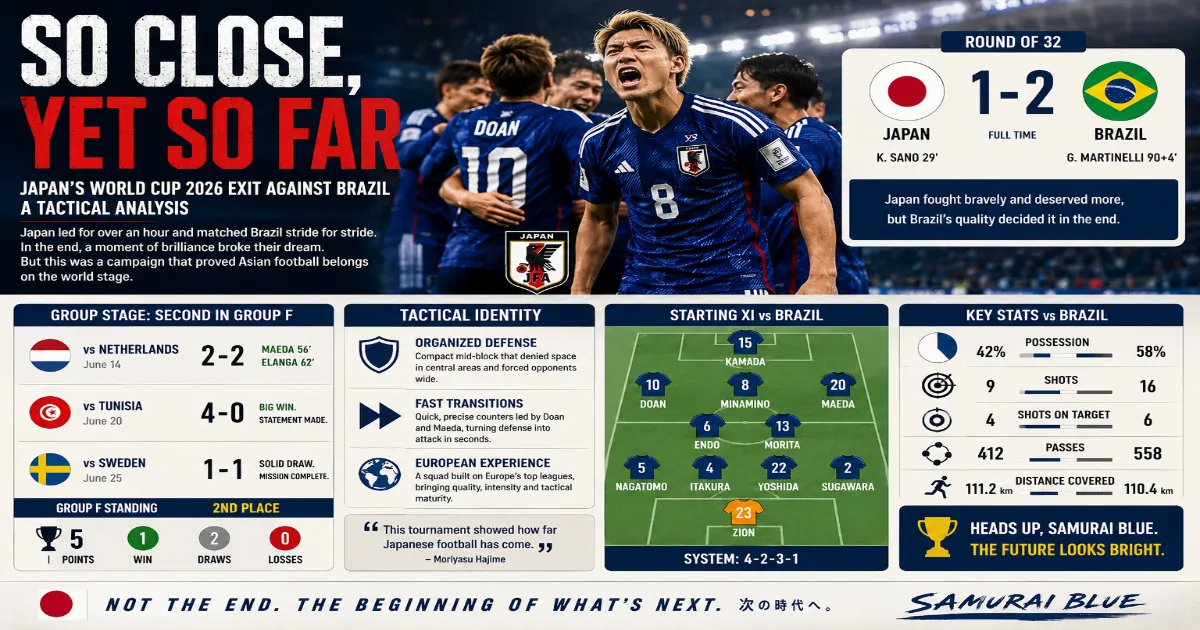
That is the Japan World Cup 2026 performance, in its final accounting. A 2-1 defeat to Brazil in the Round of 32, decided by a Gabriel Martinelli strike deep into stoppage time, after Kaishu Sano’s 29th-minute opener had given the Samurai Blue a lead they held for the better part of an hour. Japan did not lose this World Cup through inadequacy. They lost it through the brutal arithmetic of facing a five-time champion who needed only one moment of individual quality to erase an hour of disciplined, intelligent resistance.
This is the tactical analysis of how Japan got to that point — and why their World Cup 2026 campaign deserves to be remembered as one of genuine progress, not just one more chapter in the nearly-but-not-quite story of Asian football at the highest level.
The Group Stage: Survival Through Identity
Japan were drawn into Group F alongside the Netherlands, Sweden, and Tunisia — a section that, on paper, offered one clearly superior side, one continental contender, and one team Japan would be expected to beat. The reality played out with more nuance than that framework suggested.
Netherlands 2-2 Japan (June 14)
The opening match set the tone for Japan’s entire tournament: organised, courageous, occasionally thrilling, and ultimately denied the full reward their performance merited. Daizen Maeda gave Japan the lead in the 56th minute with a low finish after Ritsu Doan’s incisive run into the penalty area — a goal built on exactly the kind of quick combination play and intelligent movement that has characterised Japanese football’s evolution over the past decade. Anthony Elanga’s equaliser six minutes later restored parity, and the match finished honours even.
A draw with one of the tournament’s most fancied European sides was, by any reasonable measure, an excellent result. It also established the template Japan would follow throughout the group stage: defend in a coherent mid-block, transition with pace and precision through Doan and Maeda, and accept that the margins against superior opposition would be desperately fine.
Japan 4-0 Tunisia (June 20)
The match where Japan’s attacking quality found its fullest expression. Four goals against a Tunisian side already suffering significant internal turmoil — their head coach was relieved of his duties following the defeat — demonstrated that when the spaces opened, Japan possessed the technical sophistication and collective movement to punish them ruthlessly. This was not backs-against-the-wall Japan. This was a team capable of dominating a match from a position of control.
Japan 1-1 Sweden (June 25)
A draw in the final group match that, combined with the Netherlands’ simultaneous victory over Tunisia, confirmed Japan’s progression as Group F runners-up. The performance itself was more cautious than the Tunisia demolition — a team managing a result it knew would be sufficient, rather than chasing an outcome it desperately needed.
Final Group F Standing: Japan finished second with five points from one win and two draws, an entirely respectable return that sent them into the Round of 32 against Brazil — a draw that, while daunting on paper, also represented precisely the kind of high-profile occasion that could define a generation of Japanese players.
Tactical Identity: What Made This Japan Side Different
To understand the Japan World Cup 2026 performance properly, it is necessary to understand the specific tactical evolution this squad represented compared to previous Japanese World Cup campaigns.
The Pressing Structure
Japan’s defensive approach was built around a coordinated mid-block press that activated specifically when opponents attempted to play through the central thirds of the pitch. Rather than pressing high and risking the spaces in behind that better-resourced opponents could exploit with pace, Japan’s structure invited opponents into areas where their numerical and positional organisation could overwhelm individual quality.
This is sophisticated, modern defensive football — the kind of approach that requires extensive coaching time and total buy-in from every player on the pitch. Against the Netherlands specifically, this structure limited clear-cut chances despite facing a technically superior opponent, conceding primarily through individual moments of quality rather than systemic defensive breakdown.
The Transition Game
Where Japan’s evolution was most visible was in their transition play — the speed and precision with which they moved from defensive shape into attacking opportunity once possession was won. Doan and Maeda, both operating in wide forward roles with licence to cut inside, provided the technical quality to exploit transitional moments with genuine end product rather than simply territorial relief.
The goal against the Netherlands exemplified this perfectly: a swift combination between Doan and Maeda that exploited exactly the kind of momentary defensive disorganisation that transition-focused football is designed to create.
Squad Profile: European Pedigree Throughout
What separated this Japan squad from earlier generations was the sheer depth of European top-flight experience across the entire XI. This was not a team built around two or three exceptional individuals surrounded by domestic-league players adjusting to the gulf in quality. This was a squad where the majority of starters competed weekly in Europe’s major leagues, bringing tactical sophistication and physical conditioning that matched, rather than merely aspired to, their opponents.
The Brazil Match: Anatomy of a Heartbreaking Defeat
First Half: Japan’s Finest 45 Minutes of the Tournament
Kaishu Sano’s 29th-minute goal — Japan’s opener against the five-time world champions — was the product of exactly the patient, well-organised approach that had carried them through the group stage. Japan absorbed Brazil’s early pressure, found their moments in transition, and capitalised when the opportunity presented itself.
For 29 minutes and then for the remainder of the first half, Japan controlled the tactical narrative of the match against a Brazilian side many had installed as tournament favourites. The discipline required to maintain defensive shape against Vinícius Júnior, Raphinha, and Brazil’s broader attacking quality while still posing a credible threat themselves represented the tactical high point of Japan’s entire campaign.
Second Half: The Wall Begins to Crack
Casemiro’s equaliser shortly after half-time changed the tactical calculus entirely. Suddenly Japan, who had spent 45 minutes defending a one-goal advantage with patience and control, found themselves needing to manage a level contest against opponents with the squad depth and individual quality to escalate the pressure as the match progressed.
The introduction of fresh legs and attacking reinforcements from Brazil’s bench in the match’s closing stages — precisely the kind of squad depth advantage that separates traditional powers from emerging football nations — gradually shifted territorial and chance-creation patterns in Brazil’s favour.
Stoppage Time: The Moment That Defined the Margin
Gabriel Martinelli’s stoppage-time winner arrived in exactly the circumstances that decide matches between unequal resource bases: a moment of individual quality, in the match’s dying embers, when legs were heaviest and concentration was most vulnerable to lapse. Japan’s defensive structure, magnificent for 90-plus minutes, finally yielded to a combination of fatigue and Brazilian quality.Brazil vs Japan Match Report: Martinelli’s 95th-Minute Winner Breaks Japanese Hearts
Final Score: Brazil 2-1 Japan
What This Tournament Tells Us About Japanese Football’s Trajectory
The temptation after any narrow elimination is to focus exclusively on the margin — the single goal, the specific moment, the what-might-have-been. That temptation should be resisted here.
Japan’s World Cup 2026 performance represents continuity with, and progression from, their increasingly credible recent tournament history. A draw with the Netherlands. A statement victory over Tunisia. A controlled point against Sweden. A first-half lead and 75 minutes of genuine competitiveness against Brazil, the most decorated nation in World Cup history.
The squad’s defining characteristic — depth of players competing weekly at Europe’s elite level — is not a temporary phenomenon but a structural shift in how Japanese football develops and exports talent. That trend shows no sign of reversing. The technical and tactical sophistication on display throughout this tournament, particularly in the pressing structure and transitional attacking play, reflects coaching investment that will continue to produce results in future cycles.
For a football nation that has historically been characterised by competent organisation without the individual quality to consistently trouble the world’s elite, a first-half lead against Brazil — surrendered only to a stoppage-time moment of individual brilliance — represents genuine evidence of narrowing margins.
Japan World Cup 2026: Statistical Summary
| Category | Detail |
|---|---|
| Group Stage Result | 2nd in Group F (5 points: 1W 2D 0L) |
| Group Stage Record | Netherlands 2-2 Japan, Japan 4-0 Tunisia, Japan 1-1 Sweden |
| Round of 32 Result | Brazil 2-1 Japan (eliminated) |
| Goals Scored (Tournament) | 6 |
| Goals Conceded (Tournament) | 5 |
| Key Performers | Daizen Maeda, Ritsu Doan, Kaishu Sano |
| Defining Moment | First-half lead vs Brazil before Martinelli’s stoppage-time winner |
The Final Word
Japan’s World Cup 2026 performance ends not with the bitter taste of underachievement but with the more complicated, more promising taste of a margin narrowing in real time. They led Brazil. They matched the Netherlands. They demonstrated, across four matches against varied tactical challenges, a coherent footballing identity capable of competing with genuinely elite opposition for sustained periods.
The Samurai Blue go home from North America having lost their most significant match of the tournament by a single goal, scored in the final moments, by one of the greatest footballing nations in history. There is no shame in that equation. There is, instead, the foundation for the next campaign — and the unmistakable sense that Japanese football’s ceiling continues to rise.
▪️▪️ Follow us on Facebook ▪️▪️
MATCH TIME FOR USA, UK, EUROPE, SAUDI ARABIA, INDIA, SOUTH AFRICA & JAPAN
About the Author