Breaking down the Netherlands World Cup 2026 campaign, the penalty shootout heartbreak against Morocco, and the questions facing Ronald Koeman’s side now
Netherlands World Cup 2026 Journey
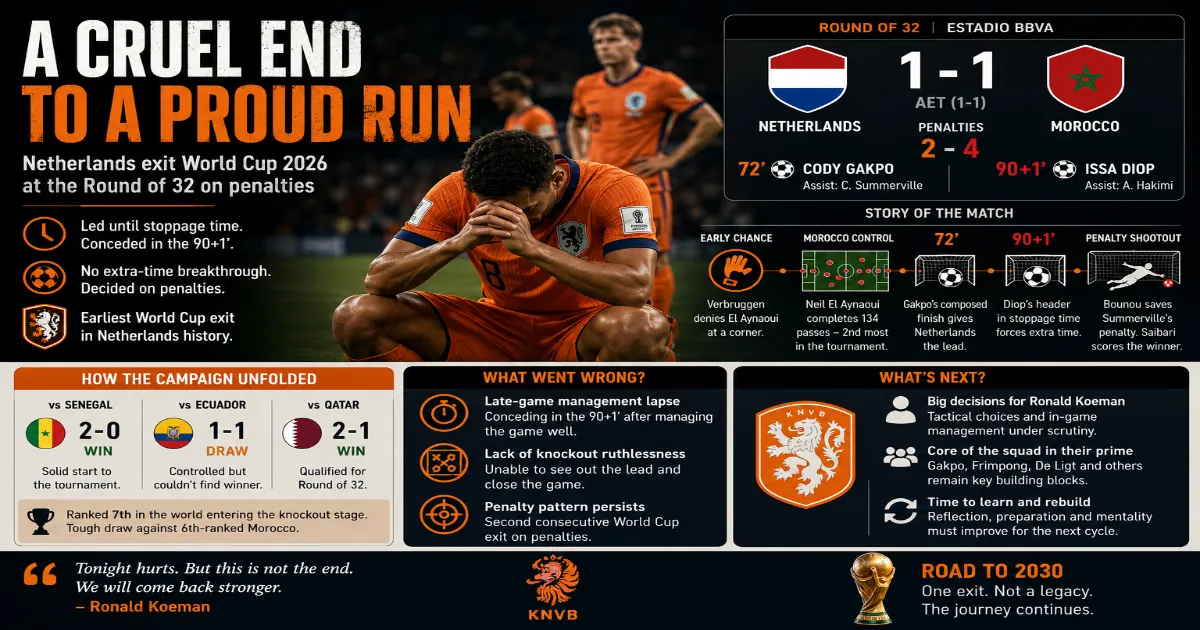
There is no gentle way to describe what happened to the Netherlands at Estadio BBVA. A team that had reached at least the Round of 16 in eleven previous World Cup appearances, including a quarterfinal run just four years ago in Qatar, is going home at the earliest stage in the country’s World Cup history. The Netherlands World Cup 2026 campaign ended not with a tactical collapse or a hammering, but with a 1-1 draw against Morocco that swung agonizingly late and was ultimately settled on penalties. For a footballing nation with this much pedigree, the manner of the exit may sting even more than the result itself.
How the Campaign Actually Unfolded
It’s worth remembering that the Netherlands arrived in the Round of 32 having done little wrong. Ronald Koeman’s side navigated their group stage competently, entering this fixture against Morocco ranked seventh in the world — part of what was, on paper, the toughest possible Round of 32 draw, given Morocco’s own ranking of sixth and their semifinal pedigree from 2022. This wasn’t a case of a major nation stumbling against a side they should have brushed aside. It was a genuinely even contest between two well-matched, well-organized teams, which somehow makes the outcome both more understandable and harder to fully process.
The match itself reflected that competitiveness throughout. Bart Verbruggen was called into action early, producing a sharp reflex save to deny Neil El Aynaoui at a corner, a sign that the Dutch back line would need to be alert all night against a Moroccan side capable of moving the ball quickly through midfield. Morocco’s control of possession in the middle of the park, illustrated by Neil El Aynaoui’s 134 completed passes — the second-highest individual total recorded at this entire World Cup — meant the Netherlands often found themselves working without the ball for long stretches, a pattern that would eventually catch up with them.
The Gakpo Moment That Almost Won It
For a brief, euphoric period, it looked like the Netherlands had found exactly the moment they needed. In the 72nd minute, a Dutch goal-kick was flicked on by substitute Wout Weghorst, releasing Crysencio Summerville down the left. Summerville drew Morocco’s last defender out of position before squaring the ball across for Cody Gakpo, who finished with the composure of a player fully aware of the magnitude of the occasion. Gakpo’s reaction afterward, breaking down in tears as his entire bench rushed onto the pitch to embrace him, carried extra emotional weight given the personal news he and his partner had shared just days before the tournament about expecting their first child. For close to twenty minutes, that goal had the Netherlands on course for the Round of 16.
The Stoppage-Time Gut Punch
What followed is the moment that will define how this Netherlands World Cup 2026 campaign gets remembered. In the first minute of stoppage time, with the Dutch seemingly seconds from securing the win, Issa Diop rose unmarked to head home an equalizer that instantly flipped the entire complexion of the match. It was a gutting concession, the kind that good teams generally avoid by managing those final, high-pressure moments with more composure, and it forced an extra thirty minutes that neither side could meaningfully separate themselves in. From there, the outcome came down to penalties, and the margins simply didn’t fall the Dutch way. With the shootout level at 2-2, Morocco goalkeeper Yassine Bounou produced a strong low save to deny Crysencio Summerville, opening the door for Ismael Saibari to convert the winning kick moments later.
It marks the second consecutive World Cup in which the Netherlands have been eliminated on penalties, a pattern that’s becoming difficult to dismiss as simple bad luck given how frequently it has now repeated itself at the biggest moments.
What Actually Went Wrong
There’s a temptation, after any shootout elimination, to write the result off purely as misfortune — a coin flip that happened to land the wrong way. That framing undersells some real, recurring issues in this Dutch squad that this tournament has now exposed twice in a row. Conceding in the first minute of stoppage time, having appeared comfortably in control of the closing stages, points to a lapse in game management at exactly the moment a side with this much World Cup experience should be at its most disciplined. It’s not the first time in recent years that a Koeman-managed Dutch side has struggled to see out a knockout match once ahead late on, and this result will inevitably reignite questions about whether that’s a tactical issue, a mentality issue, or simply a sign that this current generation hasn’t quite developed the same knockout-game ruthlessness that defined earlier Dutch sides.
There’s also a broader pattern worth acknowledging around penalties specifically. Two consecutive World Cup exits on spot-kicks isn’t purely random variance at this point; it raises legitimate questions about preparation, penalty-taker selection, and the mental approach the squad brings into shootouts, areas that other major footballing nations have invested heavily in addressing after their own past shootout failures.
What Comes Next for Koeman and the Squad
The immediate question facing Dutch football is whether Ronald Koeman remains the right man to lead the rebuild that now inevitably follows an exit this early. Koeman’s contract situation and the federation’s appetite for continuity will likely dominate Dutch football media in the weeks ahead, with this result almost certainly intensifying scrutiny on his tactical setup and his in-game management during precisely the kind of high-pressure moments that defined Monday night’s collapse.
On the playing side, there are clearer reasons for optimism buried inside the disappointment. Cody Gakpo’s performance, and the emotion he showed scoring what should have been a World Cup-winning goal, reinforced his standing as a genuine first-choice attacking option for this team heading forward. Crysencio Summerville’s combination play in the buildup to that goal showed real quality, even if his missed penalty will understandably dominate how Monday night gets remembered around him personally. The broader squad still features players entering, rather than exiting, their prime years, which means this exit, painful as it is, doesn’t necessarily signal the end of a golden generation in the way some past Dutch tournament failures have.
A Tournament Cut Short, Not a Golden Generation Ended
It’s worth resisting the urge to declare this the end of anything permanent for Dutch football. The Netherlands remain one of the deepest talent pools in European football, with players scattered across the continent’s biggest clubs, and a single penalty shootout loss to a genuinely strong Moroccan side doesn’t erase that underlying quality. What it does demand is honest reflection — about late-game management, about penalty preparation, and about whether the current coaching setup is extracting the best version of this group when matches are tightest.
The Netherlands World Cup 2026 story ends earlier than this nation is used to, and earlier than this squad’s talent level probably deserved. But football has a long memory for redemption as much as disappointment, and how this group responds over the next cycle, starting with whatever decisions the Dutch federation makes about its coaching staff in the coming weeks, will determine whether this exit becomes a turning point or simply another frustrating footnote in a country with no shortage of either.
▪️▪️ Follow us on Facebook ▪️▪️
About the Author


1 thought on “Netherlands World Cup 2026: A Painful Early Exit, and What Comes Next”