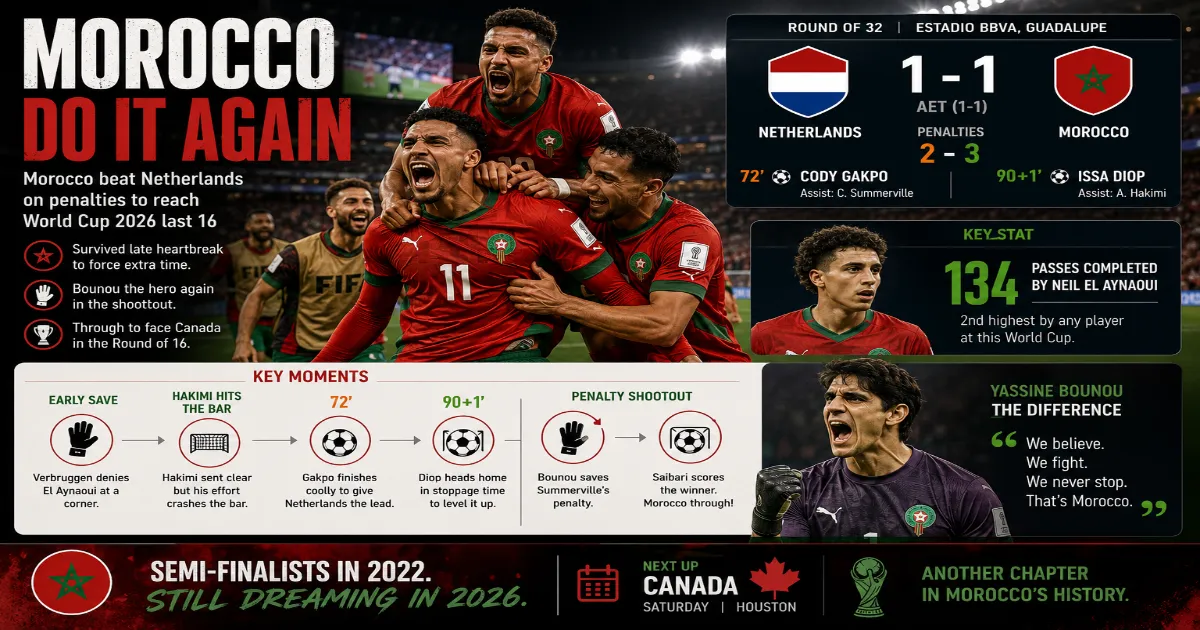
 Morocco Beat Netherlands on Penalties to Reach the World Cup 2026 Last 16
Yassine Bounou and Ismael Saibari deliver under pressure as Morocco survive a dramatic 1-1 draw with the Netherlands to advance after penalties.
Morocco have done it again.
Four years after their historic run to the World Cup 2022 semifinals, the Atlas Lions have once again shown that they belong among international football’s most difficult knockout opponents. At Estadio BBVA in Guadalupe, Morocco survived a tense 1-1 draw with the Netherlands before winning 3-2 on penalties to book their place in the World Cup 2026 Round of 16.
The match had almost everything a knockout game demands: defensive discipline, missed opportunities, a late equalizer, extra-time tension and a goalkeeper producing a decisive moment when everything was on the line.
For long stretches, the Netherlands appeared capable of controlling the contest. But Morocco refused to disappear. When the pressure reached its highest point, Yassine Bounou produced the save that changed everything, before Ismael Saibari calmly converted the penalty that sent Morocco through.
It was another reminder that this Moroccan generation has developed something beyond talent: belief under pressure.
Achraf Hakimi FIFA World Cup 2026: Profile, Stats & Career | StrikerReport
The Fastest NBA Players Ever, Ranked
Morocco and Netherlands Begin With Caution
The opening half reflected the quality and importance of the occasion.
With Morocco and the Netherlands ranked sixth and seventh in the world respectively, this was one of the most evenly matched fixtures of the Round of 32. Neither side wanted to make the first major mistake, and that caution shaped the opening stages.
Possession moved between the two teams without either being able to establish complete control. Morocco attempted to use Achraf Hakimi’s attacking threat and their midfield passing, while the Netherlands looked to create openings through their wide players and quick combinations.
Clear chances were difficult to find.
Bart Verbruggen was eventually called into action when Morocco created danger from a set piece. A flicked header from Neil El Aynaoui appeared to be heading toward the target, but Verbruggen reacted quickly to make the save.
Morocco’s goalkeeper was equally important.
At the other end, Yassine Bounou showed his experience when he tipped a powerful effort from Micky van de Ven over the crossbar.
The score remained 0-0 at halftime, but neither goalkeeper could afford to relax.
Hakimi Comes Close to Breaking the Deadlock
Morocco gradually began to look more dangerous after the interval.
The Atlas Lions pushed their full-backs higher and began finding more space between the Dutch defensive and midfield lines. Their pressure eventually created what could have been the defining moment of the match.
Achraf Hakimi was played through behind the Dutch defence and suddenly found himself with a clear opportunity.
The Morocco captain struck the ball with conviction, but the effort crashed against the crossbar.
It was agonisingly close.
Had Hakimi’s shot gone in, Morocco would likely have taken complete control of the contest. Instead, the Netherlands survived and soon found a way to punish their opponents.
That missed opportunity became even more significant when the Dutch eventually opened the scoring.
Cody Gakpo Gives the Netherlands the Lead
The Netherlands took advantage of a transition in the 72nd minute.
A Dutch goal-kick reached substitute Wout Weghorst, whose flicked header released Crysencio Summerville into space down the left.
Summerville carried the ball forward before drawing the final defender toward him.
His decision was excellent.
Rather than attempting to finish himself, he squared the ball into the path of Cody Gakpo, who remained composed and finished the move.
The Netherlands were ahead 1-0.
Gakpo’s celebration carried considerable emotion. The Liverpool forward was immediately surrounded by his teammates and members of the Dutch bench, producing one of the most memorable moments of the evening.
For Morocco, however, the task had suddenly become extremely difficult.
They had controlled important portions of the match, hit the crossbar and defended well, but now found themselves only minutes away from elimination.
Issa Diop Rescues Morocco in Stoppage Time
For almost twenty minutes, the Dutch lead looked increasingly secure.
Morocco pushed forward, but the Netherlands defended with determination. Every clearance and every second became more valuable.
Then came the moment that changed the entire match.
In the first minute of stoppage time, Morocco found their equalizer.
Issa Diop rose to meet the ball and headed it into the net, sending the Moroccan supporters inside Estadio BBVA into celebration.
The timing could hardly have been more dramatic.
The goal was Morocco’s second-latest World Cup goal, behind only Zakaria Aboukhlal’s injury-time winner against Belgium during their extraordinary 2022 campaign.
Suddenly, a Moroccan team that had been staring at elimination was alive again.
The Netherlands had allowed the game to slip away.
Extra Time Produces More Drama
The equalizer forced the match into extra time.
Both teams understood that one mistake could end their tournament.
Morocco continued to search for openings, while the Netherlands attempted to regain control and avoid another late defensive collapse.
But neither side could find the decisive goal during the additional 30 minutes.
The physical demands of the match were increasingly obvious. Players were tiring, spaces were opening and attacks became more difficult to execute.
Yet the defences held.
After 120 minutes, the score remained 1-1.
The winner would therefore be decided by penalties.
For Morocco, that meant another opportunity for the goalkeeper who had already played such an important role throughout the match.
Bounou Becomes Morocco’s Hero
Penalty shootouts are often described as a lottery, but elite goalkeepers can dramatically change the odds.
Bounou has been in this situation before.
The Moroccan goalkeeper remained composed as the two teams exchanged successful penalties. After four rounds, the shootout was locked at 2-2, leaving the next attempt potentially decisive.
Then came Bounou’s moment.
Crysencio Summerville stepped forward for the Netherlands.
Bounou waited, read the direction and dived low to his left.
He made the save.
The stadium erupted.
Morocco now had the opportunity to finish the shootout.
Saibari Sends Morocco Through
The responsibility fell to Ismael Saibari.
The pressure was enormous. One successful penalty would eliminate the Netherlands and send Morocco into the Round of 16.
Saibari showed no hesitation.
He struck his penalty low toward the left corner as Verbruggen moved the other way.
The ball hit the net.
Morocco had won the shootout 3-2.
Saibari immediately removed his shirt and was swallowed by celebrating teammates.
For Morocco, it was another unforgettable World Cup moment.
For the Netherlands, it was a brutal elimination after coming within minutes of victory.
The Numbers Behind Morocco’s Performance
The final scoreline does not fully explain Morocco’s performance.
One of the clearest indications of their ability to control the game came through their midfield passing.
Neil El Aynaoui completed 134 passes, giving him the second-highest single-match passing total at the tournament at the time, behind Leandro Paredes’ 153 against Jordan.
That statistic illustrates how Morocco were able to maintain possession and dictate significant portions of the match despite the Netherlands’ quality.
Their performance was not simply based on defending and counterattacking.
Morocco demonstrated that they could control possession, build attacks patiently and compete technically with one of Europe’s strongest teams.
That evolution is important.
The Morocco of 2022 became famous for their defensive organisation and ability to frustrate elite opponents. The current side is showing signs of becoming a more complete team.
Bounou and Hakimi Continue to Lead the Generation
Two familiar figures remain central to Morocco’s success.
Yassine Bounou continues to provide security in goal. His ability to remain calm during high-pressure moments has become one of Morocco’s greatest strengths, and his penalty-save heroics once again demonstrated why experienced goalkeepers can be so valuable in knockout football.
Then there is Achraf Hakimi.
The Paris Saint-Germain full-back remains one of the most dangerous attacking defenders in international football. His willingness to push forward creates an additional attacking option and forces opponents to make difficult defensive decisions.
Even though his shot against the Netherlands struck the crossbar, his presence continued to influence the match.
Around those established stars, Morocco’s emerging players are beginning to make their own impact.
El Aynaoui’s passing numbers and Saibari’s decisive penalty are examples of a younger generation increasingly comfortable with the pressure of international football.
Morocco’s Golden Generation Has Another Run in Them
Morocco’s achievement in Qatar could easily have been treated as a once-in-a-generation surprise.
It now looks increasingly like the beginning of a new era.
The Atlas Lions became the first African team to reach a World Cup semifinal in 2022. Their victories over elite opposition changed perceptions of Moroccan football and demonstrated what was possible for African national teams on the biggest stage.
Four years later, they have reached the knockout stage again and eliminated the Netherlands.
The significance is difficult to ignore.
Morocco are no longer entering major tournaments simply hoping to surprise somebody.
They are entering them with expectations.
That brings a different kind of pressure.
The challenge now is whether they can turn another knockout victory into another deep tournament run.
Canada Await in the Round of 16
Morocco’s reward is a Round of 16 meeting with co-hosts Canada in Houston on Saturday.
It will be a fascinating matchup.
Canada will have home-region support and their own ambitions of progressing deep into the tournament, while Morocco arrive with the confidence of eliminating one of the competition’s strongest European sides.
The key question will be whether Morocco can recover physically after 120 minutes of intense football and a penalty shootout.
Their defensive organisation will again be tested, but so will their ability to create chances against a Canadian side that will be determined to take advantage of every opportunity.
If Morocco advance again, the conversation around this team will become even bigger.
What Morocco’s Victory Means
There was a time when Morocco reaching the latter stages of a World Cup would have been considered extraordinary.
After Qatar, expectations changed.
Now, beating a major European opponent and reaching the Round of 16 feels less like a miracle and more like evidence of sustained progress.
The victory over the Netherlands was not perfect. Morocco missed a major opportunity through Hakimi, conceded first and needed a stoppage-time equalizer to survive.
But that is precisely what makes the victory significant.
Great knockout teams do not always dominate from start to finish.
Sometimes they simply refuse to lose.
Morocco did exactly that.
Bounou delivered when the shootout demanded it. Saibari accepted the pressure of the decisive penalty. El Aynaoui helped control the midfield. Hakimi continued to provide an attacking threat.
Together, those moments sent Morocco through.
Final Verdict
Morocco 1-1 Netherlands (Morocco win 3-2 on penalties) was another chapter in the remarkable evolution of the Atlas Lions.
The Netherlands looked set to progress after Gakpo’s 72nd-minute goal, but Morocco’s late equalizer changed everything. After a goalless extra time, Bounou’s penalty save and Saibari’s composure settled the contest.
Morocco now advance to the World Cup 2026 last 16, where Canada await.
The bigger story, however, is that Morocco’s success no longer feels accidental.
The 2022 semifinal run may have introduced the world to this generation.
The 2026 tournament is giving them the opportunity to prove that their success was never a one-off.
Morocco are through — and once again, the Atlas Lions have found a way when it mattered most.
About the Author



1 thought on “Morocco Beat Netherlands After 120 Minutes of World Cup Drama”