Alphonso Davies: Canada’s Captain Finally Gets His World Cup Moment
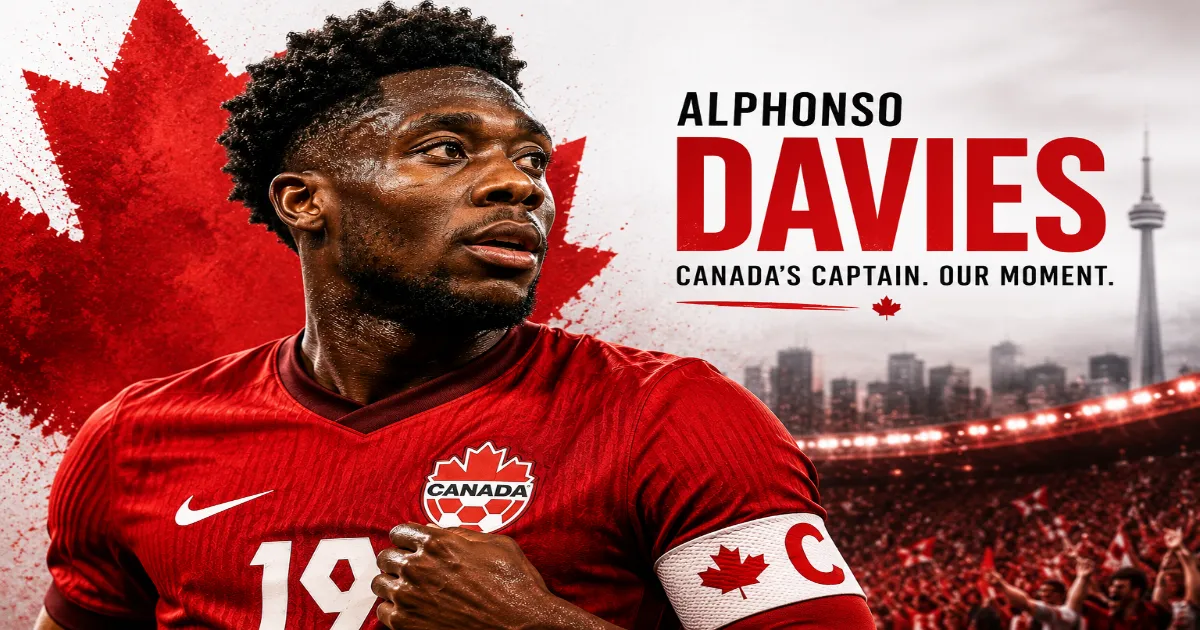
There’s a running group that moves through the streets of Toronto on Monday nights, and lately, a noticeable number of the runners are wearing Canada jerseys with one name and number across the back: Davies 19. Ask one of them if they follow soccer closely, and the answer is sometimes a shrug. But ask if they know who Alphonso Davies is, and the response changes completely. That’s the strange, singular gravity Davies carries into a World Cup his country is co-hosting, even after spending its entire group stage watching from the sidelines.
LaLiga 2026/27 Schedule: Fixtures, Dates & Times
Who Is Gianluigi Buffon? The Journey of Italy’s Legendary Goalkeeper
The Fastest NBA Players Ever, Ranked
A Decade in the Making
Alphonso Davies’ connection to this tournament goes back further than most. In 2018, as a 17-year-old with a brace-faced smile and a frame yet to fill out into the muscular specimen he is now, he stood at the podium during FIFA’s Congress in Moscow and made part of the final pitch for North America’s joint bid to host the 2026 World Cup. The bid succeeded. Eight years later, that same teenager is now Canada’s captain, walking into the tournament he helped bring to his own country — a storyline almost too neat to be anything other than true.
His path to Canadian citizenship is itself part of national folklore. Born in a refugee camp in Ghana to Liberian parents fleeing civil war, Davies’ family settled in Canada when he was five, eventually putting down roots in Edmonton. He took his oath of citizenship in downtown Vancouver in June 2017 as a 16-year-old, joining the Canada squad for the Gold Cup almost immediately afterward. Farhan Devji, who wrote a book on Davies’ early life, has described that citizenship ceremony as the first time Davies saw his own mother cry — a moment that opened his eyes to the full weight of his family’s story just as the wider footballing world was starting to learn his name.
The Highs of Qatar, the Years That Followed
Four years ago in Qatar, Davies scored Canada’s first-ever goal at a men’s World Cup, giving his side an early lead against 2018 finalists Croatia. It remains the high point of his international career to date, even though that match, like all six Canada has ever played at the tournament, ended in defeat. What followed afterward was considerably harder. Across the 2024-25 and 2025-26 seasons, Alphonso Davies was repeatedly hit by serious injuries. The most devastating came in March 2025, when he tore his ACL during a CONCACAF Nations League third-place match against the United States — an injury so severe, and reportedly handled so contentiously by the medical staff on duty, that Bayern Munich threatened legal action against both Canada Soccer and head coach Jesse Marsch over how it was managed. Recovery took 221 days, during which Davies missed 39 matches for club and country combined.
He had barely returned to full fitness when another setback arrived — a hamstring strain suffered while playing for Bayern Munich in a Champions League semifinal against Paris Saint-Germain, sustained at the very end of the club season, just weeks before the World Cup he had waited his entire career to play in his own country. Speaking to reporters in Montreal before the tournament, Davies didn’t hide how heavy that run of injuries had felt. “There was a doubt in my head, I was sad,” he admitted. “From being a 17-year-old kid going to Russia and getting this World Cup to our country and not being able to participate, it dawned on me.” He spoke candidly about the psychological toll as much as the physical one: “Mentally, it was very draining, suffering these injuries. I think it’s nice to just step away and reset your mind and think of how far you’ve come. I was going into a hole where I was doubting myself, but I had that time off and I thought about why I’m doing this and how important this is to me.”
Missing the Opener on Home Soil
The cruelest twist of all was the timing. Canada kicked off World Cup 2026 against Bosnia and Herzegovina at Toronto Stadium — the first men’s World Cup match ever played on Canadian soil — without their captain, who remained sidelined by the hamstring issue and following a strict independent recovery protocol after arriving in camp on June 1. Jesse Marsch later admitted he had effectively used Davies as a “decoy” through parts of the group stage, never genuinely expecting him to be ready, even as Davies was named in the squad for the match against Switzerland without featuring, the coaching staff prioritizing his full fitness for the knockout rounds over rushing him back early.
Through it all, Davies had featured in just two of Canada’s previous 21 international matches due to the combination of fitness issues, a brutal stretch for a player still only 25 years old and already carrying 15 goals in 58 caps for his country.
The Return
The moment Canadian fans had been waiting for arrived ahead of the Round of 32 clash against South Africa on June 28. Marsch confirmed Davies had been declared fully fit and would return to the squad for what was, by any measure, the biggest match in Canadian men’s soccer history. “Now that we have Alphonso back and healthy and ready to perform, I think it’s a big moment for the team, and a big boost for the team,” Marsch said. For a Canadian side that had navigated its group stage cautiously and somewhat anxiously without its most talented and dynamic player, the timing could not have been better — arriving precisely when the tournament’s stakes shift from group-stage survival to genuine knockout football.
What Alphonso Davies Actually Brings Back
It’s worth remembering exactly what Canada gets back when Davies is fully fit. He remains, even after the injuries, arguably the most explosive attacking left-back in world football — a player whose pace and directness fundamentally change how opponents have to set up defensively, forcing wingers and full-backs alike to respect the space in behind him rather than press aggressively. As captain, his presence also carries a psychological weight for a Canadian squad still building belief at this level; this is, after all, the same player who scored the country’s first-ever men’s World Cup goal and helped guide them to a surprise Copa América semifinal in 2024.
A Story Still Being Written
Davies’ World Cup, in some ways, only truly begins now. The group stage he was forced to watch from the sidelines is behind him, and what’s ahead is the part of the tournament he has spent nearly two years and two serious injuries fighting to be available for — knockout football, in his own country, in front of fans who have spent months wearing his name on their backs whether or not they otherwise follow the sport closely. Whatever happens from here, Davies has already provided one of this World Cup’s more compelling human stories: not a tale of effortless stardom, but of a player who had to fight, repeatedly and publicly, just to get the chance to play.
Also reads:
Inside Morocco’s Penalty Shootout Win Over the Netherlands
Brazil vs Japan Match Report: Martinelli’s 95th-Minute Winner Breaks Japanese Hearts
South Africa vs Canada Match Report: Eustáquio Breaks Bafana Hearts in Added Time
▪️▪️ Follow us on Facebook ▪️▪️
About the Author