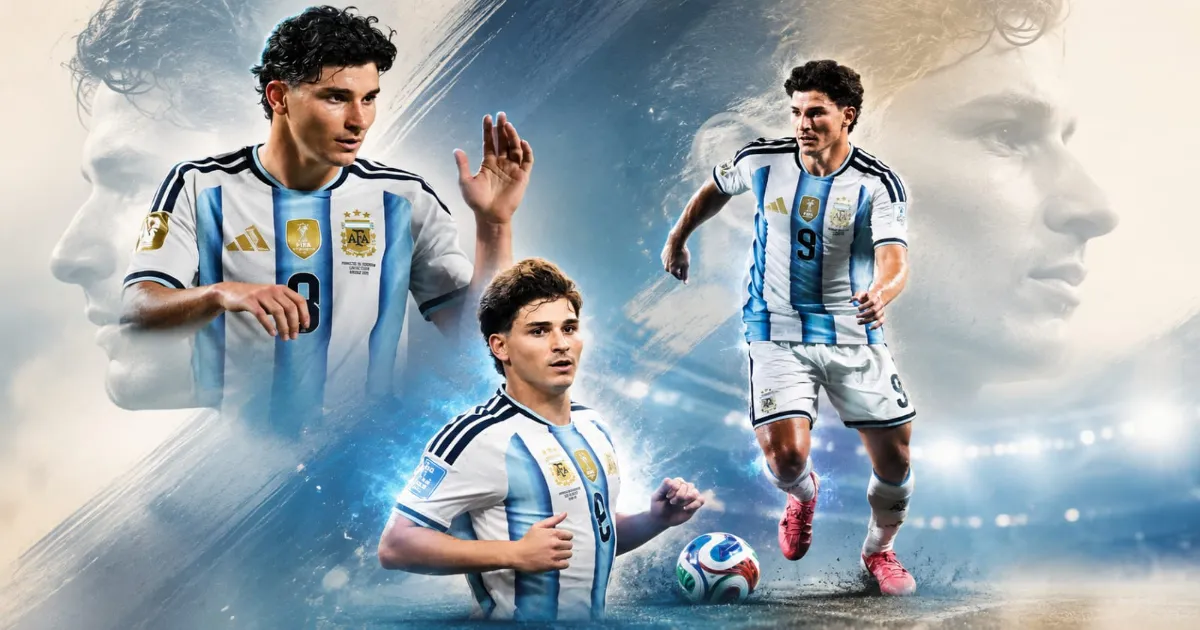
The Julián Álvarez Story: World Cup 2026 and the Best Form of His Life
There’s a version of Julián Álvarez’s career that gets told purely in trophies: a Copa Libertadores at River Plate, a World Cup with Argentina, two Copa Américas, two Premier League titles, an FA Cup, and a Champions League with Manchester City, all collected before his 27th birthday. That version is accurate, and it’s remarkable on its own terms. But it misses the more interesting story underneath it — a forward who has spent his entire career being underestimated relative to the players around him, only to keep proving, tournament after tournament, that he belongs in exactly the rooms he’s standing in.
From Calchín to River Plate
Álvarez was born on January 31, 2000, in the small town of Calchín in Córdoba province, and joined River Plate’s youth system from hometown club Atlético Calchín in 2016 after trials with both Boca Juniors and Real Madrid — the latter scoring twice in five games for the Spanish giants in a youth tournament but unable to join due to age restrictions. Under Marcelo Gallardo at River, he was molded into a modern frontman: intense in the press, sharp in combination play, ruthless in front of goal. His breakthrough was rapid. He was part of the squad that won the historic 2018 Copa Libertadores final against fierce rivals Boca Juniors, played in Madrid, and by 2021 he was delivering goals and assists at a rate that made every major European club take notice.
The Qatar Breakthrough
Álvarez arrived at the 2022 World Cup as promising depth rather than a guaranteed starter, sitting behind Lautaro Martínez in Lionel Scaloni’s pecking order. Everything changed after Argentina’s stunning opening defeat to Saudi Arabia forced a tactical rethink. Given a starting role against Poland, Álvarez scored the goal that secured Argentina’s progression and simply never looked back, cementing his place all the way through to the final. His semifinal performance against Croatia remains the signature moment of that run — a brace that made him the youngest player since Pelé in 1958 to score twice in a World Cup semifinal, at 22 years and 316 days old. Though he didn’t find the net in the final itself, he was directly involved in Argentina’s second goal as they beat France 4-2 on penalties after an extraordinary 3-3 draw, completing a tournament that transformed him from a promising squad option into a genuine household name.
The Spider’s Web
Álvarez’s nickname, “La Araña” — the Spider, or sometimes “El Hombre Araña,” Spider-Man — comes from his trademark web-shooter goal celebration, but it’s also become an apt description of how he plays: patient, lurking in spaces defenders don’t expect, before striking with sudden, decisive movement. At Manchester City, often in a supporting role behind Erling Haaland, he still managed 36 goals in 103 appearances while winning a treble. Since moving to Atlético Madrid in 2024, that supporting role has disappeared entirely. Under Diego Simeone, a manager known for rigid tactical structure, Álvarez has been built into the focal point of the entire attack, and the early skepticism about whether his attacking freedom would fit Simeone’s system has been answered emphatically — close to 50 goals across two seasons, including a club-record 10 in the 2025-26 Champions League campaign alone, and 20 goals with 9 assists across all competitions this season, with a La Liga average rating of 7.11 that places him among the continent’s elite forwards.
Continued Excellence for Argentina
The international numbers tell their own story of consistency. Álvarez enters World Cup 2026 with 51 caps and 14 goals for Argentina, including a goal against Brazil in a standout 4-1 win during CONMEBOL qualifying for this very tournament. He also contributed to Argentina’s Copa América triumphs in both 2021 and 2024, making him part of a small group of players to win the World Cup and Copa América in the same competitive cycle. Few forwards his age across world football can match that combination of consistent club output and sustained international trophy success.
World Cup 2026: Form and Role
Argentina arrived at this tournament in Group J alongside Algeria, Austria, and Jordan, and Álvarez has featured in every match, rotating up front and pressing tirelessly alongside Lionel Messi and Lautaro Martínez under Scaloni. His match-by-match involvement has reflected a rotating, managed role rather than a guaranteed 90 minutes — 35 minutes against Algeria in the 3-0 opening win, 26 minutes in the 2-0 victory over Austria, and 82 minutes in the 3-1 win away at Jordan that closed out the group — with Argentina topping Group J and advancing to face Cape Verde in the Round of 32.
That rotation reflects less a loss of trust and more the genuine embarrassment of attacking riches Scaloni has at his disposal, with Messi’s continued participation still partly dependent on managing his own physical condition across a long tournament. Whatever role Álvarez ends up playing match to match — central striker, support forward, or impact substitute — his pressing intensity and movement in behind defenses remain a constant disruptive presence that opposing defenders have to account for regardless of the scoreline.
The Subplot Off the Pitch
Álvarez’s tournament has also been shadowed by a brewing transfer saga that has added an unusual layer of drama to his World Cup. During the competition itself, he publicly stated his desire to leave Atlético Madrid, saying he believed a transfer was “the best for everyone involved” and that he wanted to “fulfil his dream” — comments that intensified speculation over a move to Barcelona and prompted a furious response from Atlético’s hierarchy, who accused Barcelona of negotiating with a player still under contract and confirmed plans to file a formal complaint with FIFA. It’s an unusual subplot for a player mid-tournament, and one that will likely follow him into whatever comes after Argentina’s World Cup campaign concludes, regardless of how deep that run goes.
What Comes Next
At 26, entering a World Cup in arguably the best individual form of his career, Álvarez carries less of the spotlight than Messi but arguably more of the tactical responsibility. If Argentina are to defend their title, his pressing, his finishing, and his ability to operate in the spaces around Messi and Lautaro Martínez will matter just as much as any single moment of individual brilliance. The Spider has spent his entire career proving doubters wrong in rooms full of bigger names. World Cup 2026 looks like another opportunity to do exactly that.
Argentina 2022: Messi, Mbappe and the Greatest World Cup Final Ever Played
▪️▪️ Follow us on Facebook ▪️▪️
About the Author