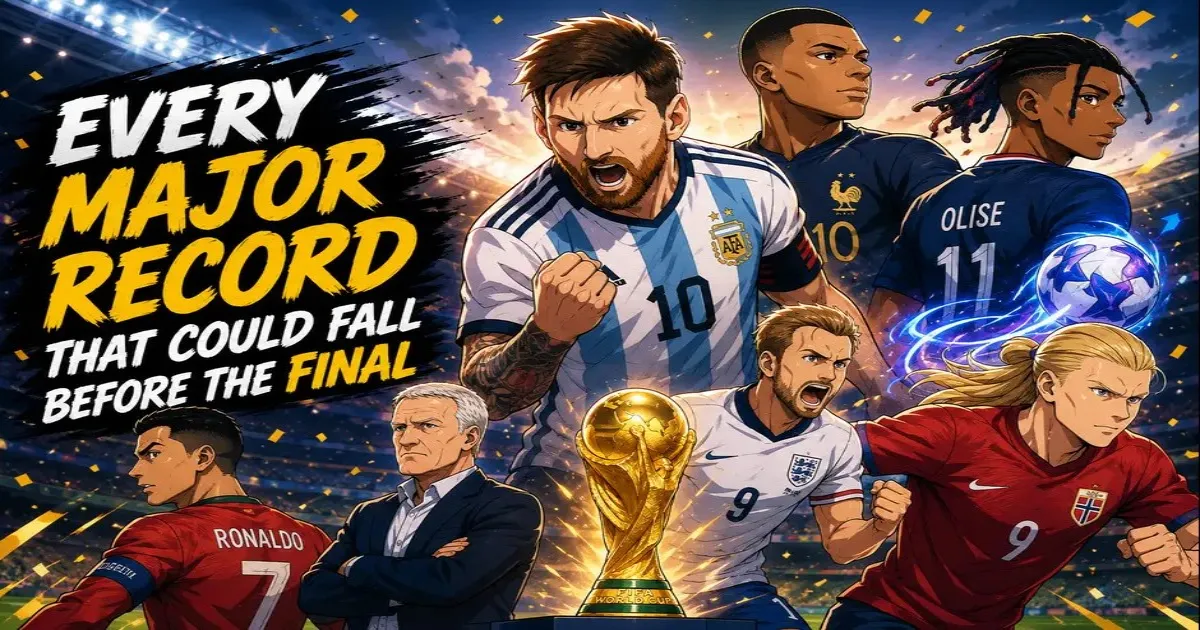
 FIFA World Cup 2026 delivered a historic tournament packed with major record-breaking moments, as Lionel Messi, Cristiano Ronaldo, Kylian Mbappé and other stars pushed football history into new territory.
The 2026 FIFA World Cup is over, and it did far more than produce a new champion. Major Record after Major Record fell across 104 matches, from Lionel Messi and Kylian Mbappé rewriting the scoring history of the competition to Michael Olise breaking Pelé’s long-standing assist mark and Unai Simón producing the best clean-sheet record by a goalkeeper in a single World Cup.
What began as the first 48-team World Cup eventually became one of the most statistically remarkable editions in tournament history. Spain lifted the trophy after defeating Argentina 1–0 after extra time in the final, but the tournament’s record book was rewritten long before Rodri raised the trophy in New York/New Jersey. FIFA confirmed that the competition finished with 308 goals, 6,810,966 spectators and 104 matches, all part of a tournament that established new benchmarks on and off the pitch.
Messi’s World Cup Record Streak: Nine Straight Matches and the Milestones Still Falling
The original question was which major records could fall before the final. Now that the tournament is complete, we can answer the more interesting question: which records actually fell, who owns them, and which milestones came closest to changing hands?Thiago Messi: Club Career, Playing Style, Lifestyle and Future Prospects
Major Record: Messi’s World Cup Appearance Record Reaches 34
Lionel Messi entered the 2026 tournament already holding numerous World Cup records, but his final campaign added another extraordinary number to the list.
The Argentina captain appeared in the final against Spain, taking his career total to 34 World Cup matches, extending his record for the most appearances in the competition. FIFA confirmed that Messi also became the second-oldest player ever to appear in a World Cup final, at 39 years and 25 days, and the oldest outfield player to feature in the showpiece match.
The final was Argentina’s last match of the tournament, meaning Messi’s World Cup career ended with 34 appearances.
His longevity is particularly remarkable because he has played at eight World Cup tournaments across a career stretching from Germany 2006 to North America 2026.
Messi’s Major World Cup Records
| Record | Messi’s 2026 figure | Status |
|---|---|---|
| Most World Cup appearances | 34 | Record |
| Most World Cup victories | 23 | Record |
| Most consecutive World Cup matches scored in | 9 | Record |
| Most goals from outside the box | 7 | Record |
| Oldest World Cup hat-trick scorer | 38 years, 357 days | Record |
| World Cup goals | 21 | Surpassed during tournament |
| World Cup final appearances | 2 | Historic milestone |
FIFA’s record database confirms Messi finished the tournament with 23 World Cup victories and a nine-match scoring streak, while his seven goals from outside the box also became a tournament record.From Roberto Carlos to Messi: Ranking the Best Free Kicks in History
Major Record: Mbappé Becomes the All-Time World Cup Top Scorer
If Messi dominated the record conversation during the early stages, Kylian Mbappé ultimately produced perhaps the biggest statistical finish of the tournament.
The French captain entered 2026 behind Messi in the all-time World Cup scoring rankings. By the end of the competition, he had completely overturned that deficit.
Mbappé scored 10 goals at the 2026 World Cup, winning the Golden Boot for the second consecutive tournament. More importantly, those goals pushed his career World Cup total to 22, one ahead of Messi’s final total of 21 and three ahead of Miroslav Klose’s previous record of 16. FIFA officially confirmed Mbappé as the new all-time leading World Cup scorer.
His achievement is even more remarkable when considering that he has played in only three World Cups.
Mbappé’s World Cup Scoring Progression
| World Cup | Goals | Career total |
|---|---|---|
| 2018 | 4 | 4 |
| 2022 | 8 | 12 |
| 2026 | 10 | 22 |
Mbappé therefore finished his third World Cup with 22 goals, becoming the first player to reach that mark.
He also became only the second player to win the Golden Boot at consecutive World Cups, after Brazil’s Ronaldo achieved the feat across 1998 and 2002.
Major Record: Michael Olise Breaks Pelé’s Assist Record
One of the most impressive records of the tournament belonged to Michael Olise.
Before 2026, Pelé’s six assists at the 1970 World Cup represented the benchmark for assists in a single edition. Olise arrived in North America without the same historical profile as the legendary Brazilian, but by the end of the tournament he had moved beyond him.
The France winger finished with seven assists, becoming the outright record-holder for most assists at a single World Cup. FIFA confirmed that five of those assists were for Mbappé, creating one of the tournament’s most productive attacking partnerships.
Olise’s seven assists were especially significant because he reached the record despite France falling in the semi-final against Spain.
Single-World-Cup Assist Record
| Player | World Cup | Assists |
|---|---|---|
| Michael Olise | 2026 | 7 |
| Pelé | 1970 | 6 |
| Several players | Various | 5 |
The record was therefore not merely equalled. Olise moved one clear of Pelé.Best Assists of FIFA World Cup 2026: The Playmakers Ranked
Major Record: Rodri Sets New Passing Benchmark
Spain’s midfield dominance produced another major statistical milestone.
Rodri completed 790 passes during Spain’s eight-match campaign, breaking the previous record of 638 completed passes that he himself established at Qatar 2022.
That means Rodri now occupies both the first and second positions on the list of most completed passes in a single World Cup. FIFA confirmed that his 2026 total surpassed his own previous record, which had itself overtaken Xavi’s 599 completed passes from the 2010 tournament.Franco Baresi Passes Away at 66: Italy Mourns a Legend
Most Completed Passes in One World Cup
| Rank | Player | World Cup | Completed passes |
|---|---|---|---|
| 1 | Rodri | 2026 | 790 |
| 2 | Rodri | 2022 | 638 |
| 3 | Xavi | 2010 | 599 |
The record reflects not simply volume but Spain’s tactical identity. Rodri operated as the central reference point for a team that controlled possession, progressed the ball patiently and eventually won the World Cup.
Major Record: Unai Simón Produces Seven Clean Sheets
Spain’s defensive numbers were among the most extraordinary of the tournament.
Unai Simón recorded seven clean sheets in eight matches, establishing a new record for the most clean sheets by a goalkeeper in a single World Cup. Spain conceded only once throughout the entire tournament — in their quarter-final against Belgium — before shutting out France in the semi-final and Argentina in the final.
That defensive consistency played a huge role in Spain winning their second World Cup.
Spain’s Defensive Record
| Category | Spain 2026 |
|---|---|
| Matches | 8 |
| Clean sheets | 7 |
| Goals conceded | 1 |
| Goals scored | 14 |
| Tournament result | Champions |
FIFA described Spain’s one-goal concession as the fewest ever by a World Cup-winning team.
That puts Simón’s Golden Glove alongside one of the strongest defensive tournament performances ever produced by a champion.
Major Record: Spain Become the First Nation to Hold Both FIFA World Titles
Spain’s victory created a record that went beyond the men’s tournament.
Spain were already the reigning FIFA Women’s World Cup champions after winning the women’s tournament in 2023. Their men’s victory in 2026 therefore made Spain the first country to simultaneously hold FIFA’s senior men’s and women’s World Cup titles.
It was one of the most unusual records generated by the 2026 tournament and another indication of the country’s remarkable football development across both men’s and women’s competitions.
Major Record: Luis de la Fuente Becomes the Oldest World Cup-Winning Coach
Spain coach Luis de la Fuente also entered the record books.Top 10 Players to Watch in the 2026 MLS All-Star Game
At 65 years and 28 days, De la Fuente became the oldest coach ever to win the FIFA World Cup, surpassing the previous benchmark held by Spain’s own Vicente del Bosque.
The achievement added another layer to Spain’s historic triumph. De la Fuente combined experience with an exceptionally young squad, including teenagers Lamine Yamal and Pau Cubarsí.
Major Record: Yamal and Cubarsí Set Teenage Appearance Mark
The emergence of Spain’s teenage stars was another defining story.
Lamine Yamal and Pau Cubarsí, both 19, became the fourth and fifth teenagers to play in a World Cup final. More remarkably, each finished the tournament with eight World Cup appearances before turning 20, establishing a new record for the most World Cup matches played by a player before reaching that age.
Their appearance in the final also placed them in an extraordinarily exclusive group of teenage World Cup finalists.
Pelé was 17 in 1958, Giuseppe Bergomi was 18 in 1982 and Mbappé was 19 in 2018. All three had previously finished those finals as champions, a pattern Yamal and Cubarsí continued with Spain in 2026.
Major Record: The 2026 World Cup Becomes the Highest-Scoring Tournament
The expansion to 48 teams inevitably created questions about whether the tournament would produce more goals simply because it contained more matches.
The answer was emphatic.
The 2026 World Cup finished with 308 goals across 104 matches, averaging 2.96 goals per game. That comfortably surpassed the previous tournament record of 172 goals at Qatar 2022, although the number of matches was also substantially higher.Complete FIFA World Cup 2026 Awards List: Every Winner
The tournament therefore established a new absolute record for goals scored at a World Cup.
Major Record: Attendance Surpasses 6.8 Million
The records were not limited to the pitch.
The 2026 tournament attracted 6,810,966 spectators across 104 matches, an all-time World Cup attendance record. FIFA reported an average attendance of 65,490 per match, with stadiums operating at approximately 99.7% capacity.
The achievement was particularly significant because the tournament was spread across three countries and 16 host cities.
The scale of the 2026 World Cup therefore produced a new benchmark not only for football’s biggest tournament but for major sporting events more broadly.
Major Record: Argentina Reach Back-to-Back World Cup Finals
Argentina did not defend their World Cup title successfully, but they still produced an extraordinary achievement.
Their 2026 run took them into a second consecutive World Cup final, making them only the sixth nation in history to reach consecutive finals. FIFA also noted that Argentina entered the final having gone unbeaten in their previous 13 World Cup matches.
The opportunity to win consecutive World Cups remained alive until the final, where Spain’s extra-time victory ended Argentina’s attempt to join Italy and Brazil as the only nations to win successive World Cups.
Major Record: Ronaldo’s Six-Tournament Scoring Achievement Stands
Cristiano Ronaldo did not reach the latter stages of the 2026 tournament with Portugal, but his historical achievement remained intact.
Ronaldo became the first player to score at six different World Cups, a record stretching from Germany 2006 through North America 2026.
The tournament also saw Ronaldo become Portugal’s all-time World Cup top scorer, overtaking Eusébio’s previous total of nine goals. FIFA confirmed that Ronaldo reached 10 World Cup goals during the group stage.
Although Portugal’s elimination ended his 2026 campaign, the six-tournament scoring record remains one of the most difficult milestones for any future player to match.
Major Record: Messi’s Nine-Match Scoring Streak
Another Messi record survived the tournament and became even stronger.
Messi scored in nine consecutive World Cup matches, extending a streak that began during the previous tournament cycle. FIFA confirmed that he surpassed the previous six-match benchmark shared by Just Fontaine and Jairzinho.
The streak made Messi’s final World Cup campaign statistically remarkable even though Argentina ultimately lost the final.
His 2026 tournament therefore ended with another collection of records rather than simply another appearance on the biggest stage.
Major Record: The Tournament Produced 104 Matches
The 2026 edition was the first World Cup to feature 48 teams, producing 104 matches across the tournament.
That expansion fundamentally changed the statistical scale of the competition. FIFA confirmed that 1,039 players featured across the tournament and that 308 goals were scored.
The increased number of matches also meant more opportunities for records to be broken, but many of the individual achievements still required extraordinary performance rather than simply additional fixtures.
Major Record Table: The Biggest Milestones of World Cup 2026
| Record | 2026 achievement | Record holder |
|---|---|---|
| Most World Cup goals | 22 | Kylian Mbappé |
| Most World Cup appearances | 34 | Lionel Messi |
| Most World Cup wins | 23 | Lionel Messi |
| Most consecutive matches scored | 9 | Lionel Messi |
| Most goals from outside the box | 7 | Lionel Messi |
| Most assists in one World Cup | 7 | Michael Olise |
| Most completed passes in one World Cup | 790 | Rodri |
| Most goalkeeper clean sheets in one World Cup | 7 | Unai Simón |
| Fewest goals conceded by a champion | 1 | Spain |
| Oldest World Cup-winning coach | 65 years, 28 days | Luis de la Fuente |
| Most World Cup matches before age 20 | 8 | Lamine Yamal & Pau Cubarsí |
| Most goals in one World Cup | 10 | Kylian Mbappé |
| Most goals in tournament history | 308 total | 2026 World Cup |
| Highest total attendance | 6,810,966 | 2026 World Cup |
The individual records were confirmed by FIFA’s tournament record summaries and final statistical review.
The Records That Came Close but Did Not Fall
Not every record chase ended with a new name at the top.
The most obvious example was the single-tournament Golden Boot record. Mbappé scored 10 goals, an extraordinary total that won him the Golden Boot, but he did not surpass Just Fontaine’s 13-goal record from the 1958 World Cup.
Messi also finished with eight goals, while Jude Bellingham and Erling Haaland each finished with seven. FIFA’s final Golden Boot statistics confirmed Mbappé’s 10-goal total ahead of Messi’s eight.
The assist record, however, did fall. Olise’s seven assists moved beyond Pelé’s six, making that one of the clearest examples of a record chase turning into a new piece of World Cup history.
Why the 2026 World Cup Will Be Remembered as a Record-Breaking Tournament
The remarkable aspect of the 2026 World Cup is that the records did not come from one player or one country.
Messi and Mbappé dominated the attacking record books. Olise transformed the assist record. Rodri rewrote the passing statistics. Simón established a new goalkeeper benchmark. De la Fuente became the oldest champion coach. Yamal and Cubarsí represented a new generation. Spain simultaneously conquered the men’s and women’s World Cups.
And above all of them was a tournament that changed its own statistical scale.
The 48-team format produced 104 matches and 308 goals, while more than 6.8 million spectators attended the games.
Spain ultimately won the trophy, defeating Argentina 1–0 after extra time, but the lasting story of the tournament will not be limited to the champion.
The Final Verdict: A World Cup That Rewrote Its Own History
The original list of records that might fall before the final proved to be only the beginning.
Some records survived. Fontaine’s 13-goal single-tournament scoring record remains intact. Ronaldo’s six-edition scoring milestone remains his. Others were shattered completely: Mbappé finished as the all-time World Cup scoring leader, Olise took Pelé’s assist record, Rodri extended his own passing record and Simón established an unprecedented clean-sheet mark.
Then there were the records that could only be created by the 2026 tournament itself: 48 teams, 104 matches, 308 goals and more than 6.8 million spectators.
The most fitting conclusion may belong to Messi and Mbappé. Messi entered the tournament holding the all-time scoring record, while Mbappé entered knowing he had a realistic opportunity to challenge him. By the end, Mbappé had taken the career scoring crown with 22 goals, while Messi left with an even longer list of records, including 34 appearances and 23 victories.
That is what made the 2026 World Cup so extraordinary. It was not simply a tournament in which records were broken. It was a tournament in which an entire generation of World Cup records changed hands — and several new records were created that future generations will now have to chase.
Cristiano Ronaldo Jr.: Club, Lifestyle, Career and Future Prospects
Thiago Messi: Club Career, Playing Style, Lifestyle and Future Prospects
◾◾ follow us on facebook ◾◾
About the Author