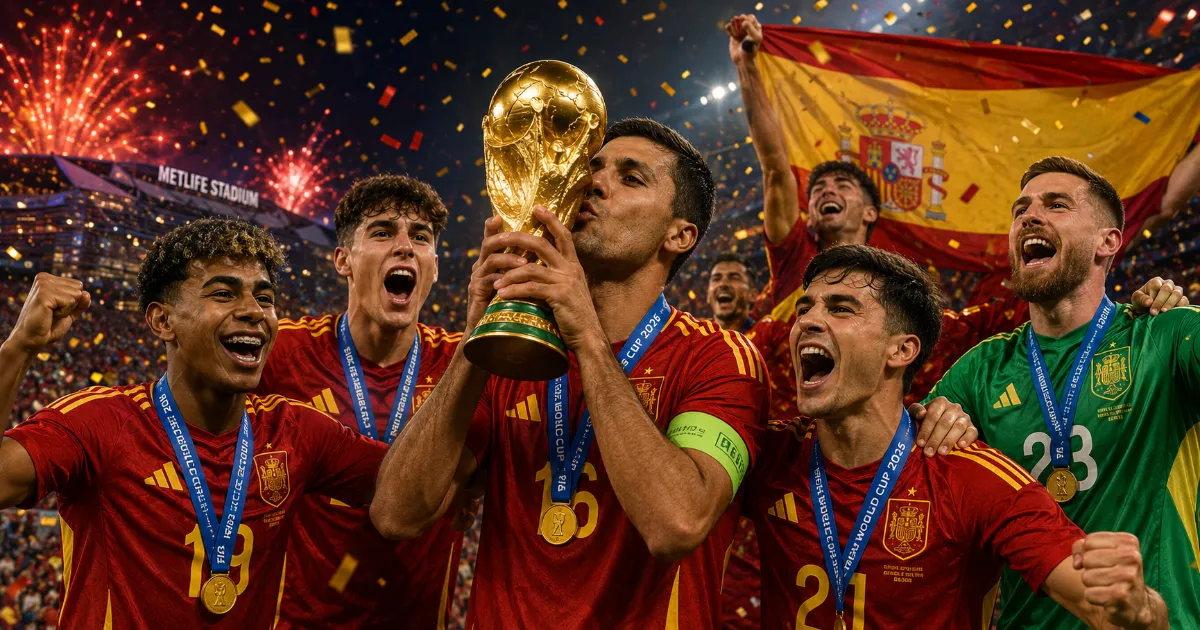
 Spain Are World Champions take a look at Road to Glory
Spain are the FIFA World Cup 2026 winners, beating Argentina 1-0 after extra time at New York New Jersey Stadium on Sunday to claim a second World Cup title, sixteen years after their first. It capped an unbeaten eight-match run through the tournament that began, fittingly enough, with a match Spain didn’t even win.
Golden Ball Winner Rodri: The Case for Football’s Quietest Superstar
Spain World Cup Prediction: We Backed Spain on June 5—Now They’re One Match Away
Golden Glove Winner Unai Simon: The Historic World Cup Goalkeeping Masterclass
An Opening Draw That Set the Tone
Spain’s campaign began on June 15 with a goalless draw against World Cup debutants Cape Verde in Atlanta — hardly the statement opener a pre-tournament favourite is supposed to produce. It would prove to be the only match all summer Spain failed to win, and in hindsight, it set up exactly the theme that would define their run: control without always needing a spectacular scoreline to prove it.
They followed it with a 4-0 rout of Saudi Arabia, featuring a brace from Mikel Oyarzabal, before wrapping up top spot in Group H with a tighter 1-0 win over Uruguay in Guadalajara, Álex Baena settling the contest in the 42nd minute after pouncing on a goalkeeping error from Fernando Muslera. Seven points from three matches, and Spain headed into the knockout rounds as group winners without ever looking seriously troubled.From Tunisia to Spain: Every World Cup 2026 Team Ranked
Four Knockout Wins, One Goal Conceded
What followed was as close to knockout-stage perfection as international football produces. Spain beat Austria 3-0 in the round of 32, Oyarzabal scoring twice before Mikel Merino came off the bench to add a stoppage-time third — a strike with real déjà vu attached, given Merino had scored an almost identical late winner as a substitute against Germany at Euro 2024. A tight 1-0 win over Portugal followed in the round of 16, before a 2-1 quarterfinal win over Belgium in Los Angeles produced the only real blemish on an otherwise flawless defensive record: a Charles De Ketelaere goal that remains, to this day, the only one Spain conceded across the entire tournament outside the final.
The semifinal against France was Spain’s most complete performance of the tournament. A comfortable 2-0 win, built on a Mikel Oyarzabal penalty and a slick finish from Pedro Porro after a Dani Olmo assist, sent Spain into their first World Cup final since 2010 — and extended what was already an eye-catching unbeaten run to a mark that would eventually equal an all-time record.Mikel Merino Profile: From Pamplona to Ending Ronaldo’s World Cup
The Final: Patience, a Red Card, and Extra Time
Sunday’s final against Argentina was, by Spain’s own admission afterward, a genuine test of patience. De la Fuente’s side dominated territory and chances from the opening whistle — they would finish with an expected goals total near 1.94 from 20 shots, against Argentina’s 0.2 from just two attempts — but found Emiliano Martínez in inspired form between the posts, the Argentina goalkeeper producing a men’s World Cup final record of ten saves to keep the scoreline level deep into the second half.
The breakthrough Spain needed arrived indirectly. Argentina midfielder Enzo Fernández was sent off for a second bookable offence in second-half stoppage time, reducing Argentina to ten men as the match moved into extra time. Even then, Spain had to work for it — a Nico Williams goal was initially ruled out for a foul in the build-up — before finally finding a way through just 39 seconds into the second period of extra time. Williams headed a deep cross into the path of substitute Ferran Torres, who rifled the ball home from close range to spark wild celebrations among the Spanish substitutes and staff.Inside Lamine Yamal’s World Cup 2026: Every Record and Goal
Argentina, already down to ten men, saw a second player sent off after the final whistle when substitute Leandro Paredes lost his composure following the result — a small, ugly footnote to what had otherwise been a match defined by Spain’s control and Martínez’s heroics rather than ill discipline.
A Tournament Defined by Defensive Perfection
The numbers behind Spain’s triumph are as remarkable as the run itself. They conceded just once across the entire tournament — the De Ketelaere goal in the quarterfinal — finishing with seven clean sheets from eight matches, a new World Cup record for a single tournament. Goalkeeper Unai Simón, who claimed the Golden Glove as the tournament’s best goalkeeper, now has nine career World Cup clean sheets, one shy of the all-time record shared by Fabien Barthez and Peter Shilton.
Individual honours went Spain’s way almost across the board. Rodri, Spain’s captain and defensive midfield anchor, won the Golden Ball as the tournament’s outstanding player, edging out Lionel Messi, who took home the Silver Ball in what was almost certainly his final World Cup appearance. Nineteen-year-old centre-back Pau Cubarsí was named Best Young Player, beating out his own teammate, 18-year-old sensation Lamine Yamal. The Golden Boot went the other way, to France’s Kylian Mbappé, who finished with ten goals to Messi’s eight and Spain’s own top scorer Mikel Oyarzabal’s five.
What It Means
A second World Cup title puts Spain level with nations like Uruguay and France on two triumphs, and cements the current generation — Rodri, Yamal, Cubarsí, Pedri, and the rest of Luis de la Fuente’s squad — as a genuine second golden era for Spanish football, distinct in style from the possession-only side that won in 2010 but every bit as effective when it mattered most. For a team that opened its campaign with a draw against a tournament debutant, the road to glory turned out to be exactly as complete as it gets: unbeaten, nearly unscored upon, and settled, fittingly, by a substitute’s header and a rifled finish deep into extra time of the final itself.
Thiago Messi: Club Career, Playing Style, Lifestyle and Future Prospects
Cristiano Ronaldo Jr.: Club, Lifestyle, Career and Future Prospects
🔹🔹 follow us on facebook 🔹🔹
About the Author


2 thoughts on “Spain Are World Champions: The Story of Their 2026 Triumph”