 Lamine Yamal’s World Cup 2026 Legacy, Goal by Goal and Record by Record
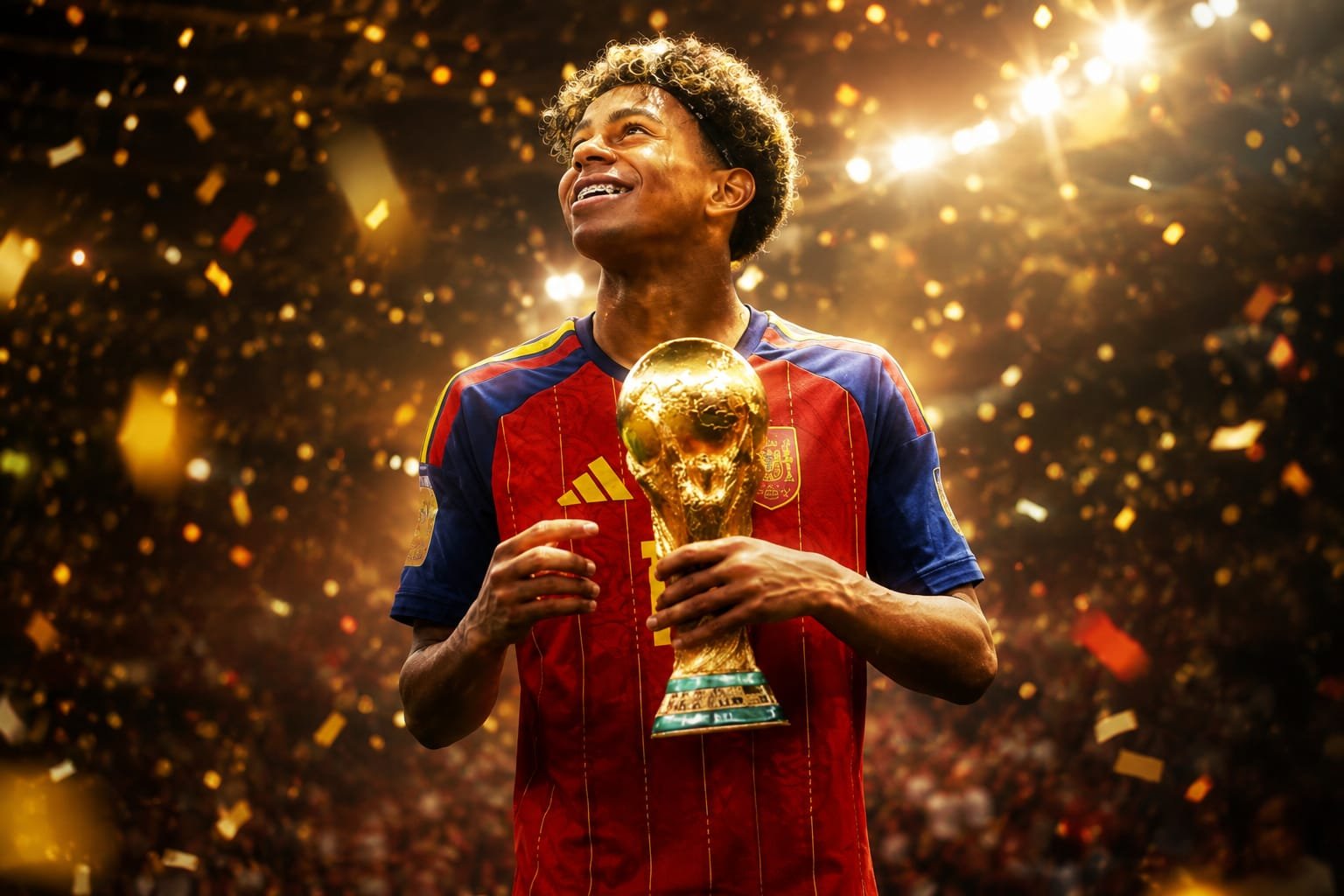
He turned 19 the day before Spain’s semifinal, drew a penalty the very next match, and ended his first-ever World Cup with a winner’s medal. Lamine Yamal’s World Cup 2026 was not the tournament of a supporting player learning on the job — it was the tournament of a teenager who already looked entirely ready for the biggest stage football has to offer.
Rodri’s World Cup Performance: The Midfielder Who Controlled the Tournament
We Called It: How Our Spain World Cup Prediction Came True
The Slow-Burn Start
Yamal’s tournament didn’t begin with a bang. He came off the bench in Spain’s opening group match, a scoreless draw against debutants Cape Verde, and had to wait for his real breakthrough moment. It arrived in Spain’s second group game against Saudi Arabia — Yamal’s first World Cup start, and he needed just ten minutes to score, becoming Spain’s second-youngest scorer on the finals stage at 18 years and 343 days old. From that point on, Yamal was a fixture in De la Fuente’s starting XI for the remainder of the tournament.
Building Momentum Through the Knockouts
Yamal’s influence grew steadily as the knockout rounds progressed, even as a hamstring concern threatened to disrupt his tournament ahead of the quarterfinal against Belgium. He played through it, starting regardless, and continued to be one of Spain’s most reliable creative outlets on the right side of attack. By the time Spain reached the semifinal against France, Yamal had become one of just seven teenagers in World Cup history to start a semifinal — with fellow Spain defender Pau Cubarsí the only other player to share that distinction in this tournament, a reflection of just how deep Spain’s production of elite young talent has become.
The Record-Setting Moment Against France
The clearest individual highlight of Yamal’s tournament came one day after his 19th birthday, in the semifinal against France. Yamal drew the penalty that opened the scoring, becoming the second-youngest player in sixty years to win a penalty in a World Cup knockout-stage match — behind only England’s Michael Owen, who achieved the same feat at 18 years and 198 days old against Argentina at the 1998 World Cup. The historical echo was almost too neat: a teenage prodigy drawing a decisive foul in a knockout match, exactly the kind of moment that had once announced Owen’s own arrival on football’s biggest stage nearly three decades earlier.
Beyond that single moment, Yamal’s semifinal masterclass — praised widely by pundits and opposition players alike — cemented his reputation as a player who did not shrink from occasions, no matter how large. His head-to-head numbers against elite opposition backed up the eye test: since joining Real Madrid, Kylian Mbappé had lost every single knockout match, for club or country, in which he faced Yamal directly — a statistic that speaks to a genuine, established psychological edge over one of the two or three best forwards in the world, built at an age when most players are still fighting for regular first-team minutes.
The Final: A Quieter Night, But a Winner’s Medal
Yamal’s role in the final itself was more understated than his semifinal heroics, in keeping with a tense, low-event match that took 106 minutes to produce a single goal. He remained a persistent threat throughout, at one point beating two Argentina defenders and preventing the ball from crossing the end line before squaring it for substitute Ferran Torres, whose header was saved by Emiliano Martínez. It wasn’t until later in extra time that Torres, combining instead with fellow substitute Nico Williams, finally broke Argentina’s resistance. Yamal didn’t get his name on the scoresheet in the final, but he ends his first World Cup with the only medal that ultimately matters: a winner’s one.
The Awards Picture: Genuine Recognition, Not Quite the Top Prize
It’s worth being precise about where Yamal’s individual accolades actually landed, rather than overstating them. FIFA’s Best Young Player award — for which Yamal was one of the clear favorites throughout the tournament — ultimately went to his own Spain teammate, Pau Cubarsí, whose defensive composure across the tournament narrowly won out. Yamal did not win an individual FIFA award at this World Cup. What he did do was establish himself, through performance rather than trophy, as one of the two or three most important attacking players on a team that conceded a single goal all summer and finished the tournament as world champions.
That distinction matters. Yamal’s legacy from this tournament isn’t built on a golden statuette — it’s built on the tape: a teenager who started a World Cup semifinal, drew a penalty that opened the scoring in it, and played a direct hand in his team’s run to the final itself, all before his 19th birthday had even settled in.
How Yamal’s Tournament Compares to History’s Great Teenage Breakouts
Football has seen teenage World Cup breakouts before — Pelé in 1958, Michael Owen in 1998, Kylian Mbappé himself in 2018 — but Yamal’s version carries a distinguishing feature none of those precedents quite share: he didn’t just contribute to a winning team, he did so as part of the meanest defensive unit the tournament has produced in decades, on a team that conceded a single goal across eight matches. Owen’s breakout in 1998 came on an England side that didn’t escape the Round of 16. Mbappé’s 2018 breakout came as a supporting attacker in a France side built primarily around defensive solidity and counter-attacking pace, not too dissimilar in structure to this Spain team, but Mbappé was 19 then too, and still took until his sophomore tournament to become the focal point rather than a supporting piece.
Yamal, by contrast, was already a first-choice starter and one of Spain’s two or three most important attacking outlets by his second tournament as a senior international, having already won a European Championship as a teenager before this World Cup even began. The pattern of his career so far suggests someone accumulating team success and individual refinement simultaneously, rather than needing several tournament cycles to convert obvious talent into the finished, tactically mature product that showed up against France in the semifinal.
What This World Cup Means for Yamal’s Broader Career
Yamal now has two major senior trophies with Spain before turning 20 — Euro 2024, won as a supporting attacking weapon at just 16 and 17 years old, and now a World Cup winner’s medal earned as a genuine first-choice starter. Few players in the sport’s history have accumulated that level of team success at such a young age, and unlike many prodigies whose early achievements come with a team carrying them, Yamal’s contributions at this World Cup — the goal against Saudi Arabia, the penalty draw against France, the relentless creative threat throughout the knockout rounds — were genuinely central to how Spain won the tournament, not incidental to it.
At 19, Yamal already has a case as one of the most decorated teenagers in the history of the sport. What comes next — a Ballon d’Or challenge, a Golden Ball at a future tournament, further team honors with both Barcelona and Spain — is speculation for another day. What isn’t speculation is what he has already accomplished: a World Cup winner’s medal, a genuine highlight-reel moment on the sport’s biggest stage, and a growing body of evidence that his rise is built on substance rather than hype alone.
About the Author