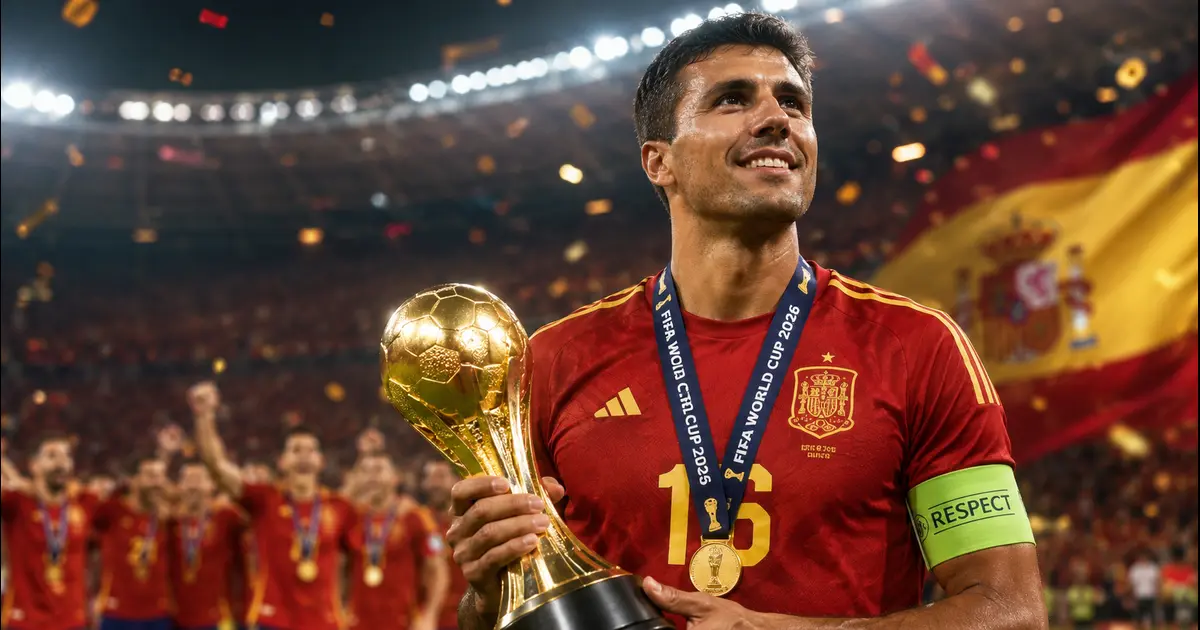
 From a ruptured ACL to a World Cup winner’s medal and the Golden Ball, Rodri’s 2026 tournament was a masterclass in quiet, total control
There is a version of this World Cup where Rodri never plays a single minute. In September 2024, the Manchester City and Spain midfielder ruptured his right ACL, an injury that ended his season within weeks of being named the world’s best player, and cast real doubt over whether he would even be fit for this tournament, let alone central to it. Instead, Rodri’s World Cup performance turned into the defining individual story of Spain’s triumphant campaign — a return to his absolute best, at exactly the moment his country needed it most, capped by a Golden Ball award as the tournament’s outstanding player.Spain Are World Champions: The Story of Their 2026 Triumph
FIFA World Cup 2026 Winner Prediction: Why Spain Will Lift the Trophy
The Numbers Behind the Control
Statistically, Rodri’s tournament was not just excellent — it was historically unprecedented. He finished with 655 accurate passes, the most completed by any player at a single World Cup since detailed record-keeping began in 1966, converting at a 92.91% completion rate across 705 attempts. His accuracy climbed even higher in advanced areas: 92.51% in the final third from 187 attempts, the best mark of any player to attempt at least 100 final-third passes this tournament. According to Squawka’s tracking data, Rodri topped Spain’s entire squad in touches (794), accurate passes (655), accurate final-third passes (173), duels won (41), possessions won (34) and tackles (22) — a level of near-total statistical ownership of a team’s midfield output rarely seen at this level of competition.
He also covered more ground than any other player in the tournament, with FIFA’s own tracking data crediting him with the highest total distance of any player across the whole competition. His 106 line-breaking passes — the passes that split defensive lines and progress attacks — trail only Xabi Alonso’s 126 (2010) and Toni Kroos’ 109 (Brazil 2014) among players since 2010, placing Rodri in genuinely rare historical company for a single tournament’s creative output from deep midfield.
Undroppable, Whatever the Shape
What made Rodri’s campaign so remarkable wasn’t just the raw numbers — it was his consistency across an evolving Spain system. Luis de la Fuente shuffled his supporting cast throughout the tournament: Pedri lost his starting spot for the quarterfinal and semifinal in favor of Fabian Ruiz, and various forwards rotated through the front line depending on matchup. Through all of it, Rodri remained the one constant, starting and playing almost every available minute — he was substituted only in the closing stages of Spain’s opening match against Cape Verde, and started every match after that, regardless of formation. Whether Spain lined up in a 4-3-3 or a 4-2-3-1, Rodri was always the deepest midfielder, the base from which everything else in Spain’s system was built. [link to: Spain vs Argentina predicted lineups]
Why Spain’s Defensive Record Started With Him
Spain’s tournament defensive record — a single goal conceded across eight matches, the most clean sheets ever recorded by a champion in a single World Cup — is usually attributed to the back four and Unai Simon’s goalkeeping. But the analytics tell a more complete story. Rodri ranked third at the entire tournament for possessions won in the middle third of the pitch, and sixth for possessions won in the attacking third, meaning much of Spain’s defensive solidity started well before the ball ever reached their own penalty area. By winning the ball back high and often, Rodri effectively reduced the number of direct chances Spain’s actual defenders had to face — a preventative form of defending that doesn’t always show up in a highlight reel, but which statisticians increasingly regard as just as valuable as last-ditch tackles inside the box.
The Final: A Captain’s Performance
In the final itself, a tense, goalless 1-0 extra-time win over Argentina, Rodri’s role shifted slightly to match the specific demands of the occasion. With comparatively little defensive work required against an Argentina side that managed just two shots across 120 minutes, Rodri pushed further forward than his usual template, completing 16 passes into the final third alone — a number NBC Sports’ player ratings specifically flagged as remarkable given his more withdrawn defensive starting position. He captained the side throughout, the armband a fitting symbol for a player whose return from injury had become inseparable from Spain’s entire tournament narrative.
A Golden Ball Completing an Improbable Journey
When FIFA’s Technical Study Group announced Rodri as the winner of the Golden Ball — awarded to the tournament’s outstanding player — it denied Lionel Messi a record-extending third career win of the award, with Messi settling for the Silver Ball and Kylian Mbappe taking the Bronze. For Rodri, the recognition completed a journey that began not with this tournament, but with the devastating injury that preceded it.
“I’m proud and I would love for new generations to see that it is possible,” Rodri said after receiving the award. “That a player who touches the sky and then plummets to hell is also capable of rising again. It is an example of overcoming adversity, and you have to believe. Honestly, it’s incredible.”
The win also completed a rare individual triple for Rodri: having already won the UEFA Champions League with Manchester City and the Ballon d’Or in 2024, the Golden Ball made him just the 11th player in the sport’s history to hold all three honors simultaneously — a list that includes some of the most decorated midfielders and playmakers the game has ever produced.
The Wider Context: A Second Straight Tournament-Defining Performance
This wasn’t the first time Rodri had been the difference-maker in a major Spain tournament run. He was similarly influential in Spain’s UEFA Nations League triumph, scoring the decisive penalty in a shootout win over Croatia in the 2023 final and earning Player of the Finals recognition for that competition. His return to that level after the severity of his ACL injury represents one of the more remarkable individual comeback arcs in recent international football — a player who, less than two years removed from a serious knee reconstruction, produced the single most statistically dominant midfield performance of an entire World Cup.
Why This Performance Will Be Remembered
World Cup Golden Ball winners are not always universally agreed upon in the years that follow — reasonable arguments can be made for plenty of players who put up flashier individual numbers without controlling a match the way Rodri controlled almost every one he played in this tournament. But the specific combination of circumstances behind this particular Golden Ball — a career-threatening injury, a genuinely uncertain recovery timeline, and a return not just to fitness but to record-setting statistical dominance at the sport’s biggest event — gives Rodri’s award a weight that goes beyond a simple end-of-tournament vote. [link to: Spain’s road to the final]
Final Word
Rodri’s 2026 World Cup will likely be remembered less for any single moment of skill and more for its sheer, sustained consistency — a player who set a passing record that had stood since 1966, anchored a defense that conceded once in eight matches, and did all of it less than two years after an injury that once threatened to derail his career entirely. The Golden Ball he lifted alongside the World Cup trophy itself wasn’t just a reward for one tournament’s performance. It was confirmation that Rodri’s return from the very bottom was every bit as complete as it looked from the outside.
About the Author

1 thought on “Rodri’s World Cup Performance: The Midfielder Who Controlled the Tournament”