 Inside the Collective Plan That Neutralized the Greatest Player of His Generation
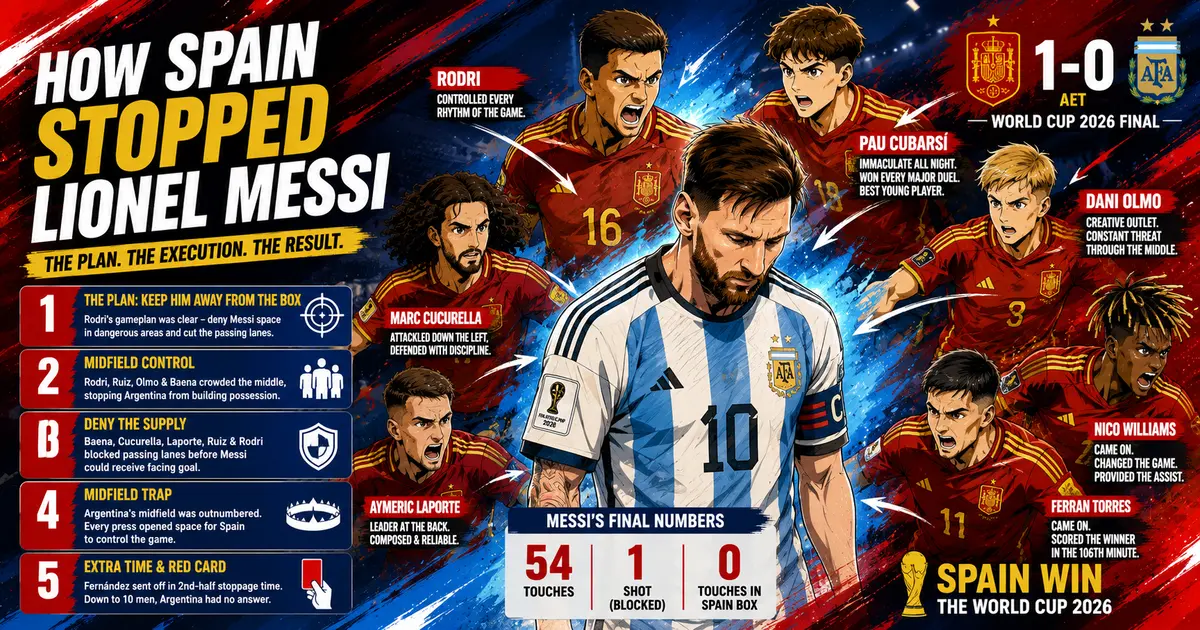
The final numbers barely need commentary: 54 touches, one shot — blocked — and zero touches inside Spain’s penalty area, across 120 minutes plus stoppage time. For a player who had spent the entire tournament producing moments of individual genius on demand, Sunday’s World Cup final was, statistically, the quietest game of Lionel Messi’s summer. This is how Spain stopped Lionel Messi — not through a single heroic man-marking job, but through a fully collective plan that started before kickoff and never let up.
Champions League 2026/27 Schedule: Fixtures, Dates & Times
LaLiga 2026/27 Schedule: Fixtures, Dates & Times
Premier League 2026/27 Schedule: This Week and Next Week
Rodri’s World Cup Performance: The Midfielder Who Controlled the Tournament
The Plan, in Rodri’s Own Words
Spain’s approach wasn’t a secret improvised at halftime — it was the explicit gameplan going in. Ahead of the match, captain Rodri laid out the thinking directly: Spain’s broader defensive identity all tournament had been built on pressing forward to force opponents backward, and against Messi specifically, the target was simple — keep him away from the box. Rodri acknowledged the obvious complication with that plan out loud: Messi’s unpredictability meant Spain would need to stay alert throughout, because no scheme fully accounts for a player capable of creating something from nothing.
What made Sunday different from so many previous attempts to contain Messi throughout his career wasn’t a single standout defensive performer assigned to shadow him. It was collective discipline. Baena, Cucurella, Laporte, Ruiz and Rodri all contributed to the containment effort — not through rigid man-marking, but by consistently blocking the passing lanes that would have let the ball reach him in dangerous positions in the first place. If Messi couldn’t receive the ball facing goal, in space, the rest of his tools became largely irrelevant.
The First Half: Denying the Supply Line
Spain’s approach in the opening 45 minutes was built around midfield control rather than direct confrontation. With Rodri, Fabián Ruiz, Dani Olmo and Alex Baena all operating in tight rotation through the center of the pitch, Spain effectively crowded out Argentina’s ability to build any sustained possession. Argentina’s central defenders, Cristian Romero and Lisandro Martínez, positioned themselves ready to drop deep in response — a defensive adjustment that discouraged Spain’s own players from attempting risky line-breaking passes, but one that also meant Argentina’s buildup rarely had the platform to get the ball to Messi in advanced, dangerous areas.
The result was a strange kind of stalemate for the game’s most dangerous individual player: not smothered by a single defender, but starved of service by an entire structure built to deny him the ball before the question of stopping him even arose.
The Midfield Trap That Amplified Everything
Spain’s control deepened as the match progressed, particularly once Rodri began dropping into deeper positions to help build attacks from the back. This created a genuine tactical trap for Argentina. If Alexis Mac Allister followed Rodri to press him, it opened gaping holes between Argentina’s lines — space that Pau Cubarsí, Spain’s composed 19-year-old center-back, repeatedly exploited by threading passes forward to find Olmo unmarked in dangerous central pockets.
Argentina’s midfield had no good answer. With Rodrigo De Paul and Leandro Paredes unable to add enough control alongside Fernández and Mac Allister to match Spain’s four-man rotation through the middle, Argentina found themselves unable to string together even three consecutive passes for long stretches of the match. That is, in practical terms, the clearest possible way to stop Messi without ever directly marking him — if your opponent’s entire team can’t retain possession, your most dangerous individual player simply never gets the ball in a position to hurt you.
The Extra-Time Wrinkle That Made Things Worse for Argentina
Argentina’s own in-game management compounded the problem as the match wore on. Manager Lionel Scaloni’s decision to introduce a pacier substitute in search of a spark left Fernández and Mac Allister as Argentina’s only recognized central midfielders for a stretch of the match — thinning exactly the area of the pitch Spain had already established total control over. Spain, sensing the opportunity, had what one analysis described as “a field day” in midfield during this period, further isolating Messi from any meaningful buildup involvement.
Then, in the third minute of second-half stoppage time, the situation worsened further for Argentina: Fernández was shown a second yellow card for a challenge that sent Cubarsí tumbling through the air, reducing Argentina to ten men for the remainder of the match — the second period of extra time included. Messi, already starved of service, was now working with even fewer bodies around him to help generate the platform he needed.
The Moment It Almost Unraveled
To Spain’s credit, the plan didn’t fully hold without a scare. Messi’s only genuine moment of real danger arrived late in extra time, as Argentina — down a man and out of ideas structurally — began throwing bodies forward with pure heart rather than clear tactical purpose. It was, by most accounts, the closest Messi came to conjuring the kind of moment that had defined his entire tournament up to that point. But by then, Ferran Torres had already scored the goal that decided the match, converting a Nico Williams assist in the 106th minute, and Argentina’s late push arrived too late to matter.
How This Compares to History’s Other Messi Containment Jobs
Spain’s plan invites an obvious comparison to previous attempts across Messi’s two-decade career at the top of the sport. Germany’s approach in the 2014 World Cup final leaned on disciplined defensive shape and physical resilience over 120 minutes, eventually winning 1-0 without ever fully shutting Messi down individually — he still had chances, including one late effort that drifted just wide. Earlier in that same tournament, the Netherlands used disciplined, patient defending to frustrate Argentina into a scoreless semi-final, though Messi had periods of real influence before that match went to penalties.
Sunday’s version was different in kind, not just degree. Spain didn’t primarily rely on physical resilience or a deep defensive block absorbing pressure. They relied on total control of the ball and the spaces around it, for the entire match, against an Argentina team that never had enough sustained possession to even ask the containment plan a serious question until the final knockings of extra time. It’s a version of “stopping Messi” built less on defending against him directly and more on making sure his team never had the platform to involve him in the first place — arguably the most complete individual nullification job of his entire career, at the exact moment it mattered most.
Why This Plan Worked Where Others Have Failed
Football has tried and failed to fully neutralize Messi for two decades using every conceivable approach — physical man-marking, double teams, defensive lines set deliberately deep to deny him space in behind. What made Spain’s version different was that it never depended on any single moment of individual defending going right. Even when one link in the chain broke — Lisandro Martínez’s early enforced substitution, or the odd moment of individual quality Messi still managed to produce — the surrounding structure absorbed it without panic, because the plan was never built around stopping him with one player. It was built around denying an entire team the platform to get him the ball in the first place.
That, in the end, is the real story of how Spain stopped Lionel Messi in a World Cup final: not a single hero assigned to shadow him, but a collective, disciplined structure that made sure the ball rarely found him in a position to matter — and when it finally did, deep into extra time, it was already too late.
🔹🔹 follow us on facebook 🔹🔹
About the Author