 Seven Storylines Everyone Will Be Debating After Spain’s Triumph
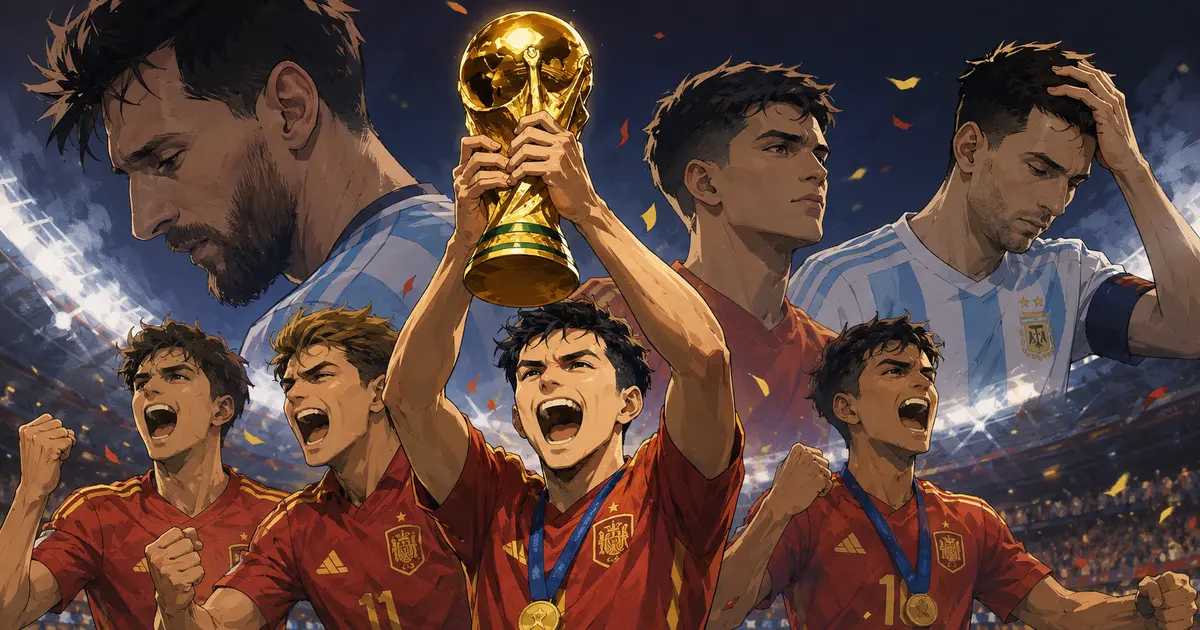
Spain are world champions again, and Sunday’s 1-0 extra-time win over Argentina at MetLife Stadium leaves plenty to unpack beyond the final scoreline. Here are the biggest talking points from the World Cup final that will define the conversation for weeks to come.Inside Lamine Yamal’s World Cup 2026: Every Record and Goal
1. Was Argentina’s Approach a “Win for Football,” or a Step Too Far the Other Way?
This is the debate that erupted within minutes of the final whistle. Former World Cup winner Toni Kroos posted his reaction immediately after full-time, framing Spain’s victory as a genuine win for footballing values — and the underlying numbers back up that framing in stark terms. Argentina finished the match with an expected-goals figure of just 0.09, registered zero shots on target across 120-plus minutes, and went 117 minutes at one point without recording a single shot of any kind. Some pundits went further, describing Argentina’s approach as deliberately regressive — content to sit deep, disrupt, and hope for a moment, rather than genuinely compete for the ball. Others pushed back, noting that Argentina had “bullied” their way through the last several rounds of the tournament with exactly this kind of resilience, and that Spain’s suffocating control simply left them no room to play any other way. Either way, expect this specific final to become a reference point in football’s ongoing debate between control-based and result-based approaches to the biggest matches.
2. Enzo Fernández’s Red Card Changed the Complexion of Extra Time
Fernández’s second-yellow dismissal in the third minute of second-half stoppage time — for a challenge that sent Pau Cubarsí tumbling through the air — meant Argentina played the entirety of extra time a man light. Manager Lionel Scaloni was diplomatic afterward, crediting Spain’s quality rather than dwelling on the sending-off, but he did note openly that he would have loved to know how the closing stages might have unfolded with a full complement of players. It’s a fair, if unanswerable, question — Argentina’s late push in extra time showed genuine heart even a man down, and a fully staffed Argentina side pressing in that same window is a different tactical proposition entirely.
3. Messi’s Quiet Final Doesn’t Rewrite His Tournament, But It Complicates the Ending
Fifty-four touches. One shot, blocked. Zero touches inside the box. For the player many consider the greatest of all time, playing what’s widely assumed to be his final World Cup, those numbers are a strange note to go out on. Messi himself appeared to hint, even before the final, that this would likely be his last World Cup appearance, with a place at the 2028 Copa América still a possibility down the line. The football romantic in everyone wanted one final Messi moment to decide the biggest game of all — and for a few minutes deep in extra time, as Argentina threw everything forward, it briefly looked possible. It never quite arrived. That doesn’t undo a legendary career, or even a legendary tournament — Messi became the World Cup’s all-time leading scorer earlier this summer — but it does mean his story ends on a note of collective team defeat rather than personal triumph, a genuinely rare outcome across his career’s biggest occasions.
4. Rodri’s Golden Ball Is Now Beyond Dispute
Any lingering debate about whether Rodri deserved the tournament’s top individual honor should be settled after Sunday. His performance in the final was a complete showcase of exactly what made him the standout player of the summer — controlling tempo, dropping deep to progress possession under pressure, and anchoring a Spain midfield that never allowed Argentina any sustained foothold. “I think now I’m in a cloud,” Rodri said afterward, a rare moment of pure, uncomplicated joy from a player usually more associated with quiet, systematic control than emotional outpourings. It was a fitting final image for a player whose entire tournament was built on making the difficult look inevitable.
5. The Substitutes Who Won the World Cup
Neither Ferran Torres nor Nico Williams started Sunday’s final. Both ended it as the two most important names on the team sheet. Williams, introduced from the bench, combined with fellow substitute Torres deep into the second period of extra time, and Torres finished the move with the goal that decided the match. It’s a storyline that fits neatly into a broader pattern that defined Spain’s entire knockout run — Mikel Merino’s back-to-back winning goals off the bench earlier in the tournament, and now this. Luis de la Fuente’s willingness to trust his full squad, not just his strongest starting XI, has been arguably the single most underrated factor in Spain’s title, and Sunday’s final was the clearest possible proof of concept.
6. Spain’s Defensive Record Now Belongs in the History Books
Step back from the individual storylines, and the collective achievement is almost hard to process: Spain conceded a single goal across the entire tournament, faced just ten shots on target in eight matches — 1.25 per game — and did it against a gauntlet that included France, Belgium and Portugal before finishing the job against Argentina. That defensive record now sits alongside the greatest World Cup-winning campaigns in the competition’s history, and it arrived without sacrificing attacking identity — Spain still managed 20 shots and 12 on target in the final alone. De la Fuente’s side leaves this tournament with a 38-game unbeaten run intact and a case, backed by genuine statistical evidence rather than sentiment, as one of the most complete international sides in recent World Cup memory.
7. What This Final Means for the Expanded 48-Team Format
Sunday’s final was the 104th and last match of the biggest World Cup ever staged — a 48-team tournament spread across the United States, Canada and Mexico. The expanded format produced more total goals than any previous edition, nearly three per match across the competition as a whole. Spain’s stingy final, and their remarkably low-scoring path to the trophy more broadly, stood out as a genuine outlier against that backdrop — a reminder that even in a tournament built for goals and spectacle, the team that controls territory and possession most completely can still find a way to make the occasion its own, on its own terms, right through to the very last match.
The Bigger Picture
Seven talking points, one trophy, and a tournament that will be remembered as much for its defensive drama as for any individual moment of magic — a genuinely unusual outcome for a final built around two of the sport’s most star-studded rosters. Spain’s structural discipline out-argued Argentina’s individual brilliance over 120 minutes, and however the “win for football” debate ultimately settles, nobody can argue with the trophy in Luis de la Fuente’s hands or the Golden Ball around Rodri’s neck. The conversation from Sunday’s final will likely run for weeks. The result itself, at this point, is already history.
About the Author