 A complete statistical breakdown of the most defensively dominant champion in World Cup history
Numbers rarely tell the whole story of a World Cup win, but Spain’s 2026 campaign is the rare exception where the statistics are almost as remarkable as the trophy itself. These Spain World Cup 2026 stats describe a team that conceded a single goal across eight matches, produced the tournament’s outstanding individual player, and delivered a European nation’s second World Cup title in the most defensively suffocating fashion the competition has ever seen.
Spain Are World Champions: The Story of Their 2026 Triumph
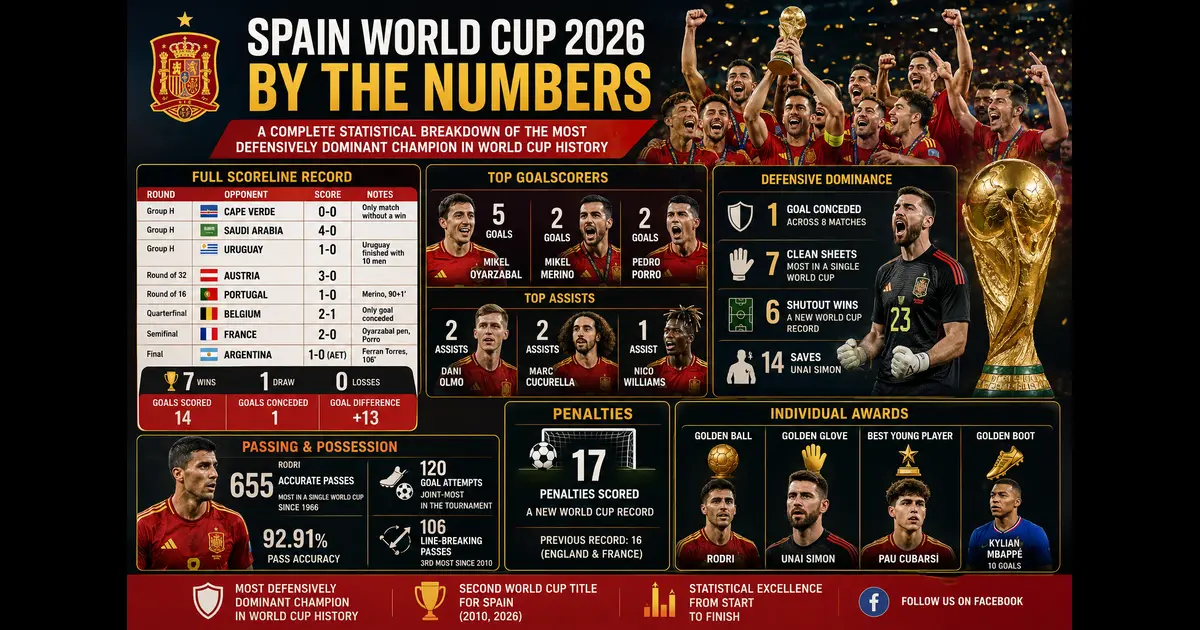
The Full Scoreline Record
| Round | Opponent | Score | Notes |
|---|---|---|---|
| Group H | Cape Verde | 0-0 | Only match without a Spain win |
| Group H | Saudi Arabia | 4-0 | |
| Group H | Uruguay | 1-0 | Uruguay finished with 10 men |
| Round of 32 | Austria | 3-0 | |
| Round of 16 | Portugal | 1-0 | Merino, 90+1′ |
| Quarterfinal | Belgium | 2-1 | Only goal conceded all tournament |
| Semifinal | France | 2-0 | Oyarzabal pen, Porro |
| Final | Argentina | 1-0 (AET) | Ferran Torres, 106′ |
Overall record: 7 wins, 1 draw, 0 losses. Goals scored: 14. Goals conceded: 1. Goal difference: +13.
Goals: A Collective Effort Led From the Penalty Area
Mikel Oyarzabal finished as Spain’s leading scorer with five goals, becoming just the third Spanish player in history to reach that tally in a single World Cup, joining David Villa (2010) and Emilio Butragueño (1986). It was also the 30th international goal of Oyarzabal’s career, moving him past Fernando Hierro for sixth on Spain’s all-time scoring list.
Beyond Oyarzabal, Spain’s scoring was spread unusually evenly for a champion. Mikel Merino scored twice as an impact substitute, including the stoppage-time winner against Portugal in the Round of 16 — a habit of decisive late intervention that made him one of the tournament’s most valuable bench options. Pedro Porro became just the fifth defender in 60 years to score multiple goals in the knockout stage of a single World Cup, while substitute Ferran Torres provided the most important goal of the entire tournament, his extra-time winner in the final arriving with his first goal of the competition.
Assists: Olmo and Cucurella Lead the Chart
Dani Olmo and Marc Cucurella each finished with two assists across the tournament, the joint-highest tally on the team heading into the final. Nico Williams’ assist for Ferran Torres’ winning goal in the final — a looping header knocked into Torres’ path — added a further mark to that column in the tournament’s single most important passage of play. Zooming out to Olmo’s combined major-tournament record, his World Cup and European Championship assist tally now sits level with Cesc Fabregas’ Spain record of eight, a mark built across both this tournament and Spain’s Euro 2024 triumph.
Clean Sheets: A Genuinely Unprecedented Defensive Campaign
This is where Spain’s tournament becomes historically significant rather than simply excellent. Unai Simon kept seven clean sheets across eight matches, the most by any goalkeeper in a single World Cup, and Spain’s overall total of six shutout wins before the final was already the first time any team had recorded six clean-sheet victories in a single edition of the tournament — a mark extended further by the final itself.
The only goal conceded all tournament came from Belgium’s Charles De Ketelaere in the quarterfinal, meaning Spain’s complete defensive ledger across eight matches — against Cape Verde, Saudi Arabia, Uruguay, Austria, Portugal, Belgium, France and Argentina — reads: one goal allowed, full stop. That’s a lower goals-against tally than Spain conceded during their previous World Cup triumph in 2010, when they let in two goals across seven matches.
Individual Defensive Numbers
Behind that clean-sheet record sits a defense built on genuine individual quality throughout. Unai Simon recorded 14 saves across the tournament, along with 108 key defensive interventions inside his own penalty area and a further 84 outside it — numbers that outstripped Argentina goalkeeper Emiliano Martinez’s figures of nine saves, 87 and 73 respectively heading into the final, even before Martinez’s own record-setting final performance. Pau Cubarsi, at 19 years old, played every single minute of the tournament in central defense, completing 121 passes in the final alone, a total that reflects both his defensive positioning and his comfort progressing the ball under pressure.
Passing and Possession: Rodri’s Statistical Dominance
Spain’s approach throughout the tournament was built on sustained possession and patient passing, and no player embodied that more completely than Rodri, whose midfield numbers topped every meaningful team and tournament-wide category. He completed 655 accurate passes — the most in a single World Cup since detailed record-keeping began in 1966 — at a 92.91% completion rate. Behind him, Aymeric Laporte (531) and Pau Cubarsi (550) ranked among the tournament’s top passers, reflecting a build-up structure that consistently worked through both the base of midfield and the heart of defense. Spain also recorded the joint-most goal attempts of any team in the tournament with 120, seven more than Argentina managed across their own seven matches heading into the final.
Penalties: A Tournament Record
Spain also set a new World Cup record for penalties scored in a single tournament, converting 17 spot-kicks across the competition — surpassing the previous joint record of 16 shared by England and France. That number reflects both the frequency with which Spain’s attacking players drew fouls inside the penalty area and the composure of their designated takers, led by Oyarzabal, across pressure situations throughout the knockout rounds.
Awards: A Clean Sweep of the Individual Honors
Spain’s dominance extended fully into FIFA’s end-of-tournament individual awards. Rodri won the Golden Ball as the tournament’s outstanding player, denying Lionel Messi a record third career win of the award. Unai Simon collected the Golden Glove for the tournament’s best goalkeeper, on the back of his seven-clean-sheet campaign. Pau Cubarsi won the Best Young Player award, edging out teammate Lamine Yamal — meaning Spain’s own players finished first and second in that category. The only individual award Spain didn’t claim was the Golden Boot, which went to France’s Kylian Mbappe on ten goals and four assists, ahead of Messi’s eight goals and four assists. [link to: Rodri’s World Cup performance and Golden Ball win]
Expected Goals: The Numbers Behind the Final
Advanced metrics from the final itself underline just how comprehensively Spain controlled the biggest match of the tournament. Spain generated 1.94 expected goals in the final compared to Argentina’s 0.20, a gulf reflected in the actual shot count: 20 attempts for Spain to just two from Argentina across 120 minutes, with Argentina not registering a single shot until the second period of extra time. Emiliano Martinez’s 11 saves set a new World Cup final record, the primary reason the match remained scoreless deep into extra time despite Spain’s overwhelming territorial and statistical dominance.
Discipline: A Mostly Clean Campaign, With One Ugly Final
Spain picked up relatively few cautions across the tournament relative to their number of matches played, a reflection of a team that spent most games in comfortable control rather than defending under sustained pressure. The final itself was the tournament’s most heated disciplinary affair for Spain, with Pau Cubarsi on the receiving end of the challenge that saw Argentina’s Enzo Fernandez shown a second yellow card and red card in second-half stoppage time, reducing Argentina to ten men heading into extra time.
Final Word
Strip away the emotion of a second World Cup title and Spain’s 2026 campaign still holds up as one of the statistically greatest in the tournament’s history: 14 goals scored, a single goal conceded, seven clean sheets, a passing record that had stood since 1966, and a clean sweep of individual honors bar the Golden Boot. Whatever else gets said about this Spain squad in the years to come, the numbers leave little room for argument about just how thoroughly they controlled this World Cup from start to finish.
🔹🔹 follow us on facebook 🔹🔹
About the Author