 Best Assists of FIFA World Cup 2026: The Playmakers Ranked
Goalscorers get the headlines, but every one of this tournament’s biggest moments had someone setting it up. Michael Olise finished as the World Cup 2026 best assists leader, but the race behind him was crowded with genuine star quality — a reminder that a World Cup is won as much by the pass before the goal as the finish itself.
NBA Schedule 2026-27: Christmas Day Rivalries, Ring Night and the Games to Watch
Biggest Upsets FIFA World Cup 2026: Every Shock Result Ranked
Michael Olise: The Tournament’s Leading Creator
France’s Michael Olise finished the tournament with five assists in eight matches, the outright leading tally of the competition, delivered without scoring a single goal of his own across the entire campaign. It’s a genuinely rare kind of World Cup performance — a player whose influence on his team’s run to the semifinal was almost entirely about the players around him rather than his own end product. Olise’s tally included a brace of assists apiece in comfortable wins over Iraq and Sweden, and it places him among a small group of historic World Cup creators: Robert Gadocha (Poland, 1974), Thomas Hässler (West Germany, 1994), Pierre Littbarski (West Germany, 1982) and Diego Maradona (Argentina, 1986) have all previously finished a single tournament with five assists. Only Pelé, with six for Brazil in 1970, sits clear above that group — a record that’s now stood for more than half a century.Cristiano Ronaldo Jr.: Club, Lifestyle, Career and Future Prospects
Thiago Messi: Club Career, Playing Style, Lifestyle and Future Prospects
The Chasing Pack: Four Players Tied on Four
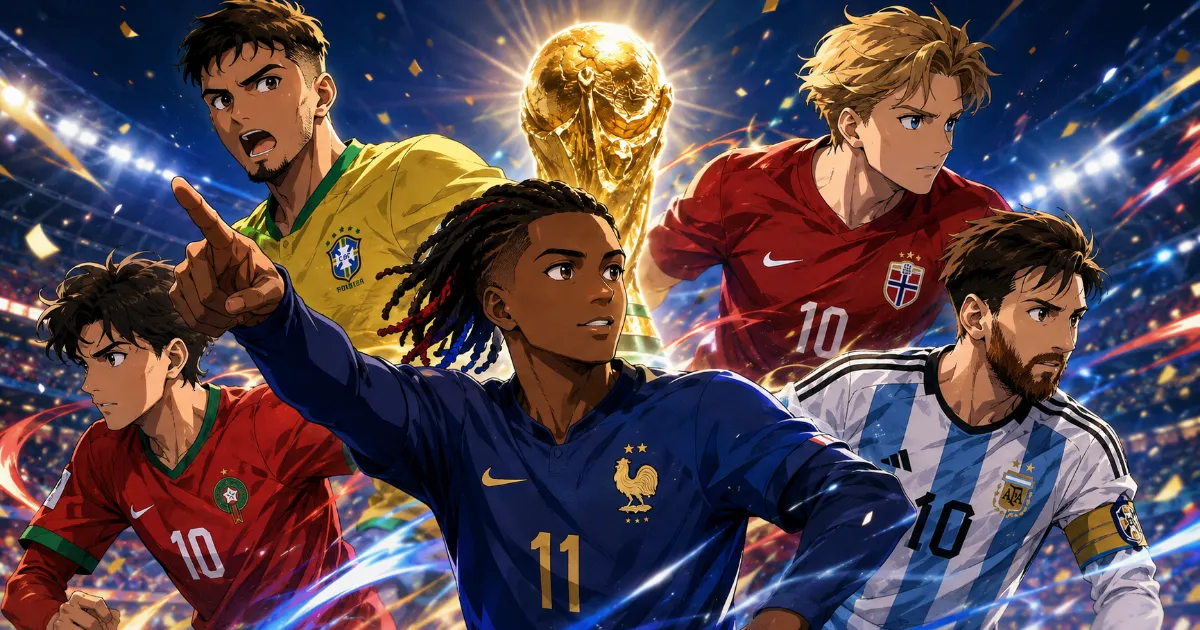
Behind Olise, a genuinely global cluster of playmakers finished level on four assists apiece. Bruno Guimarães provided the creative platform behind Brazil’s attack from midfield. Brahim Díaz did the same for Morocco’s surprise run to the quarterfinals, pulling strings from a deeper position than his club role at Real Madrid typically asks of him. Martin Ødegaard was central to Norway’s run to the last eight, setting up Antonio Nusa’s celebrated goal against England among his four assists on the tournament. And Lionel Messi, at 39, showed he remains one of the game’s great creators as much as its great finishers — his four assists included the two that turned Argentina’s semifinal against England, teeing up both Enzo Fernández and Lautaro Martínez in the space of six second-half minutes to complete one of the tournament’s signature comebacks.
The Names Just Behind
A step further down the leaderboard, Andreas Schjelderup, Bukayo Saka, Alexander Isak and Florian Wirtz all finished with three assists apiece, rounding out a top ten stacked with players from teams that went deep into the knockout rounds. It’s a pattern worth noting: creative output at this World Cup correlated heavily with tournament longevity, since a player can only accumulate assists across matches his team actually plays. Olise’s five arrived across France’s full eight-match campaign, while several players with genuine individual quality simply didn’t get enough matches to climb the same leaderboard after their teams exited early.Erling Haaland: The Goal Machine Rewriting Football’s Record Books
Why This Race Matters
Assist totals rarely get the same attention as the Golden Boot race, but this tournament’s playmaking leaderboard tells its own story about how different nations actually created their chances. France’s attack ran disproportionately through Olise rather than being evenly distributed, a detail that helps explain how Kylian Mbappé was able to score so freely without needing to drop deep and create for himself as often as he has at previous tournaments. Argentina’s reliance on Messi as a creator, not just a finisher, was equally central to their run to the final — his assists in the semifinal against England weren’t secondary contributions, they were the difference between an early exit and a place in the final itself.
The Bigger Picture
What stands out most about this year’s assists table is its balance. Unlike the Golden Boot race, which came down to a clear gap between Mbappé and the rest of the field, the playmaking standings were tightly bunched for most of the tournament, with the lead changing hands more than once before Olise’s brace against Sweden in the round of 32 pulled him clear. Four different continents and footballing cultures were represented in the four-assist chasing pack alone — South American, European and North African talent all found a home near the top of the list, underlining just how globally distributed the game’s creative talent has become. For a tournament remembered largely for Spain’s defensive perfection and Mbappé’s scoring exploits, the players quietly picking out the final pass deserve just as much credit for how this World Cup actually played out.
Inside the 1998 World Cup: Zidane, Jacquet, and France’s Golden Summer
About the Author