 The biggest lesson FIFA World Cup 2026, from tactical evolution and young stars to squad depth and changing football trends
From Spain’s system-over-stars triumph to a genuinely historic wave of retirements, here’s what six weeks of football across three nations actually taught us
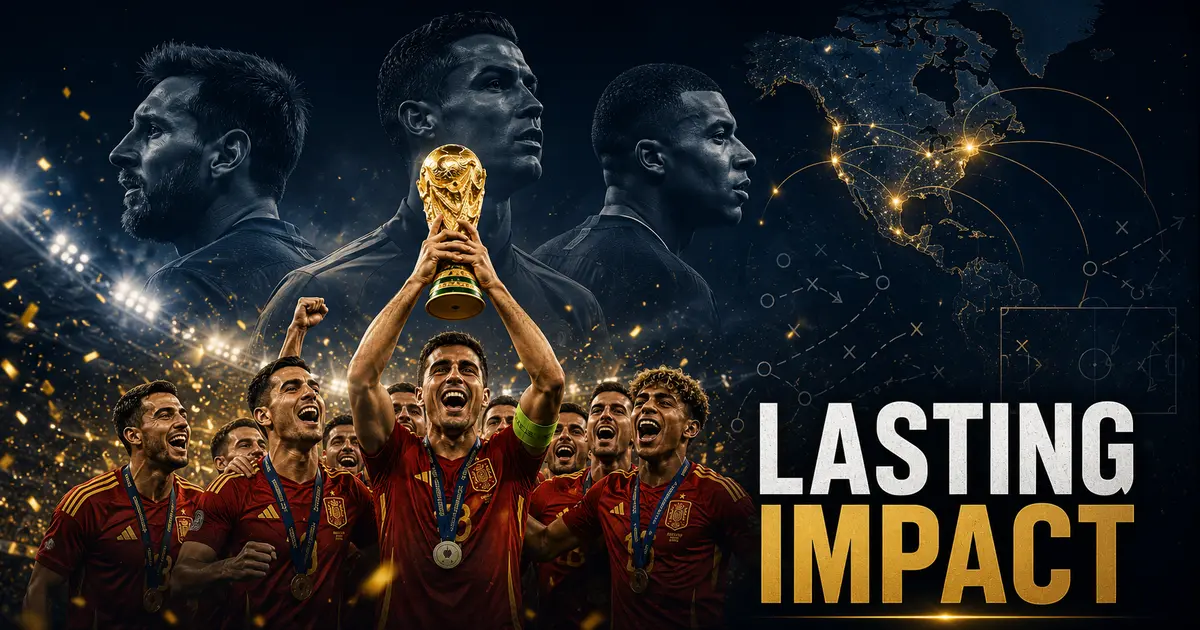
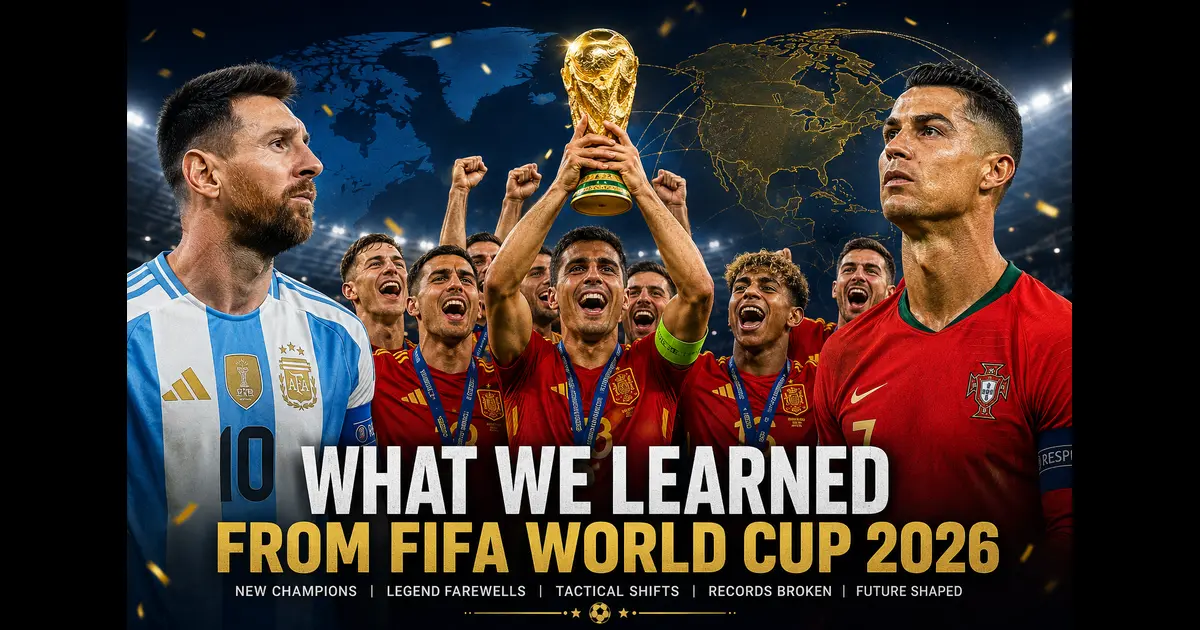
Every World Cup leaves behind more than a champion and a trophy lift — it leaves behind a set of lessons that shape how the sport is discussed, coached and covered for years afterward. What we learned from FIFA World Cup 2026 goes well beyond Spain’s extra-time win over Argentina in the final. This was a tournament that reshaped assumptions about squad depth, individual legacy, and what it actually takes to win the biggest prize in the sport. Here’s a full breakdown of the biggest takeaways.
15 Champions League Players to Watch in 2026/27: Superstars & Young Guns
Champions League 2026/27 Schedule: Fixtures, Dates & Times
LaLiga 2026/27 Schedule: Fixtures, Dates & Times
1. Collective Structure Can Beat a Superstar-Led Team
Spain’s triumph was the clearest possible rebuttal to the idea that a World Cup needs a single transcendent talent to be won. Luis de la Fuente’s side conceded one goal across eight matches, spread its scoring across five different players, and reached the final without ever leaning on one individual the way Argentina leaned on Lionel Messi or France leaned on Kylian Mbappe. Rodri’s Golden Ball-winning campaign was built on positional discipline and passing volume rather than individual moments of magic, and it was enough to outlast two teams built around some of the greatest individual talents the sport has ever produced. The lesson for future national team setups is clear: a well-drilled system with distributed goal-scoring responsibility remains a genuinely viable path to the trophy, even against opponents with more decorated individual rosters. [link to: Spain’s Best XI from FIFA World Cup 2026]
2. This Was a Genuine Generational Turning Point
Few tournaments have compressed as much individual farewell drama into a single edition. Cristiano Ronaldo played what he confirmed would be his final World Cup, exiting in the Round of 16 against Spain after becoming, at 41, the oldest goalscorer in World Cup knockout-stage history. Neymar’s international career ended in the same round, on the same New Jersey pitch where his senior debut had come 16 years earlier. Manuel Neuer, Guillermo Ochoa, Riyad Mahrez and Enner Valencia all confirmed their own international retirements within the same 72-hour window. This wasn’t simply a World Cup with a few retirements attached — it was the clearest, most visible passing of the torch the tournament has produced in years, closing the book on an era defined by Messi and Ronaldo’s parallel dominance even as Messi himself continued playing on. [link to: World Cup retirement wave 2026]
3. The Expanded 48-Team Format Delivered on Its Promise
Critics of FIFA’s expansion from 32 to 48 teams worried the additional slots would dilute quality and produce lopsided group-stage mismatches. Instead, debutant nations repeatedly punched above their weight: Cape Verde reached the Round of 32 and pushed defending champions Argentina to extra time, Jordan and Uzbekistan competed credibly in their first-ever World Cup appearances, and Morocco reached back-to-back quarterfinals as the first African nation in history to do so. Norway’s run to the quarterfinals, in their first World Cup appearance since 1998, produced one of the tournament’s most compelling underdog stories. The format expansion didn’t just add matches — it genuinely widened the competitive field in a way that produced more surprises, not fewer.
4. Extra Time and Penalties Are Becoming the New Normal
This tournament was defined by matches that simply refused to end in 90 minutes. Argentina needed extra time in three of their final four matches en route to the final. Germany’s shock Round of 32 exit to Paraguay was settled on penalties, their first-ever World Cup shootout loss. Spain and Argentina themselves needed a full 120 minutes to settle the final. Whether this reflects genuinely tighter competitive margins at the top of international football, improved defensive coaching across the board, or simply the physical toll of a longer 104-match tournament format on tired legs by the knockout stages, the pattern was unmistakable — and it’s a trend future tournament organizers and broadcasters should plan around rather than treat as an anomaly.
5. Set Pieces and Penalties Have Never Mattered More
Spain’s tournament-record 17 converted penalties wasn’t an isolated statistical curiosity — it reflected a broader shift toward set-piece and dead-ball proficiency as a genuine competitive edge. Mikel Merino’s habit of scoring decisive goals as a substitute, several matches settled by stoppage-time set pieces, and the sheer frequency of penalty shootouts across the knockout rounds all point to the same conclusion: at the very top level, where open-play chances are increasingly scarce against well-drilled defenses, the ability to convert from a dead ball or capitalize on a fine margin has become just as valuable as pure attacking fluency.
6. Individual Brilliance Still Decides Knockout Football
None of Spain’s structural triumph should obscure just how much individual quality still shaped this tournament’s biggest moments. Messi’s four assists in the semifinal comeback against England, his tournament-leading eight goals, and his record five Man of the Match awards proved that even a 39-year-old operating within a more collective system can still be the difference between elimination and survival. Mbappe’s late surge to the Golden Boot and the all-time career scoring record in the third-place playoff was a reminder that individual moments of quality remain decisive even in matches with reduced stakes. The lesson isn’t that stars no longer matter — it’s that stars embedded within genuinely coherent systems, rather than substituting for one, produced the deepest tournament runs.
7. Politics and Football Remain Impossible to Fully Separate
The banner reading “Las Malvinas son Argentinas,” unfurled by Argentina’s players after their semifinal win over England, was a reminder that football’s biggest stage remains an inevitable venue for nations to express deeper, unresolved historical and political tensions. The episode drew a pointed response from the UK government and reignited a decades-old dispute stretching back to the 1982 Falklands War, underlining that FIFA’s own political-neutrality rules will likely continue to be tested every time this specific rivalry, or others like it, plays out on the biggest possible stage. [link to: Las Malvinas banner controversy explained]
8. Youth Development Pipelines Are Paying Off Across Europe
Spain’s Pau Cubarsi and Lamine Yamal, France’s Warren Zaire-Emery and Desire Doue, and England’s Kobbie Mainoo all played significant roles at ages that would have been considered unusually young for World Cup prominence a decade ago. Cubarsi, at 19, played every single minute of Spain’s triumphant campaign in central defense — an almost unthinkable level of trust for a teenager at the sport’s biggest tournament. The consistency with which European academy systems are now producing tournament-ready teenage talent suggests this generational shift is structural rather than a one-off coincidence.
9. Defensive Solidity Is the Foundation of Modern Champions
Spain’s one goal conceded across eight matches and seven clean sheets weren’t simply a nice statistical footnote — they represented the actual foundation of the title win. In an era where attacking talent is arguably more evenly distributed across international football than ever before, the team that conceded the least, rather than the team that scored the most spectacularly, lifted the trophy. That’s a meaningful data point for national federations designing their own long-term tactical philosophies heading into the next cycle.
10. The Golden Boot and Golden Ball Races Have Never Been Tighter
Mbappe’s ten goals edged out Messi’s eight only after a third-place playoff brace, while Rodri’s Golden Ball win denied Messi what would have been a record third career award. Both races stayed genuinely open until the tournament’s final matches — a marked departure from editions where one player’s tally pulled clear early. That kind of sustained, tournament-long uncertainty over the individual awards added a layer of drama that arguably rivaled the race for the trophy itself. [link to: Every record broken and threatened at the World Cup 2026 final]
Final Word
FIFA World Cup 2026 will likely be remembered first for Spain’s trophy and second for the emotional farewells of Ronaldo, Neymar and others who closed out their international careers within days of each other. But the deeper lessons — that structural coherence can outlast individual star power, that an expanded format can genuinely widen competitive depth rather than dilute it, and that set pieces and defensive discipline now matter as much as raw attacking talent — are the ones likely to shape how national federations and coaches approach the next cycle. Six weeks of football across three nations taught the sport quite a bit about where it’s heading next.
 The Full Story of Morocco’s World Cup Journey to the Quarter-Finals
Morocco’s World Cup journey ended the way so many great football stories eventually do — not with a whimper, but against the one opponent capable of reminding an entire continent exactly how far there still is to travel. A 2-0 defeat to France at Gillette Stadium in Foxborough brought the curtain down on a campaign that had promised, for a few dizzying weeks, to go one step further than the historic run of 2022. It didn’t. But the story Morocco told between their opening whistle against Brazil and their final one against France deserves to be examined on its own terms, not simply measured against the ghost of a semi-final four years gone.
How the Journey Began: A Coach Under Pressure
Morocco’s campaign started in genuine uncertainty. Walid Regragui, the architect of the historic 2022 semi-final run, departed the role in March 2026, barely three months before the tournament kicked off. His replacement, Mohamed Ouahbi, arrived having just guided Morocco’s U20 side to a World Cup title of their own in Chile — an impressive credential, but an entirely different kind of pressure to inherit a senior squad’s biggest tournament in a generation with only weeks to prepare.
Ouahbi’s solution was continuity blended carefully with renewal. Nine survivors of the Qatar semi-final run were recalled, including goalkeeper Yassine Bounou, defender Nayef Aguerd, and captain Achraf Hakimi, while 18-year-old Ayyoub Bouaddi and other fresher faces were folded into the group. Morocco arrived in North America with genuine momentum, having topped their CAF qualifying group with eight wins, six clean sheets, and only two goals conceded — not the profile of a team simply hoping to relive past glory.
The Group Stage: Matching Brazil Blow for Blow
Nothing about Morocco’s tournament opener suggested a team happy to sit back against superior reputations. Facing five-time champions Brazil, Morocco produced 14 attempts on goal in a spirited 1-1 draw, Ismael Saibari’s opener cancelled out by Vinícius Júnior. It was an declaration of intent rather than a defensive shutdown, and it set the tone for everything that followed in Group C.
Morocco needed to come from behind twice against Haiti, with Hakimi and Saibari both scoring before Soufiane Rahimi completed the turnaround, and closed the group with a composed 1-0 win over Scotland. The pattern across all three matches told its own story: a team capable of trading blows with stronger opposition, and one with the resilience to recover when games didn’t go entirely to plan.
Surviving the Knockouts: Penalties Against the Dutch, a Statement Against Canada
If the group stage established Morocco as genuine contenders, the Round of 32 tested exactly how much substance sat behind that reputation. Trailing the Netherlands to a Cody Gakpo opener, Morocco needed a 91st-minute equaliser from Issa Diop simply to force extra time, eventually winning 3-2 on penalties — the kind of backs-against-the-wall survival that can define, or derail, an entire tournament depending on how a team responds to it.
Morocco responded emphatically. Facing co-hosts Canada in Houston in the Round of 16, they delivered arguably their most complete performance of the tournament, cruising to a 3-0 win built on a second-half Azzedine Ounahi brace and a late Rahimi finish. The result eliminated one of the tournament’s host nations and made Morocco the first African nation in history to reach consecutive World Cup quarter-finals — a distinction that, regardless of what followed, separates this Moroccan generation from every one that came before it, including the celebrated 2022 vintage.
Entering the France match, Morocco carried the longest unbeaten run of any team left in the tournament — 34 games without defeat, a streak stretching back well over a year and touching two Africa Cup of Nations campaigns as well as this World Cup. That run, and the psychological weight it carried, made the manner of its ending all the more significant.
The Quarter-Final: A Story of What Morocco Didn’t Have
Morocco’s rematch with France carried the obvious symbolism of avenging the most painful defeat in the program’s history — the 2022 semi-final loss to the same opponent. But this version of the fixture told a different story almost from kickoff. Ouahbi’s side arrived without Ismael Saibari, their in-form top scorer and the man who had struck in every group match plus the winning penalty against the Netherlands, ruled out by a hamstring injury suffered in the win over Canada. It was, in hindsight, close to a fatal blow.
Without their most reliable creative spark, Morocco recorded a first-half expected-goals figure of just 0.04 — a number that reflects not bad luck, but the near-total absence of goalscoring threat. France, by contrast, generated 3.04 xG across the full 90 minutes, a comprehensive statistical gulf that matched the eye test. Kylian Mbappé missed a first-half penalty, generously saved by Bounou, but made amends with a sensational curling finish just after the hour mark before teeing up Ousmane Dembélé for a second. Morocco did not manage a single shot on target for the majority of the match, a startling admission for a team that had spent the entire tournament matching bigger nations blow for blow.
Top Performer: Brahim Díaz’s Quiet Brilliance
If one player defined Morocco’s tournament beyond the collective resilience, it was Real Madrid’s Brahim Díaz. His four assists across five matches placed him among the tournament’s most productive creators, trailing only France’s Michael Olise on the overall leaderboard, and his ability to combine with Hakimi and Ounahi gave Morocco’s attack a rhythm that too often depended entirely on him once Saibari was ruled out. Díaz’s tournament stands as one of the most efficient individual campaigns by any midfielder in the competition, delivered on a stage considerably brighter than most of Morocco’s previous World Cup appearances offered a generation of Moroccan playmakers before him.
Elsewhere, Hakimi’s leadership carried the weight of a captain who had already experienced the program’s greatest triumph, while Bounou’s continued excellence in goal — including his penalty save against Mbappé — extended a reputation for big-match composure first built in Qatar. Ounahi’s knockout-stage brace against Canada gave Morocco their most emphatic scoreline of the tournament, and a reminder of the squad depth Ouahbi had available even without his most productive forward.
Other Parameters: Discipline, Squad Depth, and the Weight of a Continent
Morocco’s tournament carried significance well beyond their own dressing room. With Egypt eliminated in a dramatic Round of 16 defeat to Argentina, Morocco entered their quarter-final as the sole remaining representative of both African and Arab football at the tournament — a responsibility that, by their coach’s own admission, they had come to embrace rather than resent. “We’re no longer a surprise,” Mohamed Ouahbi said after the win over Canada. “We’re real contenders and a major footballing nation.” That quote captures something important about how this tournament should be remembered: not as a near-miss, but as confirmation.The Youngest Stars Dominating World Cup 2026
Morocco’s disciplinary record throughout the tournament remained largely clean, a hallmark of Ouahbi’s organised approach, and the squad’s blend of Europe-developed diaspora talent — Hakimi, Díaz, and Ounahi among them — alongside the Mohammed VI Football Academy’s domestic pipeline continues to look like one of the most sustainable talent models on the African continent. Morocco are also set to co-host the 2030 World Cup alongside Spain and Portugal, meaning every deep run this generation produces now doubles as evidence that the country’s footballing rise is arriving in perfect sync with its emergence as a major hosting nation.
The Numbers That Tell the Full Story
Look past the eventual scoreline against France and Morocco’s tournament numbers hold up remarkably well against the rest of the field. Across their five matches before the quarter-final, Morocco had conceded only a handful of goals, built largely on the same defensive organisation that made them famous in Qatar — a Bounou-marshalled back line that has now anchored two consecutive deep World Cup runs rather than producing a single flash of defensive brilliance. Their expected-goals output across the group stage and Round of 32 consistently matched or exceeded that of the opposition they faced, including a full 90 minutes against Brazil in which they matched a five-time champion attempt for attempt.Achraf Hakimi FIFA World Cup 2026: Profile, Stats & Career | StrikerReport
That is precisely what makes the France performance such an outlier rather than a representative sample. A first-half xG of 0.04 is not simply a bad day at the office — it is close to a statistical floor, the kind of number that reflects a team stripped of its primary creative outlet and unable to generate a credible Plan B. Removing Saibari from Morocco’s attack didn’t just cost them a goalscorer; it removed the specific player whose movement had unlocked space for Díaz and Ounahi throughout the tournament’s earlier rounds. Ouahbi’s side had no readymade like-for-like alternative, and it showed in a way no previous match in their campaign had exposed.
Squad Depth and the Ouahbi Rebuild in Full
It is worth stepping back to appreciate exactly how compressed Ouahbi’s rebuilding timeline was. Three months is barely enough time to install a defensive shape, let alone rebuild an attacking identity following the departure of a manager as tactically distinct as Regragui. That Morocco arrived at the tournament with a functioning system at all — let alone one capable of matching Brazil and grinding out knockout-stage penalty shootouts — speaks to a footballing federation whose infrastructure has clearly outgrown any single individual coach’s tenure.
The blend of returning 2022 veterans and emerging talent also deserves scrutiny as its own achievement. Hakimi and Bounou provided the emotional and tactical continuity that allowed younger squad members like Bouaddi, at 18 the youngest player to feature in a World Cup quarter-final since 1958, to be integrated without the pressure of leading the group themselves. That kind of generational bridge-building is exactly the sort of infrastructure work that separates one-off Cinderella runs from sustainable footballing programs — and it is precisely why Morocco’s quarter-final exit in 2026, unlike a group-stage collapse would have, does nothing to undermine the broader case that this is now a genuinely elite program.
What Comes Next
It would be easy to file Morocco’s 2026 campaign as a step backward from 2022 — a quarter-final finish following a semi-final one. That reading misses the more important signal. Reaching the quarter-finals of consecutive World Cups, under a new coach appointed only months before the tournament, with a rebuilt blend of returning veterans and fresh faces, is a far harder feat to repeat than producing a single historic run powered by underdog momentum and low expectations. Qatar 2022 surprised the world. North America 2026 confirmed that the surprise was never really a surprise at all — it was the arrival of a genuine footballing power that world football will now have to take seriously by default, not by exception, every four years from here on.
◾◾ follow us on facebook ◾◾
About the Author