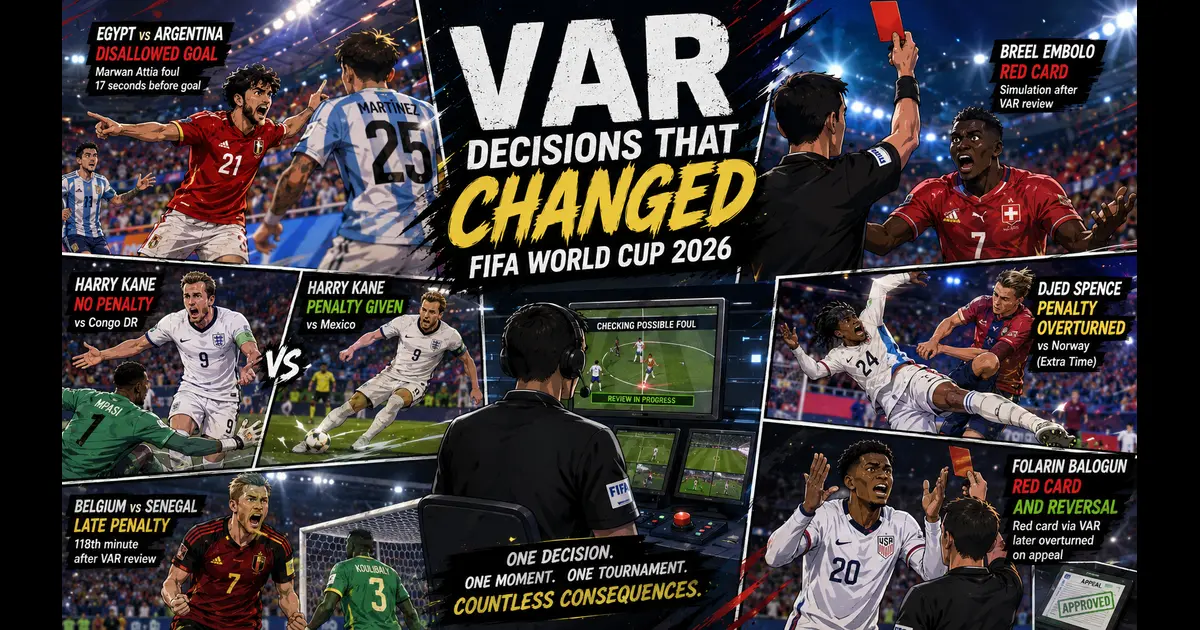
 FIFA gave referees expanded VAR powers heading into this tournament, including the ability to issue yellow cards for cases of mistaken identity — and across 104 matches, the technology found itself at the center of the story more often than any governing body would probably like. Here are the World Cup 2026 VAR decisions that most directly shaped how the tournament actually played out.
Egypt’s Disallowed Goal Against Argentina
No VAR call this tournament had a bigger impact on an actual result than the review that overturned Egypt’s second goal in their round of 16 match against Argentina. Egypt led 2-0 after Mostafa Ziko’s 58th-minute strike, only for VAR to recommend a review of an incident that had happened nearly a minute earlier and roughly 80 metres from where the goal was actually scored — Egypt’s Marwan Attia stepping on Lisandro Martínez’s foot, 17 seconds before Ziko found the net. The goal was chalked off, and the momentum swing that followed was seismic: Argentina went on to score three times in the closing stages to complete a 3-2 comeback win, in what remains one of the most debated single decisions of the entire tournament. Egypt manager Hossam Hassan was reportedly so incensed by the tournament’s officiating that he vowed not to watch the rest of the competition.
Breel Embolo’s Red Card in the Quarterfinal
Switzerland’s quarterfinal against Argentina turned on a genuinely bizarre sequence of officiating. Referee João Pinheiro initially booked Argentina’s Leandro Paredes for a soft foul on Breel Embolo, only to be sent to the monitor by VAR — and reverse course entirely, showing Embolo a second yellow card for simulation instead. Switzerland, level at 1-1 at the time, were reduced to ten men and went on to lose 3-1, with Swiss players and staff furious about a decision that had briefly gone the opposite direction before VAR intervened.
Harry Kane and a Tale of Two Penalty Decisions
England’s Harry Kane found himself at the center of VAR controversy twice within the space of two knockout matches, with wildly different outcomes each time. Against Congo DR in the round of 32, Kane went down through on goal after contact from goalkeeper Lionel Mpasi; the referee waved away England’s appeals, and VAR checked the incident but declined to intervene, much to England’s frustration. Just one round later, against Mexico, Kane won a near-identical situation — this time the referee sent the decision to the monitor, awarded the penalty, and Kane converted it for the goal that proved decisive in a 3-2 win. Two strikingly similar incidents, two opposite results, within a single week of the same tournament.
Djed Spence’s Overturned Penalty Against Norway
England’s quarterfinal against Norway added another layer to the tournament’s growing list of contentious calls. Djed Spence was initially awarded a penalty in extra time after going down in the box, only for referee Clément Turpin to review the decision and overturn it. England still went on to win the match 2-1, but the overturned penalty added yet another data point to a tournament in which England seemed to find themselves on one side or the other of a major review more often than most.
Belgium’s Late Penalty Against Senegal
Not every major VAR intervention worked against the team on the receiving end of controversy — sometimes it decided a match outright. In the round of 32, Belgium were awarded a penalty deep into extra time, in the 118th minute, after a VAR review of a Senegal challenge in the box. Belgium converted to complete a dramatic 3-2 win, a decision that effectively ended Senegal’s tournament in the final minute of a match many felt could have gone either way even before the review.
Folarin Balogun’s Red Card and Reversal
The USA’s Folarin Balogun was sent off via VAR review during a group-stage match against Bosnia and Herzegovina, for a studs-up challenge that replays suggested carried little real intent but looked considerably worse under the slow-motion replays VAR provided to the referee. The decision itself stood, but Balogun’s resulting suspension for the USA’s next match was later overturned on appeal — an unusual sequence that highlighted the gap between an in-match VAR decision and the disciplinary process that follows it.
The Recurring Theme: Consistency, or the Lack of It
What connects most of the tournament’s biggest VAR flashpoints isn’t any single bad call, but the inconsistency between similar incidents receiving different treatment. Ghana felt they were denied a clear penalty against England when Ezri Konsa appeared to catch Prince Kwabena Adu inside the box, with neither the referee nor VAR intervening — prompting Ghana coach Carlos Queiroz to sarcastically ask reporters whether VAR was still switched on. Iran had a stoppage-time goal disallowed against Egypt in the group stage under similarly disputed circumstances. And pundits and researchers studying the tournament’s officiating repeatedly pointed to the same underlying issue: VAR itself doesn’t decide how far back in time or how far across the pitch a review should extend — that judgment call remains entirely human, and this tournament showed just how differently two referees could interpret an almost identical situation.
VAR Decisions : The Bigger Picture
FIFA’s expanded VAR protocol for 2026 was designed to reduce exactly this kind of inconsistency, not amplify it, and the technology undeniably got major decisions right that would have gone unnoticed or uncorrected at previous tournaments. But the sheer number of matches this expanded, 104-game format produced also multiplied the opportunities for contentious calls, and by the time the final was played, VAR had arguably generated as much discussion about fairness and consistency as it had resolved. For a technology introduced specifically to remove doubt from the game’s biggest moments, this World Cup was a reminder that the final judgment call still belongs to a human being watching a screen — and that as long as that’s true, VAR controversy isn’t going anywhere.
Golden Glove Winner Unai Simon: The Historic World Cup Goalkeeping Masterclass
About the Author

3 thoughts on “VAR Decisions That Changed the Tournament: The Full Story”