The 2034 FIFA World Cup heads to Saudi Arabia, a single-nation host confirmed alongside major questions over timing and human rights.
 The 2034 FIFA World Cup heads to Saudi Arabia, a single-nation host confirmed alongside major questions over timing and human rights.
Four years after the 2030 centenary tournament winds through six countries and three continents, the World Cup will settle into a single nation once again — and it’s one whose hosting rights have generated as much debate as excitement. Saudi Arabia was confirmed as host of the 2034 FIFA World Cup on December 11, 2024, in a decision announced at the same Extraordinary FIFA Congress that awarded the 2030 tournament to Morocco, Portugal and Spain. Here’s everything confirmed so far, and the controversy that continues to surround it.
An Uncontested Bid
Saudi Arabia’s path to hosting rights was, in practical terms, a formality well before the official announcement. The kingdom was the only country to submit a bid ahead of the October 31, 2023 deadline, a situation that arose after Australia — the only other nation to publicly express interest — announced it would not proceed with a bid of its own. That left Saudi Arabia unopposed, and FIFA’s decision was made by acclamation rather than a competitive vote, mirroring the same uncontested process that awarded Morocco, Portugal and Spain the 2030 tournament on the very same day.
The timing of the announcement was widely read as strategic. FIFA had confirmed that bidding processes for both the 2030 and 2034 editions would run concurrently, with the 2034 rights specifically opened up to bids from the Asian Football Confederation and the Oceania Football Confederation under FIFA’s confederation rotation principles. In practice, that meant the 2034 hosting decision was effectively finalized within a remarkably short window after bids opened, with reports indicating Saudi Arabia confirmed its intention to bid within minutes of the process being announced.2030 FIFA World Cup: Hosts, Format, Stadiums and Full Details
The Stadiums and Host Cities
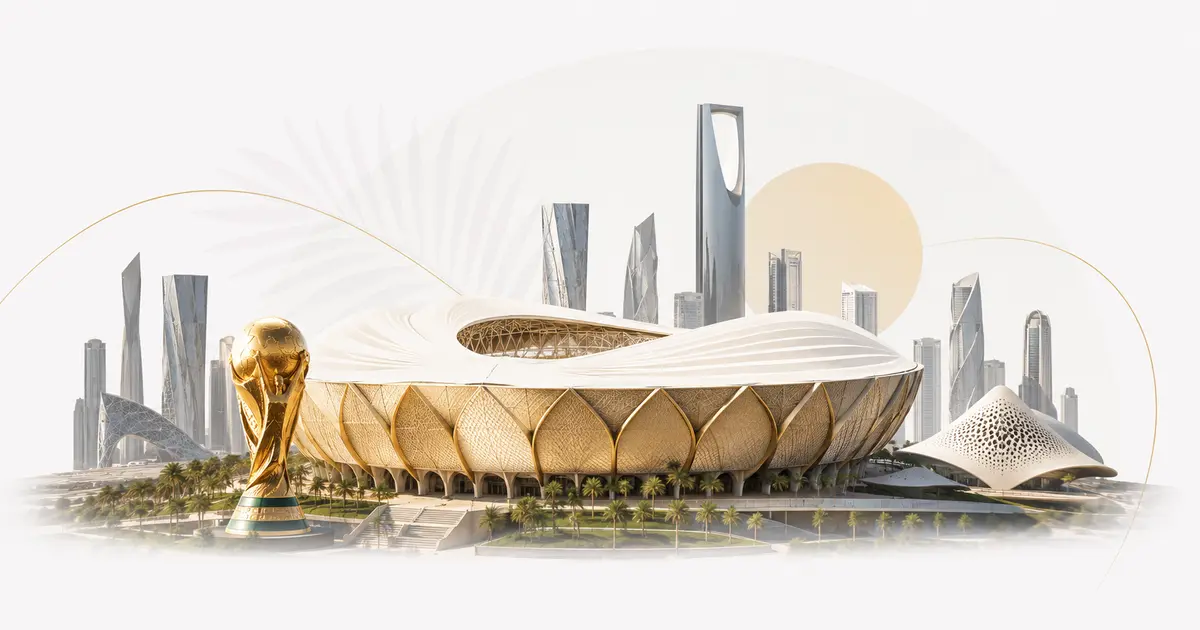
Saudi Arabia’s bid proposes staging the tournament across five host cities: Riyadh, Jeddah, Al Khobar, Abha, and the futuristic planned city of Neom. Fifteen stadiums are planned in total, split as eight in Riyadh, four in Jeddah, and one apiece in Al Khobar, Abha and Neom. Of those fifteen, four are existing stadiums slated for renovation, three are already under construction, and eight are entirely new builds still in the planning and design phase.
The centerpiece of the entire tournament will be the King Salman International Stadium in Riyadh, designed with a capacity in excess of 92,000 and scheduled to host both the opening match and the final — making it the new primary home of the Saudi national team once completed. Architecture firm Populous has described the stadium’s design as inspired by the Saudi landscape, intended to evoke the image of a seed cracking through the earth. Construction is scheduled for completion in 2029, giving organizers a five-year window to finish and test the venue before the tournament itself. Beyond the five core host cities, ten additional locations across the kingdom — including AlUla, Taif, and Buraidah — are proposed as team base camp sites rather than match venues.
Some of the tournament’s other planned venues carry equally ambitious designs. A stadium proposed for Neom is planned to sit roughly 350 meters above street level, while another near Riyadh is designed to sit atop a 200-meter cliff face, featuring a retractable wall of LED screens as part of its facade — futuristic touches consistent with Saudi Arabia’s broader Vision 2030 economic diversification and modernization program, of which the World Cup bid forms a significant part.
When Will It Actually Be Played?
Unlike the venues, the tournament’s exact dates remain unresolved, and the scheduling puzzle facing organizers is genuinely complex. The traditional June-July World Cup window is almost certainly out of the question: FIFA’s own evaluation report ahead of confirming Saudi Arabia’s hosting status flagged “elevated risk” tied to daytime temperatures in Riyadh regularly exceeding 40 degrees Celsius during those months, and notably, Saudi Arabia’s bid document didn’t propose a specific tournament window at all.
The most obvious alternative is a November-December slot, following the precedent set by Qatar in 2022 — the only previous men’s World Cup moved outside its traditional summer window, achieved by negotiating a mid-season break across Europe’s major domestic leagues. But that option is complicated for 2034 specifically by the Islamic holy month of Ramadan, which is projected to run through mid-December that year, and by Riyadh’s own commitment to host the 2034 Asian Games from late November into mid-December of the same year — an unavoidable direct scheduling conflict with the same host city. That leaves January 2034 as a genuine possibility floated by observers, though that window would land just before the Winter Olympics in Salt Lake City, adding yet another scheduling complication to an already crowded global sporting calendar. As of now, FIFA has not confirmed which option it will ultimately choose.
The Human Rights Controversy
No discussion of the 2034 World Cup is complete without addressing the scale of controversy that accompanied Saudi Arabia’s confirmation as host. FIFA’s own pre-bid evaluation acknowledged Saudi Arabia’s human rights record as a “medium risk” factor, and in the aftermath of the announcement, more than 20 human rights organizations — including Amnesty International, Human Rights Watch, and the Sport & Rights Alliance — issued a joint statement condemning the decision, warning it represented a “moment of great danger” for residents, migrant workers, and visiting fans.
The specific concerns raised by these organizations span several areas. Labor rights groups, including Building and Woodworkers International, have pointed to Saudi Arabia’s lack of a national minimum wage and limited worker safety standards, drawing direct comparisons to the well-documented worker conditions and fatalities associated with Qatar’s 2022 World Cup construction program. The Business and Human Rights Resource Centre specifically flagged reports linking one stadium already under construction to alleged exploitative labor practices, including extended shift lengths in extreme heat conditions. Broader human rights criticisms have centered on Saudi Arabia’s restrictions on free expression, its use of the death penalty, documented allegations of torture, and the country’s guardianship system affecting women’s legal autonomy — alongside the 2018 killing of journalist Jamal Khashoggi, an incident the CIA concluded with high confidence was personally ordered by Crown Prince Mohammed bin Salman, the kingdom’s de facto ruler.
FIFA and Saudi officials have offered a different framing of the tournament’s potential impact. FIFA president Gianni Infantino described the World Cup as a “unique catalyst for positive social change and unity” at the time of the announcement, positioning the tournament as a vehicle to accelerate ongoing social reforms within the kingdom, including expanded rights and freedoms for women. Saudi Arabia has pointed to genuine changes already underway as part of its Vision 2030 program: women have been permitted to attend sporting events since 2017, and the country launched a women’s professional football league in 2022, with participating players reported to face no restrictions on wearing shorts or leaving hair uncovered during matches.
Critics of the kingdom’s broader sporting investments — spanning golf’s LIV tour, Formula One, and WTA tennis events, in addition to the World Cup — have characterized the pattern as “sportswashing,” using high-profile global sporting events to improve the country’s international image and divert attention from its human rights record, a criticism Saudi officials have consistently rejected.
Alcohol, Culture and Fan Experience
Beyond the headline human rights debate, several more specific cultural questions remain unresolved ahead of 2034. Saudi Arabia’s prohibition on alcohol is unambiguous and well understood by FIFA and its sponsors well in advance of any sponsorship agreements being finalized for the tournament — a contrast with Qatar 2022, where the question of stadium alcohol sales became a point of last-minute controversy after expectations had been set differently earlier in that bid process. How Saudi Arabia and FIFA navigate matchday fan experience more broadly, including the treatment of LGBTQ+ visitors under Saudi law and the accommodation of international supporters accustomed to different cultural norms, remains an area international media and fan groups are expected to scrutinize closely as the tournament approaches.
The Format
The 2034 tournament will maintain the 48-team format introduced at the 2026 World Cup and continued at the 2030 centenary edition, meaning Saudi Arabia’s hosts will need to accommodate the same 104-match structure — including the round of 32 — that defined the two preceding tournaments. As hosts, Saudi Arabia has already secured automatic qualification, joining a growing list of nations that have used World Cup hosting rights to guarantee their place in the finals regardless of qualifying form. The other 47 places will be determined through standard continental qualification processes across FIFA’s confederations in the years leading up to the tournament.
How Saudi Arabia’s Bid Compares to Qatar’s
The parallels between Saudi Arabia’s 2034 hosting and Qatar’s 2022 tournament are difficult to avoid, and they extend well beyond the shared Gulf region. Both bids arrived essentially uncontested by the time FIFA’s formal decision was made. Both required a significant construction program building stadiums largely from scratch within a single decade. Both faced an almost identical climate-driven scheduling problem, forcing serious consideration of moving the tournament outside its traditional June-July window. And both attracted sustained criticism from international human rights organizations well before a ball was ever kicked.
The key difference lies in scale and ambition. Qatar’s entire tournament was contained within a roughly 30-mile radius around Doha, a compact footprint that became one of the defining features of that World Cup’s fan experience, with supporters able to attend multiple matches in a single day across different stadiums. Saudi Arabia’s proposed footprint is considerably larger and more geographically dispersed, spanning five cities across a landmass many times the size of Qatar, including the remote, still-under-construction city of Neom near the country’s northwestern coast. That dispersal will likely reshape the tournament’s fan experience considerably compared to Qatar’s ultra-compact model, requiring far more domestic travel between host cities than the 2022 edition ever demanded.
Vision 2030 and the Bigger Economic Picture
Saudi Arabia’s World Cup hosting rights don’t exist in isolation — they form one part of a much broader economic and cultural transformation program known as Vision 2030, spearheaded by Crown Prince Mohammed bin Salman with the explicit goal of diversifying the kingdom’s economy away from oil dependency and repositioning Saudi Arabia as a global tourism, entertainment and sporting destination. The World Cup joins an already extensive list of major sporting investments the kingdom has made in pursuit of that goal, including hosting rights or major financial involvement in Formula One racing, LIV Golf, WWE events, boxing’s biggest heavyweight fights, and the Saudi Pro League’s aggressive recruitment of global football stars in the years following Cristiano Ronaldo’s high-profile move to Al Nassr.
Critics of that broader strategy have consistently applied the term “sportswashing” to describe the pattern — using high-profile international sport to construct a more favorable global image for a government facing sustained criticism over its human rights record. Saudi officials have rejected that framing directly, arguing instead that sporting investment represents a genuine, long-term component of national economic diversification rather than an image management exercise, and that hosting events like the World Cup can itself function as a catalyst for accelerating social reform inside the kingdom, a case FIFA’s own leadership has publicly echoed since the hosting decision was confirmed.
What Happens Between Now and 2034
The decade between Saudi Arabia’s confirmation as host and the tournament’s eventual kickoff is likely to be defined by sustained, parallel scrutiny running alongside the practical construction and organizational work. On the construction side, completing eight entirely new stadiums — including the enormous King Salman International Stadium — on the proposed timeline will require an extraordinary sustained labor effort, precisely the process human rights organizations have flagged as the area of greatest concern given the kingdom’s current labor law framework. On the diplomatic and reform side, FIFA, Saudi officials, and international observers will be watching closely for concrete, verifiable changes to labor protections, freedom of expression, and treatment of women and minority groups — the specific areas cited repeatedly by the coalition of rights organizations that opposed the bid.
Saudi Arabia will also host several other major sporting events in the years leading up to 2034 that will serve as informal test cases for its readiness, including the 2027 AFC Asian Cup and the 2034 Asian Games in Riyadh — the latter creating the direct scheduling conflict with the World Cup itself that has complicated the tournament’s date planning. How smoothly those intermediate events unfold, both organizationally and in terms of international reception, will likely shape the broader narrative heading into the World Cup itself.
The Format and Qualification Path
Like the 2030 tournament preceding it, the 2034 World Cup will retain the 48-team format introduced in 2026, along with the round of 32 that added an entirely new tier to the knockout stage. Saudi Arabia’s automatic qualification as hosts leaves 47 places to be contested through standard confederation qualifying processes in the years between the 2030 tournament and 2034 kickoff — including, notably, the Asian Football Confederation qualifying pathway that Saudi Arabia’s own national team would otherwise have needed to navigate competitively.
The Bigger Picture
The 2034 World Cup represents the second time in three tournament cycles that FIFA has awarded its flagship event to a Gulf nation with a highly scrutinized human rights record, following the same essential playbook established by Qatar in 2022: an uncontested bid, a likely shift to a winter tournament window, brand-new stadiums built at extraordinary speed and expense, and a wave of criticism from international human rights organizations that FIFA has, in both cases, proceeded past regardless. Whether Saudi Arabia’s own promised social reforms accelerate meaningfully in the decade between now and kickoff, as FIFA and Saudi officials have suggested they will, or whether the tournament instead becomes another flashpoint for the same criticisms that dogged Qatar’s hosting, is likely to remain one of the most closely watched storylines in world football for the remainder of this decade.
🔹🔹 follow us on facebook 🔹🔹
About the Author